I came across this video highlighting Ga68 PSMA PET imaging from the doctor at the University of California San Francisco who helped with developing this imaging technique. It’s a bit long and a bit technical in some places, but gives a good overview.
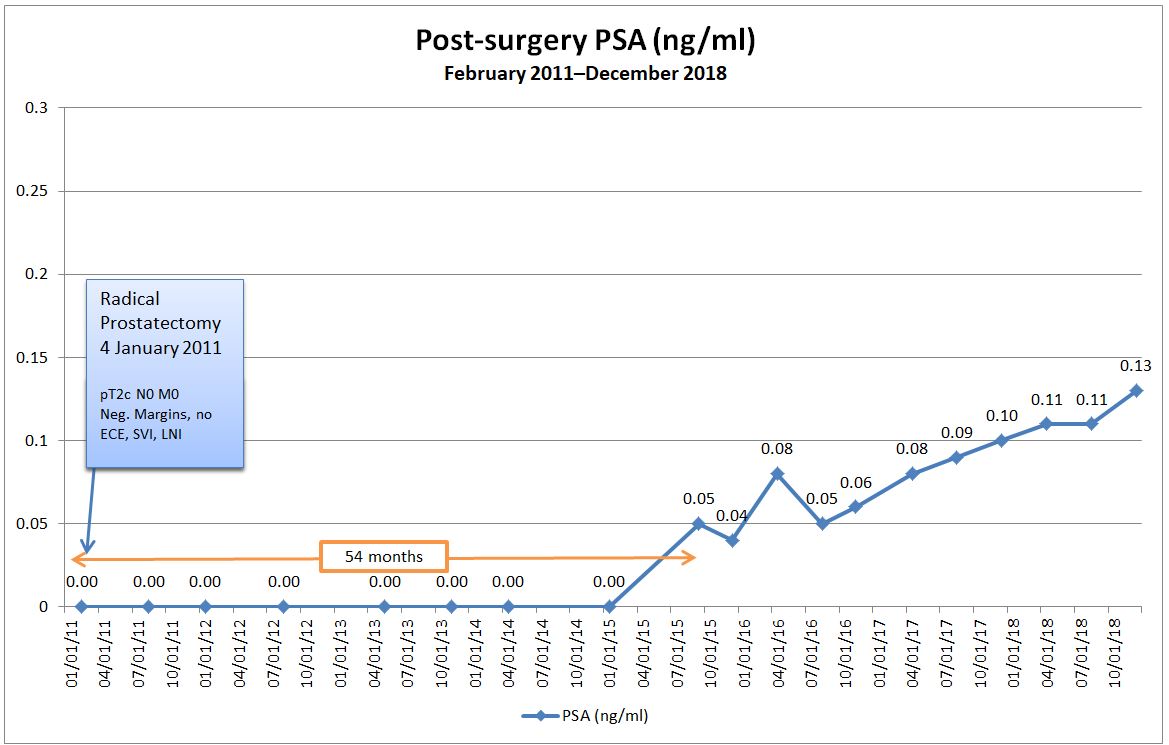
Today was a tough day. The news of my PSA increasing to 0.21 ng/ml weighed heavily on me throughout the day. It even made me a little snippy in a meeting this morning, as my tolerance for trivial bullsh*t decreased to an all-time low. Oh well. They’ll get over it.
Long-time readers of this blog already know that I’ve delayed starting salvage radiation therapy because I’m reluctant to incur the short- and long-term side effects of radiation without having a higher degree of confidence that we’re actually zapping in the correct location(s)—zapping the cancer itself.
Of course, the current state of imaging for prostate cancer generally sucks, but it is getting better with advances like PSMA PET scans using 68Ga-PSMA-11 where prostate cancer can be located much earlier and much more accurately than using previous technologies such as bone scans. But even 68Ga PSMA PET scans have their limitations.
One of the greatest challenges (gambles?) in deciding when to start salvage radiation therapy is the timing. Most will argue the earlier, the better. Statistics show that in most cases, the cancer is still in the prostate bed or pelvic region, so the radiation oncologists start blindly zapping those regions hoping the statistics are correct. But the cancer could have already spread to more remote locations.
With my PSA doubling time in the 4-5 year range, my team and I have decided to hold off on salvage radiation therapy and, in so doing, I’ve avoided any radiation side effects for five years giving me a high quality of life during that time. That has value to me. Of course, none of us know whether the little buggers have been hanging out in the prostate bed during that time (like statistics would show), or if they’ve gone on one of their own infamous road trips and have started spreading.
One of the things that I’ve been trying to determine for months now is at what PSA level can the Ga68 PSMA PET scan begin to reliably pick up prostate cancer. The answer typically was in the 1.0 to 2.0 range for the PSA. With a PSA a fraction of that (0.21) the PSMA PET scan really wouldn’t be a reliable tool for me yet. It’s not a completely worthless tool, but there are decent chances that I could come away with a false negative result.
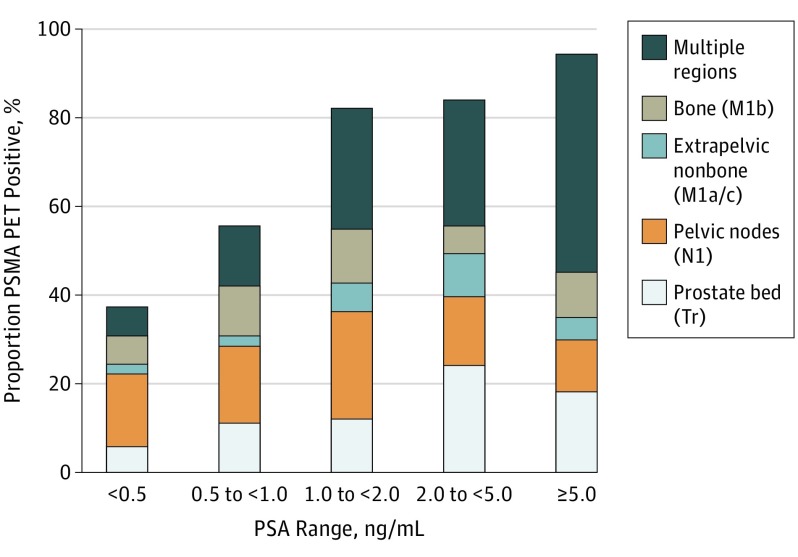
The chart below taken from the paper was exactly what I was looking for and more. First, it shows the number of cases where patients with an increasing PSA after prostatectomy have positive results based on their PSA level. For those with PSAs less than 0.5 ng/ml (me), the number of positive cases was only 38%. In other words, there’s about a one in three chance that the Ga68 PSMA PET will be able to locate the cancer at that PSA level. Not good odds, but better than zero.
To me, the really interesting thing about this chart is that it shows the location of where the PSMA PET scan found the cancer by PSA level.
Fendler WP, Calais J, Eiber M, Flavell RR, Mishoe A, Feng FY, Nguyen HG, Reiter RE, Rettig MB, Okamoto S, Emmett L, Zacho HD, Ilhan H, Wetter A, Rischpler C, Schoder H, Burger IA, Gartmann J, Smith R, Small EJ, Slavik R, Carroll PR, Herrmann K, Czernin J, Hope TA. Assessment of 68Ga-PSMA-11 PET Accuracy in Localizing Recurrent Prostate Cancer: A Prospective Single-Arm Clinical Trial. JAMA Oncol. 2019 Jun 1;5(6):856-863. doi: 10.1001/jamaoncol.2019.0096. PMID: 30920593; PMCID: PMC6567829.
You can see that more than half of the cancer in patients with PSAs below 0.5 were found either in the prostate bed or pelvic region, both of which should be very treatable with salvage radiation therapy.
However, once the cancer is in other the other regions—extrapelvic nonbone (other organs), bone, or multiple regions—the cancer becomes very difficult if not impossible to treat. At that point, it’s only managed.
Please keep in mind that those are my non-expert opinions that I will have to confirm with my medical team to make sure I’m interpreting things correctly.
You can see that, as your PSA increases above 0.5 ng/ml, the cancer was found more broadly in the study participants. By that, I mean the cancer had spread beyond the prostate bed and pelvic region. You can also see, however, that even with PSAs less than 0.5, the cancer has already spread elsewhere in about 40% of the patients in the study with that PSA level.
That’s the whole point of knowing this. If the cancer has already spread, there’s no sense in zapping the prostate bed or pelvis risking long-term radiation side effects adversely impacting quality of life for no gain whatsoever.
This is only one study with 635 patients, so I am taking the results above with a healthy dose of skepticism, and I’ll continue to do more research in the three weeks before my appointment. But this study will be a good conversation opener for the consultation.
Some of the questions that are on the top of my bald head are:
Should we run another PSA test to see if this was an outlier/anomaly like some of my previous PSA tests (I’ve been using the same lab all along)?
How much weight does PSA doubling time have now that we’ve crossed the 0.2 ng/ml threshold?
Would he support getting the Ga68 PSMA PET scan done at this PSA level?
If not, at what PSA level would he support getting the PSMA PET scan?
Would he be willing to give me a referral to get one done even if I have to pay for it myself?
Fortunately, the US Food and Drug Administration approved the Ga68 PSMA PET scan at the University of California Los Angeles (UCLA), and that would be a 2.5-3 hour drive for me to get up there to have the scan.
In the meantime, I’m going to have to reconcile in my own mind how high I’m going to let my PSA get before taking action, scan or not.
Lots of research, thinking, and soul-searching ahead. But be forewarned: My trivial B.S. tolerance level is way less than my PSA. 🙂
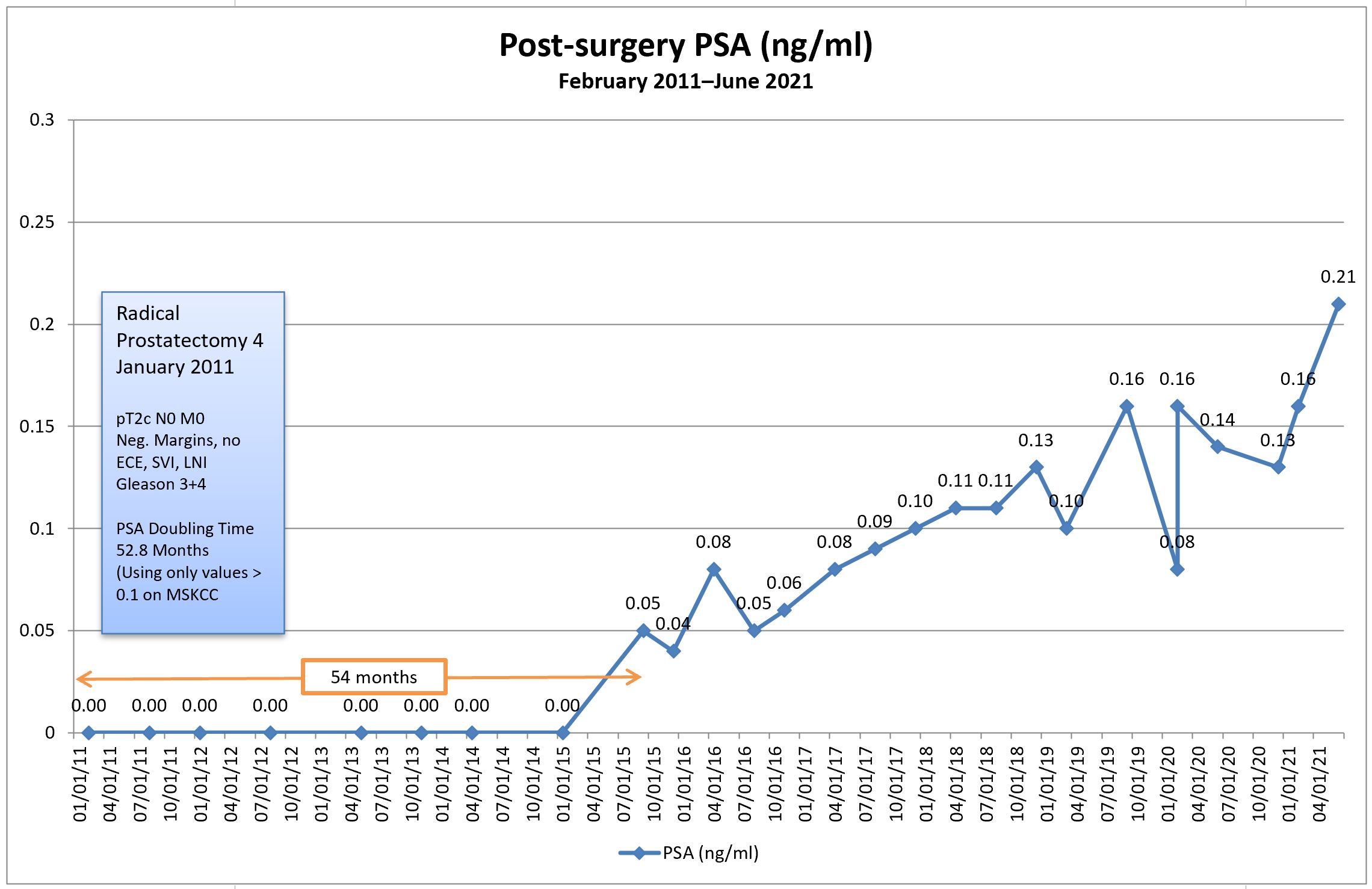
I went for my originally scheduled six-month PSA test last Thursday and was able to look online last night to see the disconcerting results: A substantial increase to 0.21 ng/ml.
Breaking the 0.2 ng/ml threshold now officially puts me into the biochemical recurrence category, at least according to the long-held definition of biochemical recurrence.
Needless to say, I felt gut-punched on seeing the results. Sure, I’ve know for over five years that my trend has been upward, but I guess I got comfortable with it bouncing around the 0.10 to 0.16 range for the last few years. I wasn’t expecting such a substantial leap between my “surprise” PSA test in February and this one in June.
When it comes to PSA doubling time, it dropped from 67.7 months to 52.8 months with this latest test result included in the calculations. If I look at only the five most recent test results, the PSA doubling time drops to 46.5 months. Of course, all of those are great numbers that a lot of guys would like to have.
My appointment with the doctor isn’t until 6 July, and it will be an interesting conversation now that we’ve crossed that magical line of 0.2 ng/ml. In a way, I’m glad I’ve got several weeks to think this through and to come up with good questions to ask so that I’m prepared for the appointment.
Of course, salvage radiation therapy just moved to the top of the list of things to talk about. It will be interesting to see if their recommendation changes given the 0.21 number versus the long PSA doubling time.
Needless to say, there’s going to be much reflection and research in the weeks ahead.
A little over a week ago, I hopped online around 10 p.m., checked my latest PSA results, and wrote my last blog post. None of that made for a good bedtime story.
The next day, I was exhausted from not sleeping well after receiving the news—so exhausted that I skipped out from work about an hour and a half early so I could go home and rest. Ever since then, I’ve been fine. I’ve accepted the new number and the fact that, once again, the only thing that I can control is how I react to it. In my heart, I expected the number to go up from the last test, and it did.
I did take a little time to search for some newer articles about salvage radiation therapy but they, like the PSA results, didn’t make for good bedtime reading either, so I put that on hold for now. I’ll be working on my list of questions for the doctor on 22 October, and we’ll go from there.
I’m pretty sure the writing is on the wall that that salvage radiation is in my future. It will take a while to get appointments set up for the radiation oncologist and to do any imaging that we can, and when you throw in the approaching holidays, I just don’t see radiation starting before the end of the year. I could be wrong. (Or, if things do happen quickly, I may just force the start to the beginning of the new year. Who wants to be getting zapped through the holidays? Seriously.)
In the mean time, I’m doing okay. Really. Just one appointment and test result at a time…
I jumped the gun and got my PSA test done about a week earlier than I planned. I had a appointment scheduled on Monday to follow-up on my thumb surgery back in February , and I thought I would kill two birds with one stone and get the blood drawn after my appointment.
About 9:00 a.m., the doctor that I had my 1:30 p.m. appointment with called to check in and see how I was doing and if I really needed to come in. “How’s your thumb?” “Still attached and working,” I replied. After a brief discussion in more detail, we mutually agreed that there was no need for me to come into the office.
That kind of put a damper on my getting two birds with one stone, but I decided that I would go to the lab anyway, as I had already planned the afternoon off. It just made sense.
I wish I hadn’t.
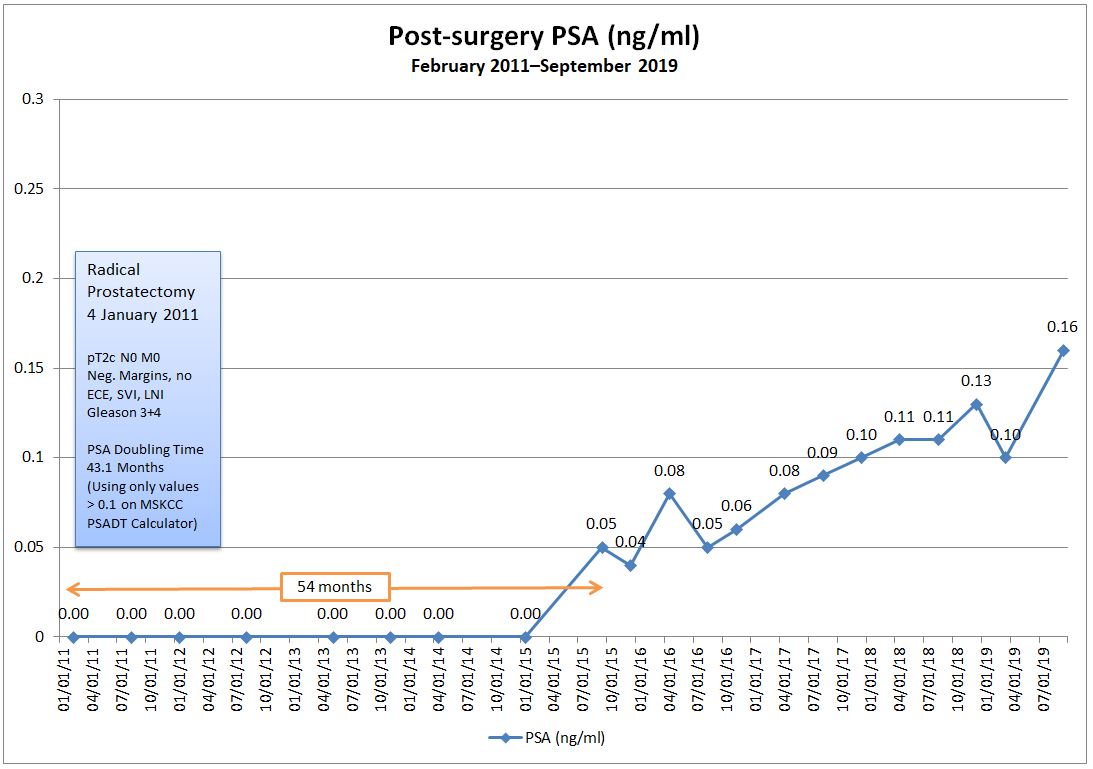
My PSA took a considerable jump up to 0.16 ng/ml. I wasn’t expecting that.
The trend function on my spiffy spreadsheet thought it would come in around 0.137 ng/ml so that’s kind of where I had prepared myself to be mentally.
I used the Memorial Sloan Kettering PSA Doubling Time calculator to recalculate my PSA doubling time (it uses values of only 0.10 ng/ml and above), and my PSADT dropped from 155.6 months to 43.1 months. Still a respectable number, but definitely moving in the wrong direction.
Needless to say, this sucks.
My appointment with the urologist is on 22 October and we’ll definitely talk about imaging possibilities and ask for another referral back to a radiation oncologist to discuss salvage radiation therapy.
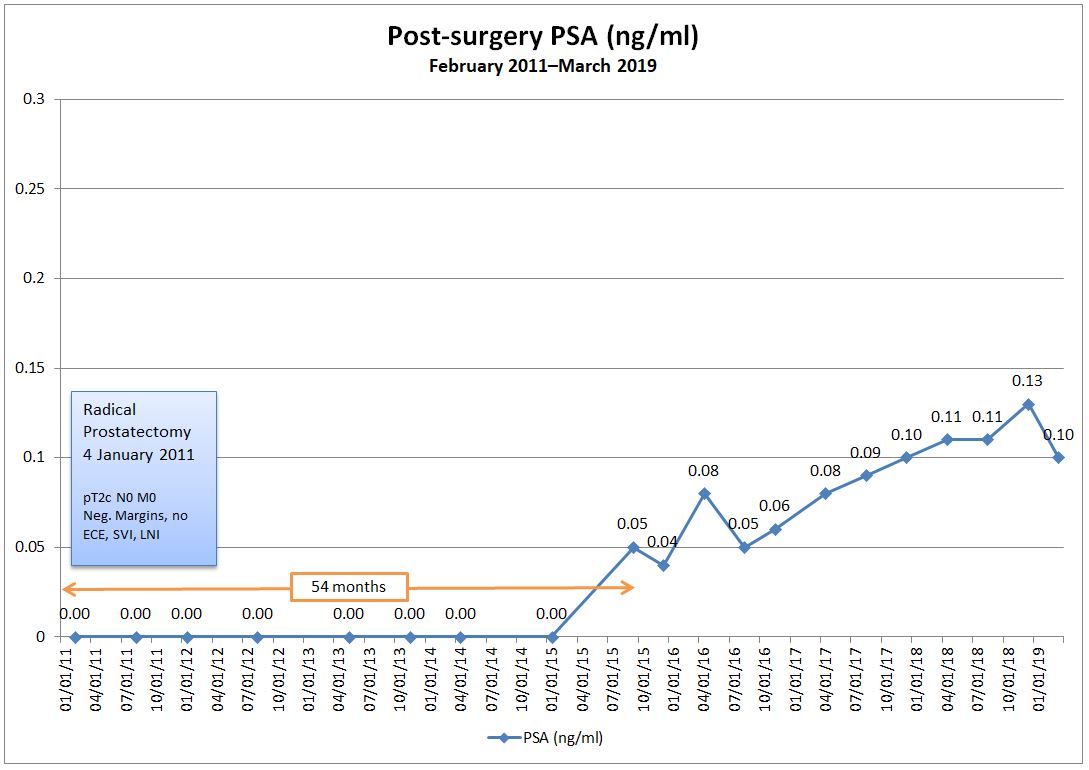
Okay. Sorry to use the vernacular, but what the f*ck?!? My PSA went down from 0.13 ng/ml to 0.10 ng/ml!
Not that I’m complaining, mind you. But, seriously, WTF?
This is great news, but when you get yourself psyched up for yet another increase (after 3.5 years of pretty steady increases), it certainly plays games with your mind when the number goes in the opposite direction in a substantial way. Did I ever mention that I hate this disease?
I can’t wait to hear what the urologist has to say about this on 18 April. It should be entertaining.
My slight sense of optimism that I gained after my last consistent PSA result was shattered at four o’clock this morning when I hopped online in a fit of insomnia to check my PSA test results from this week. I’m back on the upward climb again with a PSA of 0.13 ng/ml.
My spiffy spreadsheet predicted a value of 0.129 ng/ml, so it wasn’t unexpected. Just my hope for a more stable PSA went out the window.
Obviously, I’ve got some serious thinking to do in the weeks ahead.
The predictive part of my spreadsheet shows the increase will continue at a rate of about 0.011 ng/ml every four months. In April, I would be at 0.140 and in August at 0.151. Is that rate slow enough to delay any decision about salvage radiation therapy a while longer? I don’t know.
Do I get involved with the imaging trial at UCLA to see if we can determine where the cancer is before undergoing salvage radiation therapy? I don’t know.
Or do I just say screw it and start the salvage radiation therapy in early 2019? I don’t know.
Stay tuned for the answers. That, or for pictures of ostriches with their heads buried in the sand.
That’s what it’s coming down to, or so it seems. Using the ultimate “executive decision-making aid” to determine what I’m going to do.
What brought this on? Another email exchange between me and my radiation oncologist.
Over the weekend, a few more questions popped into my head and I wanted to get his response. Yesterday, I fired off an email asking if any advances in radiation delivery technology or methods in the last 10-15 years improved the side effect outcomes over the studies he shared with me. In short, the answer was no—there were no appreciable changes.
Of greater interest to me was his interpretation of the Freedland study, which shows that I can do nothing and have a 94% chance of being around 15 years from now. His response:
I am familiar with the study you included, and it is one of many retrospective reviews on this subject. The authors preformed a retrospective review on a total 379 patients over period of 18 years from 1982 – 2000. Therefore, although the data are valuable and contribute to the literature, I consider it (as well as the many other studies on this subject) thought provoking.
Perhaps I’m reading too much between the lines, but his last sentence translates into “skeptical of the study” to me. He continued:
The bottom line is that you have a biochemical recurrence with a low, slowly rising PSA. Do you need radiation treatment now, sometime in the future or never? I don’t have a definitive answer to that question, but there are data to suggest “the earlier the better” and other data to suggest treatment might not be needed at all. It depends on your point of view…
Am I upset by that response? Not really. It’s pretty much what I expected it to be, and that tells me that my research has been quite thorough. He and I both landed at the same place.
Will it make deciding my course of action any easier? Hell no. But it does reinforce that it’s my decision, and my decision alone.
Now where did I put those Eisenhower dollar coins again???
It’s 7:30 p.m. on the Saturday of a three-day holiday weekend in the United States, and I’m reading articles on salvage radiation therapy. Who said prostate cancer wasn’t fun?!?
I did come across this informative article from the Journal of Clinical Oncology published in May 2007:
The authors set out to create a nomogram that predicted the “probability of cancer control at 6 years after SRT for PSA-defined recurrence,” and they speak at length about the variables used in their nomogram, as well as its limitations.
I plugged my stats into their nomogram and came up with a 70% probability that I won’t see any progression at six years. That’s right in line with what the radiation oncologist told me. (The nomogram is a little clunky to use, as it’s a graphical scale that you have to draw lines through to determine your score. I’d much rather have fields to enter on an online form that calculates it more precisely.)
There was one paragraph that talked about side effects of SRT that really caught my attention:
The potential for morbidity resulting from radiation therapy argues against its indiscriminate use in the salvage setting. Mild to moderate acute rectal and genitourinary toxicity is seen in the majority of patients, but the reported incidence of acute grade 3 to 4 complications is less than 4%.4,6,9,14,21,36 Late grade 1 to 2 rectal and genitourinary toxicity are reported in 5% to 20% of patients, and late grade 3 toxicity is less than 4%.3,4,6,8,11,21 Although rare, pelvic radiation therapy for prostate cancer is associated with an increased risk of secondary pelvic malignancies.40 Postprostatectomy radiotherapy does not appear to significantly increase the risk of urinary incontinence,3,4,6,14,21,41 but we must presume that it has some adverse effect on erectile function on the basis of the data from primary radiation therapy series. The nomogram can be used to restrict SRT to those patients most likely to benefit and avoid treatment-related morbidity in those predicted to have a low probability of a long-term benefit.
That 5% to 20% range for late grade 1 to 2 rectal and genitourinary toxicities made me go, “Hmmm…” Not quite the “single digits” probabilities that my radiation oncologist said.
After reading a number of the articles in the footnotes and listed on the “We recommend” column of the website, it’s apparent from most of them that starting SRT early is the way to go. It’s also apparent that the probability of being progression free at six years varies considerably from the 30% range to the 77% range depending on your PSA doubling time, PSA level, Gleason score, time to recurrence, and post-surgery pathology. But we already knew that.
This also caught my eye:
A rising PSA alone is not justification for initiating salvage therapy because patients with PSA recurrence are as likely to die as a result of competing causes as they are of prostate cancer.1 To determine the need for salvage therapy, we suggest using one of several existing tools to estimate the probability of developing metastatic disease or cancer-specific mortality.2,22,23 Patients at high risk of progression to these clinically significant events and/or a long life expectancy should be assessed for SRT using our nomogram.
We’re right back where we started from: Zap early with an average 50-50 shot of it being effective (with the 4%-20% chance of long-term side effects) or do nothing but monitor.
I may send some of these links to my radiation oncologist on Tuesday and ask, “Which of these studies do you put the most stock in, and why?” and see what he says. Could be interesting.
Well that’s enough fun with cancer on a Saturday night. I’ll keep you posted on any new research findings or developments with the doctor.
When I was in 7th grade, I had to give a presentation on my science project, an erupting volcano, and I was so anxious about the presentation that I became physically ill and erupted myself. Not pretty. While I didn’t get physically ill today, the feeling was almost the same as I waited to see the radiation oncologist. It’s silly, I know. But it was very real.
In a nutshell, his recommendation was to start salvage radiation therapy.
The R.O. is a Navy captain medical officer, and we spent nearly forty-five minutes going over my case (which I truly appreciated). He took control of the conversation from the outset, explaining the options and consequences of each. I could tell that he had given this little presentation once or twice before. Once we got through that, we did have a real conversation. Some key points:
He disagreed with the notion that the increasing PSA is from residual benign prostate tissue left behind.
He was confident that the cancer would be in the prostate bed based on my numbers and statistics.
He talked about the differing definitions of biochemical recurrence, saying that the American Urological Association (AUA) and American Society for Radiation Oncology (ASTRO) use the 0.2 ng/ml threshold, but the National Comprehensive Cancer Network (NCCN) defines recurrence as a detectable PSA with two consecutive increases. My case meets the NCCN definition.
Continued surveillance is a viable option for me given my numbers and PSA doubling time.
We talked about the short and long-term side effects of radiation therapy: urinary control, sexual function and bowel control. His estimate the probability of long-term quality of life-impacting side effects in any of the three areas to be in the “single digits.”
He reminded me of selection bias when talking to other patients or bloggers about their side effect experiences. Yes, their experiences are very real, but for each person in an online forum, there are many others outside the forum who are leading productive, acceptable lives.
If we were to do salvage radiation therapy now with my PSA under 0.2 ng/ml, he put the probability of me having no evidence of disease five years from now at seventy-five percent. If we wait until my PSA is above 0.2 ng/ml, that number decreases.
Newer scanning technologies weren’t likely to pick up anything at my current PSA levels, yet he was open to the idea of them if it gave me peace of mind.
With my numbers, there is no reason to radiate the pelvic lymph nodes or use androgen deprivation therapy (ADT).
He was open to waiting until the August PSA results to see what they revealed before making a decision.
It was a good conversation, but I’m sorry to say that I don’t know that there was a lot of new information for me there that would tip the scale either way. The doctor wasn’t pushy in one direction or the other, saying that it was equally reasonable for me to continue surveillance or for me to begin salvage radiation therapy. The choice is mine. About the only thing he was adamant about was not starting ADT, and I’m in perfect agreement with him on that.
I did learn one really interesting thing, however. The reason that the VA Medical Center referred me to Naval Medical Center San Diego has to do with geology. Apparently VA Medical Center San Diego (La Jolla) was built sufficiently close to a geological fault line that they couldn’t build a radiation “bunker” that would be safe in the event of an earthquake.
What’s next for me? A ton of thinking, reflecting, and reevaluating.