Day 5,635 – Unexpected Call

I’m not sure how I managed it, but I picked up a nasty head cold after yesterday’s meeting with the oncologist. Perhaps it was from being at the hospital two days in a row, or from me riding our commuter-packed light rail system to get to the hospital (stops right at the hospital) that did me in, but whatever bug I caught kicked in around 5 p.m. yesterday.

Around 7 p.m. tonight, I was nursing the head cold, watching the ballgame on television when my phone rang, and I was surprised to see it was a call from the VA.

It was the head of the urology department inquiring about continuing my pelvic floor therapy at a community provider. (You may recall that I started that back in December, and the original end date of the therapy was 2 April.) I told her that the therapist and I agreed that I had plateaued and didn’t see a need for me to continue.

Not one to miss an opportunity, I mentioned me meeting with the oncologists yesterday and asked her for her take on whether starting hormone therapy would be appropriate. I also mentioned the negative scan results. She was more of the mindset of waiting until there was evidence of spread, and she said, “I wouldn’t chase numbers,” when I mentioned my current PSA level.

She noted that I had the follow-up with the oncologists on 2 June and a follow-up with urology on 23 June, and said we can review things then.

Once again, the “experts” offer differing approaches, and it’s up to us, the patient, to pick and choose what’s best. After 15 years, it’s not a surprise, but it still is frustrating at times. MO Jr. did mention that it may be appropriate to convene the “Tumor Board” to get all the key players in the same room and review the case for the best course of action.

At this point, I’m inclined to get the PSA test at the end of May and, with that new information, try to push to get everyone in the same room for a discussion of next steps forward. Or at least have them convene the Tumor Board without me.

In the meantime, I’m just going to curl up in a ball and try to get the worst of this head cold behind me before the weekend.

Be well!

Header image: Anza-Borrego Desert, California

Month 185 – Scan Results & Oncologist Meeting

It’s been a busy two days hanging out at the doctor’s offices between the scan and the oncologist. Here’s a summary of each, my final thoughts, and a quick explainer about hormone therapy for the uninitiated at the end.

18F-FDG PET Scan

“No evidence of metabolically active malignancy or metastatic disease.”

Well, I hate to say it, but I’m not necessarily surprised by that result. I didn’t have high hopes of getting a definitive answer going into the scan given its lower sensitivity and lower specificity, but I thought it was definitely worth the effort.

As far as the procedure itself was concerned, it was slightly different than the 68Ga-PSMA-11 PET scan. I had to fast for at least 6 hours (no food, just water) before the injection of the 18F-FDG tracer. They also had to measure my blood glucose level to ensure it was under 200 mg/dL (it was). If it was over, the scan would have been canceled.

There was a one-hour waiting period for the tracer to distribute through my body, and the scan itself took 45 minutes. Seeing as I had to get up at 4:30 a.m. for my 7 a.m. appointment, that hour in the recliner was much needed.

Oncologist

I actually met with two medical oncologists this morning, the resident about to complete his training (MO Jr.) and the full-blown MO Sr. who focuses on prostate and breast cancer. It was a good, nearly hour-long discussion. In a nutshell:

  • It was disappointing that the imaging didn’t show anything and, even though it would be nice to know where the cancer is located, MO Sr. felt it was time to start systemic treatment.
  • MO Sr.’s triggers for starting hormone therapy were a PSA greater than 2.0 ng/mL (I’m at 2.52) and a PSA doubling time less than 9 months (I’m at 8.9 months).
  • MO Sr. said that, with my numbers, I’m at “higher risk” for this to get away from us and metastasize.
  • MO Jr. said that the window for curative options has closed and that treatment going forward would be “palliative.” (I already knew that curative options were out the window.)
  • Both agreed it’s time for them (Oncology) to take the lead on my case at this point, with Urology still available in a supporting role.
  • Both suggested dual therapy involving androgen deprivation therapy (ADT) using Eligard (leuprolide acetate) and and androgen receptor pathway inhibitor (ARPI) using Xtandi (enzalutamide) as the current standard of care. [See explanation below if you’re unfamiliar.]
  • MO Sr. also suggested intermittent therapy over continuous therapy, using a 9-month schedule to start.

If she had her way, I believe MO Sr. would have had me start the therapy in the next week or so. I tapped on the brakes on that idea. I told her that Urology wanted another PSA test done in early June, and I thought it would be good to get that done before starting anything. Also, I’m traveling in May and I simply wanted to postpone anything until after I return. Six weeks won’t make that much of a difference.

We agreed, in concept, to the following:

  • No more scans to try to located the cancer for now.
  • Get pre-therapy lab work done the week after Memorial Day to establish baseline testosterone and PSA levels (among others) ahead of therapy.
  • Get a Dexa bone density scan to get a baseline prior to starting treatment (extended ADT can weaken bone density).
  • Meet on 2 June to review the results and make the final decision as to whether to start treatment.

Final Thoughts

It’s only been a few hours since the meeting, and I’m still trying to absorb it all and process it. Of course, after 15+ years of dealing with this, I knew we would eventually get to this point. Am I ready or willing to take the advice of the National Cancer Institute doctors in the video I shared recently to just monitor and delay treatment? I don’t know. It’s something that I’ll have to contemplate over the next six weeks or so.

I will say that I was pretty impressed with the Oncology Department as a whole. You’re assigned a care coordinator and given their direct phone number for all questions or concerns, and both doctors were good at listening and engaging in a real conversation. It seemed like they were a bit more empathetic over all, and that’s a good thing.

Certainly a lot to take in in the days and weeks ahead. I’m open to thoughts and feedback.

Be well!

—Dan


Hormone Therapy Explained

For those who aren’t really familiar with how prostate cancer works and what role hormone therapy plays, here’s a grossly over-simplified explainer.

Prostate cancer feeds off of testosterone and, as long as there’s a supply of testosterone, the cancer will continue to grow.

There are two ways to deprive the cancer of testosterone. The first is to stop or slow the production of testosterone. The second is to block the cancer cells from receiving the testosterone. The current standard of care is to use both methods simultaneously.

Let’s say the cancer cells are in the bottom of your favorite travel mug, thirsty for testosterone. If you put the mug under running water from your tap, the cells get the water (testosterone) they need and the cancer grows. But if you turn the tap off, the water (testosterone) stops flowing, and the cells in the bottom of the mug can’t grow. This is called androgen deprivation therapy (ADT).

The other way to stop the cancer cells in the bottom of the mug from getting water (testosterone), is to simply put the lid on and block the water from entering the mug. This is called androgen receptor pathway inhibitors (ARPI).

If you do both simultaneously, you can really slow the growth of the cancer. But we also know that some taps have slow leaks that drip water and, if the lid is slightly open, water (testosterone) and still make it to the cancer cells inside the mug.

There are two ways of turning the tap off. One, an orchiectomy, is a radical, surgical and permanent removal of the testes. But the adrenal glands also produce a small amount of testosterone, too, so the flow isn’t completely stopped.

The other is to use an ADT drug to have the brain tell the testes to stop producing testosterone. The drug is given via an injection in typically one, three, or six month doses, and it has significant side effects: hot flashes, mood swings, fatigue, loss of libido, loss of muscle strength, and loss of bone density, to name a few.

The way to put a lid on the mug is through an ARPI drug that’s usually taken in pill form daily. In my case, MO Sr. was recommending Xtandi (enzalutamide) as the ARPI. It has its own host of side effects: muscle and joint pain, fatigue, falls and bone fractures, headaches, high blood pressure and others.

The good news is that this combined treatment option can keep the cancer at bay for years (as long as you stay on it for years). However, at some point, the cancer can become resistant to the drugs, and you may have to move to stronger treatment options like chemotherapy.

Again, this is an oversimplification for those new to the topic.

Header image: Anza-Borrego Desert, California

Video: “Playing the Long Game” – Does your Recurrent/Advanced Prostate Cancer Need Treating? NCI Seminar

One of the best things about keeping this blog going over the years is learning new information from you, the readers.

Recently, a reader left a link to this video in the comments of one of my recent posts. It highlights the work that two doctors from the National Cancer Institute (NCI) have been doing when it comes to assessing whether and/or when to treat patients with recurrent/advanced prostate cancer.

The video is about an hour long (I changed the playback speed to 1.25x to get through it a little faster) and was very timely for my current situation.

One of the interesting parts was the discussion on how to define metastatic prostate cancer. It’s still pretty squishy if you ask me.

It will be interesting to see what the oncologist says tomorrow.

Be well!

Header image: Anza-Borrego Desert, California

Day 5,616 – Ugh.

As soon as I hung up the phone with the doctor yesterday, I started memorializing our conversation in Google Keep while waiting for my turn in the barber’s chair, and that was the outline I used for last night’s post about the conversation.

As I said last night, I had planned on documenting the conversation in an email to the doctor this morning. I drafted what I thought was an accurate, reasoned response but, before I was going to send it, I wanted to see if I could get his take on the conversation in my patient notes. I logged onto the patient portal and found his notes from the conversation.

Apparently, the doctor and I have had a massive disconnect.

He mentioned our discussion about Axumin scans, saying, “that this is not recommended at this time given prior negative PSMA PET imaging and the limited likelihood that Axumin would provide additional clinically actionable information.”

He also referenced our discussion about Pylarify scans, saying, “he recently underwent PSMA PET and that repeat advanced imaging would not be expected to change immediate management. Will review timing/appropriateness of repeat PSMA-based imaging if PSA continues to rise.”

He closed his comments with a recommendation to see Hematology/Oncology.

It was like a sucker punch to the gut—I had a genuine physical reaction to reading his notes.

This tells me two things.

First, he is not convinced that there is such a thing as a PSMA-negative patient for whom PSMA PET scans won’t work. That view is reinforced by his comments yesterday that he was confident my cancer expresses PSMA. In his mind, the 68Ga-PSMA-11 PET scan is definitive in its findings.

Second, it tells me that he isn’t pursuing any alternate imaging at all. Just let my PSA continue to increase and try again with another PSMA PET scan.

Needless to say, I discarded my draft e-mail to him, stepped away for most of the day, and have just been trying to process how to proceed. Of course, I’ll re-write my email to him politely highlighting the disconnect between our versions of the conversation.


I wish I could understand his reluctance to believe that I may be PSMA-negative. A quick search last night gave me a handful of papers from reputable organizations on the topic:

The clinical characteristics of patients with primary non‐prostate‐specific membrane antigen‐expressing prostate cancer on preoperative positron emission tomography/computed tomograph

Finding Metastatic Prostate Cancer that Doesn’t Make PSMA

The Blind Spot of Prostate-Specific Membrane Antigen Positron Emission Tomography Staging? Intraductal Carcinoma of the Prostate Is Overrepresented in Patients With No Uptake Pattern on Prostate-Specific Membrane Antigen Positron Emission Tomography and High-Grade Prostate Cancer

The oncological characteristics of non-prostate-specific membrane antigen (PSMA)-expressing primary prostate cancer on preoperative PSMA positron emission tomography/computed tomography

Normal Variants, Pitfalls, and Artifacts in Ga-68 Prostate Specific Membrane Antigen (PSMA) PET/CT Imaging

Of course, there’s a lot of gobbledygook that goes way over my head in those papers, but the common theme is that PSMA-negative patients do exist and that affects imaging. They only possible distinction that I’ve come up with from briefly skimming those papers is that more aggressive cancers seem to express more PSMA than less aggressive cancers. Maybe the doctor could confirm that or educate me.

Of course, the Prostate Cancer Research Institute has a video on this very topic:


What’s next? I’m thinking that I’m going to pursue two parallel paths, one within the VA and one outside of it. Both will likely take weeks if not months to pursue. (I’m not panicking about this, but I also don’t want to keep kicking the can down the road without doing anything to guide our decision-making, especially seeing as my PSA doubling time seems to be shrinking.)

Within the VA, I’m going to:

  1. Write the urologist and let him know that I came away from our phone call with a completely different take.
  2. Push to get the appointment with Oncology and hope to enlist them as an ally in trying to get an alternate scan sooner rather than later. In the in-person meeting, the urologist seemed to be deferential to their opinion.
  3. If neither of those result in any action, I’ll meet with the patient advocate at the VA and see if that can break the log jam either within the VA or by allowing me to gain community care outside of the VA.

Outside the VA, I’ll look at:

  1. Identifying what’s needed to become a patient at UCSD. It may not require much, as they did my salvage radiation therapy almost four years ago.
  2. Try to set up an appointment with the medical oncologist that the VA consulted when we talked two years ago.
  3. Get his take on alternate imaging.

I will tread very carefully because I don’t want to screw up any eligibility for care within the VA by going outside the VA or create confusion as to who is really taking the lead on my care. That’s why it’s really best that, if the VA can’t or won’t pursue additional screening, that they are the ones who initiate the request for community care. It’s something I need to research.

So that’s how I’m going into the weekend. How about you?

Be well.

Header image: Anza-Borrego Desert, California

Day 5,522 – Urologist Appointment

Late last week, I received a text message asking if I would like to move my urologist appointment from 30 December to today, 23 December, and I agreed.

My appointment was at 3:15 p.m., and I arrived around 2:45 p.m. As I’m walking up to the check-in kiosk, my cell phone rings, and it was the urology department wanting to confirm that I’d be there. That’s the first time that that’s happened, and I told the nurse that I was checking in as we spoke. “Great! We’ll come out and get you.” Apparently, they were antsy to get out of there early on the day before Christmas Eve. So was I.

The head of the department was the one who saw me this time, and we had a really good conversation. Some of the key takeaways:

  • She was concerned about the increase in my PSA but not panicked, even initially suggesting we just continue to monitor it.
  • We talked at length about doing another round of imaging to see if we can determine the location of the cancer.
  • We agreed to do another PSMA PET scan, and we negotiated doing one in March 2026. (She thought that Nuclear Medicine might push back on doing one sooner, i.e., within a year, as the last one I had was in March 2025.) She also mentioned the possibilities of other imaging should the PSMA PET scan come up with no evidence of cancer/metastasis for the fourth time.
  • We talked about the timing of starting androgen deprivation (hormone) therapy. She wouldn’t start it until there was evidence of metastasis, but was open to starting it earlier if I really wanted to do so.
  • Lastly, we reviewed my stress incontinence and nocturia issues and talked about my pelvic floor physical therapy.

It was one of the more thorough discussions that I’ve had at the VA, and I’m okay with the plan coming out of the meeting. I’ll go for another PSA test on 1 March; hopefully get the PSMA PET scan scheduled in early March; and have a follow-up with the urologist on 24 March.

I’m glad I got this out of the way before the holiday. I’ve got my answers, plus it frees up next week for me to go out an play if I want.

Merry Christmas, Happy New Year, and be well!

Header image: Hotel del Coronado at Christmas, Coronado, California

Month 181 – Physical Therapy for Incontinence

I’m of the mind that PT stands for Pain & Torture, not physical therapy. (Okay. I exaggerate.)

During my appointment with the urologist back on 7 October, we talked about how my incontinence seemed to be slowly worsening post-radiation. One of the options that he offered up was pelvic floor therapy, and I decided to give that a try.

Unfortunately, the VA doesn’t offer that therapy in-house, so they had to arrange for community care. That process took until mid-November to get the appointment set up, and I just had my first appointment last week.

I was expecting more instruction on Kegel exercises, perhaps with the biofeedback device that they used on me pre-surgery to train me on how to do the exercises. But that’s not what’s happened so far.

The physical therapist explained that many of the muscle groups in your legs and torso can have an impact on your pelvic floor muscles, too, as they’re all connected as part of a larger system. By stretching and strengthening them, we could see improvements in the pelvic floor. At first, it sounded like a bit of phooey to me, but I’m approaching this with an open mind and giving it a shot.

I’ve had just two sessions so far, and we’ve focused mainly on stretching exercises impacting my hamstrings, glutes, calves, and torso, as well as doing squats and walking on a treadmill. Some of the stretches are bordering on turning me into a contortionist, which this soon-to-be 68-year-old body is fighting tooth-and-nail (hence, “Pain & Torture”). But they’re low impact and we’re taking it slowly so I don’t injure myself.

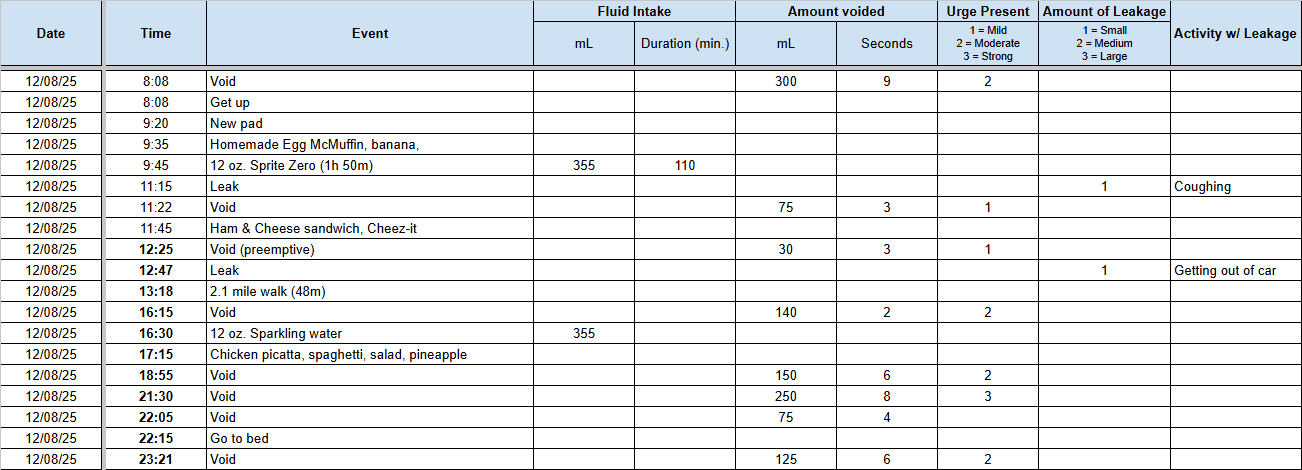
The other thing that she had me doing was documenting my fluid intake, output, and number of incontinence leaks for at least three days. We’re trying to establish a baseline against which we can measure any improvements. She had a hardcopy log which I quickly converted into a tracking spreadsheet. (You know I had to!)

She also made some recommendations to improve my diet and the types/quantities of beverages that I consume (less soda, more water).

Of course, I have to keep up with these exercises daily at home.

On the one hand, I’m a bit skeptical about this approach but, on the other hand, I do feel as though that, even after one week, I’ve noticed that I seem to be having fewer leak episodes and, the ones that I do have, seem to be smaller in size. We’ll let my spreadsheet determine if there’s a true trend, or if this is all in my head.

I have another appointment next week and then, in the new year, she mentioned that we might cut back to every other week sessions or even monthly sessions, depending on the progress that’s made.

One thing that I am a little concerned about is the potential cost of this.

Yes, the VA is covering the costs, but what many don’t realize is that some of us, based on our eligibility criteria, have to pay co-pays for our visits. Seeing the specialists—including the urologist—costs $50 per visit. Seeing a PT every week would rack up significant costs over time, and I’m not sure if the VA has an out-of-pocket cap on how much a veteran pays. (I’ll have to check into that.)

Assuming the holidays don’t mess it up, my appointment with the urologist to review my PSA results is on 30 December. We’ll definitely be talking about another PSMA PET scan and getting medical oncologists involved in my case.

—Dan

Header image: Botanical Building in holiday lights, Balboa Park, San Diego, California

Hormone Therapy for Prostate Cancer Fact Sheet – NCI

I came across this fact sheet on hormone therapy from the National Cancer Institute that does a great job of explaining it all to the uninitiated.

https://www.cancer.gov/types/prostate/prostate-hormone-therapy-fact-sheet

Salvage Therapy for Prostate Cancer: AUA/ASTRO/SUO Guideline (2024)

A moderator on the HealthUnlocked website shared a link to the new 2024 American Urological Association guidelines for salvage therapy for recurrent prostate cancer:

https://www.auanet.org/guidelines-and-quality/guidelines/salvage-therapy-for-prostate-cancer

These are the generally agreed-upon guidelines that practitioners should follow when a patient has recurrent prostate cancer after initial treatment.

Study finds prostate cancer treatment can wait for most men

I saw this on the national news last night and thought the results of the study were interesting:

The study directly compared the three approaches — surgery to remove tumors, radiation treatment and monitoring. Most prostate cancer grows slowly, so it takes many years to look at the disease’s outcomes.


“There was no difference in prostate cancer mortality at 15 years between the groups,” Loeb said. And prostate cancer survival for all three groups was high — 97% regardless of treatment approach. “That’s also very good news.”

That’s going to make a whole lot of guys go, “Huh?!?” The science may say it’s okay to do nothing, but once you hear “cancer,” it will be extraordinarily difficult to not want to do something more proactive. It will be interesting to see if guys stop or cut back on getting screened, and we wind up with more men being diagnosed with advanced prostate cancer instead of localized prostate cancer because they delayed screening.

https://www.nbcnews.com/news/us-news/study-finds-prostate-cancer-treatment-can-wait-men-rcna74512

Here is the New England Journal of Medicine article (I didn’t sign up for full access):

https://www.nejm.org/doi/full/10.1056/NEJMoa2214122

The Cost of Cancer

Cancer isn’t cheap.

I received the last of my Explanation of Benefits statements covering my salvage radiation therapy (SRT) with concurrent androgen deprivation therapy (ADT). You know me. For grins and giggles, I had to play with the numbers.

Ouch!

TherapyBilled
Radical Prostatectomy
and post-surgery infection
(January 2011)
$109,989
Salvage Radiation Therapy
(incl. 6-month Eligard dose)
(May-August 2022)
$176,548
Total$286,737

Those numbers do not include all of the doctor visits and PSA tests from diagnosis to today—just the surgery and SRT/ADT.

For the radical prostatectomy and the subsequent infection hospitalization, that’s what the hospital and doctors billed my employer-provided health insurance company. Of course, the insurance company didn’t pay the hospital the full amount, and I had some copay responsibilities to the tune of $4,372 as well.

For the SRT/ADT, the “Billed” number is what USCD has billed the VA for my treatment. Each zapping session was billed at $3,894. (My radiation oncologist had no idea it was that expensive. As a university employee, he’s not involved in billing.) It appears that the VA is reimbursing UCSD at a rate of somewhere between 10% and 15% of the billed costs.

Coincidentally, I came across this article about the costs of ADT: It cost $38,398 for a single shot of a very old cancer drug. My Eligard shot was billed at $10,835. What a deal! <sarcasm font>

Of course, the emotional cost of cancer is incalculable.

Moral of the story: Don’t get sick without health insurance.

Header Image: Sunset over the Pacific Ocean, Silver Strand State Beach, Coronado, California