Day 2,823 – Surprised

I was more than pleasantly surprised this morning when I learned that my PSA remained the same! It came back at 0.11 ng/ml, the same that it was in April.

PSA 20180801 plain


I learned the news from my primary care physician this morning when I was in to have something else checked out. In fact, I was so surprised by the result that I had to ask him twice to confirm that it was the 1 August reading and not the April reading.

I did ask him for his take on the reading, my history, and what he thought I should do next. He agreed that there are too many differing opinions and recommendations making it frustrating for patients. “Go with your gut,” was the best advice he could muster up.  Gee, thanks.

Of course, the stalled PSA growth (one data point does not make a trend), makes me inclined to kick the decision can another four months down the road—another four months without the side effects of radiation therapy. However, when I meet with the urologist on 19 August to go over the results, I’ll focus the conversation on the long term side effects of salvage radiation therapy because I don’t want to rule that completely out yet, either.

I may even email the radiation oncologist the results to get his take on them. Would he still want to zap me now (probably yes), or would he be more inclined to wait a while longer?

Regardless, I’m going to enjoy the results for now and think about decisions after the visit on the 19th.


Day 2,821 – PSA Test Time

It’s that time again. I had my blood drawn this morning and I suspect I’ll have the results online late Friday night.

My last PSA in April was 0.11 ng/ml and my handy-dandy spreadsheet predicts that this PSA will come in around 0.124 ng/ml. We’ll see…

If it does, that will add a little more pressure to make the “zap or not to zap” decision.

Stay tuned…

Day 2,722 – No Probability for Me

I’m one of those people who always thinks of a snappy comeback—three days after the conversation.

Over the weekend, I reflected on my conversation with the doctor last Thursday, and one of the things that I failed to ask was what probability he would assign to the notion that my increasing PSA is attributable to benign residual prostate tissue instead of returning cancer. I sent an email that asked specifically:

I fully understand that none of us have a crystal ball, but the one thing that I failed to ask Dr. is what he thought the probability of this being benign residual tissue was. Is it 5%? 25%? 50%? His experience gave him the insights to make the comment, so his experience may also be able to measure the likelihood as well.

To which he replied:

I’m afraid I am not able to assign a percentage likelihood to the chance that any residual tissue is benign. I can only really extrapolate from the rate of change in the PSA. The longer it took to be detectable and the slower it rises, the more it seems likely to be a bit of benign tissue. Either way, it is those lab values and their pattern that will help to guide treatment. If it rises quickly then will treat, since a) that pattern is more likely cancer, and b) if it’s not cancer it is acting like cancer and the stakes are too high to disregard even with a high % prediction at this point that the tissue is benign.

Hope that helps!

Dr.

His comment, “…b) if it’s not cancer it is acting like cancer and the stakes are too high to disregard even with a high % prediction at this point that the tissue is benign,” seems to be all over the place and contradicts his opening statement of not being “able to assign a percentage likelihood.” Hmmm…

So that was an interesting little exercise. I really didn’t expect him to come back with a specific number, but I thought I’d ask anyway. I don’t know that his answer convincingly persuades me one way or the other, but it does allow me to throw a tad more weight behind his theory that this is benign. A tad.

Bottom line: The only thing we know with any certainty is that my PSA continues to climb. Beyond that, it’s all a freaking guessing game.

On a related note, I’ve yet to hear from the radiation oncology department with an appointment for me. If I don’t hear from them tomorrow or Thursday (a crazy day at work for me), I’ll try to call on Friday to get on the calendar.


UPDATE:

About an hour after posting this, I came across this little gem of an article from 2005:

The presence of benign prostatic glandular tissue at surgical margins does not predict PSA recurrence

Key points:

We conclude that the presence of benign prostatic tissue at the surgical margins is not associated with adverse prognostic features and does not have prognostic relevance; therefore, we do not advocate reporting the presence of benign prostatic tissue at the inked margins as a standard part of the surgical pathology report on prostatectomy specimens.

Because benign epithelium at surgical margins is not correlated with postoperative PSA rises, postoperative PSA increases should in most cases continue to be considered “biochemical failure”.

Obviously, that’s not good news and certainly warrants more research.

This article from 2013 calls a few things into question:

Benign Prostate Glandular Tissue at Radical Prostatectomy Surgical Margins

Key point:

The most interesting finding of this study is the identification of Benign Glands at the Surgical Margins (BGM) after both Open Radical Prostatectomy (ORP) and Robot Assisted Laproscopic Radical Prostatectomy (RALRP) was not associated with recurrence, either biochemical or clinical, during a median follow-up interval of 49 months after ORP and 28 months after RALRP.

Extending followup further should clarify whether BGM leads to low, detectable levels of PSA that may not meet threshold for defining biochemical failure. This may be particularly relevant with the widespread availability of ultra-sensitive PSA assays. The routine use of ultra-sensitive tests after treatment has not been validated and remains controversial in clinical practice, and may be particularly true in patients at low risk of disease recurrence and potentially in those with BGM.

Within our cohort, longer follow-up may reveal detectable levels of PSA associated with BGM that may not reflect actual prostate cancer recurrence but rather a clinically benign elevation of PSA.

In other words, there’s more research to be done.

Day 2,703 – PSA Results

The bad news: My PSA continued its upward climb to 0.11 ng/ml. The good news: The rate of increase remained constant (and is still quite slow).

The result is exactly where my spiffy spreadsheet said it would be, so I’m not overly surprised. All that’s left to do now is wait for my appointment with the urologist on 19 April. I’ll have to do my best to let him speak a little before I assault him with my already prepared list of questions.

This result reinforces my belief that it’s time to bring a radiation oncologist into the discussion so I can get his or her perspective on salvage radiation therapy, especially regarding the risks of long-term side effects impacting quality of life and the likelihood of success.

More to come…

PSA 20180405

Month 88 – Ready for Next PSA Test

It’s not often that I want time to pass more quickly in order to get to my next PSA test, but this time it’s different for some reason. I’ve been really anxious to have 3 April roll around to get this over and done with. Perhaps it’s because I suspect that this test will be the tipping point that finally gets me into real decision-making mode.

Of course, I would prefer not to see my PSA continue its gradual climb, but I suspect that it will. My spiffy little spreadsheet predicts a value of 0.115 ng/ml, up from 0.10 ng/ml. Let’s see how accurate its predictive powers are.

On a related note, I’m fairing much better than I was in my last blog post. How did I manage the emotional turnaround? One word: Disconnect.

I disconnected from my prostate cancer forums and from the good old Google machine in an effort to maintain some semblance of sanity, and it worked. That doesn’t mean that I quit them altogether or didn’t read the occasional article that popped up in a news feed, but I stopped actively researching for now.

Sure, there hasn’t been a day that’s gone by where I haven’t thought about my predicament. That’s only normal. I just don’t dwell on it like I did four weeks ago, and that’s improved my mood and focus considerably. Depending on my PSA results (I should be able to retrieve them online on 5 or 6 April), my mood and ability to focus may go out the window again. My appointment with the urologist is on 19 April, and one point of discussion will be a referral to a radiation oncologist.

Between now and then, I’ll do my best to simply forget about it all. Wish me luck!

Day 2,596 – Doctor Visit

I met with my doctor this afternoon to review my increasing PSA results, and it went just about as expected. There’s increasing concern, but things are progressing slowly enough that we can continue on the four month test cycle for now. That means I’ll be doing this all over again in April.

There were a few reality check moments in the conversation, though. I’ll get to those in a moment.

One thing I need to learn to do is shut up—at least for the first part of the meeting with the doctor. I’m not very good at letting the doctor talk and offer up his thoughts and recommendations and then ask the questions that I have. I just launch into a barrage of questions based on the research that I’ve done and assault the poor guy. On a positive note, he really didn’t dispute anything that I told him nor did he tell me that I was completely out to lunch on certain issues.

We reviewed the success rate for SRT, with various studies showing it to be 35%-55% effective at being progression-free at 5 or 6 years. (Here’s one.) We also discussed the potential side effects of SRT, and he did seem to believe that the risks were lower than I thought they may be.

The conundrum of starting SRT early versus knowing where to radiate based on imaging came up as well. My sense was that he’d prefer to start SRT while the PSA is less that 0.2 ng/ml, and certainly before it reaches 0.5 ng/ml, assuming that the cancer remained in the prostate bed. Doing so, he said, offers the best chance for success. He suggested that, if we wait until it would be detectable on even the most sensitive imaging (which can’t detect anything reliably until the PSA hits the 1.5-2.0 range), that radiation would do little if any good at that point, as the cancer will likely have spread. Androgen deprivation therapy (ADT) would be the treatment option of choice at that point, and ADT is not curative. It only prolongs life (with substantial side effects impacting quality of life).

The reality check moment for me came with his comment about waiting too long to the point where SRT wouldn’t be effective, and that ADT would be my primary treatment option. That really was an, “Oh, shit,” moment for me. It’s very easy to sit here and speculate how I will act in hypotheticals, but at some point in the future, I am going to have to make real world decisions that affect my longevity and quality of life.

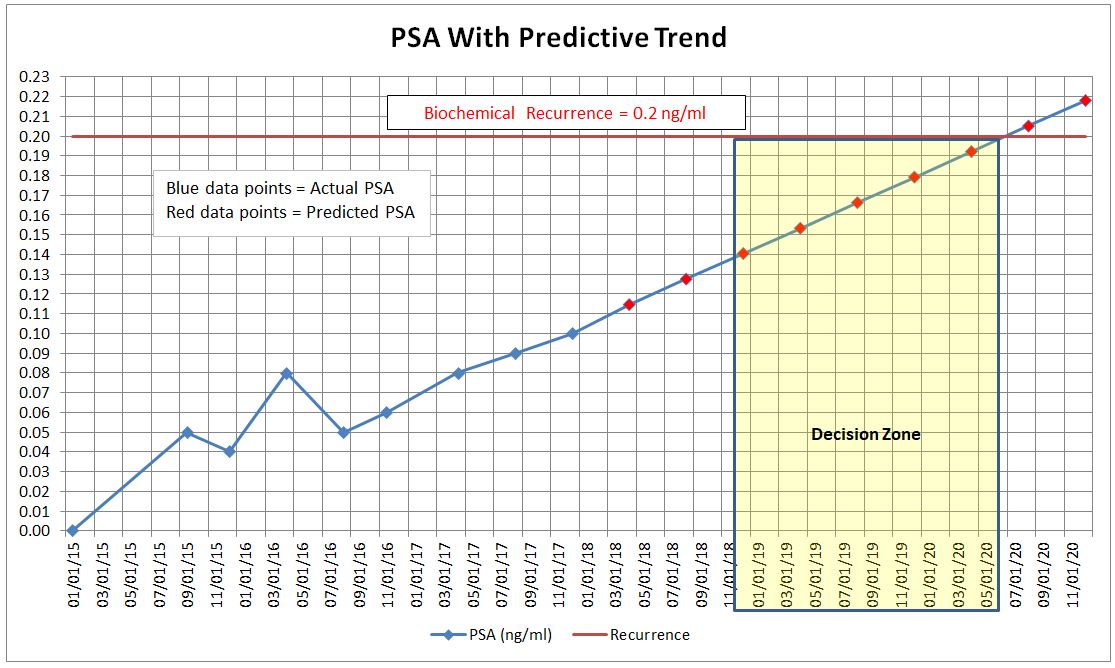
Based on my slow PSA doubling time (around 16 months), if my PSA progresses at its current rate, I’ll have 12 to 28 months to think about this and make my decision, based on whether I want to act if my PSA is around 0.15 or let it go all the way to 0.20. (See my “decision zone” in yellow below—yes, I had to geek out in my spreadsheet once again.) If I want to wait until it’s all the way to 0.5, I’ll have even more time.

Of course, one option is to do nothing. A study in 1999 showed that it took, on average, 8 years after PSA levels began to rise to reach metastasis, and another 5 years after metastasis to death.

The bottom line is that this is becoming increasingly real and that there will be some tough decisions in the next year or two. Of course, those decisions are mine and mine alone, and will be based on a variety of factors, not least of which will be my risk tolerance and any treatment’s impact to quality of life.

On that happy note, I wish you a Merry Christmas and a happy 2018! 🙂


Thanks, too, to those who took time to answer my questions in my salvage radiation therapy survey a few weeks ago. Your insights were quite helpful to me.

Day 2,583–PSA Results

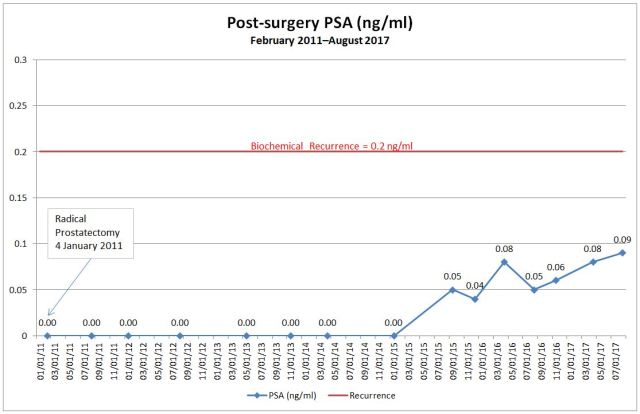
PSA 20171204My December PSA results came back just as predicted by my spreadsheet’s silly little trendline: 0.10 ng/ml.

The bad news is that it keeps climbing; the good news is that the doubling rate appears to be about 16 months. My follow-up appointment with my doctor is 19 December 2017 where we’ll probably agree to continue to monitor every 3-4 months for the time being.

Interestingly, from an emotional perspective, this has been pretty much a non-event for me. I’ve resigned myself to the fact that the likely explanation for the increasing PSA is the return of the cancer, so at this point, it’s only confirmation of something that I already suspect/accept/know.

That’s it for now. I’m sure I’ll have more thoughts in this month’s regular post on 11 December.

Day 2,581 – PSA Test Time

Yes, it’s that time again—time for my next PSA test. I had the blood drawn this morning, and I should be able to get the results online in three days.

My last reading was 0.09 ng/ml and, if you put a trend line over the last four readings, this reading should come out somewhere around 0.105 ng/ml. Let’s see how accurate its predictive powers are.

Stay tuned.

PSA Tracker 20170802

Month 82 – Reviewing PSA Results with Doctor

At this afternoon’s visit to the doctor to review my August PSA results, he asked, “How are you doing?” I replied, “I’m hoping you’re going to tell me.” “With a PSA of 0.09, you’re doing fine.”

I have to admit that I wasn’t quite psychologically prepared for that answer. Nor was I really prepared for the conversation that followed. But before getting into that, the bottom line was just as I expected: Continue to monitor PSA on a four-month cycle, which has me back in the lab in early December.

This was a new doctor that I hadn’t seen before and he was definitely more seasoned than the last one that I had. Still, all those years of experience could have taught him some better communication skills. He talked in broad generalities and in circles—even in response to my direct questions—and that was more than frustrating.

On the topic of recurrence, he didn’t think that I should be so quick to assume that an increasing PSA is indicative of recurrent cancer. He offered up the possibility that it could have been some benign prostate tissue left behind after the surgery and has grown enough where it’s detectable on the PSA test. Or, it could be cancer.

On the topic of PSA tests in general, he reminded me that the really old threshold for biochemical recurrence was 0.4 ng/ml before it was lowered to 0.2 ng/ml. It seemed that he valued the ultra-sensitive PSA test only as it related to the post-surgery pathology. If the pathology was bad, he seemed to put more stock in the ultra-sensitive PSA; but if the pathology was good, he seemed less inclined to put stock in it.

In other words, if you had a 4+3 Gleason score, positive margins, seminal vesicle involvement, or lymph node involvement—or some combination thereof—he would be more likely to consider acting on a 0.09 ng/ml PSA. But it my case with a 3+4 Gleason, negative margins, and no seminal vesicle or lymph involvement, my sense was that his response to my 0.09 PSA was a pretty nonplussed, “Meh.” Or, if my PSA gets to “around 0.13 ng/ml,” we might start exploring treatment options.

On the topic of doing additional testing such as scans to see if there is cancer anywhere, he said that nothing would show up on a scan or MRI with a PSA of 0.09. I want to dig into that some more.

On the topic of salvage treatments, he thought that, given my pathology, the first step would be “a little radiation.” (I’m not sure if sprawling out on the beach for 7 weeks qualifies for “a little radiation,” but it may be worth asking.) He wouldn’t do ADT (hormone therapy) in conjunction with the radiation, again, given my pathology.

Lastly, at one point during the conversation, he quite confidently made the bold prediction that I wouldn’t die from prostate cancer. You think I’d be jumping for joy. I’m not. Perhaps its my experience as a seasoned patient that’s telling me to withhold judgment on that one for the time being.

All in all, this is good news. My lack of enthusiastically embracing it, however, comes from the fact that, rather than eliminating variables to consider, I feel that this meeting introduced a few more, and that just muddied the waters. Emotionally, at this point, I just want this stupid disease to pick a path and stay on it. I may also check with the VA to see if there’s any way I can pick one doctor that I can build a relationship with rather than this new-doctor-a-quarter routine.

Month 81 – PSA Threshold for Salvage Therapy Survey Results

In last month’s post, I asked readers to complete a short survey to get a better idea of the PSA threshold that would dictate the beginning of salvage therapy. The survey asked:

  • How their medical teams defined “undetectable” PSA levels.
  • How their medical teams defined biochemical recurrence after a prostatectomy (what PSA level).
  • At what PSA level did they and their medical teams decide to begin salvage therapy.
  • How long after PSA biochemical recurrence was it before salvage therapy began.

Before going into the results, I first want to thank those who took the time to participate. You may view the results using the link below:

Salvage Therapy Treatment Survey Results

I could have designed the survey better. I probably should have asked for post-surgery Gleason score and pathology to see if there was a correlation between a higher Gleason score and acting earlier at a lower PSA level. The sample size is small enough where it’s not statistically significant, but there were some interesting observations:

  • The definition of “undetectable” generally ranged from <0.01 to <0.1 ng/ml. I believe that to be a reflection of whether the traditional PSA test or the ultra-sensitive PSA test is being used.
  • The consensus for the definition of biochemical recurrence seemed to be 0.2 ng/ml.
  • The PSA level at which some sort of salvage therapy began was widely spread between 0.17 ng/ml and 3.5 ng/ml.
  • The time to begin salvage therapy after biochemical recurrence varied from one to 35 months.

[Note: I’ll keep the survey open for a while longer and new responses may skew the summary above.]

For me, there aren’t any real “A-ha!” findings that provide clarity, and I expected that going into this exercise. The only thing that’s clear is that each case is unique—from both the patient’s perspective and the medical team’s perspective—and that means that my numbers will be different from your numbers and those will be different from Sam’s numbers and all of us will act (or not) on those numbers differently.

It is nice to know, however, that my medical team is in alignment with others on some of the measures.

And just to prove that I’m not nuts obsessing over the definition of biochemical recurrence, a somewhat dated research paper (2007) showed “a total of 145 articles contained 53 different definitions of biochemical recurrence for those treated with radical prostatectomy….In addition, a total of 208 articles reported 99 different definitions of biochemical failure among those treated with radiation therapy.” [Emphasis added.]

No wonder there’s confusion among us patients!

For me, the key statement in that paper was, “The Panel acknowledges that the clinical decision to initiate treatment will be dependent on multiple factors including patient and physician interaction rather than a specific prostate specific antigen threshold value.”

It’s up to us.