Day 3,392 – PSA Retest Results

My last PSA test on 4 February showed a 50% drop in my value compared to the previous test in September 2019, which is a major, unexplained swing considering that I haven’t been doing treatments of any type to lower my PSA. It just didn’t sit right with me, so I asked for a retest.

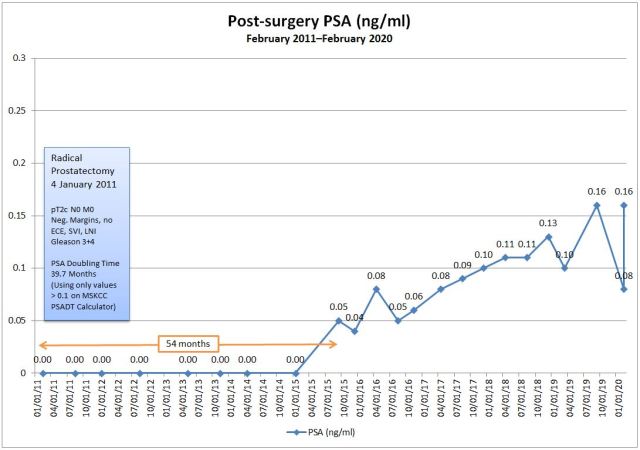
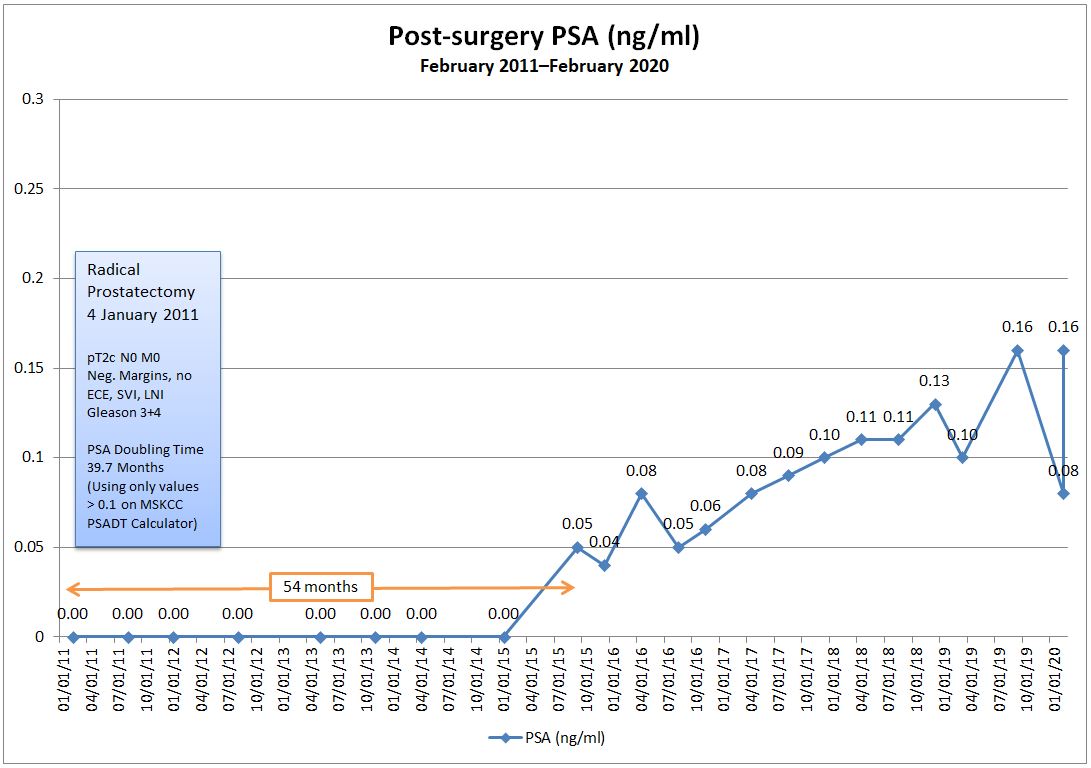
PSA 20200223I went in on 20 February for the retest, and the PSA came back at 0.16 ng/ml, exactly where it was in September 2019. (At least that’s the silver lining in the cloud: it didn’t go even higher.)

We’ll probably never get a good explanation for the dip in my PSA earlier this month, and I guess that’s just part of dealing with this beast. I’m going to leave the errant data point on my chart just to show how wacky this can be at times.

The one thing that this has done, though, is drive my PSA Doubling Time down to 39.7 months according to the Memorial Sloan-Kettering PSADT Calculator (excluding the 0.08 reading). That’s still a very good number, but it’s downward trend over time is becoming more concerning.

I’m really glad that I was able to get the retest done before my appointment with the doctor on Tuesday. It certainly will make for an interesting discussion.

More to come…

Month 111 – PSA Results Are In

Baffled. Completely and utterly baffled.

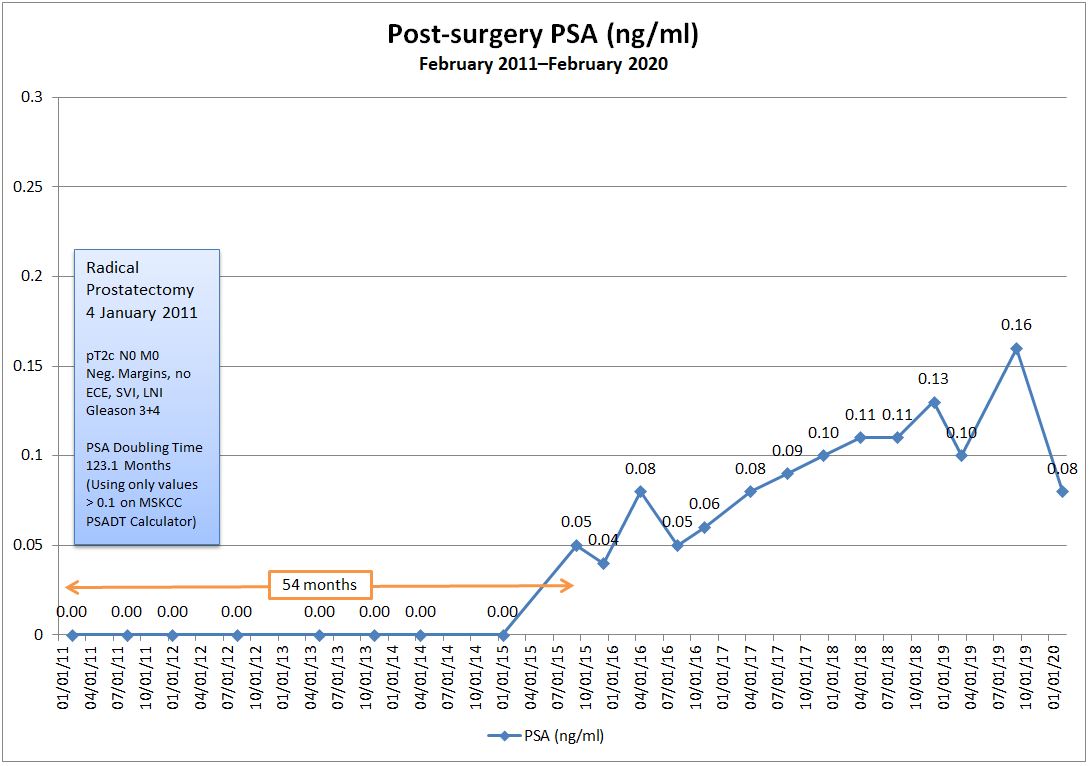
Excited that my PSA value went from 0.16 ng/ml in September to 0.08 ng/ml last week, but completely thrown for a loop as to how and why a 50% decrease happened (without any treatment or other intervention). The last time I was at 0.08 ng/ml was nearly three years ago in April 2017.

I follow the same routine for a week before each PSA blood test to avoid activities that may influence the outcome. The only difference time was that I had a cold/flu the days before the test (Monday afternoon-Thursday evening; blood draw on Friday morning), but I can’t imagine that having any influence on a PSA number. I’ll ask when I talk to the doctor on 25 February 2020.

I tried updating my PSA Doubling Time using the MSKCC PSADT calculator, and this bumped my PSADT from 43 months to 123 months. There is a caveat, though. The online calculator accepts only PSA values of 0.10 or more, so I rounded up my 0.08 to 0.10 to run the calculation.

I get that there can be lab errors or accuracy concerns as well, but I would be hard-pressed to attribute a 50% shift to a lab issue. Still, when you look at the last four data points on my chart, there is pretty significant fluctuation between each and its previous data point when compared to the quite consistent series of data points prior to that. It makes you go, “Hmm…”

Don’t get me wrong. I’m not complaining about where the PSA is at. I will say, however, that these kinds of wild swings make it challenging to wrap your head around what’s happening in order to prepare for what’s next. I was mentally gearing up for calls to imaging centers and radiation oncologists because I was expecting the result to be in the 0.16 to 0.18 range this time around.

So that’s it. A short post with unexpected, somewhat bizarre results. We’ll see what the doctor says on the 25th.

PSA 20200207

Month 110 – Getting Older

Years ago when I was in my late 40s, I was on one of my infamous road trips through the U.S. Deep South—Mississippi, specifically. I stopped for lunch at a fast food joint, placed my order, and was surprised by how cheap it was. When I got to my seat, I looked at my receipt and it showed “Senior Discount.” I was in my 40s, for crying out loud! I know I didn’t look that old.

Now, about 15 years later, I’m seeking out senior discounts. Or at least one in particular.

In the United States, when you turn 62 years old—as I did last week—you can purchase a lifetime pass that gives you access to all of our national parks for a one-time fee of a mere $80. Within a few hours of turning 62, I was in possession of my lifetime pass. Sweet! Now, I just have to make the time to use it.

My sister came out from Chicago to celebrate my birthday, and it was good to be able to spend some quality time with her, showing her some of the more popular sites in sunny San Diego. She, of course, enjoyed escaping the Chicago winter, even if it was just for a long weekend.

So there are some perks to making one more trip around the sun each year as we grow older. It doesn’t always seem that way on days when joints ache and memory slips a tad (now where are those keys again??), but it certainly beats the alternative.

I’ll be back to reality with my next PSA test in early February. Until then, you may find me in a national park someplace. (Yes, even Death Valley. It’s on my bucket list and now is the time of year to go.)


I’ve been a bit remiss in following my regular posting schedule the last two months. I’ll work to get back on track, posting on the 11th of each month. (Unless I happen to be in a national park.)


Day 3,248 – PSA Results

I jumped the gun and got my PSA test done about a week earlier than I planned. I had a  appointment scheduled on Monday to follow-up on my thumb surgery back in February , and I thought I would kill two birds with one stone and get the blood drawn after my appointment.

About 9:00 a.m., the doctor that I had my 1:30 p.m. appointment with called to check in and see how I was doing and if I really needed to come in. “How’s your thumb?” “Still attached and working,” I replied. After a brief discussion in more detail, we mutually agreed that there was no need for me to come into the office.

That kind of put a damper on my getting two birds with one stone, but I decided that I would go to the lab anyway, as I had already planned the afternoon off. It just made sense.

I wish I hadn’t.

My PSA took a considerable jump up to 0.16 ng/ml. I wasn’t expecting that.

PSA 20190930

The trend function on my spiffy spreadsheet thought it would come in around 0.137 ng/ml so that’s kind of where I had prepared myself to be mentally.

I used the Memorial Sloan Kettering PSA Doubling Time calculator to recalculate my PSA doubling time (it uses values of only 0.10 ng/ml and above), and my PSADT dropped from 155.6 months to 43.1 months. Still a respectable number, but definitely moving in the wrong direction.

Needless to say, this sucks.

My appointment with the urologist is on 22 October and we’ll definitely talk about imaging possibilities and ask for another referral back to a radiation oncologist to discuss salvage radiation therapy.

Crap.

Month 106 – Almost Time

Work is insanely busy for me right now, so this will be a shorter post than usual. (“Thank you!” you say.)

I’m coming to the end of the six months since my last PSA test (and the first six month test frequency in many years), so it’s almost time for my next visit to Dracula. I’m looking at my calendar and I’m thinking that I’ll go somewhere around 7 or 8 October, but anticipation may have me try to squeeze it in a little earlier. Perhaps even the tail end of September. Either way, I have an appointment with the urologist on 22 October to review the results.

I’m not even going to try and predict where the next marker on the chart will land. My spreadsheet failed me wonderfully last time out. As I recall, it predicted a value of around 0.14, and I came in at 0.10. One result at a time…

As a refresher here’s my PSA chart:

PSA 20190326

Last week, I stumbled across a comment in a Facebook prostate cancer support group that talked about rising PSA, and the author recommended reading/viewing Dr. Charles “Snuffy” Smith’s article, “When Recurrent PCa isn’t Cancer.” Dr. Smith is the editor-in-chief of the website, Prostapedia.

The video was published four years ago, but Dr. Smith seemed to reinforce the notion that my continued surveillance of my PSA without taking other action may not be as crazy an idea as many may think it is (including myself, on occasion). Of course, I’m sure there are plenty of others out there who would argue otherwise, too.

Even though there are a thousand opinions out there, we patients sometimes forget that we really can control our treatment path, as long as we do it in a well-researched and well-thought out way, assessing the risks and rewards. I get to decide what to do in the end. It’s my body and my life, after all.

Stay tuned.

Month 102 – Turning a Corner?

Normally, there’s a relatively short half-life of feeling good after returning from a vacation. The mountain of work emails and unpaid bills that accumulated while you’re gone just suck the vacation memories and relaxed feelings out of you quite rapidly as you get back into the daily grind.

That’s held pretty true for me after last month’s trip to Switzerland, with two exceptions that, if I can keep the momentum going, make me feel as though I’m turning a corner.

For those of us who have introduced the word “cancer” into our vocabulary, we know that thoughts of cancer are always nearby. Some days we’re better at suppressing them than others. But when the notion of recurrence hits, the thoughts become more prevalent, more intense, and more psychologically draining over time. At least that’s what happened to me.

But since my vacation and since my visit with the urologist last month, I’ve begun to turn a corner in my thinking about my recurrence. In a nutshell, given my numbers (current PSA level and extraordinarily long PSA doubling time), my thoughts are finally shifting from panic to calm concern.

In some of the more recent literature about prostate cancer, you hear more and more people talking about treating some cases of prostate cancer as more of a chronic illness instead of an aggressive disease. For now, I’m happy to—rightly or wrongly—lump myself into the “manage it as a chronic illness” category. It certainly has helped relieve some of the stressful thoughts about recurrence and the potential side effects of salvage radiation therapy or hormone therapy. Of course, if my PSA shoots up again in October, that may change my approach to all of this yet again.

This approach certainly isn’t for everyone. I feel blessed to have a PSA doubling time of 155 months, but even so, I still recognize there’s an element of Russian roulette in my decision to continue to monitor for now. I’m okay with that.

The second exception to my vacation not wearing off within a week has been with my photography.

Spending ten days wandering around Switzerland with my camera (the first time I’ve flown with most of my gear) reinvigorated my interest in getting out and photographing even more, and that’s been therapeutic for me as well. When I’m looking through the lens and—excuse the pun—focusing on what’s in front of me, I’m not thinking about cancer. At. all.

I’ve been out with my camera every weekend and even a few week nights since coming back, and I hope I can keep the momentum going through the summer. I feel better, plus practice makes perfect. (Although there’s no such thing as a “perfect” photograph.)

In the end, I’m glad that I pushed myself to go on the trip. Perhaps the half-life of this vacation will be as long as my PSA doubling time (or longer).

—Dan

P.S. Sorry for the tardiness of this post. I was out playing. 🙂

Day 3,081 – PSA Discussion with Doctor

IMG_20190418_134348455While waiting for my appointment with the doctor this afternoon, I got caught up on reading about the new Datsun 280ZX in the waiting room in the May 1981 edition of Road & Track magazine. Seriously. That thing belonged in the National Archives, not the doctor’s waiting room. Needless to say, it was a fun trip down memory lane, as I had just graduated from college three months earlier and was driving my 1974 Ford Galaxie 500 (my first car).

The discussion with the doctor went about as expected. In a nutshell: Continue to monitor; no action needed at this point given my PSA level and my PSA doubling time of 155 months. (Calculated using the Memorial Sloan-Kettering PSADT nomogram.)

She told me something new, too, concerning the explanation for some of the very minor fluctuations in PSA levels. I knew that physical activity and having orgasms before a blood draw could impact your PSA level, but she said that even variations in your hydration level can cause minor variations in your PSA readings. Interesting.

Just for grins and giggles, I asked her the $64,000 question: How do you define biochemical recurrence?

There was quite a long pregnant pause before she responded, “That’s a difficult question to answer.” She explained the that it’s been defined many ways and, while she never did answer my question directly, my impression was that she was in the “two or more consecutive increases in your PSA level” camp.

One thing the doctor said, too, was that she has seen cases where patients PSAs start increasing and then plateau and sit there for years without much change at all and no need for intervention.

She also suggested that, given where my PSA level was and how slowly it was moving, that we could retest in six months instead of sticking to the four month schedule that I’ve been using for the last three and a half years. I agreed. I return on 22 October 2019.

Again, the meeting went pretty much as I expected it would, and I’m okay with what we discussed.


I had a great trip to Switzerland in the first half of the month despite some dodgy weather (which is to be expected in northern climates in April). If you’re interested in reading about it (or at least just looking at some photos), you can check it out on my other blog, Travelin’ Dan.

Month 101 – Homeward Bound

This will be a short post, as I’m hammering this out on my tablet somewhere between Zürich, Switzerland and San Diego.

In December, Delta Airlines was having a 24-hour sale on its Delta One service to Europe, and I jumped on the opportunity. I landed a round-trip ticket for 128,000 frequent flyer miles and $93 USD in taxes, fees, and travel insurance. Sweet! The only catch was that I had to travel between February and early May.

When I went into planning this trip, it was a “What if I have to have radiation and this might be the last big trip I can take?” kind of thought running through my head. It was a bucket list trip of sorts. But then my PSA results came back and it became more of a celebratory trip.

I’ll work on my detailed post for my travel blog, Travelin’ Dan, once I recover from the trip and a 9-hour difference in time, and review a few hundred photos and process only the best. In a nutshell, though, I visited Luzern, Interlaken, Bern, and Fiesch. The photo for this post (above) was taken from the Schilthorn and shows (from left to right) the Eiger, Mõnch, and Jungfrau mountains.

For fun, here’s a cell phone photo of the Aletsch Glacier on the south side of the Eiger, Mönch, and Jungfrau, at 23 km / 14 miles, the longest in the Alps. One person told me they had about a meter of fresh snow a week earlier. (It snowed while I was in Luzern.)

And a back-to-reality reminder: I talk to the doctor on the 18th about my most recent PSA results.

Day 3,060 – PSA Results: WTF?!?

Okay. Sorry to use the vernacular, but what the f*ck?!? My PSA went down from 0.13 ng/ml to 0.10 ng/ml!

Not that I’m complaining, mind you. But, seriously, WTF?

This is great news, but when you get yourself psyched up for yet another increase (after 3.5 years of pretty steady increases), it certainly plays games with your mind when the number goes in the opposite direction in a substantial way. Did I ever mention that I hate this disease?

I can’t wait to hear what the urologist has to say about this on 18 April. It should be entertaining.

So that’s that. Go figure.

PSA 20190326

Dr. Daniel George on PSA Recurrence

This article discussing PSA recurrence showed up in my reader about the same time that I went for my PSA test, so it was pretty timely.

I’m not a subscriber to Protastatepedia, so I can’t see the full articles that they post.

https://wp.me/p4yQj7-zm

One of the things that Dr. George talks about is the PSA doubling time as an indicator to aggressiveness. Using the Memorial Sloan Kettering Cancer Center PSADT calculator, my doubling time was 35 months before this week’s reading; now it’s at 155 months.

Yes, that last reading is most likely and anomaly skewing the results. Or perhaps the 0.13 reading was the anomaly and I’ve been holding steady at the 0.10-0.11 range for a while. The next test will tell.

I like the idea of treating this as more of a chronic illness than something to go after aggressively given my numbers. We’ll have that discussion with the doctor on 18 April.


Getting on my soapbox for a second…

Prostatepedia certainly doesn’t seem to want to engage their readers. I left a comment on their blog and, when it wasn’t even moderated let alone answered, I left the same comment on their Facebook page. It’s now gone.

If you’re not going to acknowledge reader comments, Prostatepedia, why bother giving us the option to do comment in the first place?

Here’s what I wrote:

Thank you for a good overview of biochemical recurrence, but there’s one thing that you’ve omitted from the article: how biochemical recurrence is defined.

I know that for years, BCR after a radical prostatectomy was defined as hitting a PSA level of 0.2 ng/ml. But with the advent of the ultra sensitive PSA test, I’ve seen some suggest that BCR occurs with a PSA as low as 0.03 ng/ml. Others define it as three consecutive increases in PSA regardless of the value. Not having a clear and widely accepted definition is infuriating to those of us with an increasing PSA.

Cookson, et al., did a review of published articles on the topic of BCR (J Urol. 2007 Feb;177(2):540-5.). They reviewed 145 articles and found 53 different definitions of BCR. Needless to say, from a patient’s perspective, that just boggles the mind.

https://www.ncbi.nlm.nih.gov/pubmed/17222629/

I had a radical prostatectomy in January 2011, and had undetectable PSAs for 54 months when it became detectable at 0.05 ng/ml in September 2015. We’ve been testing every four months ever since, and my most recent PSA in December was 0.13 ng/ml. Using the MSK PSADT calculator, my PSADT is around 32 months.

Last May, I saw a radiation oncologist for the first time when my PSA was at 0.11 ng/ml, and he recommended starting salvage radiation therapy right away. Given my slow PSADT, I opted to continue to monitor. When I saw the urologist in December, he said that I haven’t even hit BCR yet because I hadn’t hit 0.2 ng/ml.

So on the one hand, I have one professional telling me that I have recurrence and the earlier we start SRT, the better the outcome chances are and, on the other hand, I have another professional telling me that I don’t even have recurrence yet. Frustrating.

I’m not asking for medical advice on what I should do, but I do believe that ANY discussion about biochemical recurrence includes how recurrence is defined and/or how the definition is evolving.

Your comment is awaiting moderation.