Day 4,153 – Radiation Oncology Appointment

The radiation oncologist threw a curveball that I wasn’t expecting at this morning’s appointment.

In a nutshell, he suggested doing concurrent androgen deprivation (hormone) therapy with the salvage radiation. That was not something that we discussed at our first meeting. The ADT would be for six months if done concurrently.

Doing ADT concurrently would give an estimated 10% benefit to the radiation and longer-term PSA reduction according to the doctor. But he also said that my case would also justify doing the salvage radiation alone and holding off on any hormone therapy until after the radiation is completed. He could argue for either option, but was leaning to the more aggressive concurrent therapies.

I asked about the ADT now lessening its effectiveness later when it’s needed most, and he said that six months of ADT would not really make the cancer hormone resistant.

We didn’t do the body mapping this morning based on this little twist, and that’s okay.

He offered to let me contemplate this over the weekend, and he’ll call me Monday morning to answer any further questions and see which option I would prefer.

I have to admit that the acceleration in my PSA increases is making me lean toward the more aggressive concurrent therapy.

If I choose the straight radiation, I’d go back to UCSD and get mapped and begin the actual zapping a few weeks later. If I choose the concurrent therapy, I’d have to go back to the VA San Diego for the shot and then wait up to two months (I have to confirm, I wasn’t in the note-taking mode) before starting the actual radiation back at UCSD.


Whichever option I decide, I learned this morning that I’m going to have to practice the art of bladder filling.

I was told for the mapping session that I should come in with a full bladder, so I started drinking water about an hour before the 8:30 a.m. appointment: about half a liter at 7:30 a.m. and another half a liter around 8 a.m., plus sipping on water in the waiting area.

By the time the nurse called me back to the exam room around 8:45 a.m., my bladder was about to burst and I had to run to the toilet. “Try to keep some of it in you,” she blurted as I scurried out the door. Yeah, right. By the time I was leaving after seeing the doctor (about 9:15 a.m.), I had to make another mad dash to the toilet. This has the potential to be pretty tricky.


On a somewhat related note, I needed a bit of escapism in advance of the appointment, and I noticed that the weather in Tucson, Arizona was going to be around 74° F / 23° C the first half of this week. I wanted to head over to spend some time in Saguaro National Park and Organ Pipe Cactus National Monument. It was a hectic trip, but I had fun and it definitely diverted my attention away from all of this.

If you’re interested, you can check out my report and photos here:

Saguaro National Park and Organ Pipe Cactus National Monument

Salvage Radiation Therapy Nomograms

I’ve been playing around with two nomograms that offer predictions on the outcome of salvage radiation therapy (SRT). One if from the Memorial Sloan Kettering Cancer Center (MSKCC) and the other is from the Cleveland Clinic (CC). They are similar in design, but the MSKCC nomogram requires more detailed information to be input by the patient, but the CC nomogram provides a more information at the output.

Summary

Both nomograms gave results that are in the same ballpark, with the CC nomogram being a bit more conservative.

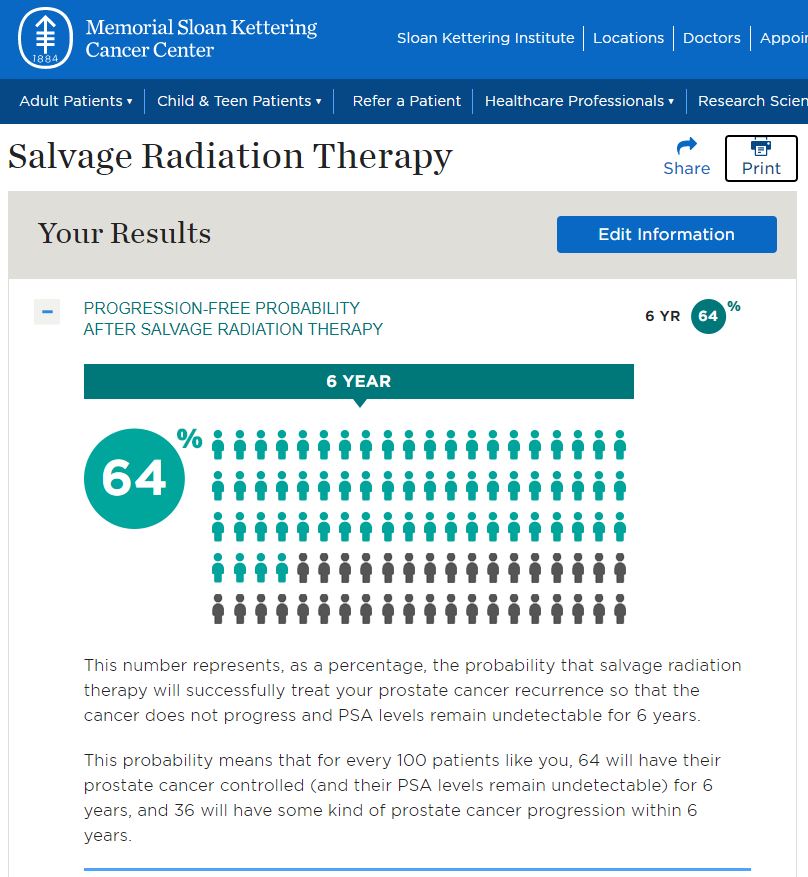
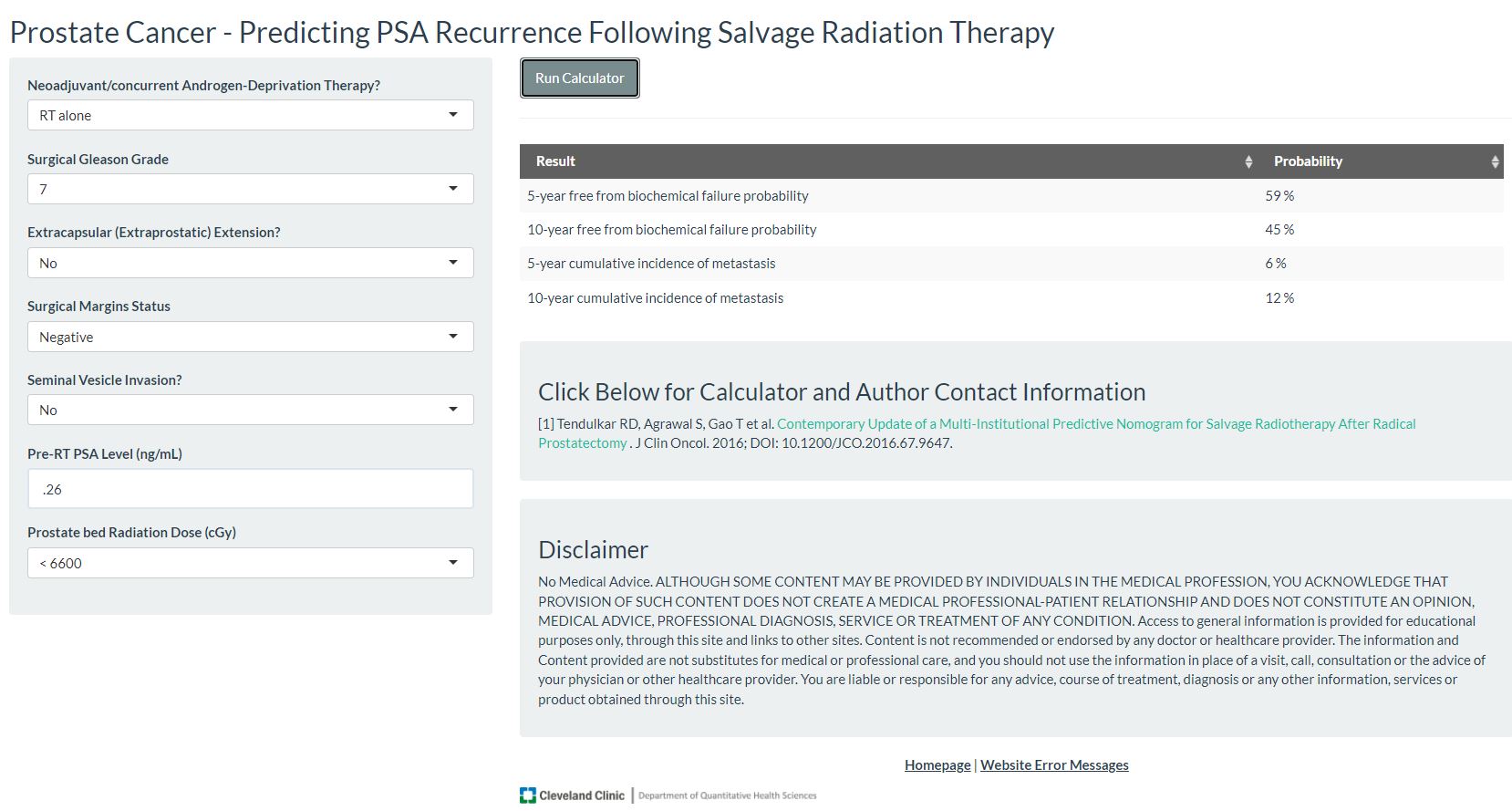
MSKCC said that I would have a 64% chance of being progression-free after 6 years after SRT; CC said that I have a 59% chance of being progression-free after 5 years, and 45% chance of being progression-free at 10 years.

The CC nomogram takes it one step further and estimates a 6% cumulative chance of metastasis at 5 years, and a 12% cumulative chance of metastasis at 10 years.

MSKCC Nomogram

MSKCC Salvage Radiation Therapy Nomogram link: https://www.mskcc.org/nomograms/prostate/salvage_radiation_therapy

In order to use the MSKCC SRT nomogram, you will first need to calculate your PSA Doubling Time, and they specify that you should use the PSA values obtained in the last twelve months.

MSKCC PSA Doubling Time Calculator link: https://www.mskcc.org/nomograms/prostate/psa_doubling_time

The MSKCC SRT nomogram requires you to provide:

  • Pre-surgery PSA value.
  • Most recent PSA value.
  • PSA Doubling Time.
  • How many months have passed before your PSA reached 2.0 ng/mL or higher. [Interesting note: The field only accepts values between 0 and 72 months and, for me, it took 125 months to cross the 0.2 ng/mL threshold. I’m guessing that may mean that my result will be a bit conservative because I had to plug in 72 months instead of 125.]
  • Your Gleason score.
  • Information about your:
    • Surgical margins.
    • Extracapsular extension.
    • Seminal vesicles.
    • Pelvic lymph nodes.
  • Whether your PSA remained elevated post-surgery.
  • The planned radiation dose. (I left this set at their default value of 65 Gy because I had no idea.)
  • Whether you will be undergoing hormone therapy before or along with radiation. (I checked “No” as there has been no discussion of that so far.)

After plugging all of that information in, here are my results:

Cleveland Clinic Nomogram

Cleveland Clinic Salvage Radiation Therapy nomogram link: https://riskcalc.org/ProstateCancerAfterRadicalProstatectomyNew/

The CC nomogram asks you to provide:

  • Whether you will be receiving SRT alone or with concurrent Androgen Deprivation Therapy.
  • Surgical Gleason score.
  • Extracapsular extension.
  • Surgical margin status.
  • Seminal vesicle invasion.
  • Pre-SRT PSA level.
  • Prostate Bed Radiation Dose. [It was interesting to note that CC defaulted this to a dose greater than or equal to 6600 Gy, but it does give you the option to select “<6600”. To be able to compare the CC nomogram results with the MSKCC results, I changed that to be <6600 Gy so the doses would be similar.]

My results are below (click to enlarge):

Interestingly, if I bump up the radiation dose to >=6600 Gy, then my percentages change to 65% free at 5 years and 53% free at 10 years. That makes sense, but do higher radiation doses translate into higher risk of side effects? I’m guessing so. Something to ask the radiation oncologist on Thursday.

Conclusion

Certainly, those are average to good probabilities, but are they good enough to risk impact to quality of life? I don’t know. Of course, the next step is to dig deeper into the risks of real impact on quality of life after salvage radiation.

I’m thankful to everyone who provided information about their own experiences, either here in comments on my previous posts or in other forums. They’ve been very insightful and give me an understanding of the range of possibilities to expect. But each case is unique, and I have to remember that, should I choose this, my case will be different from everyone else’s.

More to come.

Month 135 – Approaching SRT Decision Point

My visit with the urologist this week went about as expected.

We talked about my PSMA PET scan results—negative—and he was of the mindset that those would be the expected results at my PSA level. The scan isn’t reliably sensitive enough when the PSA is hovering around 0.2 ng/ml.

With my steadily increasing PSA, he said that there’s cancer there somewhere. In his view, it’s likely location is still in the prostate bed, but we can’t rule out that there aren’t micro-metastases elsewhere.

In reviewing the totality of my case, he commented, “This is one of the trickier cases I’ve seen.” I don’t believe he was too offended when I replied, “No shit, Sherlock.” I guess my frustration of dealing with this over the years came out a little too strong.

What puzzled him about my case is how long after my surgery the PSA returned and how slowly it was increasing over the years. That led to a discussion about PSA doubling time and how my doubling time is shortening at an accelerating rate.

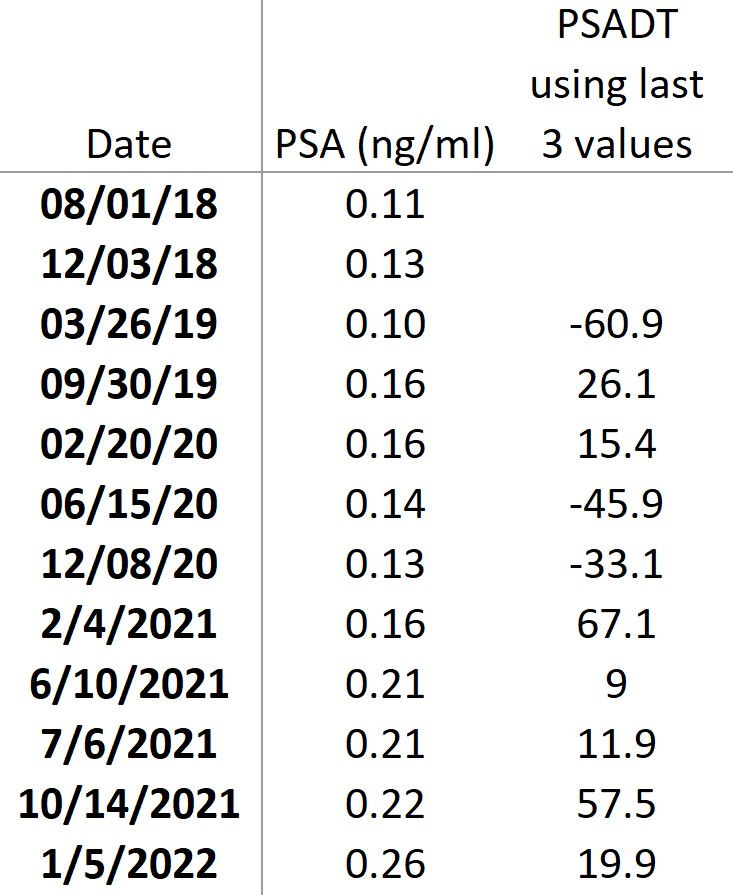
As part of that discussion, I asked him how many data points should be included in the PSA doubling time calculations, and he typically uses only the last three to get a current snapshot of where it is now. (I re-ran my numbers when I got home, and using the last three PSAs, my doubling time is 19.9 months.)

Of course, the engineer in me had to play with that a little, so I went through my PSA spreadsheet and calculated the PSA doubling time if I used the last three values after each test. The results were all over the place:

His recommendation, of course, was salvage radiation to the prostate bed.

He thought that salvage radiation still had a chance of being curative at this point, and given that I’m 64 years old, he thought that I would have plenty of years ahead of me should I choose to go down that path.

We talked about long-term side effects. He thought that there was a 20% to 30% chance that my stress incontinence would worsen, as would my sexual function given where it’s currently at now. He wasn’t confident enough to speak about the chances of rectal issues, at least in the numbers that I was seeking. I expressed concern about the incontinence, and he reminded me that they can take care of that with an artificial sphincter. Great. Another surgery.

I did ask how much longer I could kick this can a little farther down the road, and he didn’t seem to think that that was a good idea at this point. My stomach turned into knots.

We agreed to set up the consult with the radiation oncologist, as well as retest my PSA in early April.

Wednesday afternoon, I received a call from the scheduler trying to set up the radiation oncologist referral. She gave me the option of going to Naval Medical Center San Diego—where I used to work and had a previous referral—or going to University of California San Diego (UCSD). As good a medical treatment facility as NMCSD is, I opted for UCSD. If nothing else than for a second perspective, plus I believe UCSD will have more state-of-the-art equipment and a lower turnover rate in medical teams.

Thursday, morning, UCSD called and we’re set up to meet next Thursday, 17 February 2022. I was a little surprised when they told me that it would be at their Radiation Oncology center that’s about three-quarters of a mile (one kilometer) from my house instead of their main hospital in San Diego.


As you regular readers already know, I’ve been fearful of getting to this point for a while now. Whether my fears are irrational, unfounded or not, I don’t know, but they’re real for me.

My fears center more on having very real, quality of life-impacting side effects from the radiation than on whether or not the radiation will be curative. For some inexplicable reason, my gut intuition is that something will go awry and I’ll be in that 1% or 3% or 10%—or whatever it is—group that gets to experience those side effects impacting quality of life. The radiation oncologist is going to have to give a strong sales pitch to convince me the risks are minimal.

There will be ton of soul-searching and thinking in the days and weeks ahead.

Stay tuned.

Month 134 – PSA Results

Well, happy freakin’ New Year and Happy Birthday! <Sarcasm font>

My PSA continued its upward climb from 0.22 ng/mL in October to 0.26 ng/mL yesterday.

Additionally, my PSA Doubling Time fell from 45.3 months to 41.5 months. Still not bad, but that’s including all of my PSA values from December 2017 through present. That may be giving me a false sense of security, so I ran the numbers for just the last two years (February 2020-present), and that PSA Doubling Time is 26.6 months.

Memorial Sloan Kettering PSA Doubling Time Calculator

What’s really frustrating is that the 68Ga PSMA-11 PET scan just five weeks ago didn’t see anything. Anywhere.

I’m definitely going to have to mull this one over. At what point do the actual PSA value and PSA doubling time outweigh the PSMA PET scan results of not seeing anything? Or do the scan results prevail? I don’t know.


I hope that your 2022 is off to a better start than mine and, yes, I celebrate my 64th trip around the sun this month.

Be well!

Dr. Kwon Video – Part 2

Here’s the second part of Dr. Kwon’s video. Like the first video, it’s very informative (perhaps even more so, at least for me).

Even though I had seen similar statistics before, one of the kickers for me is that only 33% of recurrent cancer is found in the prostate bed (local); 45% will be metastatic; and 22% will be both local and metastatic. As Dr. Kwon rightly points out, knowing where the cancer is located will guide your treatment decisions, and that’s why I have been so reluctant to blindly step into salvage radiation therapy without having first identified the location of the cancer. Why risk the possible toxic side effects of radiation if you’re not radiating in the correct location?

In my previous post, I mentioned that Dr. Kwon was a pioneer in dealing with oligometastatic prostate cancer. At the beginning, many in the profession dismissed his work out of hand (I’ll admit I was skeptical, too), but it seems that over the last 10 years, his work has gained the respect of others and is supported by further research.

In any case, this video is 31 minutes long and I encourage you to watch it.

Day 3,910 – Bone Scan Results

As a baby boomer, I grew up with Spock. Both of them.

First, there was Dr. Benjamin Spock, the noted pediatrician who told my parents—and millions of other parents—how to raise and care for their kids. Then, of course, there was the Star Trek Spock, whose existence was rooted in Vulcan logic.

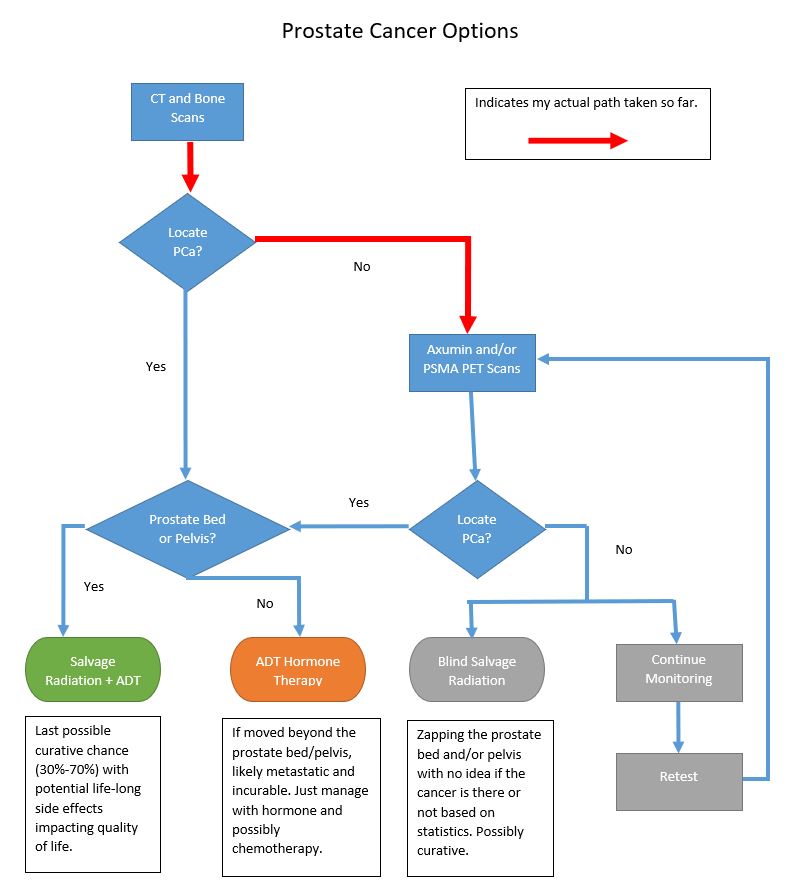
Now I’m not a Trekkie, but if you’ve read any part of this blog, you do know that facts, figures, and logic are high on my priority list, too. I thought, “What better way is there to outline the possible scenarios and decisions that are ahead of me than to put them all in a flow chart.” So here goes:

So let’s step through this.

We start with the CT and Bone scans that happened over the last two weeks. The first question is, “Did those scans determine the location of the prostate cancer (PCa)?”

If the answer is yes, then the next question is, “Was the prostate cancer in the prostate bed and/or pelvis?”

PCa in Prostate Bed/Pelvis

If the answer is yes, the PCa is in the prostate bed and/or pelvis, then Salvage Radiation Therapy (SRT) with or without Androgen Deprivation Therapy (ADT) (Hormone therapy) offers the last possible chance of a true cure. Of course, there are risks associated with SRT that would impact your daily quality of life: bowel control, bladder control, and lack of sexual function. Additionally, depending on which study you look at, SRT may be successful only 30% to 70% of the time. (Green bubble above.)

PCa is Not in Prostate Bed/Pelvis

But if the answer is no, the PCa is outside of the prostate bed and pelvis, that means the PCa is now distant and likely metastasized. If that’s the case, there is no cure and the PCa can only be managed with hormone therapy and perhaps chemotherapy. (Orange bubble above.)

CT and Bone Scans do not Locate the Prostate Cancer

We’ve talked at some length that neither the CT scan nor the bone scan have the sensitivity to pick up the cancer’s location based on my PSA level of 0.21 ng/mL. It was very likely that neither would pick up the cancer at that first decision point on the flow chart, so further investigation is required by using the Axumin or PSMA PET scan.

CT and Bone Scan Results

In fact, neither the CT nor the bone scan picked up the location of the cancer:

No definite scintigraphic evidence of metastatic bone disease and no evidence of a widespread osseous process

So that’s actually good news with the bone scan. It shows that it has not metastasized to the bones, which is definitely a good thing. (Or, at least if there is metastasis to the bones, it’s at a level that’s unable to be picked up by the sensitivity of the scan.)

Next Steps

We follow my red arrows above and run the Axumin or PSMA PET scans (or both) to see if either of those can pick up the location of the cancer. I’ll have that discussion with the urologist on 3 August 2021, and we’ll see when we can get them on the calendar.

If the Axumin and/or PSMA find the cancer in the prostate bed/pelvis, then we go back to the section above and land on SRT as the option. But if it’s found outside the prostate bed/pelvis, then we go back to the other section where we just manage with ADT. (If the lesion outside the pelvis is well-defined, it may be something that could be zapped in its location. Something to explore.)

If the Axumin or PSMA PET scan cannot locate the PCa, then things get fuzzy fast.

Sure, we could go ahead and blindly complete the salvage radiation therapy, hoping that we’re zapping in the correct place. Or, we could continue to monitor for a while longer and then retest to see if the cancer can be pinpointed.

This may have been a bit of an oversimplification of what’s ahead for me, but I’m hoping that it makes sense to you.

Be well!

Day 3,899 – CT Scan

You know me. I love tracking things, and this post is the 400th published post on this blog. Woo-hoo! 🎈🎉✨ Of course, I would have preferred to not have written any of them at all, but that’s life.


I thought I had had a CT scan in the past, but if I did, I don’t remember it being anything like what I experienced today. It kicked my ass. Technically, it was the contrast they injected into me that kicked my ass. The scan—sliding in and out of the scanner—was a non-event.

The radiologist forewarned me of the sensations that I would experience shortly after he injected the contrast. The sensation of a full and warm bladder? Check. Metallic taste in my mouth? Check. A warm sensation throughout my body? Check.

What he didn’t do a very good job of was forewarning me of the intensity of the some of these things. At one point, I thought I was going to vomit like Vesuvius. It was awful. As soon as he stopped the IV flow of contrast, I could feel some of these side effects dissipating. (But not nearly as quickly as they came on.)

I didn’t even bother to ask the technician if they saw anything odd on the scan as they were running the test. I’ll usually do that because sometimes, if you’re lucky, the technician will help you out. They may not be able to be all that specific, but I’ve had one or two tell me, “You really don’t have anything to worry about.” I was just more focused on getting out of there without puking.

The whole appointment went like clockwork and went faster than I expected. My appointment was for 2:30 p.m. I pulled into the parking garage at 1:45 p.m.; was checked in a Radiology by 2 p.m.; on the scanner bed by 2:10 p.m.; and headed back to my car by 2:35 p.m. Again, I know there are tons of complaints about the VA healthcare system, but San Diego VA Medical Center has been top-notch as far as I’m concerned.

The radiologist thought they would have the full results available by Friday.

I’ll have to admit that on my commute to work this morning, I had a bit of a knot in my stomach. Not because I was afraid of the scan (now I am—a little), but because this is the beginning of the process that will give me results I may not want to hear.

On a related note, my employer-provided healthcare insurance did confirm that the Department of Nuclear Medicine at UCLA is in network, so that’s a good thing.

What’s next? Here’s an estimated timeline:

  • Get online access to CT Scan results sometime this weekend or early next week.
  • Have the bone scan on Friday, 23 July.
  • Get online access to bone scan results 3-5 business days after the scan.
  • Have a follow-up appointment to review both scan results with the urologist on 3 August.

I’ll contact UCLA to start that process and hopefully have all of my homework done in time for the appointment on 3 August.

Well, time to drink a few liters of water to purge that contrast out of me.

Be well!

Day 3,895 – Insurance Update

I just received a quick update from my health insurance company regarding coverage of the Ga68 PSMA PET scan at UCLA—the quick turnaround surprised me. It appears to be good news, but it was a little squishy, so I had to ask for confirmation of a few things.

In their email to me, they listed the contractual amount that they would pay out for each CPT code that I gave them, but that’s all they said. It sort of implies that I’m covered, but it doesn’t say so explicitly. Needless to say, when dealing with insurance companies, I want things to be very explicit without any loopholes.

I just sent them and email asking them to:

  • Confirm that I am covered under my employer-provided healthcare plan.
  • Confirm whether or not UCLA Department of Nuclear Medicine is considered to be in-network or out-of-network (different deductibles).

Hopefully, I get that confirmation early next week and can share the information with my doctor.

More to come…

Be well!

Day 3,893 – PSMA PET at UCLA Info

My health insurance company replied to my email with more questions than answers, which was okay by me because they were trying to learn more about the Ga68 PSMA PET scan at UCLA.

First, they were looking for the Current Procedural Terminology (CPT) codes that would apply to the imaging. I didn’t know what those were, so I had to do a little searching:

Current Procedural Terminology, more commonly known as CPT®, refers to a medical code set created and maintained by the American Medical Association — and used by physicians, allied health professionals, nonphysician practitioners, hospitals, outpatient facilities, and laboratories to represent the services and procedures they perform. No provider of outpatient services gets paid without reporting the proper CPT® codes.

https://www.aapc.com/codes/cpt-codes-range/

I called the Nuclear Medicine Clinic at UCLA (+1 310-794-1005) to get the applicable CPT codes, and they happily shared them with me:

78815
70491
79260
74177
A9597

My insurance company also wanted to know the specific address of the clinic to help determine if they were in or out of network:

200 UCLA Medical Plaza
Los Angeles, CA 90095

Lastly, I did ask the UCLA representative how much the scan costs and, as of 8 July 2021, it’s $3,300.

So I fired all of that information back to my insurance representative and am awaiting her response. I’ll keep you posted.

Be well!

P.S. To anyone trying to get information about the Ga68 PSMA PET at UCLA for their insurance company, you’re welcome!

Day 3,892 – Scan-a-Palooza

Let the radioactive fun begin!

I was able to schedule my bone and CT scans this morning with considerable ease. In fact, things will happen much sooner than I thought they might. My CT scan is scheduled next Wednesday, 14 July, and my bone scan is scheduled Friday, 23 July.

I have to go for some pre-scan lab work tomorrow afternoon to ensure that my kidneys are working fine and won’t be damaged by one of the contrasts.

I haven’t given up on the Ga-68 PSMA PET scan. In fact, I wrote my health insurance company an email about 4:30 a.m. as I tossed and turned. (Last night was hell. If I slept more than 2 hours—non-consecutively—that was about it.) They tout having a response within 2 business days, so we’ll see if they come through with that.

UCLA is out of network for my insurance company, so I’d have to cough up 40% of the cost if they’re going to cover it at all. I’m okay with that. (For my overseas readers, welcome to U.S. health care systems!)

So that’s the latest and greatest. More to come, I’m sure.

Be well!