Month 181 – Physical Therapy for Incontinence

I’m of the mind that PT stands for Pain & Torture, not physical therapy. (Okay. I exaggerate.)

During my appointment with the urologist back on 7 October, we talked about how my incontinence seemed to be slowly worsening post-radiation. One of the options that he offered up was pelvic floor therapy, and I decided to give that a try.

Unfortunately, the VA doesn’t offer that therapy in-house, so they had to arrange for community care. That process took until mid-November to get the appointment set up, and I just had my first appointment last week.

I was expecting more instruction on Kegel exercises, perhaps with the biofeedback device that they used on me pre-surgery to train me on how to do the exercises. But that’s not what’s happened so far.

The physical therapist explained that many of the muscle groups in your legs and torso can have an impact on your pelvic floor muscles, too, as they’re all connected as part of a larger system. By stretching and strengthening them, we could see improvements in the pelvic floor. At first, it sounded like a bit of phooey to me, but I’m approaching this with an open mind and giving it a shot.

I’ve had just two sessions so far, and we’ve focused mainly on stretching exercises impacting my hamstrings, glutes, calves, and torso, as well as doing squats and walking on a treadmill. Some of the stretches are bordering on turning me into a contortionist, which this soon-to-be 68-year-old body is fighting tooth-and-nail (hence, “Pain & Torture”). But they’re low impact and we’re taking it slowly so I don’t injure myself.

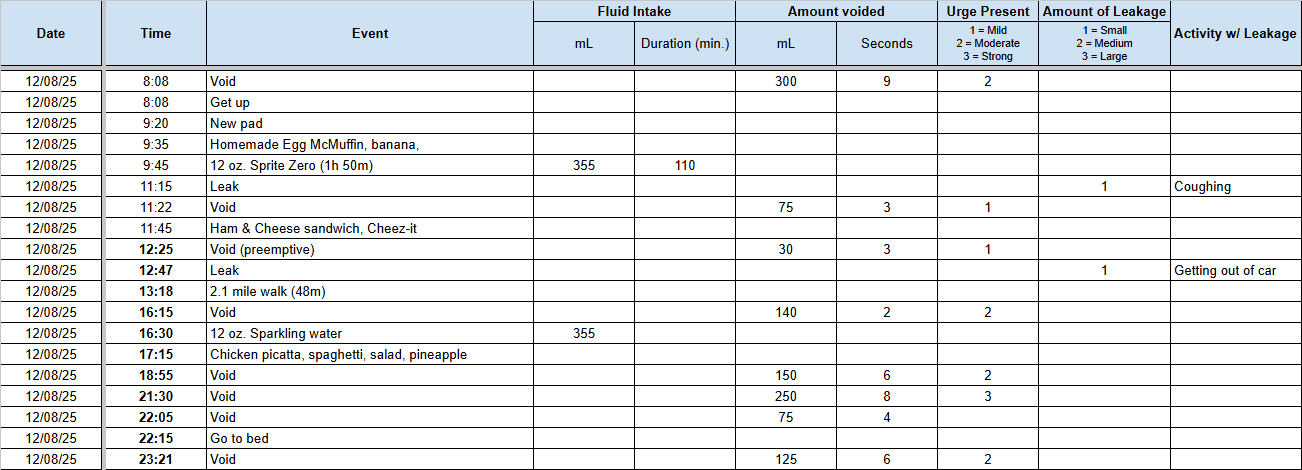
The other thing that she had me doing was documenting my fluid intake, output, and number of incontinence leaks for at least three days. We’re trying to establish a baseline against which we can measure any improvements. She had a hardcopy log which I quickly converted into a tracking spreadsheet. (You know I had to!)

She also made some recommendations to improve my diet and the types/quantities of beverages that I consume (less soda, more water).

Of course, I have to keep up with these exercises daily at home.

On the one hand, I’m a bit skeptical about this approach but, on the other hand, I do feel as though that, even after one week, I’ve noticed that I seem to be having fewer leak episodes and, the ones that I do have, seem to be smaller in size. We’ll let my spreadsheet determine if there’s a true trend, or if this is all in my head.

I have another appointment next week and then, in the new year, she mentioned that we might cut back to every other week sessions or even monthly sessions, depending on the progress that’s made.

One thing that I am a little concerned about is the potential cost of this.

Yes, the VA is covering the costs, but what many don’t realize is that some of us, based on our eligibility criteria, have to pay co-pays for our visits. Seeing the specialists—including the urologist—costs $50 per visit. Seeing a PT every week would rack up significant costs over time, and I’m not sure if the VA has an out-of-pocket cap on how much a veteran pays. (I’ll have to check into that.)

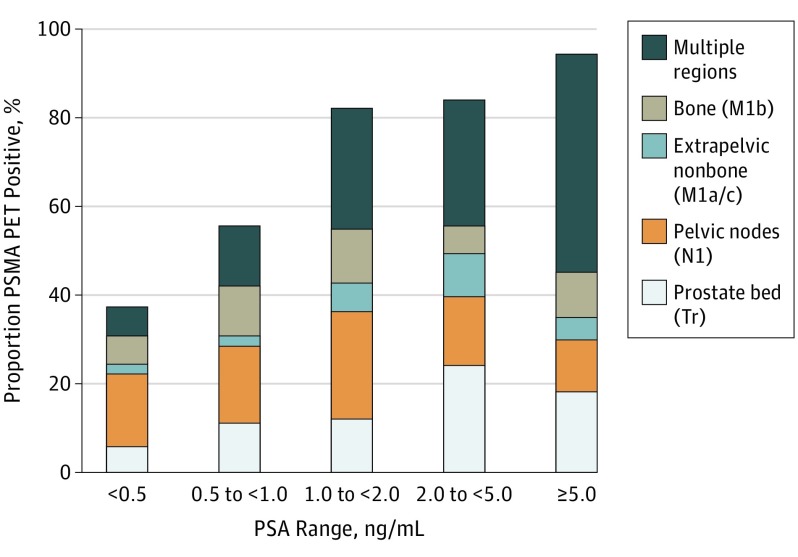
Assuming the holidays don’t mess it up, my appointment with the urologist to review my PSA results is on 30 December. We’ll definitely be talking about another PSMA PET scan and getting medical oncologists involved in my case.

—Dan

Header image: Botanical Building in holiday lights, Balboa Park, San Diego, California

Day 5,188 – A Wee Problem

I’ve been debating whether to write this post but figured that I’ve never shied away from sharing the gory details of the total prostate cancer experience. So if you don’t want to read about my latest adventure with incontinence, you can check out the trip report of my trip to Death Valley last week.

In fact, the issue began as a result of my trip to Death Valley.

After four days of standing in the middle of the desert pretty much solo the entire time, I returned home Wednesday evening. Thursday morning, I can off to the clinic for my PSA test (it took 7 minutes and 38 seconds from check-in to walking out the door). But by Thursday afternoon, I was feeling a bit wonky.

By Thursday night, I was down for the count with a full-blown head cold/flu. I was both baffled by how I contracted it, and annoyed that I had. It had been several years since I’ve had a cold or flu.

Unfortunately, one of the symptoms that hit me hard and caused the incontinence issues was a nagging tickle in the back of my throat that had me coughing pretty consistently and, in many cases, pretty intensely. It sucked.

It sucked because coughing is perhaps the greatest trigger for my stress incontinence. The harder I cough, the more I leak.

I wear Depend Shields in my daily life, and I can get by with one or two pads a day. But by the weekend, the coughing and resultant leaking exceeded their capacity. I had one coughing fit that had me fill the pad, overflow, and soak my jeans. Not fun. Through the weekend and into early this week, I was going through multiple pads a day and doing several loads of laundry.

I toyed with the idea of running to the store to get Depend Guards, the pads with more absorbency and capacity, but I didn’t want to risk embarrassing myself in the middle of Aisle 12 at the grocery store. Plus, I was probably as contagious as Typhoid Mary, so that wouldn’t have been a good thing, either.

I was taking some cold/flu medicine that helped reduce the cough—the root cause of my issue—and I just rode out the storm for a few more days. Today, a week after this all kicked in, I’m back to my good ol’ self getting by with the occasional drip and dribble.

The lessons learned for me are to keep the cough medicine on hand to help reduce the root cause, and to keep a supply of Depend Guards on hand to do a better job of controlling the mess.

Now you know why I may have been hesitant to share this. But, hey, it’s for educational purposes, right?


On a related note, I was successful in getting my appointment to review my PSA results moved to an earlier date. It’s now 18 February 2025 (four weeks is better than four months). I’m okay with that.


Unless you’ve been living under a rock the last two weeks, you already know that southern California has been ablaze with wildfires. Luckily, up until this point, they have stayed clear of San Diego for the most part. Until today.

This little gem popped up about 6 miles / 10 km from my house this afternoon:

View of the Border Fire on Otay Mountain taken from the vacant lot down the street from my house.

It’s grown to about 600 acres / 240 hectares in about six hours, and we’re expecting high Santa Ana winds this evening. It’s in a very mountainous area, and air crews have been working the scene all afternoon. Luckily, it’s adjacent to a large reservoir, so there’s plenty of water for the helicopters to access. We also have rain in the forecast for the weekend for the first time in months (San Diego has had the driest start to the wet season since they began keeping records in 1850. We’ve had only 0.14 inch / 3 mm of rain since 1 July 2024.)

Of course, I’m concerned and I’ve made preparations to leave if need be. But given the location, the fact that the reservoir is between me and the fire, and the prevailing winds are keeping the smoke south of me, I’m hopeful that my neighborhood will be unaffected.

I’ll keep everyone updated over the next day or two.

Be well.

Header image: Courtyard at The Ranch at Death Valley National Park, California

Day 4,315 – A Week After SRT Ended

If you recall my last update, I was all abuzz with energy on my first day after salvage radiation therapy ended. Well, that didn’t last long.

Sunday and Monday I was pretty much knocked out with fatigue, and Tuesday wasn’t much better. The rest of the week saw slight improvements with each passing day, but you would have still found me taking a cat nap here or there.

The urinary frequency is still there, meaning I’m still running to the toilet four to six times a night which is annoying. But there has been another change, and I’m not sure if it’s a result of the radiation, the Flomax (Tamsulosin), or a combination of both.

Post-surgery, pre-radiation, I would get the urge to empty my bladder and I’d have time to make it to the toilet and then consciously start the flow to empty my bladder. Since the radiation, the time between my brain receiving the urge to empty my bladder and the time I need to be at the toilet is much shorter. It also seems that my ability to control the start of the flow is lessened to a degree, meaning it starts flowing on its own. That’s led to one minor accident where I was just a few seconds shy of getting to the toilet.

I’m not overly concerned about this at the moment, as it’s still early after the radiation ended. Plus, it may be the Flomax that’s contributing to this as well, and the radiation oncologist said it would be acceptable to stop taking it around the end of September if I felt it wasn’t helping me with the urinary frequency. However, if it continues beyond that, I may have to get one of those “Where’s the toilet?” apps for my phone. 🙂

This morning, I was surprised by blood on the toilet paper after my morning constitutional. I’m pretty sure it’s from irritated hemorrhoids rather than from something deeper inside. It’s something to keep an eye on going forward.


You may recall that, back in June about five weeks after I received my Eligard injection, I was noticing a dull musculoskeletal ache in the middle of my back. Through the summer, that stayed pretty consistent—just a minor ache in the background not causing any issues. It was tolerable and I didn’t think much of it. In the last few weeks, that’s changed.

The ache is more intense and a bit more widespread across my back than when it first appeared. Plus, I can have brief shots of acute pain if I move suddenly or twist my body in a weird way (like after unexpectedly bumping into something). It’s more like a muscle spasm response than anything else. But it can and does impact how the way I walk (a little more gingerly) and how I stand up.

Of course, hormone therapy is known to contribute to musculoskeletal issues, and one of the listed side effects of Flomax is “body aches.” Perhaps they’re additive.

Of course, my mind also has to go down the path of possible distant metastases to the spine or ribs even though it’s extraordinarily unlikely given where my PSA was at going into SRT (0.36 ng/ml). Still, it’s a conversation that I’m going to have with my urologist in my meeting on 20 September.

Stay tuned for more to come.

Be well!

Image: Salton Sea, California

Month 129 – Incontinence Run Amok

Okay, if you don’t want to read a frank discussion about incontinence, then CLICK HERE to go find some cute kitten and puppy videos. Otherwise, read on…

In short, I don’t know what in the hell is going on with my incontinence. For years, I’ve been able to get away without pads because I was routinely “dry.” A sneeze or a cough might cause a few drops to come out, but that was it.

But in the last month or so, things have changed considerably for the worse. I’m back to wearing Depend Shields for Men on a daily basis, but I’m discovering that those may not be enough protection.

A week or so ago, I was watching TV on the sofa in the family room and had to get up to go to the bathroom. It wasn’t anything urgent—just a normal call from nature. As I stood up, my bladder just emptied itself right there on the spot. Of course, the shield wasn’t equipped to handle that and my trousers were soaked.

Today at work near the end of the day (thankfully!), I had a tickle in my throat and started a mild coughing fit to get rid of it. With each cough, I could feel a squirt going into the pad and, before long, the pad was at capacity and I could feel my trousers begin to get wet. (I wear only black trousers for this reason—to help hide any “accidents.”) What shocked me, though, was there was an area of wetness that extended to my shirt about 10 cm/4 inches above my belt line! “How the f*ck did that happen?!?” I have no idea.

Needless to say, to have this much change in such a short period of time is more than disconcerting. In fact, you could say that I’m pissed off at getting pissed on. 🤬 (Yes, that’s dark prostate cancer humor.)

I did check online for the lab results for the UTI tests that we did last week, but I only see the bloodwork results and not the urinalysis results. I emailed the doctor to find out what’s going on and reported the last few incidents, too.

Edit after posting:

I’ve tried to determine what’s causing this, but have been coming up empty. I haven’t changed the volume of liquids that I drink on any given day. It doesn’t seem to be restricted to a certain time of day. My weight, although more than I would like it to be, has been pretty stable throughout the last year or two. It’s mystifying and makes me wonder if it’s related to my increasing PSA somehow.


There’s no update to share on the scheduling of the 68Ga-PSMA-11 PET scan. I figure I’d let the administrative wheels churn through the end of this week before asking the doctor on his progress with the referral.

Be well!

Day 3,819 – Doctor’s Visit

The dreaded tools of the DRE trade.

My visit to the urologist this afternoon went just as expected, and even a little better.

With the San Diego VA Medical Center being a teaching hospital, it’s rare that I see the same doctor twice. Because I liked the doctor I saw last time because of the conversation we had and the plan that we mapped out together, I specifically requested to see her again this time. Unfortunately, a young resident showed up in her place.

That actually may have worked to my advantage.

Dr. K started the conversation by asking if I had come to a decision as to whether I wanted to do salvage radiation therapy or hormone therapy. I was a bit taken aback by that—”Haven’t we skipped a few steps here, Doc?”—but then I remembered the way that Dr. L wrote up her notes from my visit with her, it would be easy for him to come to that conclusion.

I filled in a few of the blanks with Dr. K regarding our plan to follow up the negative CT and bone scans with an Axumin or PSMA PET scan in hopes of finding the cancer before making the SRT vs. ADT decision. He dutifully reminded me that either or both scans could come back negative, too, meaning that the cancer was still likely in the pelvis or prostate bed.

Interestingly, when we were talking about the merits of the Axumin and PSMA PET scans, he immediately went to, “Why even bother with the Axumin scan; go straight to the PSMA scan.” I didn’t even have to nudge him in that direction. He and I were on the same page.

To his knowledge, though, SD VAMC had not yet referred anyone to get a PSMA PET scan, but he seemed eager to figure our how to make it happen and have me be the first (or among the first) to be referred. He wasn’t even sure where to begin, so I told him.

Instructions for PSMA Referral

I opened my file folder that I had with me and pulled out the one-page sheet that I had put together, stepping him through the referral process that UCLA had shared with me. It was all there for him, and he asked, “May I keep this?”

He did admit, though, that he had no idea how long it may take to get approval from the hospital team before he could even ask for the referral, so this may play out over a few weeks or longer. Rest assured that I’ll keep on top of this, asking for periodic updates.

I’m pretty excited that we’re moving in the direction of going straight to the PSMA PET scan, but also recognize there can be a number of administrative twists and turns along the way.

In the interim, we agreed to test my PSA again in early November, keeping on a four-month testing cycle. I’m okay with that while we’re trying to sort everything else out.


We also talked about my incontinence episodes becoming more frequent and more substantial in the last 6 weeks or so. He wanted to rule out a urinary tract infection, so he sent me off for some labs and we’ll see what they yield.

These episodes have put me back in incontinence pads for the last few weeks. Before, a sneeze or a cough would yield a few drops; now, they yield a squirt. Not good.

More to monitor and report on going forward.

That’s it for this post.

Be well!

Month 125 – Urinary Frequency

The only constant is change, and things have been changing for some inexplicable reason on the urinary frequency front, especially at night.

For years after my surgery, I could make it through most nights without having to get up and use the toilet. If I did, it was only once per night. In the last month or two, I’ve been noticing that I’ve been getting up two, three, and even four times a night to drain my bladder. That certainly impacts quality and quantity of sleep.

I wish I had an explanation for it. I really haven’t changed any drinking habits where I’m drinking lots of liquids all evening long or just before going to bed. It’s just happening.

Perhaps the only plausible explanation is that I have been trying to go to bed about an hour to an hour and a half earlier than I used to (I was a terrible night owl), and that means longer time in bed. I’ll just start a little spreadsheet to track it all to see if I can see a pattern emerging. (Nerd!)

My next PSA test will be near the end of June with the doctor’s appointment on 6 July 2021.


Other than that, things are slowly improving in San Diego. we’ve moved from the Purple Tier to the Red Tier and now to the Orange Tier, meaning that things have become less and less restrictive on the COVID front. Let’s hope that we continue to move in the right direction.

As far as vaccinations are concerned, 25% of all adults in San Diego are fully vaccinated, and 50% have had at least one dose. That’s good.

Stay well!

Month 124 – Prostate Cancer a Chronic Illness?

It’s tough to come up with a decent prostate cancer-related topic for this month. I guess when things are going relatively well, that’s a good thing.

I’ve gotten to the point where I think of this more as a chronic illness like arthritis than I do a potentially life-ending cancer. Last month’s bump up in my surprise PSA test hasn’t fazed me at all. It is what it is. Move on. Maybe that’s a mistake.

I will say, though, that I’ve probably packed on a couple of pandemic pounds over the last twelve months of quarantine and work from home and, when that happens, I tend to see a slight uptick in minor incontinence episodes. Nothing major. A little dribble here, a little dribble there. More a nuisance than anything. Time to get more active and shed a few of those pounds.

Speaking of getting active, I did just that after my last post. I took my first ever trip to Death Valley. I figured if I can’t socially distance there, where can I socially distance? It’s a remarkable place. Going in February is one of the best times to go. Temperatures were in the low 70s °F/ 20s °C during the day and around 45 °F/7° C at night. Not bad at all.

After visiting Death Valley, I drove to the Valley of Fire just about an hour northeast of Las Vegas. That was amazing as well. If you’re looking for a diversion, you can check out my write-up and photos HERE. My apologies for the slow-loading photos. I uploaded the full resolution versions, but if you zoom in on any of them, the detail is incredible.

I’ve got King’s Canyon/Sequoia and Yellowstone National Parks on the agenda for later this year barring any massive changes in the pandemic status. Once this is all lifted and international travel is allowed again, New Zealand has made it to the top of my bucket list. Fingers crossed.

That’s about it for this installment.

Stay well!

Day 3,302 – Jets, Pads, and Discs

This is the famous Jet d’Eau in Geneva, Switzerland. It shoots 500 liters / 130 gallons of water per second 140 meters/460 feet into the air. Keep that image in mind.

DSC00602

On Thursday, 14 November, I went and got my obligatory seasonal flu shot—a necessity working in a hospital. It was no biggie.

Friday afternoon, though, I was feeling a bit wonky—a bit of a chill and general tiredness—but it only lasted a brief while. I went to an event for work later that evening and did just fine.

Saturday morning was fine, too. I threw my camera in the car and I was headed out to take some photos. Before I got out of town, though, the chills and wonky feeling returned, a little more intense than the previous day, so I bailed on the photography and went back home for a quiet evening of rest just in case something might be taking hold.

Sunday was fine, but Monday at work, a sore throat and headache kicked in full-bore, and the next thing you know, I’m curled up in bed at home Tuesday, Wednesday, and Thursday.

The bug had me trying to cough up my toenails for the better part of those three days. And each time I coughed, there was a jet (see photo above) of something other than Eau coming out of my nether regions. Back into incontinence pads I went. And I went through pads like, well, pee through a man without a prostate. Not fun.

To add insult to injury, somewhere in one of those cough-up-your-toenails coughing fits, I must have moved one of my herniated lumbar discs around. (Old injury from 1986.) Now, in addition to jetting pee into my pad with each cough, I simultaneously send a bolt of lightning/pain down my right leg.

Let’s just say it’s not been the best of weeks. (Yeah, I know. Dial 1-800-Waaaahh!)

The cold is slowly relenting, and I’m sure it will be behind me by Thanksgiving. The nerve in my leg? That’s another story…

I’ve been pretty lucky with my back over the years just by being very conscientious of what my limits and capabilities are. About 2005, though, things went bonkers with it.

It would take me 10 minutes to put a sock on my foot and another 10 minutes to put the shoe on, and the only position I was relatively comfortable in was standing. A series of visits to a physical therapist (including traction), did nothing to improve the situation.

I went off to a Harley-Davidson-riding female neurosurgeon to see what could be done. We did all the scans, and she found that a piece of my disc had broken off and was the culprit that was bouncing on the nerve to my leg. She refused to do surgery (risk > reward), but tried using a steroid injected into the spine to dissolve the piece of disc that was floating around. It worked and I haven’t had any serious problem since then.

Historically, when my back does flare up, it tends to resolve itself on its own in a matter of days to a few weeks. This feels a bit different, though. It’s impacting my gait; my right leg lights up when I try to take a normal step, but if I take about two-thirds of a step, there isn’t as much pain.

Moral of the story: Don’t get a flu shot.

Okay. Disregard that. Get your flu shot.

This is the first time I’ve had a reaction to a flu shot like this and, who knows, it may not have been the flu shot at all. It may have been just pure coincidence that I caught the bug around the same time I got the shot. I do work around sick people in a hospital and I take public transit to work, after all. Plenty of opportunity for virus transmission.

Time to pound down a shot of cough medicine and call it a night.

The real moral to the story: Keep plenty of pads on hand. You’ll never know when you’ll need them to tame a jet.

Day 2,841 – A Chat with the Urologist

I met with the urologist this afternoon to go over my 1 August 2018 PSA test results and it was an interesting conversation.

This was a new guy wearing his spiffy white lab coat with the University of California-San Diego (UCSD) emblem embroidered on the pocket. (I pretty much see a different doctor each time I go to the VA hospital and, yes, UCSD doctors care for patients at the VA hospital, too.) I had my PSA trend chart printed and sitting on his desk when he walked in, which he appreciated seeing the whole history on one page.

I let him start the conversation and it was pretty clear right from the start that he was of the “continue to monitor; no need to act right away” mindset. He really focused on my PSA doubling time being so long as being the reason for his recommendation to just watch this for now.

I shared my conversation with the radiation oncologist with him and he really didn’t comment one way or the other about the R.O.’s initial recommendation to zap.

I did take advantage of the opportunity to discuss the urological side effects of being zapped in salvage radiation therapy. One of the things that I focused on was urinary strictures.

He explained that just by having a prostatectomy and stretching the bladder neck to reconnect with the urethra, you’re in essence creating a stricture to begin with. “That’s a good thing,” he said, “because it helps control the urine flow in the absence of the prostate.” But zapping the area will change the nature of the surrounding tissue and can cause it to close down further. If that’s the case, they may have to do a procedure to re-open things and that’s where you can get into the higher leakage scenarios.

One of the things that really resonated with me during that discussion about side effects was when he said that I shouldn’t even be worried about them because I could go months or years without even having to think about salvage radiation therapy. (And, no, I didn’t prompt him to say that!)

That led to a discussion about the newer imaging technologies and he reinforced what I already knew—that most are unreliable with PSAs less than 0.2 ng/ml. I told him that the spreadsheet that generated my chart shows that I won’t hit 0.2 until late 2020 or early 2021 if it continues at its current pace. Perhaps in that time, the new imaging technologies will be better and more reliable at lower PSA levels. (He was also empathetic to the idea of not zapping unless you knew where the cancer was.)

We also talked about the frequency of my PSA tests and his immediate response was that we could do this every six months, again, based on my PSA doubling time. That surprised me. We’ve been on a four-month cycle for three years now. He said it would be my call, so I opted to stick to the four-month cycle for at least one more cycle.

Wrapping up the conversation, I did ask, “If I do have to get zapped at some point, where would you do it? UCSD or Naval Medical Center?” He deflected my question and never responded, so I asked again. Again, he remained silent but his hint of a grin perhaps answered it for me.

All in all, I was pleased with the consult and am content to continue to monitor, with my next PSA test being in early December.

Yes, I know that more studies are showing that zapping recurrent prostate cancer early leads to better outcomes in the long run. But other studies (Pound, Freedland) show that someone with my pathology can delay or even forego additional treatment and its associated side effects impacting quality of life and stick around for an additional 8-15 years. So, yes, this is a bit like playing a game of chicken or Russian roulette, and that thought never leaves my mind.

So why not get zapped and be done with it? Because quality of life is very important to me and if I can maintain it for a few years more than I want to try and do that. Is there risk of the cancer getting away from me? Of course. But with continued monitoring and perhaps advances in imaging technology, we can stay one or two steps ahead of it.

Time will tell.

Life After Radical Prostatectomy: 90 Months Later

So it’s been 90 months since my radical prostatectomy. How am I doing?

Status

With a continuously rising PSA, it’s time to face that reality that I have a biochemical recurrence and the cancer is back. Now it’s just a matter of trying to figure out what to do about it. Far easier said than done.

Emotions

Whether consciously or subconsciously, I came to terms with the idea of recurrence a while ago. What I’m really struggling with right now is how I’m going to make the decision as to whether to proceed with salvage radiation therapy now, later, or even at all. I have no idea how I’m going to make that choice and be satisfied that it’s the right one. When I chose surgery and my surgeon after my initial diagnosis, I was completely satisfied with my choice, had no regrets, and never second-guessed it once. I’m lacking that confidence right now.

Incontinence

On the whole, I’m still doing well with incontinence—well into the mid-90% dry range. I have noticed, however, a few more unexpected minor leaks popping up than what I’m used to. That’s concerning, especially if I choose salvage radiation therapy and its potential side effects.

The leaks usually happen when I’m more physically active (especially lifting something heavy), so if I know I have that kind of activity planned in my day, I’ll throw a thin pad in my underwear for good measure.

Sexual Function

It seems that my ability to achieve decent erections has regressed a little, too. I’m probably more in the 70%-85% range now. Good enough to achieve an orgasm, but questionable for much more than that. Of course, if I have salvage radiation therapy, those numbers will likely drop significantly, especially because only one nerve bundle was left behind.

Summary

My first ever visit to a radiation oncologist in May was a defining moment for me. It certainly took its emotional and physical toll from me. I was so mentally and physically exhausted from the research and constant thoughts that I just had to stop and step away. I know I have a major decision ahead of me at some point in the future but, for now, I’m content with not thinking about it at all at the moment.

I know I’ll get snapped back into reality when I go for my next PSA test on 1 August 2018.