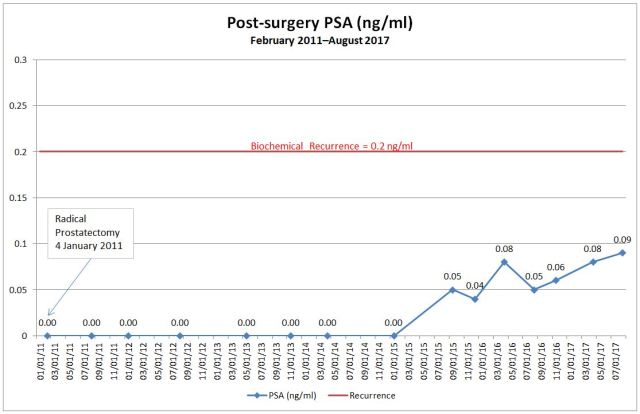
Day 2,841 – A Chat with the Urologist

I met with the urologist this afternoon to go over my 1 August 2018 PSA test results and it was an interesting conversation.

This was a new guy wearing his spiffy white lab coat with the University of California-San Diego (UCSD) emblem embroidered on the pocket. (I pretty much see a different doctor each time I go to the VA hospital and, yes, UCSD doctors care for patients at the VA hospital, too.) I had my PSA trend chart printed and sitting on his desk when he walked in, which he appreciated seeing the whole history on one page.

I let him start the conversation and it was pretty clear right from the start that he was of the “continue to monitor; no need to act right away” mindset. He really focused on my PSA doubling time being so long as being the reason for his recommendation to just watch this for now.

I shared my conversation with the radiation oncologist with him and he really didn’t comment one way or the other about the R.O.’s initial recommendation to zap.

I did take advantage of the opportunity to discuss the urological side effects of being zapped in salvage radiation therapy. One of the things that I focused on was urinary strictures.

He explained that just by having a prostatectomy and stretching the bladder neck to reconnect with the urethra, you’re in essence creating a stricture to begin with. “That’s a good thing,” he said, “because it helps control the urine flow in the absence of the prostate.” But zapping the area will change the nature of the surrounding tissue and can cause it to close down further. If that’s the case, they may have to do a procedure to re-open things and that’s where you can get into the higher leakage scenarios.

One of the things that really resonated with me during that discussion about side effects was when he said that I shouldn’t even be worried about them because I could go months or years without even having to think about salvage radiation therapy. (And, no, I didn’t prompt him to say that!)

That led to a discussion about the newer imaging technologies and he reinforced what I already knew—that most are unreliable with PSAs less than 0.2 ng/ml. I told him that the spreadsheet that generated my chart shows that I won’t hit 0.2 until late 2020 or early 2021 if it continues at its current pace. Perhaps in that time, the new imaging technologies will be better and more reliable at lower PSA levels. (He was also empathetic to the idea of not zapping unless you knew where the cancer was.)

We also talked about the frequency of my PSA tests and his immediate response was that we could do this every six months, again, based on my PSA doubling time. That surprised me. We’ve been on a four-month cycle for three years now. He said it would be my call, so I opted to stick to the four-month cycle for at least one more cycle.

Wrapping up the conversation, I did ask, “If I do have to get zapped at some point, where would you do it? UCSD or Naval Medical Center?” He deflected my question and never responded, so I asked again. Again, he remained silent but his hint of a grin perhaps answered it for me.

All in all, I was pleased with the consult and am content to continue to monitor, with my next PSA test being in early December.

Yes, I know that more studies are showing that zapping recurrent prostate cancer early leads to better outcomes in the long run. But other studies (Pound, Freedland) show that someone with my pathology can delay or even forego additional treatment and its associated side effects impacting quality of life and stick around for an additional 8-15 years. So, yes, this is a bit like playing a game of chicken or Russian roulette, and that thought never leaves my mind.

So why not get zapped and be done with it? Because quality of life is very important to me and if I can maintain it for a few years more than I want to try and do that. Is there risk of the cancer getting away from me? Of course. But with continued monitoring and perhaps advances in imaging technology, we can stay one or two steps ahead of it.

Time will tell.

Day 2,827 – Q&A with the Radiation Oncologist

Just a quick update…

I shared my last PSA results with my radiation oncologist via email yesterday to see if the results would influence his treatment recommendation.

He stated that a stable PSA is “great news” and that “continuing to monitor at this point is a very reasonable approach.” I also asked if a four-month PSA test frequency was appropriate or if we should look at increasing the frequency. With my numbers, he said that a three to six month frequency was most common, so sticking to four months was fine.

I also asked for clarification about sexual function after salvage radiation therapy. For some reason, I had it in my mind that from our conversation during the initial consult, he said that zapping me would likely damage my one remaining nerve bundle to the point that sexual function would be a thing of the past. He corrected me.

He said that post-radiation function is highly dependent on pre-radiation function. There will likely be some degradation, but not necessarily a complete loss of function as I had somehow lodged in my brain.

He closed the conversation by saying, “Hopefully your PSA will continue to behave itself and we can worry about that [sexual function] down the road.”

Needless to say, I was quite pleased with those responses.

We’ll see what the urologist says on the 21st (I put the wrong date in my last post) but, for now, I’m fine with doing nothing until my next PSA test in December.


Day 2,823 – Surprised

I was more than pleasantly surprised this morning when I learned that my PSA remained the same! It came back at 0.11 ng/ml, the same that it was in April.

PSA 20180801 plain


I learned the news from my primary care physician this morning when I was in to have something else checked out. In fact, I was so surprised by the result that I had to ask him twice to confirm that it was the 1 August reading and not the April reading.

I did ask him for his take on the reading, my history, and what he thought I should do next. He agreed that there are too many differing opinions and recommendations making it frustrating for patients. “Go with your gut,” was the best advice he could muster up.  Gee, thanks.

Of course, the stalled PSA growth (one data point does not make a trend), makes me inclined to kick the decision can another four months down the road—another four months without the side effects of radiation therapy. However, when I meet with the urologist on 19 August to go over the results, I’ll focus the conversation on the long term side effects of salvage radiation therapy because I don’t want to rule that completely out yet, either.

I may even email the radiation oncologist the results to get his take on them. Would he still want to zap me now (probably yes), or would he be more inclined to wait a while longer?

Regardless, I’m going to enjoy the results for now and think about decisions after the visit on the 19th.


Day 2,821 – PSA Test Time

It’s that time again. I had my blood drawn this morning and I suspect I’ll have the results online late Friday night.

My last PSA in April was 0.11 ng/ml and my handy-dandy spreadsheet predicts that this PSA will come in around 0.124 ng/ml. We’ll see…

If it does, that will add a little more pressure to make the “zap or not to zap” decision.

Stay tuned…

Month 92 – Sweating it Out

Literally. It’s been a god-awfully hot weekend here in San Diego. On Friday, the temperature downtown on the waterfront hit 97° F / 36° C and in Ramona, about an hour to the northeast of San Diego, it hit a toasty 117° F / 47° C! Yep. That’s correct. It’s not a typo.

Four wildfires broke out in the area Friday afternoon as well, with the nearest one to my house only 11 miles / 17 km away. A bit unnerving to say the least seeing as how rapidly those things can spread. (In 2003, the Cedar Fire spread about 25 miles / 40 km in about 16 hours thanks to a raging Santa Ana wind.) Thankfully, there was no such wind on Friday, and our amazing firefighters kept the fire to 10 acres / 40.000 m² but one home was lost.


I’ve been rather successful at not sweating over prostate cancer for a while now, and it’s been a good thing. In fact, so much so that I really don’t have much else for this post. Of course, that will change in three weeks when I go for my PSA test on 1 August.

So with nothing else to report, I’ll just leave you with a photo of some oak leaves in the sun near Big Bear Lake…

IMG_5293

Day 2,703 – PSA Results

The bad news: My PSA continued its upward climb to 0.11 ng/ml. The good news: The rate of increase remained constant (and is still quite slow).

The result is exactly where my spiffy spreadsheet said it would be, so I’m not overly surprised. All that’s left to do now is wait for my appointment with the urologist on 19 April. I’ll have to do my best to let him speak a little before I assault him with my already prepared list of questions.

This result reinforces my belief that it’s time to bring a radiation oncologist into the discussion so I can get his or her perspective on salvage radiation therapy, especially regarding the risks of long-term side effects impacting quality of life and the likelihood of success.

More to come…

PSA 20180405

Month 88 – Ready for Next PSA Test

It’s not often that I want time to pass more quickly in order to get to my next PSA test, but this time it’s different for some reason. I’ve been really anxious to have 3 April roll around to get this over and done with. Perhaps it’s because I suspect that this test will be the tipping point that finally gets me into real decision-making mode.

Of course, I would prefer not to see my PSA continue its gradual climb, but I suspect that it will. My spiffy little spreadsheet predicts a value of 0.115 ng/ml, up from 0.10 ng/ml. Let’s see how accurate its predictive powers are.

On a related note, I’m fairing much better than I was in my last blog post. How did I manage the emotional turnaround? One word: Disconnect.

I disconnected from my prostate cancer forums and from the good old Google machine in an effort to maintain some semblance of sanity, and it worked. That doesn’t mean that I quit them altogether or didn’t read the occasional article that popped up in a news feed, but I stopped actively researching for now.

Sure, there hasn’t been a day that’s gone by where I haven’t thought about my predicament. That’s only normal. I just don’t dwell on it like I did four weeks ago, and that’s improved my mood and focus considerably. Depending on my PSA results (I should be able to retrieve them online on 5 or 6 April), my mood and ability to focus may go out the window again. My appointment with the urologist is on 19 April, and one point of discussion will be a referral to a radiation oncologist.

Between now and then, I’ll do my best to simply forget about it all. Wish me luck!

Day 2,583–PSA Results

PSA 20171204My December PSA results came back just as predicted by my spreadsheet’s silly little trendline: 0.10 ng/ml.

The bad news is that it keeps climbing; the good news is that the doubling rate appears to be about 16 months. My follow-up appointment with my doctor is 19 December 2017 where we’ll probably agree to continue to monitor every 3-4 months for the time being.

Interestingly, from an emotional perspective, this has been pretty much a non-event for me. I’ve resigned myself to the fact that the likely explanation for the increasing PSA is the return of the cancer, so at this point, it’s only confirmation of something that I already suspect/accept/know.

That’s it for now. I’m sure I’ll have more thoughts in this month’s regular post on 11 December.

Day 2,581 – PSA Test Time

Yes, it’s that time again—time for my next PSA test. I had the blood drawn this morning, and I should be able to get the results online in three days.

My last reading was 0.09 ng/ml and, if you put a trend line over the last four readings, this reading should come out somewhere around 0.105 ng/ml. Let’s see how accurate its predictive powers are.

Stay tuned.

PSA Tracker 20170802

Month 82 – Reviewing PSA Results with Doctor

At this afternoon’s visit to the doctor to review my August PSA results, he asked, “How are you doing?” I replied, “I’m hoping you’re going to tell me.” “With a PSA of 0.09, you’re doing fine.”

I have to admit that I wasn’t quite psychologically prepared for that answer. Nor was I really prepared for the conversation that followed. But before getting into that, the bottom line was just as I expected: Continue to monitor PSA on a four-month cycle, which has me back in the lab in early December.

This was a new doctor that I hadn’t seen before and he was definitely more seasoned than the last one that I had. Still, all those years of experience could have taught him some better communication skills. He talked in broad generalities and in circles—even in response to my direct questions—and that was more than frustrating.

On the topic of recurrence, he didn’t think that I should be so quick to assume that an increasing PSA is indicative of recurrent cancer. He offered up the possibility that it could have been some benign prostate tissue left behind after the surgery and has grown enough where it’s detectable on the PSA test. Or, it could be cancer.

On the topic of PSA tests in general, he reminded me that the really old threshold for biochemical recurrence was 0.4 ng/ml before it was lowered to 0.2 ng/ml. It seemed that he valued the ultra-sensitive PSA test only as it related to the post-surgery pathology. If the pathology was bad, he seemed to put more stock in the ultra-sensitive PSA; but if the pathology was good, he seemed less inclined to put stock in it.

In other words, if you had a 4+3 Gleason score, positive margins, seminal vesicle involvement, or lymph node involvement—or some combination thereof—he would be more likely to consider acting on a 0.09 ng/ml PSA. But it my case with a 3+4 Gleason, negative margins, and no seminal vesicle or lymph involvement, my sense was that his response to my 0.09 PSA was a pretty nonplussed, “Meh.” Or, if my PSA gets to “around 0.13 ng/ml,” we might start exploring treatment options.

On the topic of doing additional testing such as scans to see if there is cancer anywhere, he said that nothing would show up on a scan or MRI with a PSA of 0.09. I want to dig into that some more.

On the topic of salvage treatments, he thought that, given my pathology, the first step would be “a little radiation.” (I’m not sure if sprawling out on the beach for 7 weeks qualifies for “a little radiation,” but it may be worth asking.) He wouldn’t do ADT (hormone therapy) in conjunction with the radiation, again, given my pathology.

Lastly, at one point during the conversation, he quite confidently made the bold prediction that I wouldn’t die from prostate cancer. You think I’d be jumping for joy. I’m not. Perhaps its my experience as a seasoned patient that’s telling me to withhold judgment on that one for the time being.

All in all, this is good news. My lack of enthusiastically embracing it, however, comes from the fact that, rather than eliminating variables to consider, I feel that this meeting introduced a few more, and that just muddied the waters. Emotionally, at this point, I just want this stupid disease to pick a path and stay on it. I may also check with the VA to see if there’s any way I can pick one doctor that I can build a relationship with rather than this new-doctor-a-quarter routine.