Day 5,256 – Doctor Visit

I had my post-PSMA PET scan visit with the urologist today, and I wasn’t really sure what to expect going into it.

The doctor (same as last time) shared the scan results saying that they’re something I should celebrate. I mentioned, though, that I have had three scans and were inconclusive despite the rising PSA numbers. He was quick to reply by saying that the scan not showing evidence of prostate cancer or metastasis was conclusive.

I understand where he’s coming from, but until we know where the cancer is, I’m going to have a difficult time accepting that perspective.

I did ask whether there was some sort of test that can determine if my cancer doesn’t express PSMA, and he said that there wasn’t. Something in my pea-sized brain tells me I need to double check him on that.

I also asked if there could be another explanation beyond the cancer that would explain my rising PSA. He ruled out the possibility of some residual prostate tissue being left behind after the surgery as being the cause based on my PSA kinetics over time.

In terms of what’s next, we’re kicking the can six months down the road for another PSA test and follow-up. I was a bit surprised that he wanted to wait six months, and suggested doing the test in three or four months. He was a bit insistent on the six month window. He felt comfortable with my current situation—the slight increase in my last PSA test from the previous one and my PSA doubling time—that waiting six months wouldn’t be a problem. He also argued that having a longer period between tests would better reflect what’s going on.

As we wrapped up, he reminded me that the scan results were good news, and I know that he’s right in that regard. I’ll work on changing my own perspective going forward (even though those little cancer bugs are still doing their thing inside me.)

My follow-up appointment is on 30 September 2025.

That’s it for today. Be well!

Header image: Cherry Blossoms, Japanese Friendship Garden, San Diego, California

Day 5,214 – Doctor Visit

You may have overachieved when your doctor asks, “Are you a urologist?”

I had a good meeting with the real urologist this morning, and it appears that he actually read the questions I sent to him in advance. That made the discussion easier.

First on my question list was whether a PSMA PET scan was warranted. He agreed that it was, and we’re going to try to get that scheduled soon. He thought that, with my PSA at 0.94 ng/mL, there would be a better chance of actually finding something this time. The only concern is that the VA has required a bone scan ahead of the PSMA PET scan in the past, and he’s going to see if we can skip that. It may take several days for the schedulers to call me.

We did discuss the possibility of further radiation if a lesion is found away from the pelvis. I mentioned that I had had blood in my stools and mild radiation proctitis discovered (and addressed) during my recent colonoscopy. He was not keen on further radiation to the pelvis under those circumstances. Neither am I.

My next question was about the timing of beginning androgen deprivation therapy (ADT). He was pretty squishy on the timing, not knowing exactly where we’re at. I mentioned that, a year ago, the urologist told me that we’d start when my PSA hit 2.0 ng/mL, but the medical oncologist suggested holding off until metastasis. He generally agreed with the concept of starting it later so that the cancer doesn’t become resistant to it prematurely, with one caveat.

He seemed to give more weight to my PSA doubling time than did other doctors, and that’s when he asked me if I was a urologist. I had presented him my graph showing my PSA progression, and it showed my PSA doubling time. “How did you know how to calculate it?” I told him that I used the Memorial Sloan-Kettering PSA doubling time calculator. To him, my PSADT of 9 months was creeping into “concerning” territory, and might make him a little more inclined to start ADT earlier.

I asked him, “At what point do we call this metastatic disease?” and, “When should we get a medical oncologist (MO) involved?” To the first, he said that all we know is prostate cancer is somewhere in my body, but wouldn’t go so far as to call it metastatic yet. To the second, he was open to brining in a MO if the results of the PSMA PET scan warranted it.

We agreed to the following plan:

  • Get a PSMA PET scan and meet again in six weeks to review the results.
  • Get an updated PSA test before the six week review.
  • Let the results of the scan determine if we get the MO involved at that point.

I have the six-week follow-up appointment scheduled for 1 April 2025. My concern is getting the PSMA PET scan scheduled and completed before then. If I need a bone scan in advance of it, that may complicate or delay the PSMA PET scheduling further. If push comes to shove, I already had an appointment scheduled with urology on 8 May 2025, so that’s not that much of a delay if we can’t get everything scheduled before 1 April. 2025.

It was a productive meeting from my perspective, without any surprises.

More to come as we get things scheduled.

Header image: Cuyamaca Rancho State Park, California

Day 4,923 – PSA Results

No surprise here. In my spreadsheet, I put a placeholder value of 0.50 ng/mL for this PSA test based on the previous trend, and the actual result came in slightly higher at 0.52 ng/mL.

The PSA Doubling Time is dropping as well. Using the last five readings and the Memorial Sloan-Kettering PSA Doubling Time calculator, my PSADT was:

  • 6.7 months on 6 December 2023
  • 6.2 months on 19 January 2024
  • 5.1 months on 1 May 2024

It seems safe to say that the salvage radiation therapy failed to do the trick.

I am trying to describe my reaction to this hour-old news. I guess words that I might use would be: numb, indifferent, resigned. I don’t know. It’s a bit weird. I certainly had zero expectation that my PSA would go down or even hold steady given the previous trend.

You may recall the conversation with the medical oncologist suggested that we monitor and do another PSMA PET scan in six months, which would make it August. The question now is, based on these results, do we stick with that plan? Or do we move to the discussion on the type of androgen deprivation therapy and the timing of ADT?

I did ask the phlebotomist if he was drawing blood for a testosterone baseline test and he said yes. I don’t see the results posted online yet (my record is still going through its once-a-day update as I type this).

Well, it’s after midnight. I’ll sleep on this and perhaps I’ll be a tad more focused in the morning after having processed this.


What’s next:

  • 9 May – Appointment with primary care physician (annual physical)
  • 14 May – Appointment with urologist

Header Image: Scenes from San Diego Bay, San Diego, California

Watch “Rising PSA: How Soon Should You Get a Scan? | Thomas Hope, MD & Mark Moyad, MD | 2021 PCRI” on YouTube

Wow. This could not be more applicable to my current circumstances and certainly gives me food for thought.

Month 117 – Running on Pandemic Time

Is it just me, or is anyone else having pandemic days all blend together and you lose track of time? Late last night (technically very early this morning as I was tossing and turning in bed around 2 a.m.), I realized, “Crap! I didn’t even think about posting on my blog, let alone write anything!”

So here I am on my advertised posting day with three hours and one minute left to get this out on the 11th, and I pretty much have nothing. Well, that’s not entirely true…

I did come across this article on The “New” Prostate Cancer Infolink that talks about PSA doubling times with respect to prostate cancer progression in men with non-metastatic castration resistant prostate cancer.

PSA doubling time and prognosis for men with nmCRPC

Unfortunately, they weren’t able to access the full study report, and the summary that’s provided is pretty high-level, restating the obvious: Shorter PSADT is associated with shorter metastasis-free survival and shorter overall survival.

One of the things that I discovered working in a hospital is that I can sometimes access research reports like this via its computer network. I’ll see if I can access this report to learn more details about the study and, if I can, I’ll share anything I learn.

Whew! Finished with time to spare. 🙂

Stay well and keep living the pandemic life as best and as safely you can wherever you happen to be.

Day 3,392 – PSA Retest Results

My last PSA test on 4 February showed a 50% drop in my value compared to the previous test in September 2019, which is a major, unexplained swing considering that I haven’t been doing treatments of any type to lower my PSA. It just didn’t sit right with me, so I asked for a retest.

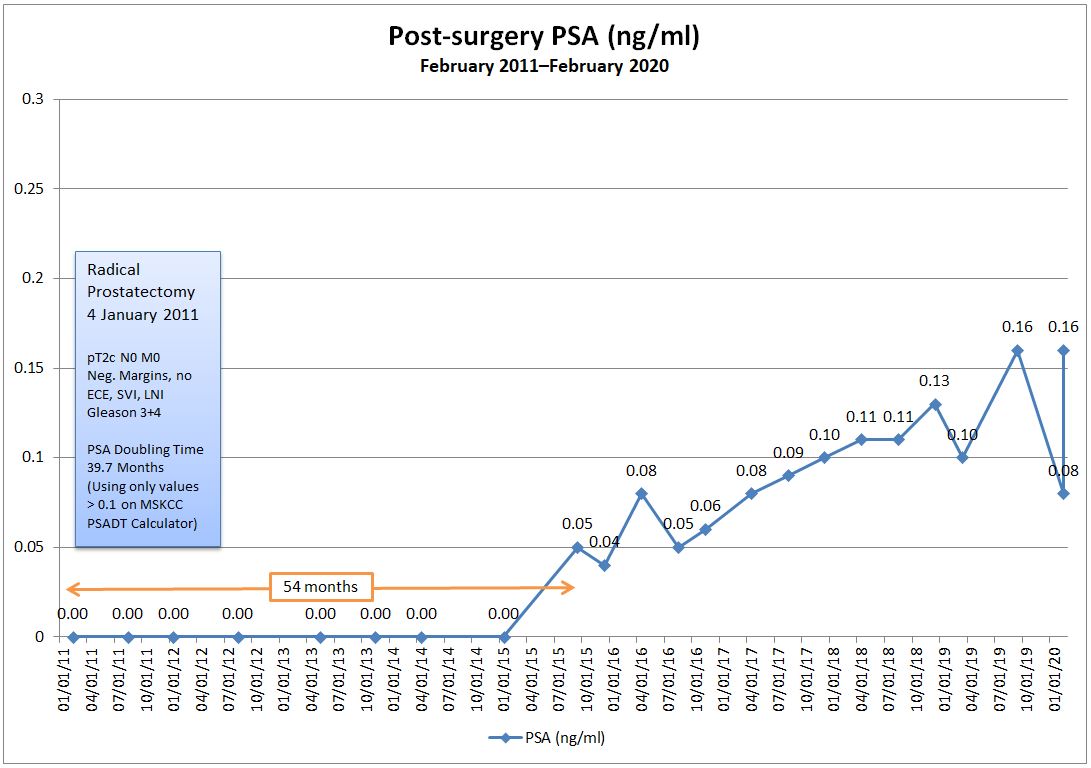
PSA 20200223I went in on 20 February for the retest, and the PSA came back at 0.16 ng/ml, exactly where it was in September 2019. (At least that’s the silver lining in the cloud: it didn’t go even higher.)

We’ll probably never get a good explanation for the dip in my PSA earlier this month, and I guess that’s just part of dealing with this beast. I’m going to leave the errant data point on my chart just to show how wacky this can be at times.

The one thing that this has done, though, is drive my PSA Doubling Time down to 39.7 months according to the Memorial Sloan-Kettering PSADT Calculator (excluding the 0.08 reading). That’s still a very good number, but it’s downward trend over time is becoming more concerning.

I’m really glad that I was able to get the retest done before my appointment with the doctor on Tuesday. It certainly will make for an interesting discussion.

More to come…

Day 3,248 – PSA Results

I jumped the gun and got my PSA test done about a week earlier than I planned. I had a  appointment scheduled on Monday to follow-up on my thumb surgery back in February , and I thought I would kill two birds with one stone and get the blood drawn after my appointment.

About 9:00 a.m., the doctor that I had my 1:30 p.m. appointment with called to check in and see how I was doing and if I really needed to come in. “How’s your thumb?” “Still attached and working,” I replied. After a brief discussion in more detail, we mutually agreed that there was no need for me to come into the office.

That kind of put a damper on my getting two birds with one stone, but I decided that I would go to the lab anyway, as I had already planned the afternoon off. It just made sense.

I wish I hadn’t.

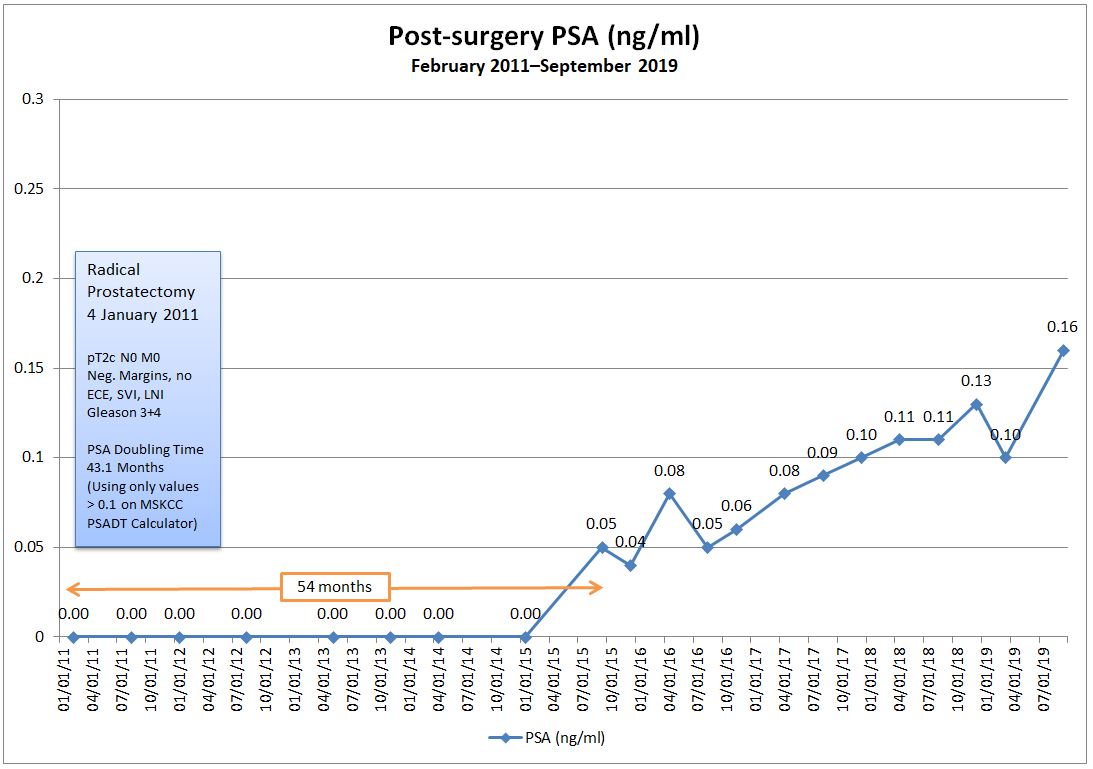
My PSA took a considerable jump up to 0.16 ng/ml. I wasn’t expecting that.

PSA 20190930

The trend function on my spiffy spreadsheet thought it would come in around 0.137 ng/ml so that’s kind of where I had prepared myself to be mentally.

I used the Memorial Sloan Kettering PSA Doubling Time calculator to recalculate my PSA doubling time (it uses values of only 0.10 ng/ml and above), and my PSADT dropped from 155.6 months to 43.1 months. Still a respectable number, but definitely moving in the wrong direction.

Needless to say, this sucks.

My appointment with the urologist is on 22 October and we’ll definitely talk about imaging possibilities and ask for another referral back to a radiation oncologist to discuss salvage radiation therapy.

Crap.

Projecting risk for metastasis after radical prostatectomy — THE “NEW” PROSTATE CANCER INFOLINK

I came across this article in one of my feeds. There isn’t an “Ah-ha!” moment in it, but it’s good to see research confirming what many have known with data.

A new paper in Clinical Genitourinary Cancer has provided us with some more detailed information about risk for metastasis in men with recurrent prostate cancer after first-line surgery.

via Projecting risk for metastasis after radical prostatectomy — THE “NEW” PROSTATE CANCER INFOLINK

Month 102 – Turning a Corner?

Normally, there’s a relatively short half-life of feeling good after returning from a vacation. The mountain of work emails and unpaid bills that accumulated while you’re gone just suck the vacation memories and relaxed feelings out of you quite rapidly as you get back into the daily grind.

That’s held pretty true for me after last month’s trip to Switzerland, with two exceptions that, if I can keep the momentum going, make me feel as though I’m turning a corner.

For those of us who have introduced the word “cancer” into our vocabulary, we know that thoughts of cancer are always nearby. Some days we’re better at suppressing them than others. But when the notion of recurrence hits, the thoughts become more prevalent, more intense, and more psychologically draining over time. At least that’s what happened to me.

But since my vacation and since my visit with the urologist last month, I’ve begun to turn a corner in my thinking about my recurrence. In a nutshell, given my numbers (current PSA level and extraordinarily long PSA doubling time), my thoughts are finally shifting from panic to calm concern.

In some of the more recent literature about prostate cancer, you hear more and more people talking about treating some cases of prostate cancer as more of a chronic illness instead of an aggressive disease. For now, I’m happy to—rightly or wrongly—lump myself into the “manage it as a chronic illness” category. It certainly has helped relieve some of the stressful thoughts about recurrence and the potential side effects of salvage radiation therapy or hormone therapy. Of course, if my PSA shoots up again in October, that may change my approach to all of this yet again.

This approach certainly isn’t for everyone. I feel blessed to have a PSA doubling time of 155 months, but even so, I still recognize there’s an element of Russian roulette in my decision to continue to monitor for now. I’m okay with that.

The second exception to my vacation not wearing off within a week has been with my photography.

Spending ten days wandering around Switzerland with my camera (the first time I’ve flown with most of my gear) reinvigorated my interest in getting out and photographing even more, and that’s been therapeutic for me as well. When I’m looking through the lens and—excuse the pun—focusing on what’s in front of me, I’m not thinking about cancer. At. all.

I’ve been out with my camera every weekend and even a few week nights since coming back, and I hope I can keep the momentum going through the summer. I feel better, plus practice makes perfect. (Although there’s no such thing as a “perfect” photograph.)

In the end, I’m glad that I pushed myself to go on the trip. Perhaps the half-life of this vacation will be as long as my PSA doubling time (or longer).

—Dan

P.S. Sorry for the tardiness of this post. I was out playing. 🙂

Day 3,081 – PSA Discussion with Doctor

IMG_20190418_134348455While waiting for my appointment with the doctor this afternoon, I got caught up on reading about the new Datsun 280ZX in the waiting room in the May 1981 edition of Road & Track magazine. Seriously. That thing belonged in the National Archives, not the doctor’s waiting room. Needless to say, it was a fun trip down memory lane, as I had just graduated from college three months earlier and was driving my 1974 Ford Galaxie 500 (my first car).

The discussion with the doctor went about as expected. In a nutshell: Continue to monitor; no action needed at this point given my PSA level and my PSA doubling time of 155 months. (Calculated using the Memorial Sloan-Kettering PSADT nomogram.)

She told me something new, too, concerning the explanation for some of the very minor fluctuations in PSA levels. I knew that physical activity and having orgasms before a blood draw could impact your PSA level, but she said that even variations in your hydration level can cause minor variations in your PSA readings. Interesting.

Just for grins and giggles, I asked her the $64,000 question: How do you define biochemical recurrence?

There was quite a long pregnant pause before she responded, “That’s a difficult question to answer.” She explained the that it’s been defined many ways and, while she never did answer my question directly, my impression was that she was in the “two or more consecutive increases in your PSA level” camp.

One thing the doctor said, too, was that she has seen cases where patients PSAs start increasing and then plateau and sit there for years without much change at all and no need for intervention.

She also suggested that, given where my PSA level was and how slowly it was moving, that we could retest in six months instead of sticking to the four month schedule that I’ve been using for the last three and a half years. I agreed. I return on 22 October 2019.

Again, the meeting went pretty much as I expected it would, and I’m okay with what we discussed.


I had a great trip to Switzerland in the first half of the month despite some dodgy weather (which is to be expected in northern climates in April). If you’re interested in reading about it (or at least just looking at some photos), you can check it out on my other blog, Travelin’ Dan.