Month 111 – PSA Results Are In

Baffled. Completely and utterly baffled.

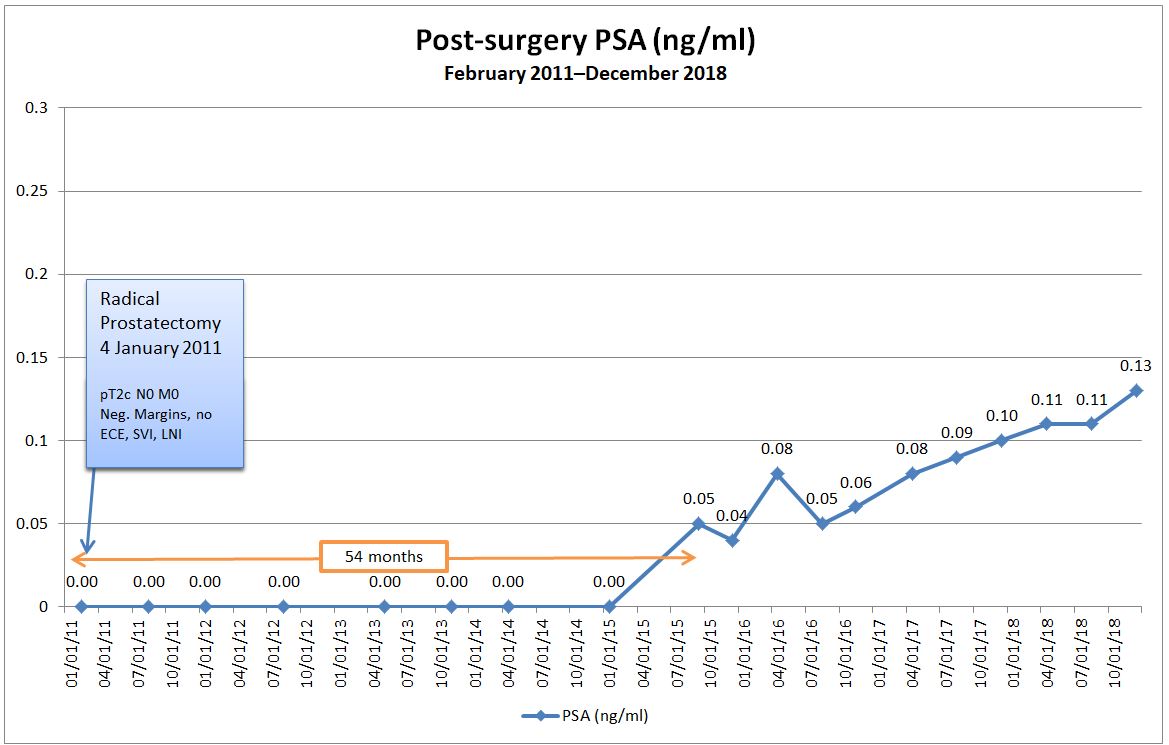
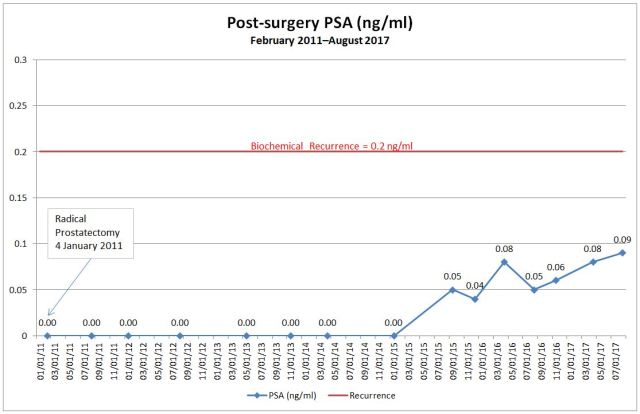
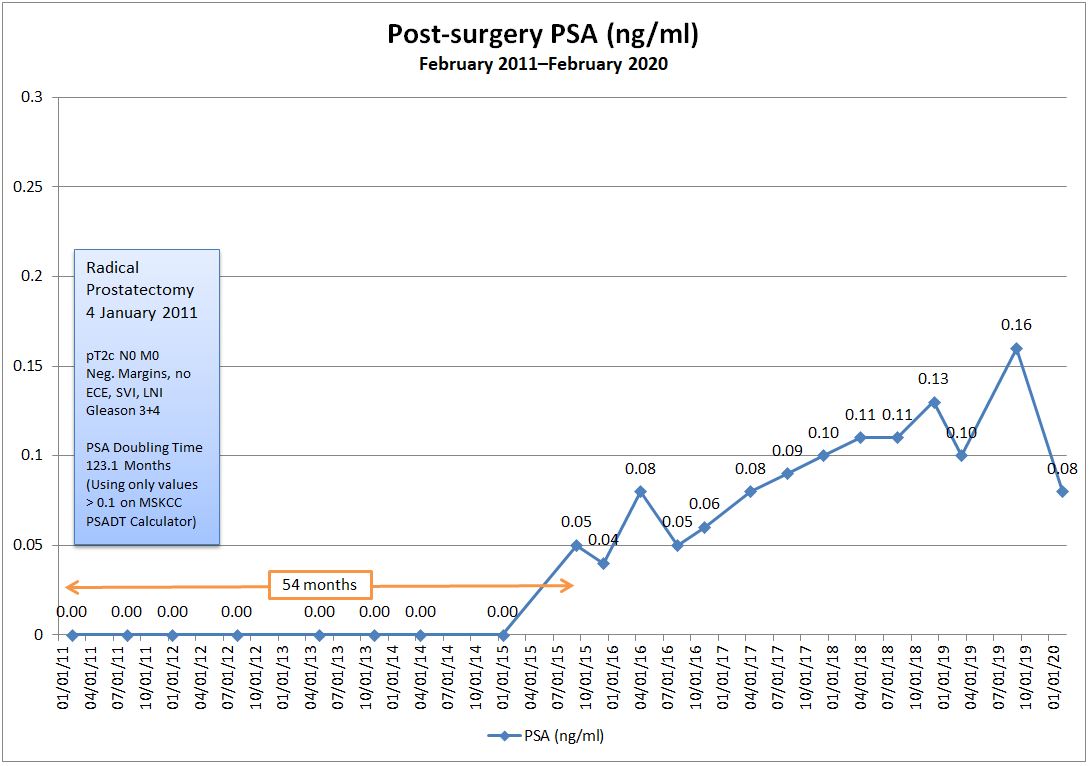
Excited that my PSA value went from 0.16 ng/ml in September to 0.08 ng/ml last week, but completely thrown for a loop as to how and why a 50% decrease happened (without any treatment or other intervention). The last time I was at 0.08 ng/ml was nearly three years ago in April 2017.

I follow the same routine for a week before each PSA blood test to avoid activities that may influence the outcome. The only difference time was that I had a cold/flu the days before the test (Monday afternoon-Thursday evening; blood draw on Friday morning), but I can’t imagine that having any influence on a PSA number. I’ll ask when I talk to the doctor on 25 February 2020.

I tried updating my PSA Doubling Time using the MSKCC PSADT calculator, and this bumped my PSADT from 43 months to 123 months. There is a caveat, though. The online calculator accepts only PSA values of 0.10 or more, so I rounded up my 0.08 to 0.10 to run the calculation.

I get that there can be lab errors or accuracy concerns as well, but I would be hard-pressed to attribute a 50% shift to a lab issue. Still, when you look at the last four data points on my chart, there is pretty significant fluctuation between each and its previous data point when compared to the quite consistent series of data points prior to that. It makes you go, “Hmm…”

Don’t get me wrong. I’m not complaining about where the PSA is at. I will say, however, that these kinds of wild swings make it challenging to wrap your head around what’s happening in order to prepare for what’s next. I was mentally gearing up for calls to imaging centers and radiation oncologists because I was expecting the result to be in the 0.16 to 0.18 range this time around.

So that’s it. A short post with unexpected, somewhat bizarre results. We’ll see what the doctor says on the 25th.
PSA 20200207

Month 106 – Almost Time

Work is insanely busy for me right now, so this will be a shorter post than usual. (“Thank you!” you say.)

I’m coming to the end of the six months since my last PSA test (and the first six month test frequency in many years), so it’s almost time for my next visit to Dracula. I’m looking at my calendar and I’m thinking that I’ll go somewhere around 7 or 8 October, but anticipation may have me try to squeeze it in a little earlier. Perhaps even the tail end of September. Either way, I have an appointment with the urologist on 22 October to review the results.

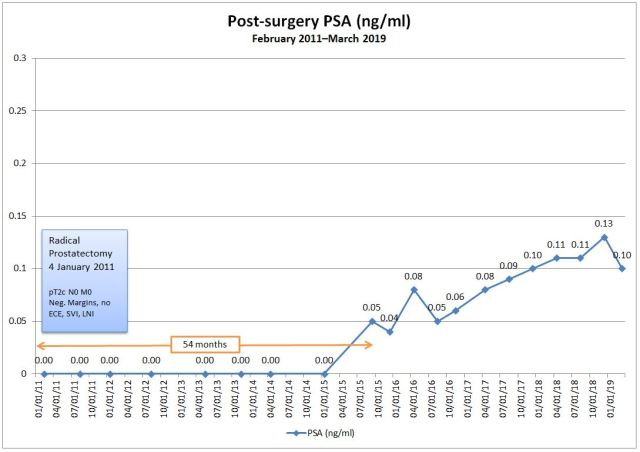
I’m not even going to try and predict where the next marker on the chart will land. My spreadsheet failed me wonderfully last time out. As I recall, it predicted a value of around 0.14, and I came in at 0.10. One result at a time…

As a refresher here’s my PSA chart:

PSA 20190326

Last week, I stumbled across a comment in a Facebook prostate cancer support group that talked about rising PSA, and the author recommended reading/viewing Dr. Charles “Snuffy” Smith’s article, “When Recurrent PCa isn’t Cancer.” Dr. Smith is the editor-in-chief of the website, Prostapedia.

The video was published four years ago, but Dr. Smith seemed to reinforce the notion that my continued surveillance of my PSA without taking other action may not be as crazy an idea as many may think it is (including myself, on occasion). Of course, I’m sure there are plenty of others out there who would argue otherwise, too.

Even though there are a thousand opinions out there, we patients sometimes forget that we really can control our treatment path, as long as we do it in a well-researched and well-thought out way, assessing the risks and rewards. I get to decide what to do in the end. It’s my body and my life, after all.

Stay tuned.

Day 3,058 – A Date with Dracula

My local friendly phlebotomist, aka Dracula, just sucked a vial of blood from my arm for the next PSA test. I should have the results online by Friday.

I was impressed. In and out of the clinic in less than ten minutes. Not bad at all.

Here’s where we were the last time around just as a refresher:

PSA 20181203 clean

Day 2,841 – A Chat with the Urologist

I met with the urologist this afternoon to go over my 1 August 2018 PSA test results and it was an interesting conversation.

This was a new guy wearing his spiffy white lab coat with the University of California-San Diego (UCSD) emblem embroidered on the pocket. (I pretty much see a different doctor each time I go to the VA hospital and, yes, UCSD doctors care for patients at the VA hospital, too.) I had my PSA trend chart printed and sitting on his desk when he walked in, which he appreciated seeing the whole history on one page.

I let him start the conversation and it was pretty clear right from the start that he was of the “continue to monitor; no need to act right away” mindset. He really focused on my PSA doubling time being so long as being the reason for his recommendation to just watch this for now.

I shared my conversation with the radiation oncologist with him and he really didn’t comment one way or the other about the R.O.’s initial recommendation to zap.

I did take advantage of the opportunity to discuss the urological side effects of being zapped in salvage radiation therapy. One of the things that I focused on was urinary strictures.

He explained that just by having a prostatectomy and stretching the bladder neck to reconnect with the urethra, you’re in essence creating a stricture to begin with. “That’s a good thing,” he said, “because it helps control the urine flow in the absence of the prostate.” But zapping the area will change the nature of the surrounding tissue and can cause it to close down further. If that’s the case, they may have to do a procedure to re-open things and that’s where you can get into the higher leakage scenarios.

One of the things that really resonated with me during that discussion about side effects was when he said that I shouldn’t even be worried about them because I could go months or years without even having to think about salvage radiation therapy. (And, no, I didn’t prompt him to say that!)

That led to a discussion about the newer imaging technologies and he reinforced what I already knew—that most are unreliable with PSAs less than 0.2 ng/ml. I told him that the spreadsheet that generated my chart shows that I won’t hit 0.2 until late 2020 or early 2021 if it continues at its current pace. Perhaps in that time, the new imaging technologies will be better and more reliable at lower PSA levels. (He was also empathetic to the idea of not zapping unless you knew where the cancer was.)

We also talked about the frequency of my PSA tests and his immediate response was that we could do this every six months, again, based on my PSA doubling time. That surprised me. We’ve been on a four-month cycle for three years now. He said it would be my call, so I opted to stick to the four-month cycle for at least one more cycle.

Wrapping up the conversation, I did ask, “If I do have to get zapped at some point, where would you do it? UCSD or Naval Medical Center?” He deflected my question and never responded, so I asked again. Again, he remained silent but his hint of a grin perhaps answered it for me.

All in all, I was pleased with the consult and am content to continue to monitor, with my next PSA test being in early December.

Yes, I know that more studies are showing that zapping recurrent prostate cancer early leads to better outcomes in the long run. But other studies (Pound, Freedland) show that someone with my pathology can delay or even forego additional treatment and its associated side effects impacting quality of life and stick around for an additional 8-15 years. So, yes, this is a bit like playing a game of chicken or Russian roulette, and that thought never leaves my mind.

So why not get zapped and be done with it? Because quality of life is very important to me and if I can maintain it for a few years more than I want to try and do that. Is there risk of the cancer getting away from me? Of course. But with continued monitoring and perhaps advances in imaging technology, we can stay one or two steps ahead of it.

Time will tell.

Month 93 – Questioning Recommendation

Regular readers of my blog know that I tend to overthink things. Big time.

I’ve had a few days to think about what the radiation oncologist said in his email—about continued monitoring being a very reasonable approach—and I began to question that bit of advice. Not necessarily its validity, but more along the lines of why the change of heart with the doctor?

When we had our consult in May, there was no doubt that his recommendation was to start salvage radiation therapy right away. He presented a pretty strong argument that early treatment is better than delaying. My numbers now are the same as when he gave his “treat now” recommendation, so why the sudden change to “okay to monitor”? Is he just appeasing me, telling me what he thinks I want to hear? Or does this one data point of a stable PSA really justify changing a treatment recommendation?

Don’t fret. As I said, I overthink things.

I’m perfectly content with the “continue to monitor” approach for the foreseeable future. I really don’t question the integrity of the radiation oncologist either. Even if he was appeasing me, part of being a good doctor is listening to the patient’s concerns and understanding that the patient’s perspective needs to be at forefront of any treatment decision. I only met with the doctor once, but given his take-charge personality, I’m confident that he would have argued more forcefully if he truly thought I needed radiation therapy right away.

I’ve put aside my little bout of cynicism and will focus on enjoying the next four months.

Speaking of four months, that’s the other little cloud that rained on my post-PSA parade. “Crap. I’m back in PSA limbo land yet again.” Mentally, I had prepared myself for the PSA to have gone up again and that I would be one step closer to making the zap or not to zap decision. It’s still emotionally draining even after almost eight years of dealing with this. Oh well. Suck it up, buttercup.


On a fun note, I was toying with the idea of driving out to the 96° F / 36° C desert tonight to try and capture the Perseid meteor shower with my camera (I’m writing this on Friday night). But after three hours in the dentist’s chair this afternoon, that ain’t gonna happen. I’m zonked. Perhaps Saturday night.

Here’s what I captured after an hour and a half of standing alone in the desert last year. A near-full moon was rising and illuminating the mountains, but it was beginning to be too bright to see meteors.

Perseid in ABDSP


Month 89 – Moving Forward

I wasn’t expecting that.

You would have thought that, with me confidently predicting that my latest PSA number would climb, I would have been relatively okay after getting the results Thursday night. Not so. Friday, I plunged into a deep funk, and my ability to concentrate at work dropped to a 2 or 3 on a scale of 10. Not good.

To combat the funk Saturday, I distracted myself by going down a relatively mindless rabbit hole on YouTube. (I know, not my proudest moment, but it worked.) One of the videos that I watch was from a young landscape photographer, Dave Morrow, that was entitled, How Quitting Social Media Changed My Life & Photography. That piqued my interest, so I spent 11 minutes watching it (video below).

As a bit of background, I was really opposed to joining Facebook and other social media years ago. I successfully resisted joining despite pressure from family and friends. In fact, this very blog arose from my disdain for Facebook yet wanting to be able to keep everyone informed about my situation.

But when I started working at the museum, we had a Facebook page for our volunteers and, as volunteer coordinator, I thought it was important to understand how to use it. I set up my own Facebook account as a playground to learn. That was four years ago, and I have to admit that I’ve been sucked into the Facebook vortex over time, spending more hours on it than I should.

The key takeaway for me in Dave’s video was when he said that he took all of the time and energy that he put into social media and devoted it to the things he enjoys and is passionate about instead. That was one of those “Ah-ha!” moments that we all knew about but had to relearn.

Regular readers of this blog will know that one of my favorite things to do is throw my camera in my car and drive. That’s precisely what I did on Sunday and, like the YouTube marathon, it, too, chased away my funk as I took a one and a half mile midday hike in the Anza-Borrego Desert State Park. (Perhaps not the wisest idea in the 90° F / 32° C heat.)

Tonight, rather than heading directly home from the office and hopping on my tablet to get caught up on all the social media postings, I opted to take an hour-long stroll up and down the beach, trousers rolled up to the knees, barefoot, ankle-deep in the incoming surf. It was delightful. (Note to self: Throw a pair of shorts in the trunk so I don’t look so geeky in trousers on the beach. Just a thought!)

I haven’t been on social media since Saturday—it’s been quite refreshing—and I’ve followed Dave’s advice and used that time for more enjoyable endeavors. Yes, it’s been a bit of a challenge not to look on Facebook, but I’ve resisted so far. Will I completely delete my accounts? Time will tell. There has been some advantage in using social media to connect with old friends, to remain connected with those half a continent away, and to even connect with fellow prostate cancer patients.

Dave’s insights were more from a developing and growing his business perspective, but obviously, they could be applied in a personal setting as well. Disconnecting from social media allows me the time to move forward doing things that I enjoy—walking on the beach, hiking in the desert, or snapping a photo or two. Each of those help combat the emotional funk.

Who would have thought that a YouTube video about managing a photography business would have reminded us that we need to eliminate those things that don’t add value or bring joy to our lives, and focus on those things that do?

I wasn’t expecting that.

Month 88 – Ready for Next PSA Test

It’s not often that I want time to pass more quickly in order to get to my next PSA test, but this time it’s different for some reason. I’ve been really anxious to have 3 April roll around to get this over and done with. Perhaps it’s because I suspect that this test will be the tipping point that finally gets me into real decision-making mode.

Of course, I would prefer not to see my PSA continue its gradual climb, but I suspect that it will. My spiffy little spreadsheet predicts a value of 0.115 ng/ml, up from 0.10 ng/ml. Let’s see how accurate its predictive powers are.

On a related note, I’m fairing much better than I was in my last blog post. How did I manage the emotional turnaround? One word: Disconnect.

I disconnected from my prostate cancer forums and from the good old Google machine in an effort to maintain some semblance of sanity, and it worked. That doesn’t mean that I quit them altogether or didn’t read the occasional article that popped up in a news feed, but I stopped actively researching for now.

Sure, there hasn’t been a day that’s gone by where I haven’t thought about my predicament. That’s only normal. I just don’t dwell on it like I did four weeks ago, and that’s improved my mood and focus considerably. Depending on my PSA results (I should be able to retrieve them online on 5 or 6 April), my mood and ability to focus may go out the window again. My appointment with the urologist is on 19 April, and one point of discussion will be a referral to a radiation oncologist.

Between now and then, I’ll do my best to simply forget about it all. Wish me luck!

Day 2,583–PSA Results

PSA 20171204My December PSA results came back just as predicted by my spreadsheet’s silly little trendline: 0.10 ng/ml.

The bad news is that it keeps climbing; the good news is that the doubling rate appears to be about 16 months. My follow-up appointment with my doctor is 19 December 2017 where we’ll probably agree to continue to monitor every 3-4 months for the time being.

Interestingly, from an emotional perspective, this has been pretty much a non-event for me. I’ve resigned myself to the fact that the likely explanation for the increasing PSA is the return of the cancer, so at this point, it’s only confirmation of something that I already suspect/accept/know.

That’s it for now. I’m sure I’ll have more thoughts in this month’s regular post on 11 December.

Day 2,581 – PSA Test Time

Yes, it’s that time again—time for my next PSA test. I had the blood drawn this morning, and I should be able to get the results online in three days.

My last reading was 0.09 ng/ml and, if you put a trend line over the last four readings, this reading should come out somewhere around 0.105 ng/ml. Let’s see how accurate its predictive powers are.

Stay tuned.

PSA Tracker 20170802

Month 82 – Reviewing PSA Results with Doctor

At this afternoon’s visit to the doctor to review my August PSA results, he asked, “How are you doing?” I replied, “I’m hoping you’re going to tell me.” “With a PSA of 0.09, you’re doing fine.”

I have to admit that I wasn’t quite psychologically prepared for that answer. Nor was I really prepared for the conversation that followed. But before getting into that, the bottom line was just as I expected: Continue to monitor PSA on a four-month cycle, which has me back in the lab in early December.

This was a new doctor that I hadn’t seen before and he was definitely more seasoned than the last one that I had. Still, all those years of experience could have taught him some better communication skills. He talked in broad generalities and in circles—even in response to my direct questions—and that was more than frustrating.

On the topic of recurrence, he didn’t think that I should be so quick to assume that an increasing PSA is indicative of recurrent cancer. He offered up the possibility that it could have been some benign prostate tissue left behind after the surgery and has grown enough where it’s detectable on the PSA test. Or, it could be cancer.

On the topic of PSA tests in general, he reminded me that the really old threshold for biochemical recurrence was 0.4 ng/ml before it was lowered to 0.2 ng/ml. It seemed that he valued the ultra-sensitive PSA test only as it related to the post-surgery pathology. If the pathology was bad, he seemed to put more stock in the ultra-sensitive PSA; but if the pathology was good, he seemed less inclined to put stock in it.

In other words, if you had a 4+3 Gleason score, positive margins, seminal vesicle involvement, or lymph node involvement—or some combination thereof—he would be more likely to consider acting on a 0.09 ng/ml PSA. But it my case with a 3+4 Gleason, negative margins, and no seminal vesicle or lymph involvement, my sense was that his response to my 0.09 PSA was a pretty nonplussed, “Meh.” Or, if my PSA gets to “around 0.13 ng/ml,” we might start exploring treatment options.

On the topic of doing additional testing such as scans to see if there is cancer anywhere, he said that nothing would show up on a scan or MRI with a PSA of 0.09. I want to dig into that some more.

On the topic of salvage treatments, he thought that, given my pathology, the first step would be “a little radiation.” (I’m not sure if sprawling out on the beach for 7 weeks qualifies for “a little radiation,” but it may be worth asking.) He wouldn’t do ADT (hormone therapy) in conjunction with the radiation, again, given my pathology.

Lastly, at one point during the conversation, he quite confidently made the bold prediction that I wouldn’t die from prostate cancer. You think I’d be jumping for joy. I’m not. Perhaps its my experience as a seasoned patient that’s telling me to withhold judgment on that one for the time being.

All in all, this is good news. My lack of enthusiastically embracing it, however, comes from the fact that, rather than eliminating variables to consider, I feel that this meeting introduced a few more, and that just muddied the waters. Emotionally, at this point, I just want this stupid disease to pick a path and stay on it. I may also check with the VA to see if there’s any way I can pick one doctor that I can build a relationship with rather than this new-doctor-a-quarter routine.