A Decade Living with Prostate Cancer

One decade. 522 weeks. 3,654 days. 87,696 hours.

That’s how long I’ve been living with prostate cancer since being diagnosed on 11 November 2010. Of course, the operative phrase is “living with.”

The diagnosis was terrifying. The treatment decision was excruciating and exhausting. The surgery recovery was longer than expected with some complications along the way. The long-term side effects have been what were advertised at the beginning.

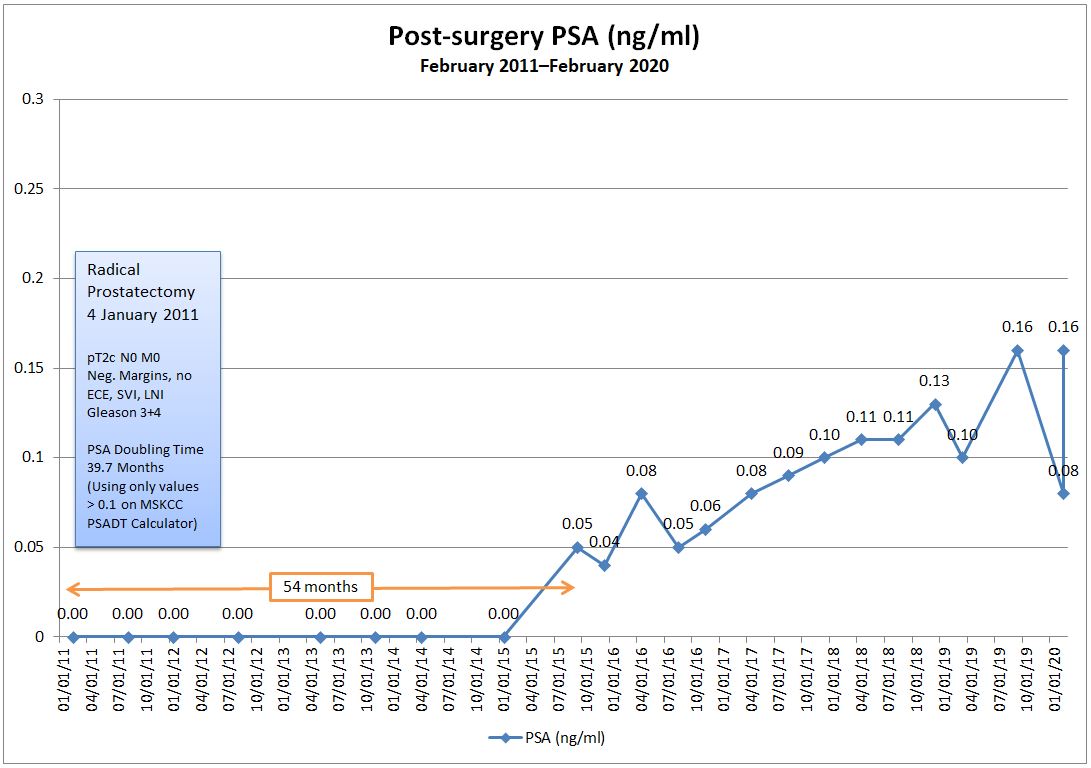
On the positive side, there were 54 months of undetectable PSA results to indicate the surgery had done the trick. Or so we thought.

When my first detectable PSA test came in five years ago, I was even more terrified and panicked than when I was initially diagnosed. It meant that my first line of defense had failed. Now I had fewer options to control or rid me of the cancer available to me.

My doctors convinced me that there was no need for immediate panic and that we could and should monitor my PSA before considering any action. My PSA fluctuated up and down, but had a slow but steady upward trend.

As my PSA continued to climb—passing several markers that are normally used to consider starting salvage radiation therapy—I continued to do nothing. I’ve been pretty steadfast in my reluctance to start zapping without knowing where the cancer is, and even some of the best new imaging techniques won’t pick up the cancer at my PSA levels.

With a PSA doubling time of four years, I’m comfortable with that decision. Heck. I’m still here five years after that initial detectable PSA reading, and ten years after my initial diagnosis.

We may find out a little more about my future direction next month when I go for my next PSA test just before Christmas. As I’ve learned (albeit slowly) over the last decade, don’t get too worked up about the results until you have them in hand. It just doesn’t do any good to speculate about the unknown. January will tell me whether I can continue the status quo or it’s finally time to take action.


If you asked me ten years ago when I started this blog (to keep family and friends informed in my pre-Facebook days) that I would still be doing this ten years later, I would have said you’re nuts. But here I am.

I’ve tried to inform and educate others about prostate cancer along the way, and to give insights to the newly diagnosed as to what you may encounter two, three, five, or ten years down the road. All the guys I spoke with pre-surgery had, themselves, only been less than a year out from their own surgery date. They had no long-term post-surgery insights to offer to me.

I’ve tried to inject a little dose of reality to those who, just like me, gleefully declared themselves to be “cancer-free” after a few undetectable PSA tests. “Not so fast.” My story is a reminder that there can be unexpected plot twists, even in the later chapters.

Along the way, I’ve met some wonderfully supportive men who have been through their own journey—some just virtually and some in person. Sadly, three of them have lost their battle with prostate cancer and they’re sorely missed.

It’s been a decade of living with prostate cancer. Living with. Let’s hope that I’m still around to write the blog post, “Two Decades Living with Prostate Cancer.”

Month 119 – Sidewalk Consult & Travel Tales

Sidewalk Consult

A few weeks ago, I ran into the radiation oncologist that I spoke with a while back outside the hospital where we both work. We started chatting and he recalled our conversation in the office and asked how I was doing.

I filled him in on my latest PSA results (0.14 ng/ml) and my PSA doubling time (48.9 months), letting him know that we punted the ball down the field until December to see what the next PSA would be. I could tell from his reaction that he would have been less supportive of that call. His preference is to start zapping at 0.10 ng/ml. But he also went into the discussion about how each case is unique and how each patients has a different risk tolerance level.

We also talked about some of the longer term side effects of salvage radiation therapy, and he confirmed that some of my urinary incontinence and ED issues could worsen post-radiation.

His wife came to pick him up and the conversation ended. I do appreciate that he was willing to have the conversation at all, let alone off the clock.

As I said, the plan is to get my next PSA taken just before Christmas with the follow-up appointment scheduled 5 January 2021.

Travel Tales

A while back I was checking my pay statement and noticed I had over four weeks of vacation on the books, which surprised me to a degree. Of course, with a global pandemic, I really didn’t have any opportunity to travel with pretty much everything locked down here in the United States.

I decided, though, that it was time to go on a trip, pandemic be damned. It had been nearly a year since I went anywhere.

The best way to be responsible in my travels was to load my camera in my car and head to some remote locations in a few of our national and state parks. That’s what I did and I was able to very easily maintain social distance 90+% of the time.

So I took a trip into Utah to visit its national parks—four of which I had never been to before. You can check out the details and photos of the trip here:

Utah’s National Parks

Enjoy!

Month 117 – Running on Pandemic Time

Is it just me, or is anyone else having pandemic days all blend together and you lose track of time? Late last night (technically very early this morning as I was tossing and turning in bed around 2 a.m.), I realized, “Crap! I didn’t even think about posting on my blog, let alone write anything!”

So here I am on my advertised posting day with three hours and one minute left to get this out on the 11th, and I pretty much have nothing. Well, that’s not entirely true…

I did come across this article on The “New” Prostate Cancer Infolink that talks about PSA doubling times with respect to prostate cancer progression in men with non-metastatic castration resistant prostate cancer.

PSA doubling time and prognosis for men with nmCRPC

Unfortunately, they weren’t able to access the full study report, and the summary that’s provided is pretty high-level, restating the obvious: Shorter PSADT is associated with shorter metastasis-free survival and shorter overall survival.

One of the things that I discovered working in a hospital is that I can sometimes access research reports like this via its computer network. I’ll see if I can access this report to learn more details about the study and, if I can, I’ll share anything I learn.

Whew! Finished with time to spare. 🙂

Stay well and keep living the pandemic life as best and as safely you can wherever you happen to be.

COVID-19 and prostate cancer management — THE “NEW” PROSTATE CANCER INFOLINK

They’re looking for someone in the U.S. whose treatment has been impacted or delayed by COVID-19.

Do you live in the USA and believe that your prostate cancer care may have been seriously affected by the COVID-19 pandemic?

via COVID-19 and prostate cancer management — THE “NEW” PROSTATE CANCER INFOLINK

Month 116 – Cancer Treatment Decisions

One of my regular readers of this blog and I have amazingly similar stories when it comes to our diagnosis and treatment. We were both diagnosed around the same age, our PSA levels were quite close to each other, and we both opted for surgery. Both of us had undetectable PSAs well after the surgery—until we didn’t. His PSA became detectable around the three year point, and mine became detectable at a few months shy of five years.

He opted to begin salvage radiation therapy (SRT) along with androgen deprivation therapy (ADT) when his PSA hit 0.08 ng/ml. And, if you’ve been following my blog for any amount of time, you already know that I’ve been punting that decision after nearly every PSA test, with my PSA bouncing around in the 0.14-0.16 ng/ml range without seeking SRT or ADT yet.

Who made the right decision?

Both of us.

When cancer is initially introduced into your vocabulary—and even long after—you’ll be faced with a myriad of decisions to make. Is treatment warranted, or can I go on active surveillance? If treatment is needed, do I opt for surgery, radiation, or one of the newer methods available? Which doctor has the most experience? Which hospital has the right equipment? The list goes on and on.

Many of those same questions are applicable in the case of recurrence, too.

When it comes time to make some of those decisions, remember first and foremost that it’s your body, your family, and your circumstances. You—and not anyone else—have the final say.

Do your research using reliable, trusted sources and don’t be afraid to ask the doctor questions or call them out on something you’re not comfortable with. Seek multiple opinions from the doctors that could provide the different treatment options to you (keeping in mind, of course, that some may push their own specialty over others).

Talk to other patients or read their silly blogs to see what their experience has been, knowing that each individual cancer case is unique and will not apply directly to your own situation.

Don’t let the words “prostate cancer” scare you into acting immediately. Unless your Gleason score is an 8 or 9, you do have a bit of time to do this research and consulting with different specialists. I made my decision to have surgery rather quickly and never consulted with a radiation oncologist to see if that would be a viable first treatment option for me. Do I regret that? No. But, with a Gleason 6, I should have slowed things down and have had the meeting anyway.

One of the options that is often overlooked is to do nothing. Okay, it’s not exactly doing nothing—you’ll definitely want to be on active surveillance—but you don’t have to leap right into a treatment option if your cancer is  low grade / not aggressive. My sense is that more and more doctors are beginning to embrace that approach to avoid over-treatment.

That brings me to my final point. Once you make a decision, don’t look back. Embrace it and move forward. If you’ve done your homework correctly, you’ll know in advance what the consequences of that decision may be, and you’ll be more accepting of them if and when they do come.

If my PSA continues to slowly increase and, at some point my body scan lights up like a Christmas tree because I haven’t started SRT, I’ll probably curse like the sailor I once was and say, “I knew this was a possibility. What’s next?” But I’ll also know that I will have had six or seven or more years of high quality of life without any short or long-term side effects from SRT and/or ADT, and that is of great importance to me. As much science as there is in the treatment of prostate cancer, in the end, it’s an educated crap shoot.

Who made the correct decision?

Both of us. One of us. Neither of us.

Time will tell.

Stay Well! Wear A Mask! Wash Your Hands! Stay Home!

Day 3,521 – A Chat with the Doctor

My appointment with the doctor is scheduled for tomorrow afternoon, but after dinner this evening, my phone rang. It was the doctor calling about my appointment.

In a nutshell, VA Medical Center San Diego is trying to reduce the number of in-person visits during COVID-19, so he was wondering if I would be okay chatting with him about my results over the phone. Of course, I was.

He let me know that my PSA dropped from 0.16 to 0.14 ng/ml and that things were pretty “stable” and having a “low PSA” was a good thing. He mentioned that at some point in the future, we may need to discuss radiation, but that point wasn’t now. “For you, that could be years from now.” I’ll take that.

I shared with him my desire to do imaging before zapping if possible. I also brought up the trial at the VA Los Angeles, and he wasn’t aware of it. So I pulled it up and shared the trial number with him for his education / reference.

Bottom line: We agreed to retest in January and go from there.

Now all I have to do is make it through six months of COVID insanity…


On a related note, the VA healthcare system has gotten a bad rap over the years for a variety of things. It seems to be location-dependent, and some of the criticism is well-deserved.

I’ve been going to the VA Medical Center San Diego and its satellite clinics for about 8 years now, and I’ve had nothing but a positive experience, and tonight’s unsolicited call from the doctor just reinforced that for me.

As we used to say in the Navy: Bravo Zulu! (Well done!)

Stay well everyone!

#WearAMask #SocialDistancing #WashYourHands #StayHome

Day 3,508 – PSA Results

Apparently, getting my blood drawn in mid-afternoon adds one day to getting my results. Needless to say, I’m pleased with the 0.14 ng/ml reading. It’s down 0.02 from the last two times (excluding that oddball 0.08 reading in February).

This reading added 10 months to my PSA doubling time, so it’s now out to 48.9 months according to the Memorial Sloan Kettering PSA Doubling Time Calculator.

PSA 20200615

My appointment with the doctor is on 2 July and we’ll see how that goes. I suspect it will be another continue-to-monitor situation, and that’s fine by me.

Have a great weekend and happy Father’s Day to all the dads out there! Stay well!

Day 3,505 – Change in PSA Test Plan

My work schedule forced a little change in plan for getting my PSA test done. I was planning on going first thing tomorrow morning, but a 9:00 a.m. scheduled meeting was a little too close for comfort, and I wasn’t sure that I could make it back to the office in time, so I left work a little early to have the blood drawn.

The clinic did do a COVID-19 screening of me before I could even enter the building, including taking my temperature. Surprisingly, there was no one in line for the lab, so I was in and out in under 10 minutes. I may make going later in the afternoon my new routine going forward. In the mornings, everyone wants to be the first one there, so you can wait for about an hour to get the test done.

If COVID isn’t affecting lab processing and reporting times, I should be able to access my results online after 10 p.m. PST Wednesday.

Month 115 – PSA Time & Imaging Trial for Veterans

Wow. I just may get this post out on time this month! I tell you, this pandemic thing has really thrown me for a loop when it comes to maintaining some sort of routine. Fortunately (or perhaps unfortunately), I’ve returned to working from the office every day for the last three weeks, and that’s brought some structure back to my life.

PSA Time

It’s hard to believe, but four months have passed since my last PSA test, and I’ll be heading off to the clinic on Tuesday morning. I hope. I haven’t actually confirmed that they’ve reopened for routine things like blood tests. If they are open and they do take the sample, I should have the results late Thursday night or Friday. My appointment to go over the results is on 2 July.

Just as a reminder, here’s my PSA roller coaster:


PSA 20200223

I’m at the point where I don’t get too worked up about these tests anymore, even with the upward trend. It is what it is and I’ll deal with the number when I get it.

Imaging Trial for Veterans in Los Angeles

The VA Greater Los Angeles Healthcare System is conducting a phase II trial  “to determine whether a positron emission tomography (PET)/computed tomography (CT) scan using 18F-DCFPyL affects the clinical management plan in Veterans.” Some are saying that 18F-DCFPyL may prove to be even better than a Ga-68 scan.

For patients with biochemical recurrence, they want your PSA to be at least 0.2 in a post-radical prostatectomy situation, so unless my PSA jumps up again next week, I’m not eligible. (No, I’m not wanting it to jump up.) The cost is free to veterans and only veterans are eligible. You can learn more about the trial here:

18F-DCFPyL PET/CT Impact on Treatment Strategies for Patients With Prostate Cancer (PROSPYL)

So that’s about it from a toasty 90° F / 32° C San Diego.

Wear a mask. Stay apart. Stay well!

Month 114 – Detectable PSA After Surgery-Treat or Watch?

Well, I missed last month’s post and this month’s is late. You would think that with all the quarantine time on my hands, I would have been a writing fool. Not so.

I did come across this study a while back that talks about PSA coming back after surgery and whether it’s wise to treat or watch.

Low Detectable Prostate Specific Antigen after Radical Prostatectomy—Treat or Watch?

My interpretation of the paper with my specific numbers kind of reinforces what the doctor told me at my last visit: that I’m okay continuing to watch my PSA for now. Others with different numbers may come to a different conclusion. We’re all unique, after all.

I’m scheduled for my next follow-up with the doctor the first week of July, so I’ll have to get my blood drawn for the PSA test in late June, assuming the COVID restrictions are lifted by then.


You may recall my last post where I talked about taking medication to lessen the nerve pain in my leg. I started the medication on 30 March 2020 and I seemed to hit the side effects jackpot. They knocked me for a loop, at least initially (hence, no writing).

Headaches, dry mouth, nausea, diarrhea, and extreme fatigue plagued me the first two weeks, but the good news was that the nerve pain was reduced a good 50% to 70%. The side effects were so troubling in the first few weeks that, by the middle of the third week, I cut the dose in half, but the nerve pain returned.

I’m back on the full dose now, and my body seems to have adapted to a degree. The fatigue is still present, the dry mouth is still there, and the nausea is very mild and only early in the morning. (No, I’m not pregnant.) The pendulum swung in the complete opposite direction on my GI system–constipation is now the norm. Sorry. I’m oversharing once again.

We did discuss physical therapy as part of my treatment plan, but that was just as COVID was rearing its head, so that’s been put on hold for now.


I had been fortunate enough to be able to work from home since 16 March because of COVID-19, but I’ve returned to work in the office at the hospital beginning last week.

On the whole, I’m pretty comfortable being in the office again. Sure, there’s a more risk than just sitting at home, but my office is well away from a high-traffic area of the hospital and I’m literally the only person here. I don’t have to go into any of the wards, and the walk from my office to the exit is relatively short. I probably feel more at risk in the grocery store.

California was one of the first states to impose a stay-at-home order and we’re being very cautious and deliberate in our re-opening. Some will say that we’re being too slow, but not me. Our efforts really did make an impact on controlling the virus. We’ve got nearly 40 million people in the state and we have just over 80,000 positive cases and 3,240 deaths. Contrast that with New York state with 19.5 million residents with over 351,000 positive cases and 28,339 deaths.

No matter how you slice it, though, it’s universally tragic. We’re all anxious to get this under control and behind us.

Stay well!