Month 88 – Ready for Next PSA Test

It’s not often that I want time to pass more quickly in order to get to my next PSA test, but this time it’s different for some reason. I’ve been really anxious to have 3 April roll around to get this over and done with. Perhaps it’s because I suspect that this test will be the tipping point that finally gets me into real decision-making mode.

Of course, I would prefer not to see my PSA continue its gradual climb, but I suspect that it will. My spiffy little spreadsheet predicts a value of 0.115 ng/ml, up from 0.10 ng/ml. Let’s see how accurate its predictive powers are.

On a related note, I’m fairing much better than I was in my last blog post. How did I manage the emotional turnaround? One word: Disconnect.

I disconnected from my prostate cancer forums and from the good old Google machine in an effort to maintain some semblance of sanity, and it worked. That doesn’t mean that I quit them altogether or didn’t read the occasional article that popped up in a news feed, but I stopped actively researching for now.

Sure, there hasn’t been a day that’s gone by where I haven’t thought about my predicament. That’s only normal. I just don’t dwell on it like I did four weeks ago, and that’s improved my mood and focus considerably. Depending on my PSA results (I should be able to retrieve them online on 5 or 6 April), my mood and ability to focus may go out the window again. My appointment with the urologist is on 19 April, and one point of discussion will be a referral to a radiation oncologist.

Between now and then, I’ll do my best to simply forget about it all. Wish me luck!

Month 87 – Adapting and Researching

Ever since my December meeting with my doctor to review the latest uptick in my PSA reading to 0.10 ng/ml where he told me I need to begin to think about salvage radiation therapy, it’s as though the clock has been turned back to when I was first diagnosed. That makes this all very real once again. We’re getting closer to having to make a decision to move from monitoring to action.

My emotions have been all over the place—from mad as hell at the world to ready to bawl at the drop of a hat—and I felt compelled to research as much as I could, as fast as I could even though my next PSA and doctor’s appointments aren’t until April. On the good news front, the peaks and valleys on the emotional roller coaster have diminished some over the last two months. They’re still there, but not as bad as they initially were.

IMG_4828
San Diego at Night

I’ve been spending a good amount of time (perhaps too much) researching and hanging out in the advanced prostate cancer section of various online support groups. That’s been both helpful and a tad frightening. It’s been helpful because I’m new(er) to the advanced prostate cancer discussion, and I’ve been learning more about the different treatment options, protocols, and latest research. It’s been frightening because reading the first-hand stories—while valuable and necessary—has stoked my fears of the treatment side effects.

I did come across one thing in my research that I’ll definitely discuss with my doctor in April.

We know biochemical recurrence after prostatectomy has been widely defined at 0.2 ng/ml for quite some time, yet more and more research is indicating that salvage therapy should begin early in order to have the best chance of success. Some suggest starting SRT before hitting the 0.2 ng/ml threshold.

Of course, as we all know in the field of prostate cancer, nothing is clear-cut. You can easily find research that has conflicting recommendations.

I came across Stephen J. Freedland’s 2005 study (co-authored by Alan Partin and Patrick Walsh—heavy hitters in the prostate cancer world from Johns Hopkins) that shows I may not have to do anything other than continue to be monitored given my status (PSA = 7, PSADT > 15 months, time to recurrence > 3 years). In fact, he writes:

“It is amazing to me that for a man who has all the low-risk features – if his PSA doubling time is greater than 15 months, his Gleason score is below 8, his PSA comes back after three years – his odds of being alive 15 years later are 94 percent.” These men do not need treatment, he adds. “If we know that 94 percent of these men are alive and well 15 years after surgery with no further treatment, anything we do to treat them is unlikely to improve on that, and probably would only affect the quality of life.”

That’s quite encouraging for someone fearful of side effects and loss of quality of life. Combine that with the Pound study done in 1999 that said it takes on average eight years to metastasis after BCR and, on average, another five years to death after metastasis without any additional treatment, and you’re building a stronger case for doing nothing other than continued monitoring for those of us who are averse to treatment side effects. At least in my mind at the moment.

You can read an abbreviated summary of the Freedland study in the Johns Hopkins newsletter, Prostate Cancer Discovery, here, and the full study as published in JAMA here.

I’m slowly adapting to this new path that I’m on, and I’ll work to find the right balance to stay away from the online support groups and the Google machine to maintain a sense of sanity. I fear, however, that controlling the emotional roller coaster is going to be far more challenging from this point forward (steer clear or pass the tissues). Just a hunch.


One related footnote. I’ve not yet met with a radiation oncologist since my PSA started going up in September 2015. If it stays the same or goes up again in April, I’ll ask the urologist for the referral just to start the conversation and learn more from his/her perspective.

Oligometastatic Prostate Cancer

There’s a mouthful for you.

I had seen the term bantered about in one of the online support groups that I participate in, and one of the members posted a link to a video [below] put together by the Prostate Cancer Research Institute featuring Dr. Eugene Kwon from the Mayo Clinic. While this may be old news to some, it was new to me, and it was definitely worth the 29 minutes to watch—I learned a lot.

First, oligo means scant or few, and when cancer metastasizes, it doesn’t metastasize throughout your entire body all at once. It’s not like throwing the switch on the national Christmas tree so your whole body lights up in a scan. It starts small and spreads from there. The hypothesis is that, if you treat those early oligometastatic locations, you are much more likely to have a successful outcome. As Dr. Kwon says, it’s a lot easier to kill something small than it is to kill multiple resistant larger tumors.

Second, imaging technology has now advanced to the point where those oligometastatic sites can be identified for treatment. Interestingly, in Dr. Kwon’s experience, only 30% of the cancer that comes back is found locally in the prostate bed. To me, that is hugely important. (For the remaining cancer, 54% is distant metastases and, in 16% of the cases, the metastases are both distant and local.)

The current standard of care is to start salvage radiation therapy (SRT) without the benefit of advanced imaging, zapping the crap out of the prostate bed, with an apparent seven in ten chance that it won’t be effective. And, as an added bonus, you get those potential life-long side effects from the radiation.

Of course, after (or in conjunction with) SRT is androgen deprivation therapy (ADT). It’s palliative in nature and only prolongs life with even more side effects.

Dr. Kwon asserts that, if you go after those early oligometastatic sites—surgically removing “hot” lymph nodes or spot-radiating affected bones—those treatments can be more curative in nature. Curative is certainly better than palliative.

You can rest assured that I’ll be investigating more of this in the future and discussing it with my doctor in April.

Month 86 – Struggling

First things, first. I’m struggling to thaw out after spending five days in frigid (-4° F / -20° C) Chicago with my sister and her family this past weekend. You may well be asking, “Who in their right mind flies from San Diego to Chicago in January?!?” Sadly, that would be me.

I contemplated returning for Christmas but had sticker shock on the cost of the airfare, so I opted to return for my birthday last week at a quarter of the cost. This birthday was one of those annoying milestone birthdays—the 30th anniversary of my 30th birthday—and that definitely warranted an appropriate celebration. Of course, anyone in our situation knows that any birthday you’re around to celebrate is a good birthday.

But what I’m really struggling with is this whole notion of recurrence and what to do about it.

I’d like to think that throughout my life I’ve been a generally optimistic, my glass is half full kind of guy, but one with a healthy dose of reality attached to that optimism. Hope for the best, plan for the worst, and recognize the inevitable. I understand the value of a positive attitude, however, I’m increasingly finding that I have a diminishing tolerance of false optimism. “You got this. You’re going to kick cancer’s ass!” Really? Are you sure about that? How do you know? And at what cost? The $109,989.11 invested in my prostatectomy (the real number, mostly paid by the insurance company) doesn’t seem to be paying off.

The costs that I’m talking about aren’t just financial, either. There are emotional and physical costs as well.

With salvage radiation therapy (SRT)—the only option that still has a curative potential—there’s the risk of increased incontinence, loss of sexual function, bowel control issues, and fatigue during the treatments. Chatting with other patients in online forums or through their own blogs, some of these issues don’t manifest themselves until well after the SRT treatments end. And all of this for a 30%-55% chance of having no evidence of disease five or six years after SRT ends.

With androgen deprivation therapy (ADT) (hormone therapy), there’s the loss of libido and sexual function, mood swings impacting relationships, hot flashes, loss of muscle mass, increased risk of osteoporosis, and significant depression. Of course, ADT is not curative, so you get to suffer through those substantial side effects for a longer period because ADT prolongs your life.

It’s easy to get excited when you see your PSA plummet after starting ADT, as it impacts those androgen-dependent cancer cells. But guess what? There are also androgen-independent cells floating around that the ADT won’t impact at all, and it’s those cells that will start driving the PSA back up again and that will ultimately kick your ass.

Being a data-driven numbers guy, I’m also struggling with how to quantify these potential impacts on quality of life.

When you’re in an online or even in-person support group, you have to remember that there’s a self-selection bias taking place that will skew your perspective to the bad. Think about it. Almost everyone who’s in the group is there because they’re at some stage of dealing with this disease and having issues that need answers. Who you don’t see are those patients who are outside of the group who have success stories in dealing with their cancer and have simply stepped away from that chapter of their life.

For me, I want to know the ratio of who’s in the group versus those who are outside the group. Is it like an iceberg with 10% of the patients in the group being the visible ones and 90% of the success stories out of sight? Is it 50-50? 30-70? 60-40? Knowing the answer to that helps me understand the risks better.

I’ve stumbled across a few studies that talk about the likelihood of potential side effects from SRT but I would like to see more. The risks do seem to be relatively low from what I recall and from what my doctor is telling me, but forgive me if I’m skittish about accepting even low risk given where I’m at. (My surgeon forewarned me that there was a 20% chance the cancer would return; I guess I’m just not feeling all that lucky at the moment given my track record.)

Similarly, with ADT, it seems that most everyone suffers some form of side effects, but each person is impacted differently. Again, the numbers guy in me would love to see some sort of study that says, “While on ADT, my quality of life has been reduced by __% in each of the following areas…” I’ve heard patients say that they are “just a shell of the person I was once” or that the ADT has them remaining in bed 20 hours a day. Of course, there are others who seem to have only mild side effects with negligible impact on their daily lives. What’s the distribution like between those two extremes? Knowing the answer to that would be very helpful in decision making.

Given all that, I’m struggling with one more thing, and it may scare or even offend some readers.

“You’ve got plenty to live for. You need to fight. You need to be strong. You need to be a warrior and defeat this disease,”—all things that I’ve heard along the way. There’s this pervasive attitude that other patients, family members, and the healthcare system have that we must do everything we can to go on living for as long as we can at all costs.

Why?

Please don’t panic and think that I’m ready to check out tomorrow. I’m not. There is plenty to live for, and that is precisely why I ask the question.

Is being a shell of yourself and staying in bed 20 hours a day really living, or is it merely existing? Would you rather live a more full, active life for 8-10 years, or merely exist for 20 years?

What about the impact on your significant other and those closest to you? Yes, they’ll be by your side every step of the way. Do you think they would rather remember your last years as being present and engaged for 8-10 years, or withdrawn, moody, depressed, and barely capable of functioning for 20 years?

What about the financial impact on your family? Would you rather take a few bucket list trips with your significant other and family in your remaining 8-10 years, or would you rather take out a second mortgage on your home to pay for the drugs and latest technology tests that will keep you existing for 20 years, placing a financial burden on those who survive you?

Before you send me all sorts of hate mail, I know those are extreme examples and that there are many shades of gray between the extremes, but, in the absence of studies or data that mitigate those examples, that’s what’s rattling around inside my analytical, pragmatic mind at the moment—right or wrong. It’s just the way I’m wired. The good news is that I have time to find those studies and data that hopefully will give me the information I feel I need to make decisions going forward.

It takes strength to go through the radiation, ADT, and chemotherapy if that’s the path that you choose. It also, however, takes strength to say, “No. I’d rather live without those debilitating side effects for as long as I can, even if it means it will be for a shorter period of time.”

Thirteen years ago, my mother was diagnosed with mesothelioma, the incurable cancer associated with asbestos exposure. She was given the option to participate in some clinical trials that may have extended her life three to twelve months, but she refused. “I don’t want to be someone’s pin cushion when the end result will be the same.” She wanted to retain control over her life for as long as she could, and she did so to the best of her ability. Sadly, though, it was only a matter of months before she died, but she went out on her own terms.

That’s how you kick cancer’s ass.

I would like to think that I’ll be able to do the same.


Just a note. Because I knew I would be traveling, I wrote this post over a week ago. While I was in Chicago, a fellow prostate cancer patient, Mark Bradford, replied to a question in an online support group, and it’s complementary to the topic of this post. The question posed was, “At what point do you get tired of fighting?” He replied:

I dislike framing this as a fight. You have a disease, and you seek treatment for [it] till you decide to stop. Being in treatment is not fighting and stopping treatment is not giving up. I was inoperable from the beginning and stage 4 soon after. My outcome was certain, so my priority was quality of life over quantity. I did HT [hormone therapy] until it stopped working, and cannabis oil throughout. I refused chemo as it would not cure me or significantly extend my life. Don’t let anyone say you’re giving up if you decide it’s time to stop treatment. I could not afford alternatives, so my choices were limited. If you have the means, do whatever seems right to you. But accepting reality is not giving up.

I don’t think that I could agree more with Mark’s comment about framing this as a fight and about being in treatment or stopping treatment.

Mark is nearing the end of his life, and you can read his very poignant blog, God’s 2 by 4: Mark Bradford’s Cancer Journal.

Another patient, Dan Cole, answered simply and succinctly: “Live the life you choose to live. That is winning the fight.”

I know I’m getting way ahead of where I should be given my current status but, if nothing else, this disease certainly causes you to prematurely contemplate your own mortality.

Life After Radical Prostatectomy: 84 Months Later

So it’s been 84 months since my radical prostatectomy. How am I doing?

Status

With my PSA increasing steadily over the last two years to the point where it’s now at 0.10 ng/ml, it appears that I’m on the path to recurrence. Needless to say, that’s not the outcome that I had in mind when I started this journey, but my surgeon did warn that approximately 20% of prostatectomy patients have the cancer return.

Emotions

My visit to the doctor in December went just as I expected it would, with one exception. I left the office feeling as though the wind had been knocked out of me. This whole notion of recurrence took on a whole new meaning when the doctor suggested that we’re going to have to start thinking about radiation in the future. It’s becoming real again. Since then, I’ve been doing okay. Not great. Not horrible. Okay.

Incontinence

I remain “dry” 98% of the time. There have been a few very long days at work where my body tired and, combined with the physical exertion at the end of the day, I was a bit more prone to leak. Rarely do I need to get up to go to the bathroom in the middle of the night—I can last 6-7 hours most nights.

Sexual Function

I continue to do so-so in the ED department. Remember, I have only one nerve bundle remaining, but I can get an 80%–90% erection most of the time. Some days are better; others are worse.

I do find that my libido is still there, and there are times through the day where I can feel things stirring down below. Not enough to obtain a natural erection—those days are gone—but enough that with a little stimulation, it would be much easier to achieve an erection.

Summary

Recurrence is the fear of every cancer patient because now your options become more limited and the costs of dealing with it—emotional, physical, and financial—begin to increase significantly. It’s time that I start seriously preparing for the trip down this fork in the road. The good news is that I have time with my PSA doubling time as long as it is.

Day 2,596 – Doctor Visit

I met with my doctor this afternoon to review my increasing PSA results, and it went just about as expected. There’s increasing concern, but things are progressing slowly enough that we can continue on the four month test cycle for now. That means I’ll be doing this all over again in April.

There were a few reality check moments in the conversation, though. I’ll get to those in a moment.

One thing I need to learn to do is shut up—at least for the first part of the meeting with the doctor. I’m not very good at letting the doctor talk and offer up his thoughts and recommendations and then ask the questions that I have. I just launch into a barrage of questions based on the research that I’ve done and assault the poor guy. On a positive note, he really didn’t dispute anything that I told him nor did he tell me that I was completely out to lunch on certain issues.

We reviewed the success rate for SRT, with various studies showing it to be 35%-55% effective at being progression-free at 5 or 6 years. (Here’s one.) We also discussed the potential side effects of SRT, and he did seem to believe that the risks were lower than I thought they may be.

The conundrum of starting SRT early versus knowing where to radiate based on imaging came up as well. My sense was that he’d prefer to start SRT while the PSA is less that 0.2 ng/ml, and certainly before it reaches 0.5 ng/ml, assuming that the cancer remained in the prostate bed. Doing so, he said, offers the best chance for success. He suggested that, if we wait until it would be detectable on even the most sensitive imaging (which can’t detect anything reliably until the PSA hits the 1.5-2.0 range), that radiation would do little if any good at that point, as the cancer will likely have spread. Androgen deprivation therapy (ADT) would be the treatment option of choice at that point, and ADT is not curative. It only prolongs life (with substantial side effects impacting quality of life).

The reality check moment for me came with his comment about waiting too long to the point where SRT wouldn’t be effective, and that ADT would be my primary treatment option. That really was an, “Oh, shit,” moment for me. It’s very easy to sit here and speculate how I will act in hypotheticals, but at some point in the future, I am going to have to make real world decisions that affect my longevity and quality of life.

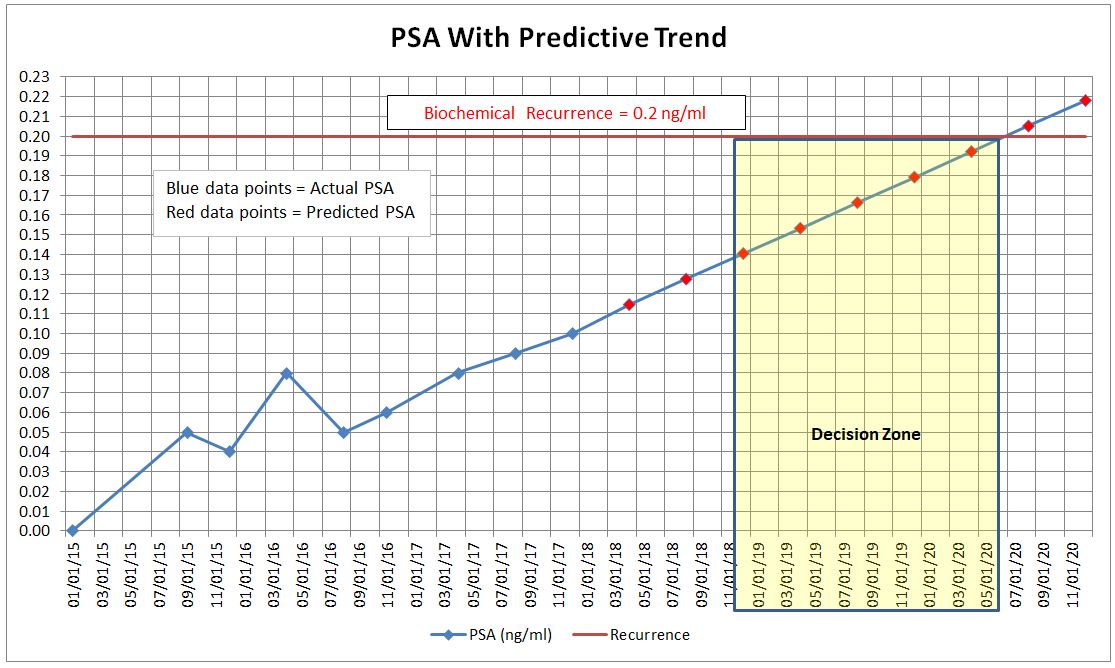
Based on my slow PSA doubling time (around 16 months), if my PSA progresses at its current rate, I’ll have 12 to 28 months to think about this and make my decision, based on whether I want to act if my PSA is around 0.15 or let it go all the way to 0.20. (See my “decision zone” in yellow below—yes, I had to geek out in my spreadsheet once again.) If I want to wait until it’s all the way to 0.5, I’ll have even more time.

Of course, one option is to do nothing. A study in 1999 showed that it took, on average, 8 years after PSA levels began to rise to reach metastasis, and another 5 years after metastasis to death.

The bottom line is that this is becoming increasingly real and that there will be some tough decisions in the next year or two. Of course, those decisions are mine and mine alone, and will be based on a variety of factors, not least of which will be my risk tolerance and any treatment’s impact to quality of life.

On that happy note, I wish you a Merry Christmas and a happy 2018! 🙂


Thanks, too, to those who took time to answer my questions in my salvage radiation therapy survey a few weeks ago. Your insights were quite helpful to me.

Month 85–Learning about Salvage Radiation Therapy

Now that I’m officially halfway to the widely accepted 0.2 ng/ml definition of biochemical recurrence, it’s time to dig deeper into the most likely next step for me: Salvage Radiation Therapy (SRT).

I’ve already done considerable research on reputable websites and through reading studies or books, but the one area that I would like more information about is from those who have actually gone through SRT after a prostatectomy. Having those first-hand insights can be invaluable.

If you have had a radical prostatectomy and subsequent salvage radiation therapy because your PSA was on the rise just as mine is, please take a few minutes to answer my questions about your experience in my:

Salvage Radiation Therapy Questionnaire

It’s only 9 questions long and should take just a few minutes to complete. I’ll be truly grateful for your input.


If I’m being perfectly honest, I have real reservations and concerns about starting SRT. Like most everything else in dealing with prostate cancer, it seems to be yet another crap shoot with questionable outcomes at potentially significant cost to quality of life.

Based on my research, SRT doesn’t seem to have all that high of a success rate, with 30%–50% of patients being progression-free at 5 or 6 years after receiving SRT. That means that 50%–70% of the patients have the cancer remain and, as an added bonus, those patients now have increased incontinence and erectile dysfunction issues, as well as potential bowel control issues.

Before we start zapping my body with radiation, I want to know with a high degree of certainty that we’re zapping the actual location of the cancer. That poses two problems.

First, studies show that the earlier you start SRT, the higher the success rate. In fact, I would not be surprised to find a few survey respondents who have started SRT at a PSA level lower than my 0.10 ng/ml. The assumption is that any remaining cancer will be in the prostate bed or pelvic region, and that’s where they focus the radiation. But how do you know that it hasn’t spread beyond the pelvis at those PSA levels? You don’t. (That 30%-50% success rate tells me it isn’t the best assumption to be making.)

That brings us to the second problem. Current imaging techniques won’t locate the cancer until the PSA is at much higher levels. Even a choline-PET scan won’t consistently detect tumors until PSA reaches 2.0 ng/ml (it may be able to detect down to 1.0 ng/ml, but the number of false readings goes up considerably).

Do I risk all those nasty life-long side effects on the assumption that the cancer is still in the prostate bed, or do I wait until imaging technology can accurately detect the cancer’s location?

I’ll have a thorough discussion with my doctor next week when we review my latest PSA results, so it will be interesting to get that input. I’ll keep you posted.

Thanks again if you’ve taken time to complete my questionnaire.

Day 2,583–PSA Results

PSA 20171204My December PSA results came back just as predicted by my spreadsheet’s silly little trendline: 0.10 ng/ml.

The bad news is that it keeps climbing; the good news is that the doubling rate appears to be about 16 months. My follow-up appointment with my doctor is 19 December 2017 where we’ll probably agree to continue to monitor every 3-4 months for the time being.

Interestingly, from an emotional perspective, this has been pretty much a non-event for me. I’ve resigned myself to the fact that the likely explanation for the increasing PSA is the return of the cancer, so at this point, it’s only confirmation of something that I already suspect/accept/know.

That’s it for now. I’m sure I’ll have more thoughts in this month’s regular post on 11 December.

Month 82 – Reviewing PSA Results with Doctor

At this afternoon’s visit to the doctor to review my August PSA results, he asked, “How are you doing?” I replied, “I’m hoping you’re going to tell me.” “With a PSA of 0.09, you’re doing fine.”

I have to admit that I wasn’t quite psychologically prepared for that answer. Nor was I really prepared for the conversation that followed. But before getting into that, the bottom line was just as I expected: Continue to monitor PSA on a four-month cycle, which has me back in the lab in early December.

This was a new doctor that I hadn’t seen before and he was definitely more seasoned than the last one that I had. Still, all those years of experience could have taught him some better communication skills. He talked in broad generalities and in circles—even in response to my direct questions—and that was more than frustrating.

On the topic of recurrence, he didn’t think that I should be so quick to assume that an increasing PSA is indicative of recurrent cancer. He offered up the possibility that it could have been some benign prostate tissue left behind after the surgery and has grown enough where it’s detectable on the PSA test. Or, it could be cancer.

On the topic of PSA tests in general, he reminded me that the really old threshold for biochemical recurrence was 0.4 ng/ml before it was lowered to 0.2 ng/ml. It seemed that he valued the ultra-sensitive PSA test only as it related to the post-surgery pathology. If the pathology was bad, he seemed to put more stock in the ultra-sensitive PSA; but if the pathology was good, he seemed less inclined to put stock in it.

In other words, if you had a 4+3 Gleason score, positive margins, seminal vesicle involvement, or lymph node involvement—or some combination thereof—he would be more likely to consider acting on a 0.09 ng/ml PSA. But it my case with a 3+4 Gleason, negative margins, and no seminal vesicle or lymph involvement, my sense was that his response to my 0.09 PSA was a pretty nonplussed, “Meh.” Or, if my PSA gets to “around 0.13 ng/ml,” we might start exploring treatment options.

On the topic of doing additional testing such as scans to see if there is cancer anywhere, he said that nothing would show up on a scan or MRI with a PSA of 0.09. I want to dig into that some more.

On the topic of salvage treatments, he thought that, given my pathology, the first step would be “a little radiation.” (I’m not sure if sprawling out on the beach for 7 weeks qualifies for “a little radiation,” but it may be worth asking.) He wouldn’t do ADT (hormone therapy) in conjunction with the radiation, again, given my pathology.

Lastly, at one point during the conversation, he quite confidently made the bold prediction that I wouldn’t die from prostate cancer. You think I’d be jumping for joy. I’m not. Perhaps its my experience as a seasoned patient that’s telling me to withhold judgment on that one for the time being.

All in all, this is good news. My lack of enthusiastically embracing it, however, comes from the fact that, rather than eliminating variables to consider, I feel that this meeting introduced a few more, and that just muddied the waters. Emotionally, at this point, I just want this stupid disease to pick a path and stay on it. I may also check with the VA to see if there’s any way I can pick one doctor that I can build a relationship with rather than this new-doctor-a-quarter routine.

Month 81 – PSA Threshold for Salvage Therapy Survey Results

In last month’s post, I asked readers to complete a short survey to get a better idea of the PSA threshold that would dictate the beginning of salvage therapy. The survey asked:

  • How their medical teams defined “undetectable” PSA levels.
  • How their medical teams defined biochemical recurrence after a prostatectomy (what PSA level).
  • At what PSA level did they and their medical teams decide to begin salvage therapy.
  • How long after PSA biochemical recurrence was it before salvage therapy began.

Before going into the results, I first want to thank those who took the time to participate. You may view the results using the link below:

Salvage Therapy Treatment Survey Results

I could have designed the survey better. I probably should have asked for post-surgery Gleason score and pathology to see if there was a correlation between a higher Gleason score and acting earlier at a lower PSA level. The sample size is small enough where it’s not statistically significant, but there were some interesting observations:

  • The definition of “undetectable” generally ranged from <0.01 to <0.1 ng/ml. I believe that to be a reflection of whether the traditional PSA test or the ultra-sensitive PSA test is being used.
  • The consensus for the definition of biochemical recurrence seemed to be 0.2 ng/ml.
  • The PSA level at which some sort of salvage therapy began was widely spread between 0.17 ng/ml and 3.5 ng/ml.
  • The time to begin salvage therapy after biochemical recurrence varied from one to 35 months.

[Note: I’ll keep the survey open for a while longer and new responses may skew the summary above.]

For me, there aren’t any real “A-ha!” findings that provide clarity, and I expected that going into this exercise. The only thing that’s clear is that each case is unique—from both the patient’s perspective and the medical team’s perspective—and that means that my numbers will be different from your numbers and those will be different from Sam’s numbers and all of us will act (or not) on those numbers differently.

It is nice to know, however, that my medical team is in alignment with others on some of the measures.

And just to prove that I’m not nuts obsessing over the definition of biochemical recurrence, a somewhat dated research paper (2007) showed “a total of 145 articles contained 53 different definitions of biochemical recurrence for those treated with radical prostatectomy….In addition, a total of 208 articles reported 99 different definitions of biochemical failure among those treated with radiation therapy.” [Emphasis added.]

No wonder there’s confusion among us patients!

For me, the key statement in that paper was, “The Panel acknowledges that the clinical decision to initiate treatment will be dependent on multiple factors including patient and physician interaction rather than a specific prostate specific antigen threshold value.”

It’s up to us.