Day 2,823 – Surprised

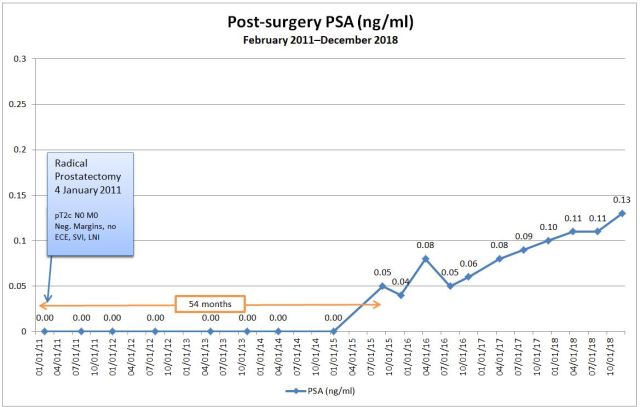
I was more than pleasantly surprised this morning when I learned that my PSA remained the same! It came back at 0.11 ng/ml, the same that it was in April.

PSA 20180801 plain


I learned the news from my primary care physician this morning when I was in to have something else checked out. In fact, I was so surprised by the result that I had to ask him twice to confirm that it was the 1 August reading and not the April reading.

I did ask him for his take on the reading, my history, and what he thought I should do next. He agreed that there are too many differing opinions and recommendations making it frustrating for patients. “Go with your gut,” was the best advice he could muster up.  Gee, thanks.

Of course, the stalled PSA growth (one data point does not make a trend), makes me inclined to kick the decision can another four months down the road—another four months without the side effects of radiation therapy. However, when I meet with the urologist on 19 August to go over the results, I’ll focus the conversation on the long term side effects of salvage radiation therapy because I don’t want to rule that completely out yet, either.

I may even email the radiation oncologist the results to get his take on them. Would he still want to zap me now (probably yes), or would he be more inclined to wait a while longer?

Regardless, I’m going to enjoy the results for now and think about decisions after the visit on the 19th.


Life After Radical Prostatectomy: 90 Months Later

So it’s been 90 months since my radical prostatectomy. How am I doing?

Status

With a continuously rising PSA, it’s time to face that reality that I have a biochemical recurrence and the cancer is back. Now it’s just a matter of trying to figure out what to do about it. Far easier said than done.

Emotions

Whether consciously or subconsciously, I came to terms with the idea of recurrence a while ago. What I’m really struggling with right now is how I’m going to make the decision as to whether to proceed with salvage radiation therapy now, later, or even at all. I have no idea how I’m going to make that choice and be satisfied that it’s the right one. When I chose surgery and my surgeon after my initial diagnosis, I was completely satisfied with my choice, had no regrets, and never second-guessed it once. I’m lacking that confidence right now.

Incontinence

On the whole, I’m still doing well with incontinence—well into the mid-90% dry range. I have noticed, however, a few more unexpected minor leaks popping up than what I’m used to. That’s concerning, especially if I choose salvage radiation therapy and its potential side effects.

The leaks usually happen when I’m more physically active (especially lifting something heavy), so if I know I have that kind of activity planned in my day, I’ll throw a thin pad in my underwear for good measure.

Sexual Function

It seems that my ability to achieve decent erections has regressed a little, too. I’m probably more in the 70%-85% range now. Good enough to achieve an orgasm, but questionable for much more than that. Of course, if I have salvage radiation therapy, those numbers will likely drop significantly, especially because only one nerve bundle was left behind.

Summary

My first ever visit to a radiation oncologist in May was a defining moment for me. It certainly took its emotional and physical toll from me. I was so mentally and physically exhausted from the research and constant thoughts that I just had to stop and step away. I know I have a major decision ahead of me at some point in the future but, for now, I’m content with not thinking about it at all at the moment.

I know I’ll get snapped back into reality when I go for my next PSA test on 1 August 2018.

Month 91 – Random Meetings and Thoughts

It was bound to happen. The other day I ran into my radiation oncologist in the little convenience store in the hospital where both of us work. It was kind of funny. There was his initial reaction when he saw me and recalled who I was, “Hey, howyadoin’?” he asked, followed quickly by a slight tinge of panic wondering if I was going to assault him with a battery of follow-up questions right next to the granola bars and packaged nuts. I didn’t. “Hi, Doc! How are you?” is all I replied, much to his relief, I’m sure.

A few days later, I was back in the convenience store standing in line behind a bearded 30-something guy in black scrubs. I commented, “Black scrubs? I don’t know that I’d want you coming into my room if I were a patient here. It would look like the Grim Reaper is coming to pay a visit.” (For being a terminal introvert, I can be good at striking up conversations with complete strangers.) He laughed and we chatted some more. “Where do you work?” I asked. “Radiation Oncology, so I suppose the black scrubs take on added meaning there.” He was one of their radiation technicians, and I didn’t bother to tell him that he may be zapping me someday soon.

All of that has highlighted me to resolve another internal debate that I’ve been having with myself: Whether or not to inform my coworkers of my recurrence.

I work for a small nonprofit that has a staff of 22 employees, plus, more and more staff members at the hospital know me because of the reach that our organization has there. In essence, we’re family. If I do choose to get zapped 75 steps away from my office, the chances of someone I work with seeing me entering or leaving Radiation Oncology are pretty good. “Surprise!”

Beyond that, I questioned why I want to share this with my work family. To have more shoulders to lean on? To let them know why I’m so distracted and distant some days? If I’m perfectly honest with myself, it’s a little bit of all of that. But I also know from experience that, when I shared my story with my coworkers shortly after being initially diagnosed, a burden had been lifted from my shoulders. “A burden shared is a burden halved,” someone once said, and there’s truth in that.

I was all set to share my story until tragedy struck when one of our staff members passed away unexpectedly. That put my little plan on pause, appropriately so.

Part of me is thankful for the pause. On reflection, I may be putting additional indirect pressure on the decision-making. If I’ve got 44 eyeballs looking at this introvert in anticipation of a decision, that could be nerve-wracking. Perhaps it’s best to wait to share my story until after I make the decision, that way there won’t be the second-guessing that comes when people question your choice, if not overtly, at least by that puzzled glance.

Speaking of the decision, I don’t know that I’m any closer to it. I continue to research for a few hours each week, reading articles and journals, and I’m coming to the conclusion that I probably have enough information on the treatment and its side effects to make the call. I’m not going to find that magical “a-ha” paper that swings the decision one way or the other.

One of the hang-ups that I have though, is the lack of ability to determine where the cancer is at my current PSA levels. I really would like to know with a high degree of confidence that we’re zapping in the right place. Yet, one article sticks in my mind where the author wrote, “That would be a self-fulfilling prophecy: by waiting for the cancer to put out more PSA [so the imaging could detect it], one is virtually ensuring that the cancer will grow, spread, and possibly metastasize.” Food for thought.

In my head, I’m thinking we wait for the August PSA results and go from there. Perhaps take a nice autumn vacation and, if I choose to get zapped, do so not long after I return. Or not. (Definitely the vacation part, though. I need that!)

Day 2,758 – Heads or Tails

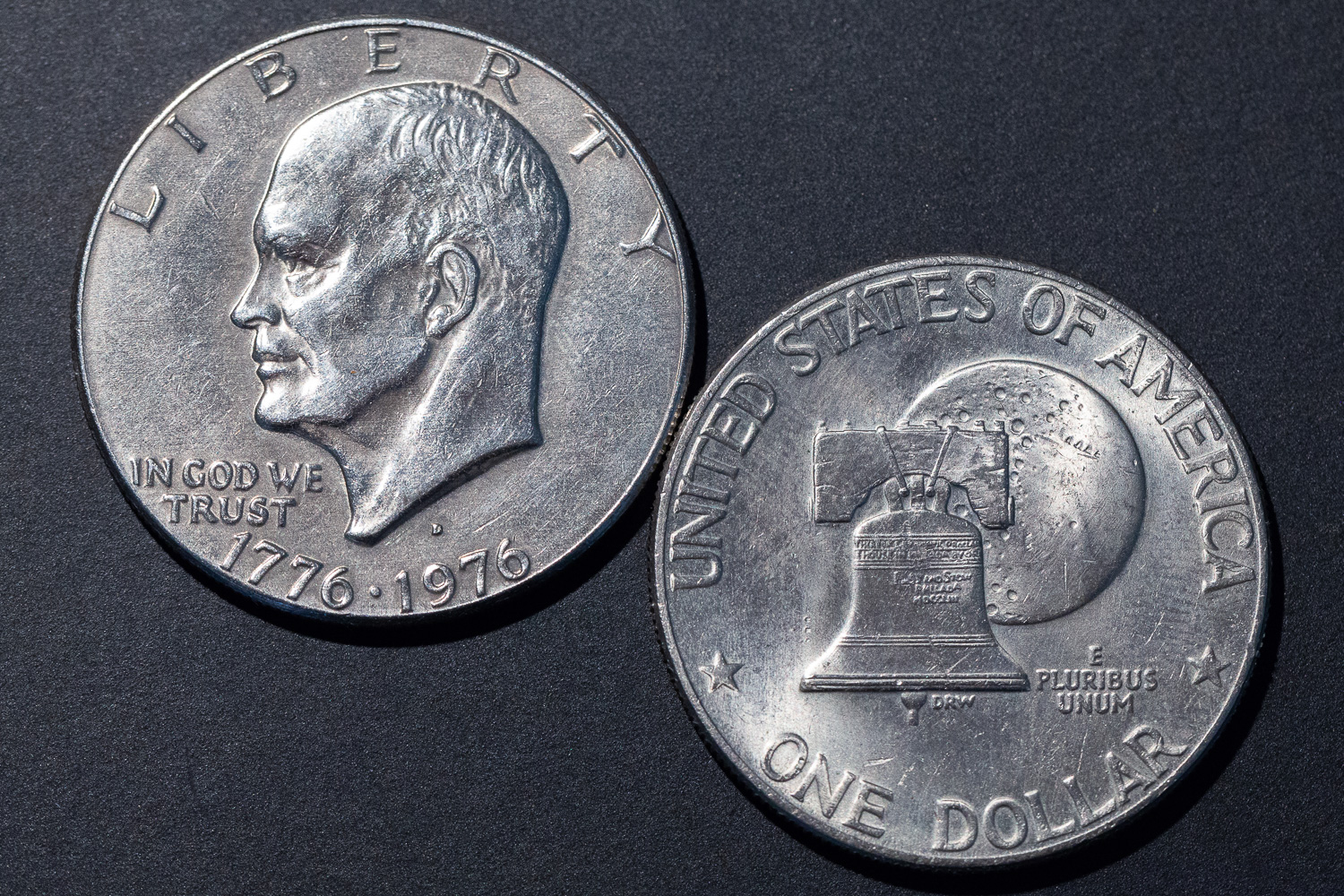
IMG_5341That’s what it’s coming down to, or so it seems. Using the ultimate “executive decision-making aid” to determine what I’m going to do.

What brought this on? Another email exchange between me and my radiation oncologist.

Over the weekend, a few more questions popped into my head and I wanted to get his response. Yesterday, I fired off an email asking if any advances in radiation delivery technology or methods in the last 10-15 years improved the side effect outcomes over the studies he shared with me. In short, the answer was no—there were no appreciable changes.

Of greater interest to me was his interpretation of the Freedland study, which shows that I can do nothing and have a 94% chance of being around 15 years from now. His response:

I am familiar with the study you included, and it is one of many retrospective reviews on this subject. The authors preformed a retrospective review on a total 379 patients over period of 18 years from 1982 – 2000. Therefore, although the data are valuable and contribute to the literature, I consider it (as well as the many other studies on this subject) thought provoking.

Perhaps I’m reading too much between the lines, but his last sentence translates into “skeptical of the study” to me. He continued:

The bottom line is that you have a biochemical recurrence with a low, slowly rising PSA.  Do you need radiation treatment now, sometime in the future or never?  I don’t have a definitive answer to that question, but there are data to suggest “the earlier the better” and other data to suggest treatment might not be needed at all.  It depends on your point of view…

Am I upset by that response? Not really. It’s pretty much what I expected it to be, and that tells me that my research has been quite thorough. He and I both landed at the same place.

Will it make deciding my course of action any easier? Hell no. But it does reinforce that it’s my decision, and my decision alone.

Now where did I put those Eisenhower dollar coins again???

Day 2,754 – Researching Salvage Radiation Therapy—Again

It’s 7:30 p.m. on the Saturday of a three-day holiday weekend in the United States, and I’m reading articles on salvage radiation therapy. Who said prostate cancer wasn’t fun?!?

I did come across this informative article from the Journal of Clinical Oncology published in May 2007:

Predicting the Outcome of Salvage Radiation Therapy for Recurrent Prostate Cancer After Radical Prostatectomy

The authors set out to create a nomogram that predicted the “probability of cancer control at 6 years after SRT for PSA-defined recurrence,” and they speak at length about the variables used in their nomogram, as well as its limitations.

I plugged my stats into their nomogram and came up with a 70% probability that I won’t see any progression at six years. That’s right in line with what the radiation oncologist told me. (The nomogram is a little clunky to use, as it’s a graphical scale that you have to draw lines through to determine your score. I’d much rather have fields to enter on an online form that calculates it more precisely.)

There was one paragraph that talked about side effects of SRT that really caught my attention:

The potential for morbidity resulting from radiation therapy argues against its indiscriminate use in the salvage setting. Mild to moderate acute rectal and genitourinary toxicity is seen in the majority of patients, but the reported incidence of acute grade 3 to 4 complications is less than 4%.4,6,9,14,21,36 Late grade 1 to 2 rectal and genitourinary toxicity are reported in 5% to 20% of patients, and late grade 3 toxicity is less than 4%.3,4,6,8,11,21 Although rare, pelvic radiation therapy for prostate cancer is associated with an increased risk of secondary pelvic malignancies.40 Postprostatectomy radiotherapy does not appear to significantly increase the risk of urinary incontinence,3,4,6,14,21,41 but we must presume that it has some adverse effect on erectile function on the basis of the data from primary radiation therapy series. The nomogram can be used to restrict SRT to those patients most likely to benefit and avoid treatment-related morbidity in those predicted to have a low probability of a long-term benefit.

That 5% to 20% range for late grade 1 to 2 rectal and genitourinary toxicities made me go, “Hmmm…” Not quite the “single digits” probabilities that my radiation oncologist said.

After reading a number of the articles in the footnotes and listed on the “We recommend” column of the website, it’s apparent from most of them that starting SRT early is the way to go. It’s also apparent that the probability of being progression free at six years varies considerably from the 30% range to the 77% range depending on your PSA doubling time, PSA level, Gleason score, time to recurrence, and post-surgery pathology. But we already knew that.

This also caught my eye:

A rising PSA alone is not justification for initiating salvage therapy because patients with PSA recurrence are as likely to die as a result of competing causes as they are of prostate cancer.1 To determine the need for salvage therapy, we suggest using one of several existing tools to estimate the probability of developing metastatic disease or cancer-specific mortality.2,22,23 Patients at high risk of progression to these clinically significant events and/or a long life expectancy should be assessed for SRT using our nomogram.

Digging into the three footnotes listed, two are studies that I’ve already referred to in earlier posts—Pound and Freedland—and both suggest that it could take a very long time for the cancer to metastasize. The third study referenced, Predictors of Prostate Cancer–Specific Mortality After Radical Prostatectomy or Radiation Therapy, also reinforces that notion.

We’re right back where we started from: Zap early with an average 50-50 shot of it being effective (with the 4%-20% chance of long-term side effects) or do nothing but monitor.

I may send some of these links to my radiation oncologist on Tuesday and ask, “Which of these studies do you put the most stock in, and why?” and see what he says. Could be interesting.

Well that’s enough fun with cancer on a Saturday night. I’ll keep you posted on any new research findings or developments with the doctor.

Day 2,747 – Side Effects of Salvage Radiation Therapy

During my conversation with the radiation oncologist on Thursday, a big part of the discussion was on the long-term side effects of salvage radiation therapy. He stated that the probability of long-term urinary or rectal side effects was “in the single digits.” That reinforced my own understanding, but after the meeting, it occurred to me that we didn’t talk about the severity of those side effects in any detail.

I fired off an email to him on Friday asking, in essence, of those with long-term urinary and rectal side effects, what percent of those are mild, moderate, or severe?

He replied in a matter of hours and said that he couldn’t respond using the terminology in my email (I gave him definitions of what each of those meant in my own mind). Instead, he referred me to the Common Terminology Criteria for Adverse Events (CTCAE) used in standardizing terminology used in research across the globe. He referred me to “cystitis” and “proctitis” to see their definitions for grades 1 through 5. (Grade 1 was the least impactful; Grade 5 was typically death.)

The doctor also shared side effect data directly pulled from the manuscripts of 3 major randomized trials in post-prostatectomy patients. He didn’t provide the links—just the text—so I used the Google machine to come up with the links/articles. It’s interesting to note that all three are focused more on adjuvant radiation therapy than salvage therapy, but I suppose getting zapped for one is pretty much the same as getting zapped for the other.


Bolla et al, Lancet, Vol 366, Aug 2005

Late effects of rectal and bladder grade 3 or higher were only slightly increased in the XRT group vs. the observation group: 4.2% vs. 2.6%.

Wiegel et al, JCO, 2009

There was only one event of grade 3 toxicity (bladder). No grade 4 events were recorded. There were three events (2%) for grade 2 genitourinary adverse effects in the RT arm compared with none in the other arms. In addition, two grade 2 GI adverse effects (1.4%) were seen in the RT arm compared with none in the other arms.

It was interesting to note that the doctor omitted the second half of that paragraph from the original study:

Altogether, the cumulative rate of adverse effects for bladder and rectum (≥ grade 1) was 21.9% in the RT arm and 3.7% in the wait-and-see group (P < .0001; Appendix Fig A2, online only). One urethral stricture occurred in arm A and two occurred in arm B. Incontinence was not assessed, because it is not mentioned in the RTOG/EORTC scoring scheme.

Thompson et al, J Urology, 2009

We conducted a companion quality of life study in 217 men randomized to S8794 with assessments at baseline, 6 weeks, 6 months and annually for 5 years. A strength of this analysis was the inclusion of a 6-week assessment, designed to capture the side effects of radiotherapy at their peak. Tenderness and urgency of bowel movements were significantly more common at the 6-week point (47% vs 5%) in the radiotherapy group but by 2 years there was little difference between the groups. Urinary frequency was more commonly seen in the radiation group but there was no difference in the rate of erectile dysfunction (common in both groups) between groups. Global assessment of quality of life, while initially worse in the adjuvant radiotherapy group, became similar by year 2 and was increasingly superior in the radiotherapy group during the following 3 years. This gradual switch toward a superior quality of life in the adjuvant radiotherapy group should be examined in the context of the increased rates of PSA recurrence, salvage radiotherapy and hormonal therapy in the observation group, all of which have negative impacts on quality of life.

I’ve only skimmed the full studies at the moment, and I’ll come back to them in a day or two. On the surface, however, the numbers have eased my fear of long-term side effects a tad.

Right now, I just need to get away from the topic for a few hours and have some fun. Time to go out and play…

Stay tuned.

Day 2,745 – Conversation with the R.O.

When I was in 7th grade, I had to give a presentation on my science project, an erupting volcano, and I was so anxious about the presentation that I became physically ill and erupted myself. Not pretty. While I didn’t get physically ill today, the feeling was almost the same as I waited to see the radiation oncologist. It’s silly, I know. But it was very real.

In a nutshell, his recommendation was to start salvage radiation therapy.

The R.O. is a Navy captain medical officer, and we spent nearly forty-five minutes going over my case (which I truly appreciated). He took control of the conversation from the outset, explaining the options and consequences of each. I could tell that he had given this little presentation once or twice before. Once we got through that, we did have a real conversation. Some key points:

  • He disagreed with the notion that the increasing PSA is from residual benign prostate tissue left behind.
  • He was confident that the cancer would be in the prostate bed based on my numbers and statistics.
  • He talked about the differing definitions of biochemical recurrence, saying that the American Urological Association (AUA) and American Society for Radiation Oncology (ASTRO) use the 0.2 ng/ml threshold, but the National Comprehensive Cancer Network (NCCN) defines recurrence as a detectable PSA with two consecutive increases. My case meets the NCCN definition.
  • Continued surveillance is a viable option for me given my numbers and PSA doubling time.
  • We talked about the short and long-term side effects of radiation therapy: urinary control, sexual function and bowel control. His estimate the probability of long-term quality of life-impacting side effects in any of the three areas to be in the “single digits.”
  • He reminded me of selection bias when talking to other patients or bloggers about their side effect experiences. Yes, their experiences are very real, but for each person in an online forum, there are many others outside the forum who are leading productive, acceptable lives.
  • If we were to do salvage radiation therapy now with my PSA under 0.2 ng/ml, he put the probability of me having no evidence of disease five years from now at seventy-five percent. If we wait until my PSA is above 0.2 ng/ml, that number decreases.
  • Newer scanning technologies weren’t likely to pick up anything at my current PSA levels, yet he was open to the idea of them if it gave me peace of mind.
  • With my numbers, there is no reason to radiate the pelvic lymph nodes or use androgen deprivation therapy (ADT).
  • He was open to waiting until the August PSA results to see what they revealed before making a decision.

It was a good conversation, but I’m sorry to say that I don’t know that there was a lot of new information for me there that would tip the scale either way. The doctor wasn’t pushy in one direction or the other, saying that it was equally reasonable for me to continue surveillance or for me to begin salvage radiation therapy. The choice is mine. About the only thing he was adamant about was not starting ADT, and I’m in perfect agreement with him on that.

I did learn one really interesting thing, however. The reason that the VA Medical Center referred me to Naval Medical Center San Diego has to do with geology. Apparently VA Medical Center San Diego (La Jolla) was built sufficiently close to a geological fault line that they couldn’t build a radiation “bunker” that would be safe in the event of an earthquake.

What’s next for me? A ton of thinking, reflecting, and reevaluating.

Enough for now. I’m spent.

Day 2,722 – No Probability for Me

I’m one of those people who always thinks of a snappy comeback—three days after the conversation.

Over the weekend, I reflected on my conversation with the doctor last Thursday, and one of the things that I failed to ask was what probability he would assign to the notion that my increasing PSA is attributable to benign residual prostate tissue instead of returning cancer. I sent an email that asked specifically:

I fully understand that none of us have a crystal ball, but the one thing that I failed to ask Dr. is what he thought the probability of this being benign residual tissue was. Is it 5%? 25%? 50%? His experience gave him the insights to make the comment, so his experience may also be able to measure the likelihood as well.

To which he replied:

I’m afraid I am not able to assign a percentage likelihood to the chance that any residual tissue is benign. I can only really extrapolate from the rate of change in the PSA. The longer it took to be detectable and the slower it rises, the more it seems likely to be a bit of benign tissue. Either way, it is those lab values and their pattern that will help to guide treatment. If it rises quickly then will treat, since a) that pattern is more likely cancer, and b) if it’s not cancer it is acting like cancer and the stakes are too high to disregard even with a high % prediction at this point that the tissue is benign.

Hope that helps!

Dr.

His comment, “…b) if it’s not cancer it is acting like cancer and the stakes are too high to disregard even with a high % prediction at this point that the tissue is benign,” seems to be all over the place and contradicts his opening statement of not being “able to assign a percentage likelihood.” Hmmm…

So that was an interesting little exercise. I really didn’t expect him to come back with a specific number, but I thought I’d ask anyway. I don’t know that his answer convincingly persuades me one way or the other, but it does allow me to throw a tad more weight behind his theory that this is benign. A tad.

Bottom line: The only thing we know with any certainty is that my PSA continues to climb. Beyond that, it’s all a freaking guessing game.

On a related note, I’ve yet to hear from the radiation oncology department with an appointment for me. If I don’t hear from them tomorrow or Thursday (a crazy day at work for me), I’ll try to call on Friday to get on the calendar.


UPDATE:

About an hour after posting this, I came across this little gem of an article from 2005:

The presence of benign prostatic glandular tissue at surgical margins does not predict PSA recurrence

Key points:

We conclude that the presence of benign prostatic tissue at the surgical margins is not associated with adverse prognostic features and does not have prognostic relevance; therefore, we do not advocate reporting the presence of benign prostatic tissue at the inked margins as a standard part of the surgical pathology report on prostatectomy specimens.

Because benign epithelium at surgical margins is not correlated with postoperative PSA rises, postoperative PSA increases should in most cases continue to be considered “biochemical failure”.

Obviously, that’s not good news and certainly warrants more research.

This article from 2013 calls a few things into question:

Benign Prostate Glandular Tissue at Radical Prostatectomy Surgical Margins

Key point:

The most interesting finding of this study is the identification of Benign Glands at the Surgical Margins (BGM) after both Open Radical Prostatectomy (ORP) and Robot Assisted Laproscopic Radical Prostatectomy (RALRP) was not associated with recurrence, either biochemical or clinical, during a median follow-up interval of 49 months after ORP and 28 months after RALRP.

Extending followup further should clarify whether BGM leads to low, detectable levels of PSA that may not meet threshold for defining biochemical failure. This may be particularly relevant with the widespread availability of ultra-sensitive PSA assays. The routine use of ultra-sensitive tests after treatment has not been validated and remains controversial in clinical practice, and may be particularly true in patients at low risk of disease recurrence and potentially in those with BGM.

Within our cohort, longer follow-up may reveal detectable levels of PSA associated with BGM that may not reflect actual prostate cancer recurrence but rather a clinically benign elevation of PSA.

In other words, there’s more research to be done.

Day 2,717 – The Discussion

I hate this flippin’ disease.

My discussion with my urologist went pretty much exactly as I suspected it would, but with a few twists to screw with my mind a little. One of those little twists, however, happened much earlier than the meeting.

This morning as I was shaving, there was this strong sense of fear that hit me, tying my stomach in knots. That was completely unexpected and unfounded because I had a good idea of what was going to happen with the doctor. Even so, it was something that took control and definitely set my mood for the day.

When the doctor entered the exam room, I told him about my propensity to just verbally vomit all over the doctors before they even had a chance to explain their interpretation of my results. I shut up and let him talk away (with my battery of questions at the ready on my lap).

Pretty much everything that he said were things that I already knew:

  • The increasing PSA is a concern, but the slow rate of increase is a good thing.
  • That salvage radiotherapy would be the likely next step.
  • Given my pathology and history, it’s likely that the cancer is still in the prostate fossa.
  • Starting salvage radiotherapy earlier rather than later has typically shown to have better outcomes.
  • We have no guarantee of knowing where the cancer is at, so the radiotherapy may be ineffective.
  • Current imaging technologies aren’t good enough to detect the cancer’s location.
  • There’s no cut-and-dry set of numbers that would dictate specific actions.

The one kicker that knocked me for a loop was something that he said as we were reviewing my PSA tracking chart (I had to bring a copy of that, of course). He did mention the possibility that what we’re tracking may actually be benign prostatic tissue left behind that’s causing the PSA to rise. His reasoning was the fact that it took 54 months for the PSA to become detectable again and its slow rise ever since. He suspected that if the cancer was returning, the PSA would be climbing more rapidly. That, of course, would be great news. He didn’t assign a probability to his theory being right, however.

He did ask if I would be open to a referral to a radiation oncologist to at least begin the discussion and get educated. I said that, if he hadn’t suggested it, I was going to request it, so, yes, I was open to the referral. I don’t have an appointment on the calendar for that yet—they should call in the next few days.

I did mention the PSMA imaging trial that’s going on at UCLA and he was supportive of me looking into it. He cautioned, though that it is a trial and there’s no way to know yet how effective it may be. To be honest, it’s been a while since I looked at the trial page and I’m not sure that I would qualify to participate if it’s still ongoing. Something to dig into.

Lastly, he said there’s no need for urgent action at the moment. We’ll continue the four-month PSA test cycle for now. That will have me in the lab the first week of August.

When you get your care through the Veterans Administration (VA), as I do, you rarely see the same doctor twice. I mentioned that to this urologist and commented that, in a way, it’s a good thing because I’m getting multiple opinions and perspectives. He was taken aback by that comment, saying, “That’s a charitable view. I usually hear the opposite.”

He’s the second doctor who’s mentioned the possibility of this being nothing more than benign prostate tissue left behind that’s causing the PSA to return and rise. Perhaps I need to put a little more stock in that theory. But after spending two years wrapping my head around the notion that the cancer is returning—a mentally and emotionally exhausting exercise—when you hear something like this, it really screws with your mind. Or at least it does mine. It’s one more variable added to an ocean of uncertainty when you’re desperately seeking solid land.

The good thing is that I have time, and time may bring a little more clarity on which to base a decision at some point in the future. In the meantime, I’ll just don my kapok life preserver and bob around in that ocean of uncertainty reflecting on how much I hate this flippin’ disease. (Yes, I’m dating myself with the kapok reference.)


Day 2,703 – PSA Results

The bad news: My PSA continued its upward climb to 0.11 ng/ml. The good news: The rate of increase remained constant (and is still quite slow).

The result is exactly where my spiffy spreadsheet said it would be, so I’m not overly surprised. All that’s left to do now is wait for my appointment with the urologist on 19 April. I’ll have to do my best to let him speak a little before I assault him with my already prepared list of questions.

This result reinforces my belief that it’s time to bring a radiation oncologist into the discussion so I can get his or her perspective on salvage radiation therapy, especially regarding the risks of long-term side effects impacting quality of life and the likelihood of success.

More to come…

PSA 20180405