Month 181 – Physical Therapy for Incontinence

I’m of the mind that PT stands for Pain & Torture, not physical therapy. (Okay. I exaggerate.)

During my appointment with the urologist back on 7 October, we talked about how my incontinence seemed to be slowly worsening post-radiation. One of the options that he offered up was pelvic floor therapy, and I decided to give that a try.

Unfortunately, the VA doesn’t offer that therapy in-house, so they had to arrange for community care. That process took until mid-November to get the appointment set up, and I just had my first appointment last week.

I was expecting more instruction on Kegel exercises, perhaps with the biofeedback device that they used on me pre-surgery to train me on how to do the exercises. But that’s not what’s happened so far.

The physical therapist explained that many of the muscle groups in your legs and torso can have an impact on your pelvic floor muscles, too, as they’re all connected as part of a larger system. By stretching and strengthening them, we could see improvements in the pelvic floor. At first, it sounded like a bit of phooey to me, but I’m approaching this with an open mind and giving it a shot.

I’ve had just two sessions so far, and we’ve focused mainly on stretching exercises impacting my hamstrings, glutes, calves, and torso, as well as doing squats and walking on a treadmill. Some of the stretches are bordering on turning me into a contortionist, which this soon-to-be 68-year-old body is fighting tooth-and-nail (hence, “Pain & Torture”). But they’re low impact and we’re taking it slowly so I don’t injure myself.

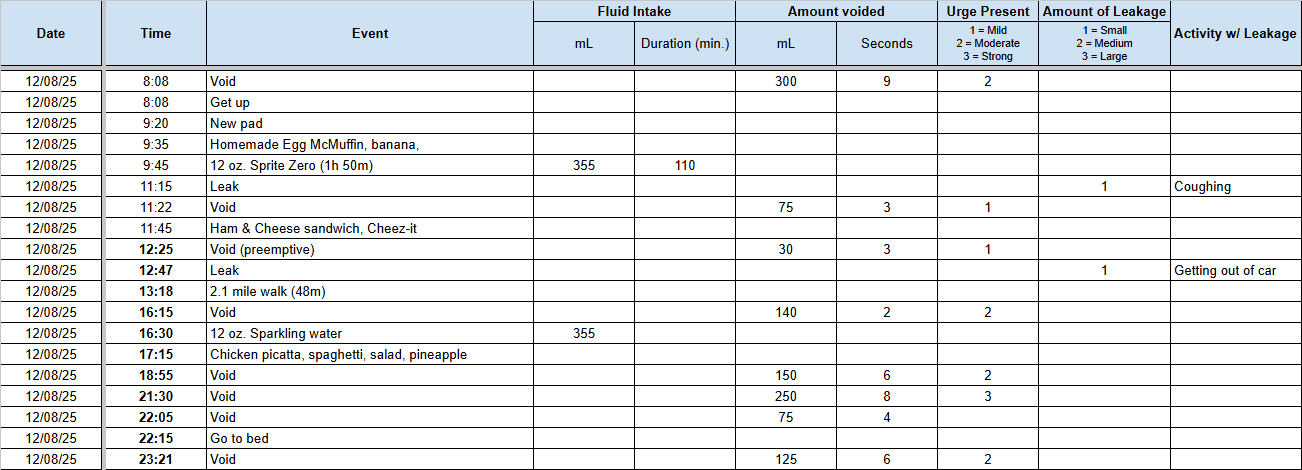
The other thing that she had me doing was documenting my fluid intake, output, and number of incontinence leaks for at least three days. We’re trying to establish a baseline against which we can measure any improvements. She had a hardcopy log which I quickly converted into a tracking spreadsheet. (You know I had to!)

She also made some recommendations to improve my diet and the types/quantities of beverages that I consume (less soda, more water).

Of course, I have to keep up with these exercises daily at home.

On the one hand, I’m a bit skeptical about this approach but, on the other hand, I do feel as though that, even after one week, I’ve noticed that I seem to be having fewer leak episodes and, the ones that I do have, seem to be smaller in size. We’ll let my spreadsheet determine if there’s a true trend, or if this is all in my head.

I have another appointment next week and then, in the new year, she mentioned that we might cut back to every other week sessions or even monthly sessions, depending on the progress that’s made.

One thing that I am a little concerned about is the potential cost of this.

Yes, the VA is covering the costs, but what many don’t realize is that some of us, based on our eligibility criteria, have to pay co-pays for our visits. Seeing the specialists—including the urologist—costs $50 per visit. Seeing a PT every week would rack up significant costs over time, and I’m not sure if the VA has an out-of-pocket cap on how much a veteran pays. (I’ll have to check into that.)

Assuming the holidays don’t mess it up, my appointment with the urologist to review my PSA results is on 30 December. We’ll definitely be talking about another PSMA PET scan and getting medical oncologists involved in my case.

—Dan

Header image: Botanical Building in holiday lights, Balboa Park, San Diego, California

Hormone Therapy for Prostate Cancer Fact Sheet – NCI

I came across this fact sheet on hormone therapy from the National Cancer Institute that does a great job of explaining it all to the uninitiated.

https://www.cancer.gov/types/prostate/prostate-hormone-therapy-fact-sheet

Salvage Therapy for Prostate Cancer: AUA/ASTRO/SUO Guideline (2024)

A moderator on the HealthUnlocked website shared a link to the new 2024 American Urological Association guidelines for salvage therapy for recurrent prostate cancer:

https://www.auanet.org/guidelines-and-quality/guidelines/salvage-therapy-for-prostate-cancer

These are the generally agreed-upon guidelines that practitioners should follow when a patient has recurrent prostate cancer after initial treatment.

Study finds prostate cancer treatment can wait for most men

I saw this on the national news last night and thought the results of the study were interesting:

The study directly compared the three approaches — surgery to remove tumors, radiation treatment and monitoring. Most prostate cancer grows slowly, so it takes many years to look at the disease’s outcomes.


“There was no difference in prostate cancer mortality at 15 years between the groups,” Loeb said. And prostate cancer survival for all three groups was high — 97% regardless of treatment approach. “That’s also very good news.”

That’s going to make a whole lot of guys go, “Huh?!?” The science may say it’s okay to do nothing, but once you hear “cancer,” it will be extraordinarily difficult to not want to do something more proactive. It will be interesting to see if guys stop or cut back on getting screened, and we wind up with more men being diagnosed with advanced prostate cancer instead of localized prostate cancer because they delayed screening.

https://www.nbcnews.com/news/us-news/study-finds-prostate-cancer-treatment-can-wait-men-rcna74512

Here is the New England Journal of Medicine article (I didn’t sign up for full access):

https://www.nejm.org/doi/full/10.1056/NEJMoa2214122

The Cost of Cancer

Cancer isn’t cheap.

I received the last of my Explanation of Benefits statements covering my salvage radiation therapy (SRT) with concurrent androgen deprivation therapy (ADT). You know me. For grins and giggles, I had to play with the numbers.

Ouch!

TherapyBilled
Radical Prostatectomy
and post-surgery infection
(January 2011)
$109,989
Salvage Radiation Therapy
(incl. 6-month Eligard dose)
(May-August 2022)
$176,548
Total$286,737

Those numbers do not include all of the doctor visits and PSA tests from diagnosis to today—just the surgery and SRT/ADT.

For the radical prostatectomy and the subsequent infection hospitalization, that’s what the hospital and doctors billed my employer-provided health insurance company. Of course, the insurance company didn’t pay the hospital the full amount, and I had some copay responsibilities to the tune of $4,372 as well.

For the SRT/ADT, the “Billed” number is what USCD has billed the VA for my treatment. Each zapping session was billed at $3,894. (My radiation oncologist had no idea it was that expensive. As a university employee, he’s not involved in billing.) It appears that the VA is reimbursing UCSD at a rate of somewhere between 10% and 15% of the billed costs.

Coincidentally, I came across this article about the costs of ADT: It cost $38,398 for a single shot of a very old cancer drug. My Eligard shot was billed at $10,835. What a deal! <sarcasm font>

Of course, the emotional cost of cancer is incalculable.

Moral of the story: Don’t get sick without health insurance.

Header Image: Sunset over the Pacific Ocean, Silver Strand State Beach, Coronado, California

Zapping Session #16 – Update

This morning’s session had an unexpected surprise. At the end of the session, the technician told me that my bladder was “borderline” not filled enough, and I found that to be really odd. I used the same bladder-filling timeline and technique this morning that I’ve been using all along. She encouraged me to practice over the weekend.


I met with the radiation oncologist on Tuesday, which was unusual because our normally scheduled meeting day is Thursdays. He told me he was going away for a few weeks, and I asked him where he was going. Long story short, his wife is from Germany and they were going to visit her family in a town that was about an hour from where my grandfather was born. Also, his wife studied at Würzburg, and my cousin is a professor and doctor at the university hospital in Würzburg. Small world.

During the meeting, I mentioned that the side effects were beginning to kick in more, and he commented, “Yeah. You’re at the dosage level where they typically start showing up.” I thought that was interesting because I never considered there to be a dosage threshold for side effects. It makes perfect sense though.

Fatigue

The fatigue is really kicking in now, although it happens in waves of varying amplitudes. For example, after yesterday’s session (Thursday), I was energetic enough to stop by an event at my former employer and just hang out for a few hours and see how everyone was doing. By mid afternoon, I was a tad tired (70% on my internal “battery”) but was able to keep going through the afternoon, past dinner, and into the evening.

Today, though, was a considerably different story. As soon as I was done with the session at 10:15 a.m., I ran and bought groceries, had lunch, and by 11:45 a.m. my internal “battery” was down to about 20% and I was napping until about 2:30 p.m. Hard. Even now, as it’s approaching 4 p.m. as I’m writing this, I feel as though my battery is about 50-60% charged even after the nap.

I may attribute part of the fatigue to my urinary frequency, because it’s definitely increased through the week.

Wednesday night into Thursday morning, I had to empty my bladder just twice. Last night, I had to empty it four times. That’s four sleep interruptions that would contribute to the fatigue.

The doctor did offer to put me on Flomax (Tamsulosin) to relax my bladder and hopefully reduce the frequency. For now, I declined his offer because at some point years ago (perhaps even before I was diagnosed), I had been prescribed Flomax and I recall that it wasn’t a very positive experience with its side effects (extreme dizziness).

Urinary Frequency

As you saw in a previous post, I was using a spreadsheet to track when I was emptying my bladder, but that was cumbersome to use, especially logging an entry in the middle of the night. I found an app called “Simple Time Tracker” that has a widget that I can have on my phone’s home screen, and all I have to do is tap it to start recording when I go to the toilet and tap it again when I’m done. It automatically records the date and time, and that’s all that I’m after. (The only downside is that I can’t export the data to my spreadsheet.)

Between 1 a.m. and 4 p.m. today, I’ve made eleven trips to the toilet, and my only fluid intake was about 1.5 liters of water before the zapping session and another 0.5 liters of soda after the session. It’s not like I’m consuming a high volume of liquids to have me going so often.

Irritation

My skin irritation remains about the same and applying moisturizing lotion does help. But now I have a general constant mild burning sensation in my urethra and hints of it starting in my rectum. It doesn’t hurt to urinate (yet), but the burning sensation is mildly annoying right now. I also think the irritation in my urethra is triggering my brain to empty my bladder when I really could probably wait a while longer without incident. I’m guessing it will likely worsen as the cumulative dosage increases.

Emotions

For one of the first times since starting the hormone therapy, I found myself to be a bit on the emotional side this week. I’m guessing the fatigue contributed to that, too. I’ll leave it at that for now, and I may write about it separately in the days ahead.

Summary

After Monday’s session (1 August) I’ll be halfway through the treatments. If the side effects stay at the current level, that can be manageable. If they get worse, I guess I’ll just have to suck it up and power through them like the countless thousands of radiation patients before me.

Enjoy your weekend!

Day 4,192 – Eligard Injection

This morning was not fun at all.

I checked in at 7:30 a.m. for my 8 a.m. appointment and was a bit nervous but doing generally okay. But around 8:05 a.m., the nurse came out and said, “I know you’re here for some medication, but the doctor forgot to enter the order for it to be administered into your record. We’re trying to track her down now and we’re not sure how long it will take.”

Needless to say, I was not a happy camper.

About 8:45 a.m., the nurse came back out to the waiting area for another patient, and I interrupted and asked him the status of tracking down the doctor. “Oh. We haven’t found her yet. We’re trying to contact any doctor but most don’t come in until after 9 a.m.”

Still not a happy camper.

As you all know, I’ve anguished over the decision to move forward with androgen deprivation therapy (ADT) for a while now. Once you make that decision, you want to move forward with it and psychologically prepare yourself for the event. When you’re given an extra hour and a half, your mind begins to race and to question whether to move forward with this essentially irreversible procedure. At least that’s what my mind did. Call me silly.

The injection itself went well. In fact, it was not much worse than getting my second COVID booster shot last week (or any vaccination). It’s been about three hours since the injection, and the injection site isn’t even sore. It was pretty much a non-event. Time will tell what other side effects will kick in, and how severe they may be.

Well, the stress from this morning has worn me out. Time for a little nap.

More to come, I’m sure.

Be well!

Month 137 – The Decision

It’s been an interesting few weeks of conversations, concern, and coordination. But first a little digression that has been a factor in this whole process.

When I walked from my home to the radiation oncologist’s (RO) office back in mid-February, the nurse took my vitals and my blood pressure was elevated to the point it both surprised and concerned me (and the nurse). We chalked some of it up to “white coat syndrome,” and left it at that for that visit. Even if it was “white coat syndrome,” it warranted further investigation.

In early March, I started experiencing headaches and even some intermittent numbness of varying intensity on the left side of my face. A bit unnerving. I scheduled an appointment with the VA Urgent Care facility and they checked me out. My blood pressure was still elevated (but not as high as at the RO office), and she didn’t suspect that there was a TIA stroke going on. An MRI confirmed no abnormalities in my brain. (Sorry. I couldn’t resist this classic scene from Young Frankenstein. Anyhow…)

Obviously, trying to figure all of this out took precedence over scheduling salvage radiation therapy (SRT), but it’s also related to SRT and androgen deprivation therapy (ADT) because some studies have shown that there may be an elevated risk of cardiovascular events while on hormone therapy. With an elevated blood pressure and a family history it became a question that I wanted to pose to the RO.

RO Call, Tuesday, 29 March

You may recall that the RO told me that I could use the weekend to think about whether or not I wanted to proceed with concurrent ADT or just do straight radiation therapy. He said he would call me between 8 a.m. and 8:30 a.m. Monday morning for my decision. He didn’t.

However, he did call early Tuesday morning and apologized for missing the call on Monday. He said that the school his kids attend dropped their requirement to wear face masks, and they came home with a common cold and gave it to him. (Justification for continued mask-wearing.)

When we began the conversation, I told him that I was ready to do the concurrent ADT—in line with his thoughts—but I wanted to discuss what was going on with my blood pressure. He said that the cardiovascular risks were “extremely small,” especially with me scheduled to be on ADT for only six months.

I told him about my family history. My dad survived a heart attack at 54 and died in his sleep at 69. We never did an autopsy, but we suspect it was either a blood clot that let loose from major injuries he suffered in a auto accident sixteen months earlier or another heart attack that did him in. My paternal grandmother died at 69 from an aneurism on her heart, and my maternal grandmother died at 66 of a massive stroke.

I also let the RO know that I had been successful in losing 15 lbs. / 7 kg in the last few months and he reminded me that hormone therapy generally leads to weight gain if you’re not very careful.

After all of that, the RO’s enthusiasm for doing concurrent ADT waned and he was more inclined to suggest straight radiation by the end of the call.

At that point in time, though, I had not yet had my MRI—that was scheduled Wednesday evening—and I told the RO that I a) wanted to get the MRI results and b) talk to my primary care physician (PCP) about all of this once he had the results.

PCP Call, Thursday, 31 March 2022

In my call with my PCP, we agreed to put me on medication to help lower my blood pressure as I continue to lose weight. He also was able to give me the MRI results over the phone which surprised me. The technician told me it would take two to three business days to get the results, and he had them in about eighteen hours. Not complaining.

When I specifically asked him about the ADT and associated cardiovascular risks, he, too, said they were minimal. Even so, he was of the mindset to skip the ADT now mainly because of its other well-known side effects of hot flashes, enlarged breasts, weight gain, mood swings, fatigue, etc.

I thought that was interesting.

Urologist Call, Friday, 1 April 2022

Thursday, I emailed the urologist and update on all of this and asked for her insights. She called and we had a good discussion. She, like the others, said the cardiovascular risks were small and that the benefit of doing the ADT concurrent with the SRT was significant. She was definitely in the concurrent ADT camp.

When I spoke with the RO on Tuesday, one of the questions that I had was what drug would they use for the ADT. He thought the VA would use either Lupron® or Eligard®, so I confirmed that with the urologist. It would be a single shot of Eligard® that lasts for six months. Interestingly, she said the SRT could start about a month after the shot; the RO said he’d start SRT about two months after the shot.

I mentioned to her that I have an in-person appointment on 10 May and she suggested I could get the Eligard® shot then. Or, if I wanted to get it sooner, I could call for an earlier appointment.

Urologist Office Call, Monday, 4 April 2022

The Urologist’s office called to schedule the Eligard® injection. It’s set for 3 May 2022.

I did tell the scheduler that I had to have the final conversation with the RO next week, and that I would cancel the appointment if we decided to do the salvage radiation without hormone therapy. He was okay with that.

I will email the urologist to ask for a “before” PSA test to be done as a baseline starting point. I have some other bloodwork on order for my 21 April PCP visit, so I’ll see if the PSA can be added to that order.

Radiation Oncologist Call, Tuesday, 12 April 2022

One thing the RO told me when we last spoke was that he was going on Spring Break vacation with his kids, and wouldn’t be back in the office until 11 April. While he was out, I emailed him a summary of everything above.

We chatted for a good half hour this morning reviewing everything, and with the MRI results not showing anything, he moved back into the “leaning concurrent ADT” camp. His training is to tackle the cancer aggressively.

The Decision

Based everything, I’ve decided to go ahead with the concurrent ADT and SRT.

Barring anything goofy happening, the timeline going forward looks something like this:

  • 18 April – Bloodwork done for PCP visit, hopefully including pre-treatment PSA. (Still trying to get that added to the order.)
  • 21 April – PCP appointment.
  • 3 May – Eligard® injection.
  • 10 May – Previously scheduled in-person appointment with the urologist.
  • Mid-June – Perform body mapping.
  • Mid- to Late June – Start 7 weeks of SRT.

The RO said he’d have his team call me later this week to nail down specific schedules for the mapping and zapping.

Summary

I wish I could say that I was relieved at the end of the call this morning, but I wasn’t. This was committing to a course of action that I really wish I didn’t have to do. Life isn’t fair, I get it. I also get that it’s the right thing to do.

Wish me luck.

Dr. Kwon Video – Part 2

Here’s the second part of Dr. Kwon’s video. Like the first video, it’s very informative (perhaps even more so, at least for me).

Even though I had seen similar statistics before, one of the kickers for me is that only 33% of recurrent cancer is found in the prostate bed (local); 45% will be metastatic; and 22% will be both local and metastatic. As Dr. Kwon rightly points out, knowing where the cancer is located will guide your treatment decisions, and that’s why I have been so reluctant to blindly step into salvage radiation therapy without having first identified the location of the cancer. Why risk the possible toxic side effects of radiation if you’re not radiating in the correct location?

In my previous post, I mentioned that Dr. Kwon was a pioneer in dealing with oligometastatic prostate cancer. At the beginning, many in the profession dismissed his work out of hand (I’ll admit I was skeptical, too), but it seems that over the last 10 years, his work has gained the respect of others and is supported by further research.

In any case, this video is 31 minutes long and I encourage you to watch it.

Timing of initiation of ADT for men with biochemical progression after first-line surgery — THE “NEW” PROSTATE CANCER INFOLINK

An interesting study concerning the timing of Androgen Deprivation Therapy (ADT).

For many years your sitemaster has been advising patients that overly early use of androgen deprivation therapy (ADT) in many men with progressive prostate cancer is not necessarily the best decision (for a number of possible reasons). The benefits of such early ADT — in terms of metastasis-free survival (MFS) and/or overall survival (OS) — […]

Timing of initiation of ADT for men with biochemical progression after first-line surgery — THE “NEW” PROSTATE CANCER INFOLINK