Month 164 – Prostate Cancer Update

To my regular readers, you may want to skip this post. This is a high-level update intended for my family and friends who don’t regularly follow this blog (gasp!), and it will be shared with them via my personal social media accounts. If you’re new here, welcome. Feel free to read away.


It’s been a while since I’ve provided any detailed update on what’s going on in the world of my prostate cancer, so here goes.

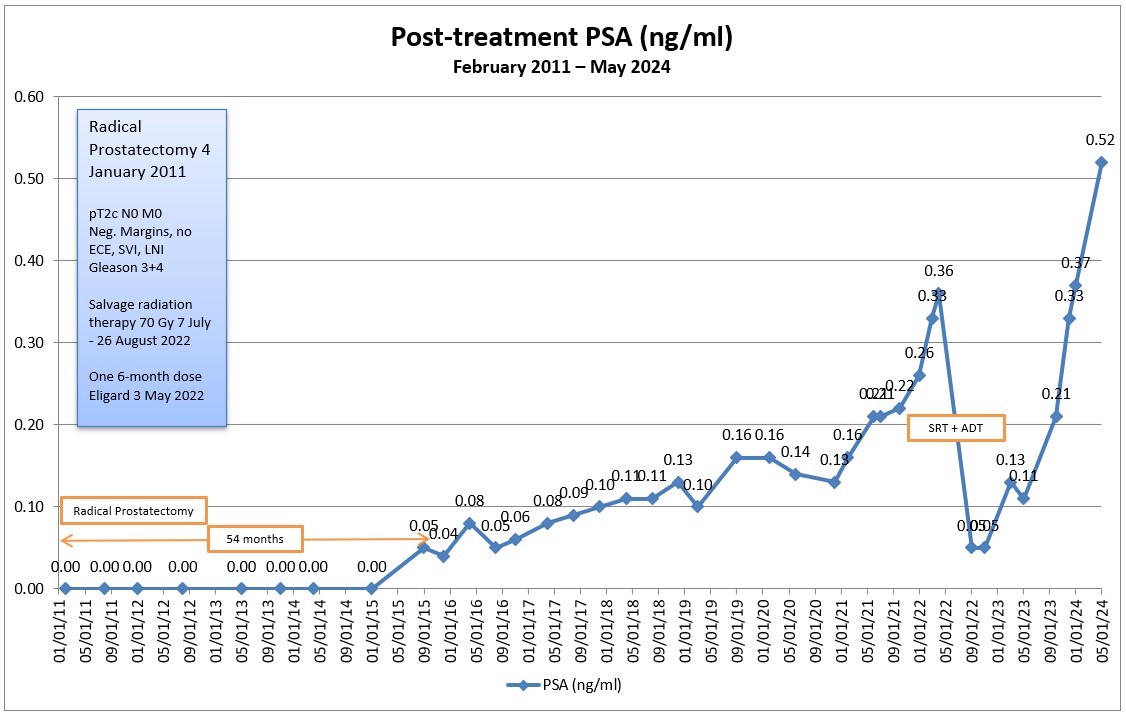
We last left our hero two years ago as he began 35 sessions of salvage radiation therapy on 7 July 2022 in attempt to kill off his recurrent prostate cancer after his surgery in January 2011 ultimately failed. Unfortunately, those little cancer cells have proved themselves to be quite resilient, and the salvage radiation therapy has failed, too. Bummer.

We know this by tracking my prostate-specific antigens (PSA) on a regular basis. After the surgery, my PSA level should have dropped to undetectable (zero) because there was no prostate left to produce the PSA. But the PSA can live on in the cancer cells even without a prostate, and that’s how we know the cancer is still there.

After the radiation, my PSA should have dropped substantially, and it did, at least initially. But about 15 months after the radiation ended, my PSA was on the rise again. It rose enough to the surpass the PSA level when we started the radiation. In May 2024, it continued its upward climb to 0.52 ng/mL, the highest it’s been since the surgery. (In the grand scheme of things, it’s still a low value that many fellow prostate cancer patients would love to have, but the fact that it’s doubling about every six months is a concern.)

There is a relatively new scan that can detect prostate cancer cells at fairly low PSA levels. It works best when the PSA is close to 1.0 ng/mL, but it has detected prostate cancer about 30% of the time at PSA levels in the 0.2–0.3 ng/mL range. I went for this PSMA PET scan in January when my PSA was 0.37 ng/mL, and the scan failed to detect anything.

On the one hand, that’s great because there were no signs of metastasis and no evidence of prostate cancer. But on the other hand, we need to know where the cancer is located and what it’s up to in order to plan our next treatment options. Because it didn’t reveal its ugly head, we can’t make any meaningful treatment decisions right now.

If there are one or two small lesions someplace, we may be able to radiate them again depending on their size and location. But if there aren’t any distinct lesions and my PSA continues to increase, that’s likely the result of micrometastases and that would require a systemic treatment approach (e.g., hormone therapy, immunotherapy, chemotherapy, or any combination thereof).

After reviewing my May PSA results with the urologist, we agreed to punt for six months and do another PSA test in late October. I know that seems counterintuitive—letting the cancer continue to grow without taking action—but there’s a reason for it. I’m predicting my PSA at that point will be in the 0.75–1.0 ng/mL range in October, and we’ll do another PSMA PET scan to see if we can determine what’s going on and then plan from there.

Up until this year, all of my conversations have been with the urologist and radiation oncologist. In February, I met with a medical oncologist for the first time because they’re the ones who deal with the systemic treatments.

Based on my conversations with the urologist and medical oncologist, the next logical treatment option is hormone therapy. Prostate cancer lives off of testosterone, so if we kill off the testosterone, we slow the growth of the cancer cells. (Hormone therapy is not curative, however.) But the timing of starting hormone therapy is important.

If we started the hormone therapy now, it would rapidly knock my PSA down so far that it would make it next to impossible to do the PSMA PET scan in November and get any meaningful results.

The other problem with starting hormone therapy too early is that the prostate cancer can become hormone resistant much in the same way that bacteria can become resistant to antibiotics. Start the treatment too early, and you’ll lose its effectiveness when you really need it later.

There seemed to be a differing of opinions between the urologist and the medical oncologist as to what would trigger the start of hormone therapy. The urologist would hold off until there’s evidence of metastasis; the medical oncologist suggested we’d start when my PSA hit 2.0 ng/mL. We can figure that out when the time comes, but both agreed that hormone therapy (and other therapies) can keep me around another 10–15 years (or more).

Of course, my quality of life may be diminished as a result of the treatments. Hormone therapy can come with a whole host of unpleasant side effects such as fatigue, muscle loss, weight gain, loss of libido, hot flashes, etc. No need to rush into that Disneyland of experiences.

Physically, I am feeling fine. I’m completely asymptomatic when it comes to the cancer, but the side effects from the surgery and radiation are present and are a nuisance more than anything. Psychologically, though, it’s been a bit of an emotional roller coaster ride as I go from PSA test to PSA test, and failed treatment option to failed treatment option. We’re closing in on 14 years since diagnosis, and it does get tiring.

One of my regular blog readers and my urologist both suggested that, at this point, I look at my prostate cancer more as a chronic illness than as a life-threatening disease. I’m still trying to embrace that perspective and, even if I do, the worry will never go away.

There you have it. The latest and greatest in this adventure of living with prostate cancer. Follow along if you want to see my monthly updates, and we’ll probably know more right around the holidays.

Be well!

Header image: Lake Michigan coastline from the John Hancock Center, Chicago, Illinois

Month 162 – Urologist Visit

The short version from yesterday’s appointment with the urologist (who happens to be the Urology Department head):

Kick the proverbial can(cer) six months down the road and retest PSA then.

Generally speaking, I’m okay with that approach. I mean, really, what else is there to do at this point? We don’t have sufficient data points to make any definitive treatment decisions right now. Of course, I may feel differently after sleeping on this for a few nights.

I have to admit that it was a challenging meeting because the doctor just wanted to rapid-fire through all the discussion points and it was difficult to get my questions out. In the end, though, I prevailed.

She was blasé about the increase in my PSA, saying it went up “a little bit.” (A 41% increase in my mind is a tad beyond “a little bit,” but what do I know?) She didn’t see much value in doing another PSMA PET scan right now because a scan with a PSA of 0.52 ng/mL has about a 50-50 chance of detecting anything. That somewhat aligns with what the medical oncologist (MO) said in February—that it would be better to wait until my PSA was at least 0.7 or 0.8 before doing another scan.

My SWAG (scientific wild-assed guess) is that my PSA will be between 0.75 ng/mL and 1.1 ng/mL in November based on the average increases in my PSA over the last four readings and my PSA doubling time. (Bookmark this prediction for future reference! 😀)

We did talk about androgen deprivation therapy. Her biggest concern was that starting too early would just accelerate the eventual likelihood of resistance later on when ADT is needed the most, so she wouldn’t start ADT until there’s confirmed metastasis. (By comparison, the MO suggested holding off until my PSA hit 2.0 ng/mL.) I did ask if starting ADT early delays metastasis and she said it didn’t, which I thought was interesting.

We talked about whether it would be a monotherapy or a combination therapy, and she suspected we would start with just a monotherapy. She acknowledged that there are several studies out there showing that a combination therapy may lead to better outcomes but, in her mind, they weren’t persuasive enough to launch straight into combination therapy. However, she did say that there are certain circumstances where it may make sense, one of which was if the metastases was in the spine.

I asked about possible radiation of localized lesions and she was not all that enthusiastic about the idea. Her biggest concern was about going through radiation twice and whether that was a wise thing given what damage it may do to my body. “I’d have to defer to the radiation oncologist to make that assessment,” she said. Her fear was additional radiation damage / side effects, and I would have that same concern, too. I would have to consider very carefully zapping anywhere in the pelvic area again given the changes I have already experienced in my bowel habits.

Even if the scan showed one or two lesions that could be zapped, she would also start ADT because “it’s pretty much guaranteed that there would be cancer elsewhere that didn’t light up on the scan.” That makes sense.

Lastly, given where I’m at in this advanced prostate cancer no-man’s land, I was curious how she would label or stage my cancer. With no evidence of metastases on the last scan, she would still have me at Stage 2. (See the American Cancer Society staging of prostate cancer HERE.)

Of course, in my mind, I turned to the actual definition of metastasis:

the spread of a disease-producing agency (such as cancer cells) from the initial or primary site of disease to another part of the body

I don’t have a prostate (initial or primary site) but I do have evidence of cancer, so it must be in “another part of the body.” By that definition, it must mean that I’m metastatic, right? (Yeah, I know… Nothing in the prostate cancer world is that clear.)

I asked the question about staging more as an academic exercise because it really doesn’t matter much what the label or stage is. All I know is that I’m living with this bug growing inside me.


One of my blog followers, Phil, recently commented that his oncologist considered prostate cancer to be more of a chronic illness than a terminal illness, and that stuck with me. I mentioned that to the doctor, and she embraced that view wholeheartedly, telling me that patients like me can be kept around for many years—even decades—and the disease can be managed like hypertension or diabetes.

Intellectually, I already knew that. But, after 13+ years, it’s quite the mental leap to jump from, “I have the Big C and it continues to grow unabated,” to, “Cancer, schmancer. It’s like arthritis in my big toe. No big deal.” But it is a leap I’m trying to make.

You would expect that, after 13+ years of testing, waiting for results, reviewing results, and planning next steps, I’d be used to it by now. It’s routine. But I’m finding it to be more and more emotionally draining with each cycle as the uncertainty drags on. Perhaps it’s because I’m coming to terms with failed treatments when I had hopes for better outcomes, or perhaps it’s because I’m back in the wait-and-see mode. Or maybe it’s just the cumulative effect of being on this roller coaster for so long.

On the positive side, I know that I’ve been blessed. Many fellow prostate cancer patients would love to have their PSAs be at my level; my quality of life is pretty good considering all that my body has been through; and—most important—I’m still here 13+ years after diagnosis.


On a somewhat related note, I finally got my baseline testosterone results back: 424 ng/dL. That was taken almost two years to the day after receiving my six-month Eligard shot in advance of salvage radiation therapy, so I’m guessing that any effect the Eligard may have had on my testosterone level has worn off by now.

From what I can tell, that’s a decent / normal number for a 66-year-old guy.

At least we have a starting point for reference now.


Well, that’s it for this post. Time to go out and play for six months. Be well!


What’s next:

  • Week of 28 October – Get PSA test
  • 4 November – Physical with primary care physician
  • 14 November – Appointment with urologist

Header Image: La Jolla Coast, San Diego, California

Imaging Alternatives For PSMA Negative Prostate Cancer Patients

Here’s another informative video from the Prostate Cancer Research Institute for the ten percent of patients for whom PSMA PET scans may not work.

If I go for a third PSMA PET scan later this summer, and it fails to show anything at an even higher PSA level than my first two inconclusive scans (0.22 ng/mL and 0.37 ng/mL), I may find myself in that category.

I’ll provide my normal monthly update next week after my visit to the urologist on 14 May.

Day 4,923 – PSA Results

No surprise here. In my spreadsheet, I put a placeholder value of 0.50 ng/mL for this PSA test based on the previous trend, and the actual result came in slightly higher at 0.52 ng/mL.

The PSA Doubling Time is dropping as well. Using the last five readings and the Memorial Sloan-Kettering PSA Doubling Time calculator, my PSADT was:

  • 6.7 months on 6 December 2023
  • 6.2 months on 19 January 2024
  • 5.1 months on 1 May 2024

It seems safe to say that the salvage radiation therapy failed to do the trick.

I am trying to describe my reaction to this hour-old news. I guess words that I might use would be: numb, indifferent, resigned. I don’t know. It’s a bit weird. I certainly had zero expectation that my PSA would go down or even hold steady given the previous trend.

You may recall the conversation with the medical oncologist suggested that we monitor and do another PSMA PET scan in six months, which would make it August. The question now is, based on these results, do we stick with that plan? Or do we move to the discussion on the type of androgen deprivation therapy and the timing of ADT?

I did ask the phlebotomist if he was drawing blood for a testosterone baseline test and he said yes. I don’t see the results posted online yet (my record is still going through its once-a-day update as I type this).

Well, it’s after midnight. I’ll sleep on this and perhaps I’ll be a tad more focused in the morning after having processed this.


What’s next:

  • 9 May – Appointment with primary care physician (annual physical)
  • 14 May – Appointment with urologist

Header Image: Scenes from San Diego Bay, San Diego, California

Month 161 – Crappy Development

If you’ve been reading this blog from the beginning, you already know that no detail is spared in the telling of this prostate cancer tale. If you haven’t read some of the early, gory details, well, buckle up, Buttercup.

Let’s talk bowels and 💩.

LAST CHANCE. If you don’t want to follow along, check out my travel website HERE or my photography website HERE.


One of the known possible long-term side effects of radiation when it comes to prostate cancer is issues with your rectum and bowels, and those side effects can manifest themselves years after the radiation was completed. (It’s been 19 months since my last zapping session in August 2022.)

Something has changed with my bowels in the last few months, and I’m wondering if this is the beginning of those side effects.

The engineer in me is trying to evaluate different variables to see if these changes could be the result of something else.

As a baseline, I used to have one bowel movement a day in the morning and I was good for the day. Also, I’m a creature of habit, and my diet really hasn’t changed at all, so that’s likely not a contributing factor.

One other thing is the timing of the onset of my symptoms. It’s about the same time that I started my daily walking regimen in earnest in February. I doubt they’re related, but it is noteworthy.

So what’s different? Well:

  • About half the time, I’m now having two to three bowel movements a day. One recent day, there were five over the course of the entire day.
  • My stools have changed from well-formed “logs” to thin, soft “snakes” or “ropes” that tend to fall apart.
  • I find myself having short periods where I’m quite gassy and flatulent without any likely dietary cause (e.g., not eating frijoles for breakfast, lunch, and dinner).

The silver lining in this cloud is that I haven’t had any increases in bowel urgency, so this is quite manageable at the moment. I will admit, though, that there have been a few times when I’ve been on my daily walks when I felt the need to pass gas, and I felt I was on the edge of getting more than I bargained for if I did. Luckily, no accidents yet.

I haven’t done a ton of research on this yet, but a study out of Sweden, Salvage radiotherapy after radical prostatectomy: functional outcomes in the LAPPRO trial after 8-year follow-up, looked at the long-term side effects of salvage radiation therapy. The summary of their conclusions on bowel function:

Fecal leakage was more common after radiotherapy as found in answers to question about ‘accidentally leaked liquid stool’ with 4.5% in Radiotherapy group versus 2.6% in Control group, ‘accidentally leaked liquid stool’ once a week or daily, Odds ratio (95% CI): 1.90 [1.38; 2.62]), ‘mucus from anus’, 6.8% versus 1.5% (4.14 [2.98; 5.76]), ‘leakage of feces in clothes’, 5.6% versus 2.4%, (2.18 [1.18; 4.04]), respectively in Radiotherapy and Control groups (Figures 2, 3A and 3B and Tables S2 and S3 in the Supplement). Bleeding from the anus was more common after salvage radiotherapy, 8.6% versus 1.2% in control (3.21 [2.32; 4.44]) as was flatulence, 25% versus 14% (1.82 [1.40; 2.37]), whereas distress due to bowel symptoms did not differ, 7.8% versus 6% (1.27 [0.90; 1.80]). Defecation urgency was more common in the group given salvage radiotherapy as reported in answers to questions about need ‘to rush to the toilet’, 14% versus 5% (3.22 [2.46; 4.21]), ‘open your bowels again within 1 hour’, 17% versus 9.4% (1.53 [1.18; 1.98]). There was no statistically significant difference in ‘how often do your open your bowels’, 3% versus 2.5% (1.23 [0.92; 1.64]).

Carlsson, S., Bock, D., Lantz, A., Angenete, E., Koss Modig, K., Hugosson, J., Bjartell, A., Steineck, G., Wiklund, P., & Haglind, E. . (2023). Salvage radiotherapy after radical prostatectomy: functional outcomes in the LAPPRO trial after 8-year follow-up. Scandinavian Journal of Urology58, 11–19. https://doi.org/10.2340/sju.v58.7318

Another silver lining: no fecal leakage, mucus, or rectal bleeding so far. Woo-hoo!

Needless to say, this will be part of my conversation with my primary care physician on 9 May and with the urologist on 14 May. I’ll likely rope the radiation oncologist into the conversation, too.

I was reluctant to talk about this earlier because I wasn’t sure if this was a temporary thing or something longer term. This has been pretty persistent for about two months now, so I thought it was time to talk about it. As long as things don’t worsen, I can live with what’s happening right now (although I would prefer that I didn’t have to if I’m being perfectly honest).


I’ll have to admit that I’ve been feeling a general sense of anger and perhaps regret about this whole situation.

The source of those emotions isn’t from the side effects themselves, per se, but rather from this entire process that tends to move patients in the direction of what is considered to be overtreatment.

I may flesh this out in a longer, separate blog post one day, but when I see the likes of Dr. Scholz and others beginning to say, “Hmm. Maybe we should let the PSA rise so we can find out where the cancer is at before we start the treatments that could have life-long side effects adversely impacting the quality of life,” I get annoyed. Annoyed because I’m beginning to agree with that line of thought more and more, instead of the old, “It’s better to attack it while the PSA is low even though we don’t know exactly what’s going on.”

It’s frustrating because, my gut instinct all along was to delay until we knew where the cancer’s location, and I let the more rapid increases in my PSA, my shortening PSA doubling time, and the current “industry” guidance to act sooner rather than later get the better of me.

The frustration will continue as I move into the next chapter. I’ve been looking for studies on the best time to start androgen deprivation therapy (ADT) for someone in my situation and, from what I’ve seen so far, the guidance seems to run the full spectrum of starting early or delaying for years. Throw in the decision of whether it’s just ADT or ADT plus some sort of antiandrogen therapy, too.

I get that there are advances in research and technologies and that things are constantly changing. But at this point, I’d be happy for a clear path forward without adding additional side effects. (But I’m experienced and knowledgeable enough to know that’s just a pipe dream at this point.)

Rant over. Time to invest in some toilet paper company stock.


What’s next?

  • 1 May – PSA test
  • 9 May – Appointment with primary care (routine physical)
  • 14 May – Appointment with urologist.
  • TBD – Another PSMA PET scan if my PSA warrants it OR wait another three months for the next PSA test.

Day 4,880 – Full MO Report

My computer issues have been sorted, so here’s the full scoop behind my meeting with the medical oncologist (MO) on Tuesday.

The meeting started with a nurse practitioner (NP) which threw me for a bit of a loop and initial disappointment. Because this was my initial contact with the oncology team, we spent a bit of time reviewing my history and how we got here. She did say that she would bring the MO into the discussion once we went through the preliminaries.

The nurse had actually done a pretty thorough job of reviewing my file prior to the meeting, and was familiar with the recent bone scan and PSMA PET scan results. Her take on my situation was that we were somewhat in limbo with no signs of metastases anywhere, and that the path forward wasn’t so clear-cut. (That actually led to a brief discussion on how metastases is defined in the world of prostate cancer. She was of the school that it’s not metastatic until it shows up on scans, while I pressed and suggested that, because the prostate is gone and the cancer is somewhere, it must, by traditional definition, be metastatic.)

Once we were through with the initial screening, the nurse brought in the MO and introduced her to me. I did ask if she specialized in prostate cancer and she does not; she’s more of a general oncologist. She did say, however, that she reviewed my case with a genitourinary oncologist at the University of California San Diego (UCSD) the day before our meeting. That was a good to know (but not the same as having a seasoned prostate MO in the room).

At that point, the three of us started going down my checklist of questions.

We talked about whether there was value in delaying the start of any treatment until my PSA rose to a level where a scan would detect the location. In the preliminary screening, the NP seemed to be inclined to start the ADT before another PSMA PET scan, and she was a little surprised that the MO said we should do another scan in six months. The MO said that the scan may reveal lesions that could be spot radiated as a treatment option.

That led to me asking about whether there would be value in whole pelvic radiation and, again, without knowing the cancer’s location neither was a fan of pursuing that at this point. Even if we did know the location, they would defer that decision to the radiation oncologist (RO).

Because my PSA is so low (in relative terms), both seemed to be more inclined to start with just ADT and not a combination therapy of ADT plus antiandrogens. The MO acknowledged that the use of combination therapy could be more effective in controlling the cancer, but cautioned about the increased side effects from doing a combination therapy approach. She also mentioned that using combination therapy is generally reserved for when the cancer is more advanced. (I’m not sure that my research agrees with that thought.)

I believe in her discussion with the UCSD GU oncologist that they said they would probably hold off initiating hormone therapy until my PSA reached 2.0 ng/mL. I’m going to have to do a little research to see if that makes sense.

We talked about intermittent therapy and whether that would be appropriate, and the consensus was that, at my low PSA, I would be a good candidate for intermittent ADT. However, that would depend on my PSA doubling time and how my PSA responds to the ADT.

I did ask if cancer in the lymph nodes would be symptomatic and generally speaking, they said, it’s not. I asked because I had had a weird pressure sensation in my groin last month that was new. (Yes, I’m at that point where I ask myself if every new ache, pain, or sensation is related to the cancer when it pops up.)

They noted going through my record that there was no baseline testosterone test, so we all agreed that that would be helpful to have. The NP put the order in to have that done when I get my PSA tested on 1 May 2024.

The MO expressed concern about my recent cardiac work-ups after my October emergency room visit (nothing of substance was found). She reminded me that hormone therapy does have a small but real risk of increasing cardiac events.

In the last part of the meeting, I did ask if I’ll be seeing the same MO going forward, and the short answer was “indirectly.”

You’ve heard me talk before that one of the drawbacks of getting my care through the VA is that it’s a teaching hospital and that I rarely see the same physician/resident twice. It’s good that I get so many differing opinions, but it prevents me from building a long-term relationship with the doctor as well. Different residents will filter through the oncology department, but the MO I met with will be overseeing all of their cases behind the scenes, so she would be tangentially involved.

I was asking because I likened myself to being an orchestra conductor, coordinating the efforts between the urologists, radiation oncologist, my primary care physician, and now the medical oncologist. I was inquiring if she or anyone else at VA would take the lead on coordinating all of these discussions and treatment considerations. She did mention that they do have a “tumor board” that reviews much more advanced cases to map out coordinated treatment plans, but because I don’t have any substantial tumors in the scans, my case wouldn’t come up for review.

Interesting, though, was the fact that the NP and MO both viewed this meeting as me getting a second opinion instead of a hand-off of my case from the urology department to the oncology department. From their perspective, the urology department still has the lead on my case until I decide to move forward with hormone therapy.

One thing the NP brought up early in the conversation was that any treatment plan would have to be aligned with my goals. If my goal was to prevent metastasis (or delay it), then starting hormone therapy sooner would make more sense. But if my goal was to avoid hormone therapy side effects for as long as possible—recognizing the inherent risks—then it may make sense to delay therapy. To be honest, I’m not sure where on that spectrum I want to land.

We wrapped up the meeting, coming to a consensus that:

  • We’ll conduct a PSA test and get a testosterone baseline on 1 May 2024.
  • Calculate the PSA doubling time including the latest results.
  • Evaluate the results and decide whether to schedule another PSMA PET scan.

While I didn’t keep specific track of the meeting, it lasted somewhere between 30 and 45 minutes, which is quite unusual.


I came out of the meeting in good spirits because it was one of the most productive, collaborative meetings I’ve had in a long time. The conversation flowed quite easily, and I attribute that to the fact that women healthcare professionals seem to be much better prepared and much better at listening to a patient’s concerns than some of their male counterparts. This isn’t the first time that I’ve noticed that. (Don’t forget, it was the thoroughness of my female primary care physician that discovered the cancer via a DRE in the first place.)

To be honest, I’m not sure why I felt compelled to mention these observations based on my personal experiences. I just suspect that some prostate cancer patients may be reluctant to discuss problems with their male bits with female healthcare professionals. You might be surprised by the difference in quality of care that you receive, so don’t rule them out.


I have been more than satisfied with my care from the VA so far but, as my cancer advances, I am beginning to wonder if it makes sense to step outside the VA so I can get a team that is dedicated to my case and one that I can build a long-term relationship with.

At the top of my list would be UCSD followed by Scripps/MD Anderson. But the VA already has such close ties to UCSD, it’s almost like I’m getting care from them already. In fact, the MO I saw is a clinical professor of medicine at UCSD, most of the residents I see in urology are from UCSD, and my VA-provided RO is from UCSD but seeing him required “community care” pre-approval. (Community care is generally only approved if the VA doesn’t have the capacity or capability, so it could be tricky arguing to obtain it.)

So while I’m on Medicare and it would be relatively easy (but more expensive) for me to step away from the VA, I would explore options for getting approval to move into community care at the USCD GU medical oncologist through the VA first.

I’m not keen on changing horses in mid-stream, but it may make sense in the long run. I’ll have to think that through.


And now you know why I didn’t want to try and type this out on my phone on Tuesday. 😂 Thanks for reading this far!

Header image: A rare spring snow in Cuyamaca Rancho State Park, San Diego County, California, 14 March 2024


Day 4,878 – Medical Oncologist Meeting

This will be a Reader’s Digest version of a future longer post. My computer died Sunday night and I’m not keen on trying to type out the full report on my phone’s itty-bitty keyboard.

The bottom line for now is to watch my PSA for the next three to six months, perhaps with another PSMA PET scan in six months if my PSA has increased sufficiently to be reasonably assured that the scan could detect something. I’m okay with that approach.

If my next PSA has a sizable increase, we’ll reevaluate.

The meeting lasted around 30 minutes, so there are more details to share once I get access to a computer again.

I’ll go for a PSA test (and get a testosterone baseline) on 1 May in advance of a 9 May meeting with my primary care physician and a 14 May meeting with the urologist.

With luck, I’ll have a full update by the end of the week.

Month 160 – Getting Ready

My first meeting with a medical oncologist is a week from Tuesday, on 19 March, so I’ve been putting together a series of questions to ask.

I’d like to leave the meeting with an understanding of whether there’s value in delaying the start of hormone therapy so my PSA can get high enough for a PSMA PET scan to locate the cancer so we know exactly what we’re dealing with, or if it’s better to start hormone therapy sooner rather than later.

I’d also like to understand whether they would want to start with just ADT or with a combination therapy of ADT and antiandrogen therapy and how to manage the side effects from both options.

I’m sure I’ll post an update after the meeting.

On an unrelated general health note, I’ve been pretty faithful about getting in a daily walk this year. I started out with short walks and now I’m up to 6 km / 3.7 miles per day. So far this year, I’ve logged about 240 km / 149 miles. Not bad for this old geezer who was always picked last for the team in school PE classes.

Stay tuned for more.

Hormone Therapy for Prostate Cancer Fact Sheet – NCI

I came across this fact sheet on hormone therapy from the National Cancer Institute that does a great job of explaining it all to the uninitiated.

https://www.cancer.gov/types/prostate/prostate-hormone-therapy-fact-sheet

Salvage Therapy for Prostate Cancer: AUA/ASTRO/SUO Guideline (2024)

A moderator on the HealthUnlocked website shared a link to the new 2024 American Urological Association guidelines for salvage therapy for recurrent prostate cancer:

https://www.auanet.org/guidelines-and-quality/guidelines/salvage-therapy-for-prostate-cancer

These are the generally agreed-upon guidelines that practitioners should follow when a patient has recurrent prostate cancer after initial treatment.