Life After Radical Prostatectomy: 84 Months Later

So it’s been 84 months since my radical prostatectomy. How am I doing?

Status

With my PSA increasing steadily over the last two years to the point where it’s now at 0.10 ng/ml, it appears that I’m on the path to recurrence. Needless to say, that’s not the outcome that I had in mind when I started this journey, but my surgeon did warn that approximately 20% of prostatectomy patients have the cancer return.

Emotions

My visit to the doctor in December went just as I expected it would, with one exception. I left the office feeling as though the wind had been knocked out of me. This whole notion of recurrence took on a whole new meaning when the doctor suggested that we’re going to have to start thinking about radiation in the future. It’s becoming real again. Since then, I’ve been doing okay. Not great. Not horrible. Okay.

Incontinence

I remain “dry” 98% of the time. There have been a few very long days at work where my body tired and, combined with the physical exertion at the end of the day, I was a bit more prone to leak. Rarely do I need to get up to go to the bathroom in the middle of the night—I can last 6-7 hours most nights.

Sexual Function

I continue to do so-so in the ED department. Remember, I have only one nerve bundle remaining, but I can get an 80%–90% erection most of the time. Some days are better; others are worse.

I do find that my libido is still there, and there are times through the day where I can feel things stirring down below. Not enough to obtain a natural erection—those days are gone—but enough that with a little stimulation, it would be much easier to achieve an erection.

Summary

Recurrence is the fear of every cancer patient because now your options become more limited and the costs of dealing with it—emotional, physical, and financial—begin to increase significantly. It’s time that I start seriously preparing for the trip down this fork in the road. The good news is that I have time with my PSA doubling time as long as it is.

Day 2,596 – Doctor Visit

I met with my doctor this afternoon to review my increasing PSA results, and it went just about as expected. There’s increasing concern, but things are progressing slowly enough that we can continue on the four month test cycle for now. That means I’ll be doing this all over again in April.

There were a few reality check moments in the conversation, though. I’ll get to those in a moment.

One thing I need to learn to do is shut up—at least for the first part of the meeting with the doctor. I’m not very good at letting the doctor talk and offer up his thoughts and recommendations and then ask the questions that I have. I just launch into a barrage of questions based on the research that I’ve done and assault the poor guy. On a positive note, he really didn’t dispute anything that I told him nor did he tell me that I was completely out to lunch on certain issues.

We reviewed the success rate for SRT, with various studies showing it to be 35%-55% effective at being progression-free at 5 or 6 years. (Here’s one.) We also discussed the potential side effects of SRT, and he did seem to believe that the risks were lower than I thought they may be.

The conundrum of starting SRT early versus knowing where to radiate based on imaging came up as well. My sense was that he’d prefer to start SRT while the PSA is less that 0.2 ng/ml, and certainly before it reaches 0.5 ng/ml, assuming that the cancer remained in the prostate bed. Doing so, he said, offers the best chance for success. He suggested that, if we wait until it would be detectable on even the most sensitive imaging (which can’t detect anything reliably until the PSA hits the 1.5-2.0 range), that radiation would do little if any good at that point, as the cancer will likely have spread. Androgen deprivation therapy (ADT) would be the treatment option of choice at that point, and ADT is not curative. It only prolongs life (with substantial side effects impacting quality of life).

The reality check moment for me came with his comment about waiting too long to the point where SRT wouldn’t be effective, and that ADT would be my primary treatment option. That really was an, “Oh, shit,” moment for me. It’s very easy to sit here and speculate how I will act in hypotheticals, but at some point in the future, I am going to have to make real world decisions that affect my longevity and quality of life.

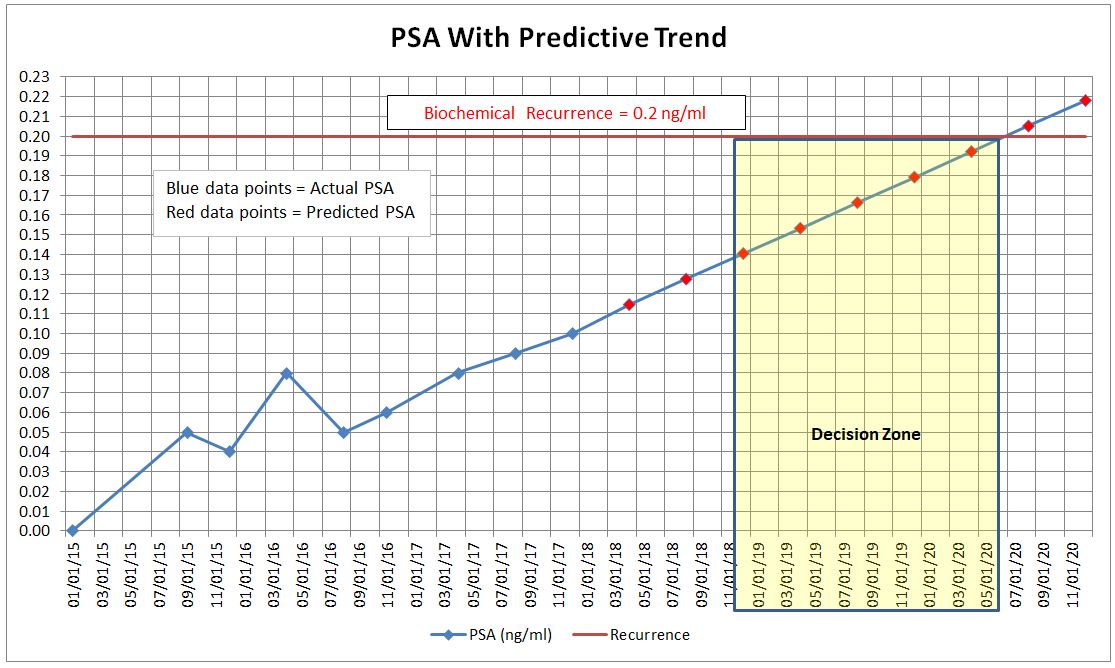
Based on my slow PSA doubling time (around 16 months), if my PSA progresses at its current rate, I’ll have 12 to 28 months to think about this and make my decision, based on whether I want to act if my PSA is around 0.15 or let it go all the way to 0.20. (See my “decision zone” in yellow below—yes, I had to geek out in my spreadsheet once again.) If I want to wait until it’s all the way to 0.5, I’ll have even more time.

Of course, one option is to do nothing. A study in 1999 showed that it took, on average, 8 years after PSA levels began to rise to reach metastasis, and another 5 years after metastasis to death.

The bottom line is that this is becoming increasingly real and that there will be some tough decisions in the next year or two. Of course, those decisions are mine and mine alone, and will be based on a variety of factors, not least of which will be my risk tolerance and any treatment’s impact to quality of life.

On that happy note, I wish you a Merry Christmas and a happy 2018! 🙂


Thanks, too, to those who took time to answer my questions in my salvage radiation therapy survey a few weeks ago. Your insights were quite helpful to me.

Month 85–Learning about Salvage Radiation Therapy

Now that I’m officially halfway to the widely accepted 0.2 ng/ml definition of biochemical recurrence, it’s time to dig deeper into the most likely next step for me: Salvage Radiation Therapy (SRT).

I’ve already done considerable research on reputable websites and through reading studies or books, but the one area that I would like more information about is from those who have actually gone through SRT after a prostatectomy. Having those first-hand insights can be invaluable.

If you have had a radical prostatectomy and subsequent salvage radiation therapy because your PSA was on the rise just as mine is, please take a few minutes to answer my questions about your experience in my:

Salvage Radiation Therapy Questionnaire

It’s only 9 questions long and should take just a few minutes to complete. I’ll be truly grateful for your input.


If I’m being perfectly honest, I have real reservations and concerns about starting SRT. Like most everything else in dealing with prostate cancer, it seems to be yet another crap shoot with questionable outcomes at potentially significant cost to quality of life.

Based on my research, SRT doesn’t seem to have all that high of a success rate, with 30%–50% of patients being progression-free at 5 or 6 years after receiving SRT. That means that 50%–70% of the patients have the cancer remain and, as an added bonus, those patients now have increased incontinence and erectile dysfunction issues, as well as potential bowel control issues.

Before we start zapping my body with radiation, I want to know with a high degree of certainty that we’re zapping the actual location of the cancer. That poses two problems.

First, studies show that the earlier you start SRT, the higher the success rate. In fact, I would not be surprised to find a few survey respondents who have started SRT at a PSA level lower than my 0.10 ng/ml. The assumption is that any remaining cancer will be in the prostate bed or pelvic region, and that’s where they focus the radiation. But how do you know that it hasn’t spread beyond the pelvis at those PSA levels? You don’t. (That 30%-50% success rate tells me it isn’t the best assumption to be making.)

That brings us to the second problem. Current imaging techniques won’t locate the cancer until the PSA is at much higher levels. Even a choline-PET scan won’t consistently detect tumors until PSA reaches 2.0 ng/ml (it may be able to detect down to 1.0 ng/ml, but the number of false readings goes up considerably).

Do I risk all those nasty life-long side effects on the assumption that the cancer is still in the prostate bed, or do I wait until imaging technology can accurately detect the cancer’s location?

I’ll have a thorough discussion with my doctor next week when we review my latest PSA results, so it will be interesting to get that input. I’ll keep you posted.

Thanks again if you’ve taken time to complete my questionnaire.

Month 82 – Reviewing PSA Results with Doctor

At this afternoon’s visit to the doctor to review my August PSA results, he asked, “How are you doing?” I replied, “I’m hoping you’re going to tell me.” “With a PSA of 0.09, you’re doing fine.”

I have to admit that I wasn’t quite psychologically prepared for that answer. Nor was I really prepared for the conversation that followed. But before getting into that, the bottom line was just as I expected: Continue to monitor PSA on a four-month cycle, which has me back in the lab in early December.

This was a new doctor that I hadn’t seen before and he was definitely more seasoned than the last one that I had. Still, all those years of experience could have taught him some better communication skills. He talked in broad generalities and in circles—even in response to my direct questions—and that was more than frustrating.

On the topic of recurrence, he didn’t think that I should be so quick to assume that an increasing PSA is indicative of recurrent cancer. He offered up the possibility that it could have been some benign prostate tissue left behind after the surgery and has grown enough where it’s detectable on the PSA test. Or, it could be cancer.

On the topic of PSA tests in general, he reminded me that the really old threshold for biochemical recurrence was 0.4 ng/ml before it was lowered to 0.2 ng/ml. It seemed that he valued the ultra-sensitive PSA test only as it related to the post-surgery pathology. If the pathology was bad, he seemed to put more stock in the ultra-sensitive PSA; but if the pathology was good, he seemed less inclined to put stock in it.

In other words, if you had a 4+3 Gleason score, positive margins, seminal vesicle involvement, or lymph node involvement—or some combination thereof—he would be more likely to consider acting on a 0.09 ng/ml PSA. But it my case with a 3+4 Gleason, negative margins, and no seminal vesicle or lymph involvement, my sense was that his response to my 0.09 PSA was a pretty nonplussed, “Meh.” Or, if my PSA gets to “around 0.13 ng/ml,” we might start exploring treatment options.

On the topic of doing additional testing such as scans to see if there is cancer anywhere, he said that nothing would show up on a scan or MRI with a PSA of 0.09. I want to dig into that some more.

On the topic of salvage treatments, he thought that, given my pathology, the first step would be “a little radiation.” (I’m not sure if sprawling out on the beach for 7 weeks qualifies for “a little radiation,” but it may be worth asking.) He wouldn’t do ADT (hormone therapy) in conjunction with the radiation, again, given my pathology.

Lastly, at one point during the conversation, he quite confidently made the bold prediction that I wouldn’t die from prostate cancer. You think I’d be jumping for joy. I’m not. Perhaps its my experience as a seasoned patient that’s telling me to withhold judgment on that one for the time being.

All in all, this is good news. My lack of enthusiastically embracing it, however, comes from the fact that, rather than eliminating variables to consider, I feel that this meeting introduced a few more, and that just muddied the waters. Emotionally, at this point, I just want this stupid disease to pick a path and stay on it. I may also check with the VA to see if there’s any way I can pick one doctor that I can build a relationship with rather than this new-doctor-a-quarter routine.

Month 81 – PSA Threshold for Salvage Therapy Survey Results

In last month’s post, I asked readers to complete a short survey to get a better idea of the PSA threshold that would dictate the beginning of salvage therapy. The survey asked:

  • How their medical teams defined “undetectable” PSA levels.
  • How their medical teams defined biochemical recurrence after a prostatectomy (what PSA level).
  • At what PSA level did they and their medical teams decide to begin salvage therapy.
  • How long after PSA biochemical recurrence was it before salvage therapy began.

Before going into the results, I first want to thank those who took the time to participate. You may view the results using the link below:

Salvage Therapy Treatment Survey Results

I could have designed the survey better. I probably should have asked for post-surgery Gleason score and pathology to see if there was a correlation between a higher Gleason score and acting earlier at a lower PSA level. The sample size is small enough where it’s not statistically significant, but there were some interesting observations:

  • The definition of “undetectable” generally ranged from <0.01 to <0.1 ng/ml. I believe that to be a reflection of whether the traditional PSA test or the ultra-sensitive PSA test is being used.
  • The consensus for the definition of biochemical recurrence seemed to be 0.2 ng/ml.
  • The PSA level at which some sort of salvage therapy began was widely spread between 0.17 ng/ml and 3.5 ng/ml.
  • The time to begin salvage therapy after biochemical recurrence varied from one to 35 months.

[Note: I’ll keep the survey open for a while longer and new responses may skew the summary above.]

For me, there aren’t any real “A-ha!” findings that provide clarity, and I expected that going into this exercise. The only thing that’s clear is that each case is unique—from both the patient’s perspective and the medical team’s perspective—and that means that my numbers will be different from your numbers and those will be different from Sam’s numbers and all of us will act (or not) on those numbers differently.

It is nice to know, however, that my medical team is in alignment with others on some of the measures.

And just to prove that I’m not nuts obsessing over the definition of biochemical recurrence, a somewhat dated research paper (2007) showed “a total of 145 articles contained 53 different definitions of biochemical recurrence for those treated with radical prostatectomy….In addition, a total of 208 articles reported 99 different definitions of biochemical failure among those treated with radiation therapy.” [Emphasis added.]

No wonder there’s confusion among us patients!

For me, the key statement in that paper was, “The Panel acknowledges that the clinical decision to initiate treatment will be dependent on multiple factors including patient and physician interaction rather than a specific prostate specific antigen threshold value.”

It’s up to us.

Month 80 – PSA Threshold for Salvage Therapy Survey

Okay, please indulge my personal curiosity. This is going to be an interactive post—there’s a pop quiz for some readers.

I’m 22 days and 8 or so hours—give or take—from my next PSA test. (But who’s counting??) And anyone who’s been diagnosed with prostate cancer already knows that there’s a ton of infuriatingly conflicting and confusing information about PSA out there.

Because my own post-surgery PSA has been creeping up in the last two years—meaning some sort of salvage therapy may be in my future—I’d like to ask other prostatectomy patients:

  1. Below what PSA level does your medical team say PSA is “undetectable”?
  2. At what PSA level does your medical team say that biochemical recurrence has occurred?
  3. If you had biochemical recurrence, how long after hitting biochemical recurrence was it before you began salvage therapy?

To make it easier for you to respond, I’ve created a short survey for those who have had a prostatectomy and had their PSA return after surgery. It’s certainly not a scientific survey, but it will be interesting and perhaps educational to see the variance in the responses. If nothing else, it will be entertaining. Click the link below to take the survey:

PSA Threshold for Salvage Therapy Survey

Seriously, having this information available when I get my next PSA results may help me with the next conversation that I have with my medical team, so I thank you in advance for helping me understand what may be next for me.

I’ll share the results in next month’s post which will be shortly after I receive my PSA results from my 2 August 2017 blood draw.


I’ve been blogging for the last 80 months to maintain my own sanity, educate myself and others, and to increase prostate cancer awareness. I certainly don’t do it for recognition. I have to admit, however, that I was surprised to see my blog listed on a Top 50 Prostate Cancer blogs list by Feedspot.

I don’t post this to feed my ego (much), but by clicking on the image below, you’ll see the other websites and resources that are available as well.

Immediate radiation when PSA levels spike after prostate cancer surgery helps reduce risk of recurrence

It’s funny that just 24 hours after having a discussion with my doctor about this very topic, this article appears on one of my social media news feeds.

My medical team seems reluctant to embrace some of the newer studies like this, sticking to the 0.2 ng/ml definition of biochemical recurrence that’s been the standard for years and years. That makes me wonder how long it takes before the medical community accepts the newer data and studies, and shifts treatment regimens to the new guidance.

Don’t get me wrong. I’m not ready to hop on a table and get radiated just because of this paper (or the two others earlier in the year along the same lines), but it is something that I’ll be keeping an eye on going forward.

More than anything at this point, I’m just sharing an observation of how the medical research community and the medical community at large can sometimes be at odds with each other, knowing how conflicting and confusing it can be from a patient’s perspective. It just reinforces my belief that you have to do your own research, be your own advocate, and make decisions that YOU are comfortable with based on what you’ve learned.

—Dan

For men who have had prostate cancer surgery, radiation therapy at the first sign of a rising PSA level can reduce the chances of the cancer recurring.

Source: Immediate radiation when PSA levels spike after prostate cancer surgery helps reduce risk of recurrence

Month 71 – More Studies on Early Salvage Radiation Therapy

With the change in my PSA over the last year, you can bet that I’ve been seeking every bit of information as to what it means and what to do about it. One of my go-to resources for the latest information in the field has been The “New” Prostate Cancer Info Link.

On 21 September, they published the following blog post that really piqued my interest:

Very early salvage radiation has up to fourfold better outcomes and saves lives

It’s certainly a topic of discussion for my next urologist visit in December. By the study’s definition, I’m still in the “very early” group—the group with the best survival if salvage radiation therapy (SRT) is started while I’m still in that group.

If we have to go down that path, my biggest concern with starting SRT is knowing that we’re actually radiating where the cancer is located. That concern is amplified if imaging can’t show where the cancer’s actually at, and we just radiate the prostatic bed because that’s what makes the most sense. Why risk some long-term, potentially nasty side effects on something so uncertain? (Yes, I know nothing is certain dealing with cancer.)

Of course, this is just one study and making a decision on it alone would probably be unwise.

We’ll just have to wait for the December PSA readings to come back and go from there.


On a happier note, I took a little drive through the country last week to tackle a few things on my travel bucket list: October Odyssey: The Mountain West. Check it out if you want to see what it was all about.

img_1194
Cimarron Canyon State Park, New Mexico

Day 1,770 – Let the Waiting Begin

It’s amazing how people in southern California forget how to drive when a little liquid sunshine falls from the sky.  Focusing on the horrible traffic in the rain kept my mind off the discussion that I was about to have. As soon as I plopped into the chair in the waiting area, the anxiety level shot back up.

The good news is that I’m not an overreacting drama queen. The bad news is that the doctor shared my concern about the movement in the PSA, but with a significant caveat.

In March of this year (after my PSA test in January and before this one in September), the hospital switched over to using the new ultrasensitive PSA test, so comparing numbers from January to September may not be a direct apples-to-apples comparison. With the new test, some of her other patients are experiencing the same phenomenon–undetectable for years, and now coming in at 0.03 – 0.05 ng/ml with the new test.

She did say, however, that she was concerned enough that this “warrants watching” to try and figure out what’s really going on, and she wants me to return in three months. The September reading will, in essence, be a new baseline uPSA, and we’ll see what December’s has to offer.

Doing the test sooner (like this afternoon!) would be too early after the 2 September test. By waiting three months, we’ll get better insight into what’s happening and what the uPSA velocity may be if it continues upward. The faster the increase, the more urgent the need for subsequent treatment.

We did briefly discuss what would happen if there are signs of recurrence. One of the first things that may come into play is getting a bone scan to see if it has spread. We talked of salvage radiation therapy (SRT) and a little about hormone therapy as options when we get to that point. We didn’t go into a lot of detail on either, mainly because I didn’t press for a lot of detail at this point and virtually everything she said fell in line with the research that I had done. It’s far too early to be thinking in those terms because we don’t know what we’re dealing with yet.

I did mention the recent studies that indicated that a 0.03 ng/ml reading on a uPSA was showing itself as a predictor of biochemical recurrence, and she really didn’t offer any insights on that one way or the other.

It appears that I’m probably headed back to a quarterly testing schedule for a while until we figure out exactly what’s happened. Just a change in testing methodology? Rising PSA?  Full moon?

My next appointment is 15 December. Merry Christmas!

Let the waiting begin.

[We now return you to our regular blog posting schedule, or at least until I have my next freak-out.]

prostate-cancer-awareness-hero-806x307,0

200th post!!

Day 1,769 – Getting Prepared

It’s the day before my meeting with my urologist, and I’ve been scribbling down the questions that I’m going to ask tomorrow. The Boy Scout in me  is coming out: Be Prepared.

Emotionally, it’s been one of my better days in the last few days. Yesterday, I was mad as hell in the morning and sad by sunset.

One of the infuriating things about this whole adventure is that there’s just sooo much information that’s out there, and there are so many different approaches to the same issue, that it makes it extraordinarily difficult to sift through it all and make sense of what I should do next. Then, of course, there’s the inherent bias introduced by perspective. Talk to a urologist, get one opinion; talk to an oncologist, get another; talk to a surgeon, get a third. While they all care about their patients, let’s face the fact that they are running a business and that can influence recommendations.

A case in point is the fact that a few days ago, I read something that made me think I would be a good candidate for salvage radiation therapy based on my Gleason score and time to PSA increasing. The next day, I read that, because I had negative margins, SRT wouldn’t really be an option, as the cancer would be outside the prostatic bed. Maybe I was just too drained and misread one or the other, but it sure can be confusing.

With luck, I’ll have some answers by lunchtime tomorrow.  Look for an update in the afternoon where hopefully I’ve been proven to be an overreacting drama queen.

prostate-cancer-awareness-hero-806x307,0