I overachieved on this post. Normally, reporting PSA results would be quite simple and short. Not this time. The act of writing helps me organize my research and rationalize treatment decisions. Thanks for your indulgence!
I went for my PSA test this morning, 1 September, and it was 3.32 ng/mL, up from 2.65 ng/mL back in May.
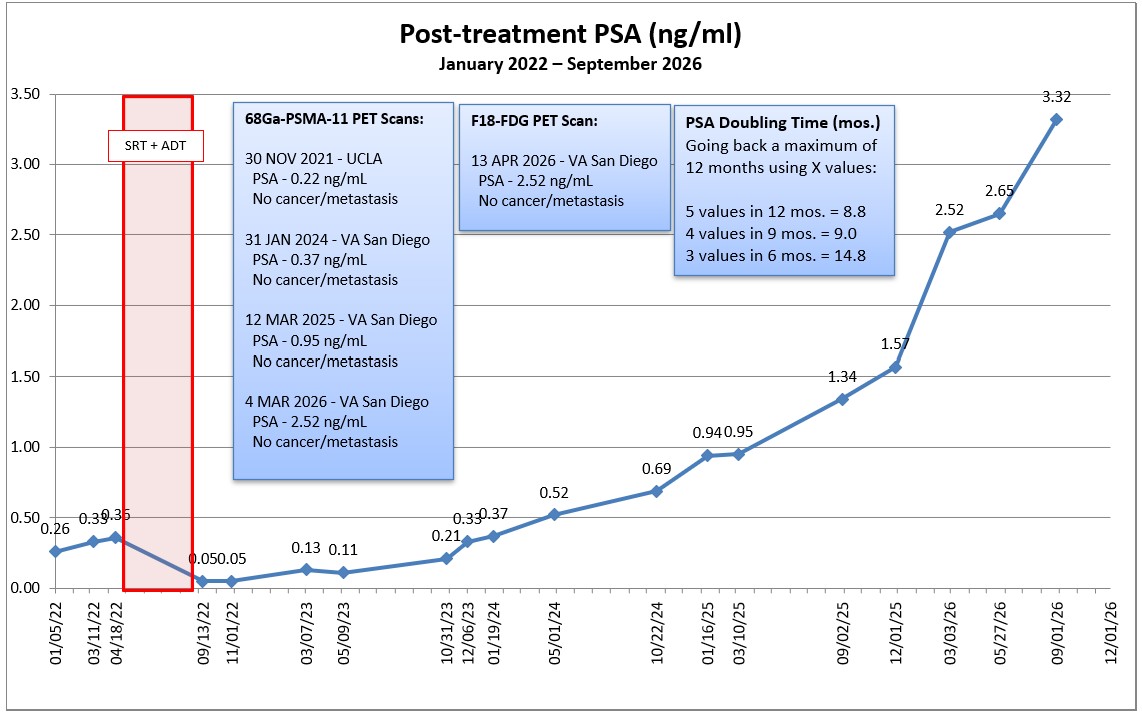
I expected my PSA to go up, and I guessed it would be around 3.0 ng/mL, so the amount it went up was a bit of a surprise. It’s closing in on my PSA level at initial diagnosis, 5.0 ng/mL.
PSA Doubling Time
Seeing as both the VA and UCSD medical oncologists (MO) stressed the importance of using PSA doubling time (PSADT) to guide treatment decisions during my meetings with them in June, I really wanted to try to nail down how it should be calculated.
The Memorial Sloan-Kettering PSADT Calculator is a great tool that I’ve been using, but it doesn’t provide any guidance on how many data points should be used over what period of time. I finally found some definitive guidance:
PSA values need not be consecutively rising and all values obtained over a maximum period of 12 months should be included in the calculation. The maximum period of the past 12 months is recommended to reflect the patient’s current disease activity, since in some men PSADT may change over time. Minimum requirements for the calculation are 3 PSA values obtained over 3 months with a minimum of 4 weeks between measurements.1
Based on those guidelines, my PSADT is:
| Number of PSA Values Used | Going back over X months | PSA Doubling Time (Months) |
| 3 | 6 (3 March 2026) | 14.8 |
| 4 | 9 (1 December 2025) | 9.0 |
| 5 | 12 (2 September 2025) | 8.8 |
You can see that I’m sitting right around that nine-month PSADT point that’s the suggested trigger for action. I’m going to keep my mouth shut and ask my MO to calculate the PSADT and see what number they come up with.
Obviously, I’m concerned, but not panicked by this jump in my PSA. I’ll email the MO to see if we should stick to the current plan of having a CT scan on 23 November, or move it to an earlier date. Or to have another PSMA PET scan. In my mind, I’d like to have at least one more scan to try and see if we can determine what we’re dealing with before leaping into combination hormone therapy.
Combination Therapy
The MO’s were really encouraging action if my PSADT was nine months or less because, with faster doubling times, there is high risk of metastasis and prostate cancer-specific mortality. The action that they’re recommending is intermittent combination therapy using androgen deprivation therapy (ADT) plus an androgen receptor pathway inhibitor (ARPI). The specific drugs they’re recommending are Eligard® (leuprolide acetate) (ADT) and Xtandi® (enzalutamide) (ARPI). The Eligard® would stop the production of testosterone, and the Xtandi® would block the cancer cells from absorbing testosterone.
The reason that the MOs want to use the combination therapy is because of the results that were shown in the EMBARK trial. Using Eligard® and Xtandi® together had 87.3% of patients in the trial reach the five-year point metastasis-free. Using just Eligard® alone—the old standard of care—just 71.4% of patients were metastasis-free at five years. The combination therapy won’t prevent progression to metastasis; it just slows it down. This short (2 min.) video from the New England Journal of Medicine gives a good overview:
The combination therapy would be given intermittently, with nine months on the medication and, if my PSA drops to a certain level (usually below 0.2 ng/mL) and stays there, there wouldn’t be a need to restart the combination therapy until there’s a rise in my PSA.
The one thing that I couldn’t find or confirm in my research was if there was a specific PSA level where, if you exceed it, this combination therapy should be started. The UCSD MO seemed okay with waiting until it was as high as 5 to 10 ng/mL if the PSADT didn’t indicate high risk.
Xtandi® (enzalutamide) is just one of several drugs known as Androgen Receptor Pathway Inhibitors (ARPIs). Two others that are commonly used include ERLEADA® (apalutamide) and NUBEQA® (darolutamide). Each has its own similar, but slightly different side effects.
Side Effects / Adverse Events
Messing around with your hormones can have substantial and sometimes debilitating side effects and, when using combination therapy, they can be additive. The National Cancer Institute has defined five grades of adverse events based on their severity:
| Grade | Impact |
| Grade 1 | Mild; asymptomatic or mild symptoms; clinical or diagnostic observations only; intervention not indicated. |
| Grade 2 | Moderate; minimal, local or noninvasive intervention indicated; limiting instrumental ADL or mild/moderate impact on age appropriate normal daily activity (pediatric)*. |
| Grade 3 | Severe or medically significant but not immediately life threatening; hospitalization or prolongation of hospitalization indicated; disabling; limiting self-care ADL or severe impact on age appropriate normal daily activity (pediatric)** |
| Grade 4 | Life-threatening consequences; urgent intervention indicated. |
| Grade 5 | Death related to AE. |
| Notes: | Activities of Daily Living (ADL): *Instrumental ADL refers to preparing meals, shopping for groceries or clothes, using the telephone, managing money, etc. **Self-care ADL refers to bathing, dressing and undressing, feeding self, using the toilet, taking medications. |
Clearly, a patient would want to steer clear of any Grade 3 or 4 side effects if possible. When you look at the grades of adverse events in the summaries of each of the drugs below, you’ll see that the percentages of patients experiencing an adverse event at all grade levels can be quite high in some cases. Bottom line: ADT + ARPI will adversely impact you and your quality of life in some shape or form. It’s just a matter of degrees.
ERLEADA® (apalutamide) Side Effects
The most common side effects include:
- Feeling very tired
- Joint pain
- Rash
- Decreased appetite
- Fall
- Weight loss
- High blood pressure
- Hot flash
- Diarrhea
- Fracture
Some of the possible, more severe side effects include:
- Heart disease, stroke, or mini-stroke
- Fractures and falls
- Lung problems
- Seizures
- Severe skin reactions
And you can see what percent of the time that patients experienced some of these side effects by adverse event grade in section 6.1 of the prescribing information HERE or in these tables HERE. Some of the Grade 3 or 4 adverse events occurred as much as 8% of the time.
NUBEQA® (darolutamide) Side Effects
The most common side effects include:
- Increase in liver function tests
- Decreased white blood cells (neutropenia)
- Feeling more tired than usual
Some of the possible, more severe side effects include:
- Heart Disease
- Seizure
And you can see what percent of the time that patients experienced some of these side effects by adverse event grade in section 6.1 of the prescribing information HERE. Some of the Grade 3 or 4 adverse events occurred as much as 4% of the time.
Xtandi® (enzalutamide) Side Effects
The most common side effects include:
- Muscle and joint pain
- Feeling more tired than usual
- Hot flashes
- Constipation
- Decreased appetite
- Diarrhea
- High blood pressure
- Bleeding problems
- Falls
- Bone fractures
- Headache
Some of the possible, more severe side effects include:
- Seizure
- Posterior Reversible Encephalopathy Syndrome (PRES) (Involves the brain with seizure or quickly worsening symptoms such as headache, decreased alertness, confusion, reduced eyesight, blurred vision or other visual problems)
- Allergic reactions
- Heart disease
- Falls and bone fractures
- Swallowing problems or choking (because of the size of the pills)
And you can see what percent of the time that patients experienced some of these side effects by adverse event grade in section 6.1 of the prescribing information HERE. Some of the Grade 3 or 4 adverse events occurred as much as 9% of the time.
Eligard® (leuprolide acetate) Side Effects
The most common side effects include:
- Hot flashes
- Fatigue (tiredness)
- Testicular atrophy
- Weakness
- Muscle pain
- Dizziness
- Clamminess
- Testicular shrinkage
- Decreased erections
- Enlargement of breasts
- Decrease in bone density
Some of the possible, more severe side effects include:
- Heart attack
- Elevated blood sugar and increased risk of developing diabetes
- Convulsions
And you can see what percent of the time that patients experienced some of these side effects by adverse event grade in section 6.1 of the prescribing information HERE.
Anecdotal Side Effect Experiences
One of the side effects that isn’t specifically mentioned above was cognitive decline. In a study, it was shown:
Patients with advanced prostate cancer treated with enzalutamide (Xtandi) had a significantly greater decline in cognitive function compared with those who received darolutamide (Nubeqa), according to results from a phase II trial.
Median cognitive change in the maximally changed cognitive domain (MCCD) from baseline to 24 weeks was -15.8% for those receiving darolutamide versus -36.1% for those receiving enzalutamide (P=0.009), reported Alicia Morgans, MD, MPH, of the Dana-Farber Cancer Institute and Harvard Medical School in Boston.2
I’m a member of an online support forum for advanced prostate cancer on HealthUnlocked, and one of the common themes of other patients who have been on Xtandi® (enzalutamide) is significant “brain fog.” Many had such severe side effects that they stopped taking Xtandi® (enzalutamide), with one patient calling it “poison.”
Now, I take what’s said in forums like that with more than a grain of salt. There’s definitely some selection bias going on—patients who are having difficulties with their treatments are more likely to talk about them in a forum than those whose treatments are going well. We just don’t know how many are out there who have minimal side effects and tolerate the treatments well.
Drug Interactions
I surprise medical professionals when they ask me to list my current prescriptions because I only have one: amlodipine to manage hypertension. I checked on Drugs.com to see if any of the four drugs above will interact with the amlodipine:
- Eligard® (leuprolide acetate) = Unknown interactions
- ERLEADA® (apalutamide) = Major interaction
- NUBEQA® (darolutamide) = Minor interaction
- Xtandi® (enzalutamide) = Major interaction
Because a well-known side effect of ADT is osteoporosis/bone density loss, patients are usually given calcium and vitamin D supplements to slow or minimize the loss. Interactions with calcium and vitamin D:
- Eligard® (leuprolide acetate) = Unknown interactions
- ERLEADA® (apalutamide) = No information
- NUBEQA® (darolutamide) = Unknown interaction
- Xtandi® (enzalutamide) = Moderate interaction
Clearly, we’re going to have to have a discussion about the amlodipine before starting anything because it has made a difference. My systolic number has dropped by 33 points and my diastolic number has dropped by 24 points. Part of that may be the amlodipine, and part may be the fact that I’ve lost 44 lbs. / 20 kg since starting the amlodipine (or both).
Timing of Starting ADT + ARPI Therapy
You may recall back in April, I shared an AnCan Foundation video of a seminar featuring Dr. Ravi Madan and Dr. Melissa Abel from the National Cancer Institute (NCI). In it, they raise the notion that with new PSMA PET scans, we may be moving too quickly to treat biochemically recurrent prostate cancer and may be overtreating patients, subjecting them to the side effects of ADT either unnecessarily or prematurely.
From the video notes:
Dr. Paul Schellhammer, said in the meeting, ‘it’s like listening 15 years ago to the folks who began to promote active surveillance (in first line treatment).” Dr. Madan and Dr. Abel have collected solid data from around 150 patients that suggests men with slow PSA doubling times can “play the long game” as Dr. Ravi calls it, and defer active treatment when their disease recurs.
Just like the concept of active surveillance, this approach does seem counterintuitive. It’s a novel take that probably isn’t that widely accepted yet, but when you watch the video and look at the data, it makes sense. They’re not saying that treatment won’t be required at some point; they’re just making a case for delaying the treatment in order to maintain quality of life, especially if nothing is showing up on scans.
One difference in their approach is that they define a high risk PSA doubling time to be in the three to six month range, instead of the widely accepted less than nine month range.
Dr. Madan wrote a very interesting paper on this topic that I highly encourage you to read. It was published in the Journal of Clinical Oncology in September 2022, With New Technology Comes Great Responsibility: Prostate-Specific Membrane Antigen Imaging in Recurrent Prostate Cancer
Summary
I have to admit that the NCI doctors have me thinking more and more about the timing of starting this combination therapy because, let’s face it, no one leaps at the opportunity to go on hormone therapy given the “fun” side effects that it brings.
When I was on Eligard® (leuprolide acetate) during my salvage radiation therapy, I tolerated it probably better than most men do. I had mild to moderate fatigue; was more emotional; lost most of my libido; but avoided hot flashes, weight gain, and some of the other common side effects. The unknown is adding the ARPI to the mix.
Of the three ARPI agents available, Xtandi® (enzalutamide) seems to be the worst when it comes to side effects and patient experiences relayed in the prostate cancer forum. Of course, that’s the ARPI that the VA apparently uses in its treatment. NUBEQA® (darolutamide) seems to have the similar results when it comes to delaying metastasis with fewer side effects,3 so you can bet I’ll be having a conversation about this option with the medical oncologist when the time comes.
If you were to ask me right now what I plan on doing, my short answer is, “I don’t know.”
On the one hand, my PSADT hovering right around the action point and has been for some time now. Is that alone reason to act?
In his video, Dr. Madan basically concluded that, if your PSADT is >6 months and you don’t have any cancer showing up on scans, you can just continue to monitor the PSA without starting the hormone therapy—in other words, active surveillance for biochemical recurrence. As I recall, he observed patients for several years with increasing PSAs and consistently negative scans. Do I roll the dice based on his research and conclusions?
That’s one of the reasons that I want to have at least one more scan before committing one way or the other.
Once again, I’m in yet another decision dilemma with the science pulling in different directions.
Depending on what the VA MO says, I may also solicit the input of the UCSD MO one more time and go from there. I’m also open to thoughts and experiences from you.
More to come, that’s for sure.
Be well!
- Arlen PM, Bianco F, Dahut WL, D’Amico A, Figg WD, Freedland SJ, Gulley JL, Kantoff PW, Kattan MW, Lee A, Regan MM, Sartor O; Prostate Specific Antigen Working Group. Prostate Specific Antigen Working Group guidelines on prostate specific antigen doubling time. J Urol. 2008 Jun;179(6):2181-5; discussion 2185-6. doi: 10.1016/j.juro.2008.01.099. Epub 2008 Apr 18. PMID: 18423743; PMCID: PMC2667701. ↩︎
- https://www.medpagetoday.com/meetingcoverage/asco/121394 ↩︎
- Nubeqa Combo Improves Outcomes in Metastatic Prostate Cancer ↩︎
Header image: Boats in San Diego Harbor, California