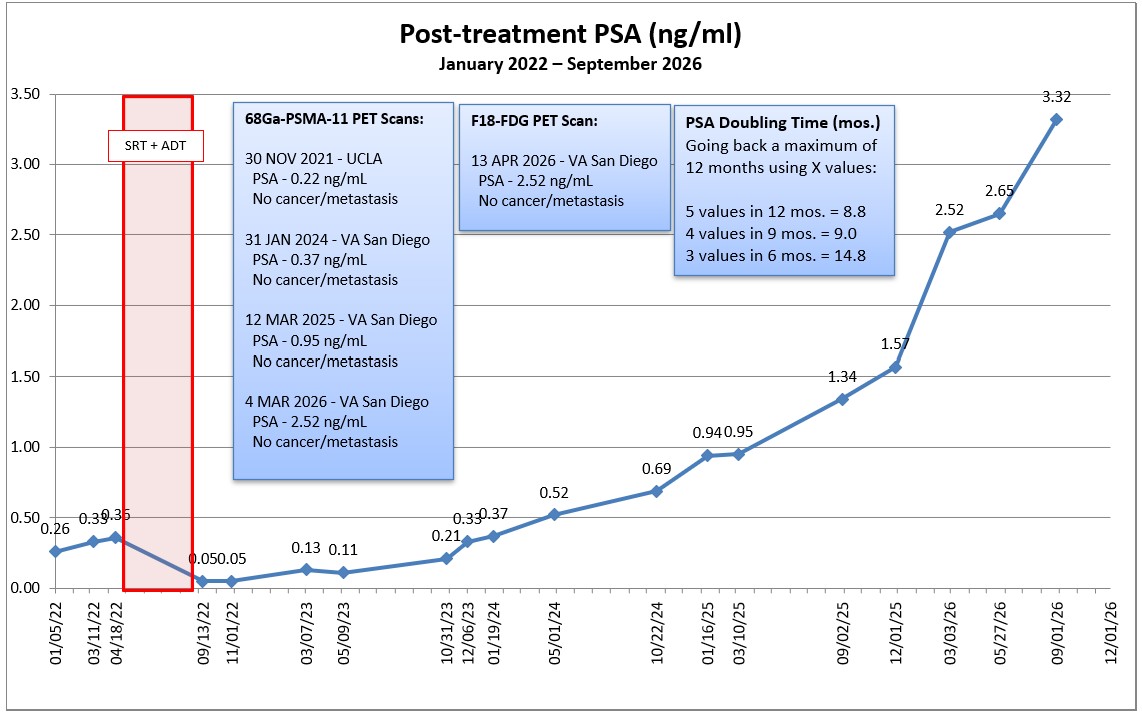
My most recent PSA results (3.32 ng/mL) have been weighing on me more heavily than I anticipated.
It’s not really the number that bothers me—I knew that it would increase. It’s what to do about that number that has had my mind in overdrive. In many ways, I feel as though I’m back to the weeks after the initial diagnosis sixteen years ago. Hours spent researching. Conflicting approaches to treatment options. Fuzzy definitions and guidelines. Frustration.
The real frustration for me is that none of my numbers or test results fit neatly into any of the guidelines, making decisions for such an important, potentially life-altering treatment even more challenging.
Cancer Staging
I know in the grand scheme of things, this matters very little, but I get frustrated by the inability of the prostate cancer community to clearly define what metastatic prostate cancer is. I’ve asked my medical team multiple times whether my cancer is metastatic, and each time I get a fairly squishy response.
It’s interesting that cancer in the pelvic lymph nodes, N1 using the TNM staging guidelines,1 is classified as Stage IV cancer, yet so many prostate cancer medical professionals say that disease confined to the pelvis really isn’t metastatic disease. Once the cancer is seen beyond the pelvic region, then they classify it as metastatic. Even my own doctors have said as much, and even the FDA thinks cancer in the pelvic region is metastatic and allows the use of ADT + ARPI drugs to treat it.
Of course, then you get to throw in the concept of micrometastases, and that isn’t covered anywhere in the staging guidelines. Yes, your PSA is rising indicating that there’s cancer somewhere, but we just don’t know where. That makes me wonder, if N1 disease in the regional lymph nodes is classified as Stage IV in the TNM guidelines, does that mean that micrometastatic disease should also be classified as Stage IV?
Rather than settling for the, “Kind of, sort of, maybe,” response, my black-and-white thinking mind goes back to the fundamental definition of metastasis:
Metastasis: The spread of cancer cells from the place where they first formed to another part of the body. In metastasis, cancer cells break away from the original (primary) tumor, travel through the blood or lymph system, and form a new tumor in other organs or tissues of the body. The new, metastatic tumor is the same type of cancer as the primary tumor.2
My prostate is gone. The cancer remains elsewhere. Therefore, by definition, I have metastatic prostate cancer. Simple concept for a simple mind.
Again, in the grand scheme of things, I suppose that the classification really doesn’t matter. If someone asks about my status, it’s just easier—and more easily understood—to say, “It’s progressed to Stage IV metastatic cancer,” instead of saying, “Do you have a few hours? It’s complicated.”
PSA Doubling Time
PSA doubling time (PSADT) seems to be an important data point in the decision-making process right now, but even with PSADT, there are disparate views on when to take action.
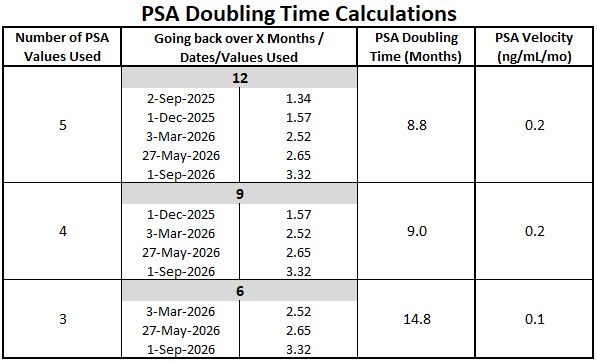
I’ve seen folks say that you don’t have to act unless your PSADT is less than six months. Others say less than nine months, and yet others say twelve months. If you’ve been following along, you already know that my PSADT has been hovering right around the nine month mark.
Depending on which guideline is used, I’m either late, early, or on the fence when it comes to starting systemic therapy. (And by systemic therapy, I’m talking androgen deprivation therapy with androgen receptor pathway inhibitors (ADT + ARPI).)
Imaging
Having a positive imaging result would certainly drive me to action. But with four 68Ga-PSMA-11 PET scans and one [F18] FDG PET scan not showing any regional or distant metastases, that would suggest that I could tap on the systemic therapy brakes for a while and wait until something does show up, even as my PSA continues to increase.
Balancing it All
So it really comes down to two factors in my mind, and I don’t know which carries more weight in the decision-making process.
Does my PSADT dipping below the nine month threshold carry more weight than negative imaging results and drive me to start systemic therapy? Or do the negative imaging results carry more weight than the PSADT and have me delay starting systemic therapy?
That’s what’s keeping me awake at night. Literally.
Medical Oncologist
I did email my VA medical oncologist (MO) last week after getting my PSA results. In essence, I asked if the jump in my PSA from 2.65 ng/mL to 3.32 ng/mL warranted a change in our plan to have the CT scan and bone scan, and to meet in early December.
In a nutshell, he described the increase as “mild,” and was okay with waiting to meet until December. He also said we could meet earlier if I wanted to.
I’m still processing whether I want to wait or have a conversation sooner. I’ve also thought of reaching out to the UCSD MO as well, and seeking his input on my increase in PSA.
[Actually, in writing this post, distilling how to weigh the two options was a lightbulb 💡 moment for me. I was having difficulty quantifying the problem until writing that a few moments ago, and that’s something to ask both of them.]
Summary
Once again, the act of writing has helped me coalesce my thoughts and ideas, which is good because it was a rough, emotionally draining week for me. Just as I said at the beginning of this adventure, you can research until the cows come home and drive yourself nuts in the process with all the contradictory guidance out there.
Even so, I’m glad I’ve done my homework over that last week or so because I’m much smarter about ADT + ARPI than I was, and that will help me with my discussions with the MO. I know it will happen at some point; it’s just a matter of when.
Time to step away from the computer into our 103° F / 39° C day. Ugh. 🥵
Be well!
Header image:Fishing boats, San Diego Harbor, California
I overachieved on this post. Normally, reporting PSA results would be quite simple and short. Not this time. The act of writing helps me organize my research and rationalize treatment decisions. Thanks for your indulgence!
I went for my PSA test this morning, 1 September, and it was 3.32 ng/mL, up from 2.65 ng/mL back in May.
I expected my PSA to go up, and I guessed it would be around 3.0 ng/mL, so the amount it went up was a bit of a surprise. It’s closing in on my PSA level at initial diagnosis, 5.0 ng/mL.
PSA Doubling Time
Seeing as both the VA and UCSD medical oncologists (MO) stressed the importance of using PSA doubling time (PSADT) to guide treatment decisions during my meetings with them in June, I really wanted to try to nail down how it should be calculated.
The Memorial Sloan-Kettering PSADT Calculator is a great tool that I’ve been using, but it doesn’t provide any guidance on how many data points should be used over what period of time. I finally found some definitive guidance:
PSA values need not be consecutively rising and all values obtained over a maximum period of 12 months should be included in the calculation. The maximum period of the past 12 months is recommended to reflect the patient’s current disease activity, since in some men PSADT may change over time. Minimum requirements for the calculation are 3 PSA values obtained over 3 months with a minimum of 4 weeks between measurements.1
You can see that I’m sitting right around that nine-month PSADT point that’s the suggested trigger for action. I’m going to keep my mouth shut and ask my MO to calculate the PSADT and see what number they come up with.
Obviously, I’m concerned, but not panicked by this jump in my PSA. I’ll email the MO to see if we should stick to the current plan of having a CT scan on 23 November, or move it to an earlier date. Or to have another PSMA PET scan. In my mind, I’d like to have at least one more scan to try and see if we can determine what we’re dealing with before leaping into combination hormone therapy.
Combination Therapy
The MO’s were really encouraging action if my PSADT was nine months or less because, with faster doubling times, there is high risk of metastasis and prostate cancer-specific mortality. The action that they’re recommending is intermittent combination therapy using androgen deprivation therapy (ADT) plus an androgen receptor pathway inhibitor (ARPI). The specific drugs they’re recommending are Eligard® (leuprolide acetate) (ADT) and Xtandi® (enzalutamide) (ARPI). The Eligard® would stop the production of testosterone, and the Xtandi® would block the cancer cells from absorbing testosterone.
The reason that the MOs want to use the combination therapy is because of the results that were shown in the EMBARK trial. Using Eligard® and Xtandi® together had 87.3% of patients in the trial reach the five-year point metastasis-free. Using just Eligard® alone—the old standard of care—just 71.4% of patients were metastasis-free at five years. The combination therapy won’t prevent progression to metastasis; it just slows it down. This short (2 min.) video from the New England Journal of Medicine gives a good overview:
The combination therapy would be given intermittently, with nine months on the medication and, if my PSA drops to a certain level (usually below 0.2 ng/mL) and stays there, there wouldn’t be a need to restart the combination therapy until there’s a rise in my PSA.
The one thing that I couldn’t find or confirm in my research was if there was a specific PSA level where, if you exceed it, this combination therapy should be started. The UCSD MO seemed okay with waiting until it was as high as 5 to 10 ng/mL if the PSADT didn’t indicate high risk.
Xtandi® (enzalutamide) is just one of several drugs known as Androgen Receptor Pathway Inhibitors (ARPIs). Two others that are commonly used include ERLEADA® (apalutamide) and NUBEQA® (darolutamide). Each has its own similar, but slightly different side effects.
Side Effects / Adverse Events
Messing around with your hormones can have substantial and sometimes debilitating side effects and, when using combination therapy, they can be additive. The National Cancer Institute has defined five grades of adverse events based on their severity:
Grade
Impact
Grade 1
Mild; asymptomatic or mild symptoms; clinical or diagnostic observations only; intervention not indicated.
Grade 2
Moderate; minimal, local or noninvasive intervention indicated; limiting instrumental ADL or mild/moderate impact on age appropriate normal daily activity (pediatric)*.
Grade 3
Severe or medically significant but not immediately life threatening; hospitalization or prolongation of hospitalization indicated; disabling; limiting self-care ADL or severe impact on age appropriate normal daily activity (pediatric)**
Activities of Daily Living (ADL): *Instrumental ADL refers to preparing meals, shopping for groceries or clothes, using the telephone, managing money, etc. **Self-care ADL refers to bathing, dressing and undressing, feeding self, using the toilet, taking medications.
Clearly, a patient would want to steer clear of any Grade 3 or 4 side effects if possible. When you look at the grades of adverse events in the summaries of each of the drugs below, you’ll see that the percentages of patients experiencing an adverse event at all grade levels can be quite high in some cases. Bottom line: ADT + ARPI will adversely impact you and your quality of life in some shape or form. It’s just a matter of degrees.
Some of the possible, more severe side effects include:
Heart disease, stroke, or mini-stroke
Fractures and falls
Lung problems
Seizures
Severe skin reactions
And you can see what percent of the time that patients experienced some of these side effects by adverse event grade in section 6.1 of the prescribing information HERE or in these tables HERE. Some of the Grade 3 or 4 adverse events occurred as much as 8% of the time.
Some of the possible, more severe side effects include:
Heart Disease
Seizure
And you can see what percent of the time that patients experienced some of these side effects by adverse event grade in section 6.1 of the prescribing information HERE. Some of the Grade 3 or 4 adverse events occurred as much as 4% of the time.
Some of the possible, more severe side effects include:
Seizure
Posterior Reversible Encephalopathy Syndrome (PRES) (Involves the brain with seizure or quickly worsening symptoms such as headache, decreased alertness, confusion, reduced eyesight, blurred vision or other visual problems)
Allergic reactions
Heart disease
Falls and bone fractures
Swallowing problems or choking (because of the size of the pills)
And you can see what percent of the time that patients experienced some of these side effects by adverse event grade in section 6.1 of the prescribing information HERE. Some of the Grade 3 or 4 adverse events occurred as much as 9% of the time.
Some of the possible, more severe side effects include:
Heart attack
Elevated blood sugar and increased risk of developing diabetes
Convulsions
And you can see what percent of the time that patients experienced some of these side effects by adverse event grade in section 6.1 of the prescribing information HERE.
Anecdotal Side Effect Experiences
One of the side effects that isn’t specifically mentioned above was cognitive decline. In a study, it was shown:
Patients with advanced prostate cancer treated with enzalutamide (Xtandi) had a significantly greater decline in cognitive function compared with those who received darolutamide (Nubeqa), according to results from a phase II trial.
Median cognitive change in the maximally changed cognitive domain (MCCD) from baseline to 24 weeks was -15.8% for those receiving darolutamide versus -36.1% for those receiving enzalutamide (P=0.009), reported Alicia Morgans, MD, MPH, of the Dana-Farber Cancer Institute and Harvard Medical School in Boston.2
I’m a member of an online support forum for advanced prostate cancer on HealthUnlocked, and one of the common themes of other patients who have been on Xtandi® (enzalutamide) is significant “brain fog.” Many had such severe side effects that they stopped taking Xtandi® (enzalutamide), with one patient calling it “poison.”
Now, I take what’s said in forums like that with more than a grain of salt. There’s definitely some selection bias going on—patients who are having difficulties with their treatments are more likely to talk about them in a forum than those whose treatments are going well. We just don’t know how many are out there who have minimal side effects and tolerate the treatments well.
Drug Interactions
I surprise medical professionals when they ask me to list my current prescriptions because I only have one: amlodipine to manage hypertension. I checked on Drugs.com to see if any of the four drugs above will interact with the amlodipine:
Because a well-known side effect of ADT is osteoporosis/bone density loss, patients are usually given calcium and vitamin D supplements to slow or minimize the loss. Interactions with calcium and vitamin D:
Clearly, we’re going to have to have a discussion about the amlodipine before starting anything because it has made a difference. My systolic number has dropped by 33 points and my diastolic number has dropped by 24 points. Part of that may be the amlodipine, and part may be the fact that I’ve lost 44 lbs. / 20 kg since starting the amlodipine (or both).
Timing of Starting ADT + ARPI Therapy
You may recall back in April, I shared an AnCan Foundation video of a seminar featuring Dr. Ravi Madan and Dr. Melissa Abel from the National Cancer Institute (NCI). In it, they raise the notion that with new PSMA PET scans, we may be moving too quickly to treat biochemically recurrent prostate cancer and may be overtreating patients, subjecting them to the side effects of ADT either unnecessarily or prematurely.
From the video notes:
Dr. Paul Schellhammer, said in the meeting, ‘it’s like listening 15 years ago to the folks who began to promote active surveillance (in first line treatment).” Dr. Madan and Dr. Abel have collected solid data from around 150 patients that suggests men with slow PSA doubling times can “play the long game” as Dr. Ravi calls it, and defer active treatment when their disease recurs.
Just like the concept of active surveillance, this approach does seem counterintuitive. It’s a novel take that probably isn’t that widely accepted yet, but when you watch the video and look at the data, it makes sense. They’re not saying that treatment won’t be required at some point; they’re just making a case for delaying the treatment in order to maintain quality of life, especially if nothing is showing up on scans.
One difference in their approach is that they define a high risk PSA doubling time to be in the three to six month range, instead of the widely accepted less than nine month range.
I have to admit that the NCI doctors have me thinking more and more about the timing of starting this combination therapy because, let’s face it, no one leaps at the opportunity to go on hormone therapy given the “fun” side effects that it brings.
When I was on Eligard® (leuprolide acetate) during my salvage radiation therapy, I tolerated it probably better than most men do. I had mild to moderate fatigue; was more emotional; lost most of my libido; but avoided hot flashes, weight gain, and some of the other common side effects. The unknown is adding the ARPI to the mix.
Of the three ARPI agents available, Xtandi® (enzalutamide) seems to be the worst when it comes to side effects and patient experiences relayed in the prostate cancer forum. Of course, that’s the ARPI that the VA apparently uses in its treatment. NUBEQA® (darolutamide) seems to have the similar results when it comes to delaying metastasis with fewer side effects,3 so you can bet I’ll be having a conversation about this option with the medical oncologist when the time comes.
If you were to ask me right now what I plan on doing, my short answer is, “I don’t know.”
On the one hand, my PSADT hovering right around the action point and has been for some time now. Is that alone reason to act?
In his video, Dr. Madan basically concluded that, if your PSADT is >6 months and you don’t have any cancer showing up on scans, you can just continue to monitor the PSA without starting the hormone therapy—in other words, active surveillance for biochemical recurrence. As I recall, he observed patients for several years with increasing PSAs and consistently negative scans. Do I roll the dice based on his research and conclusions?
That’s one of the reasons that I want to have at least one more scan before committing one way or the other.
Once again, I’m in yet another decision dilemma with the science pulling in different directions.
Depending on what the VA MO says, I may also solicit the input of the UCSD MO one more time and go from there. I’m also open to thoughts and experiences from you.
More to come, that’s for sure.
Be well!
Arlen PM, Bianco F, Dahut WL, D’Amico A, Figg WD, Freedland SJ, Gulley JL, Kantoff PW, Kattan MW, Lee A, Regan MM, Sartor O; Prostate Specific Antigen Working Group. Prostate Specific Antigen Working Group guidelines on prostate specific antigen doubling time. J Urol. 2008 Jun;179(6):2181-5; discussion 2185-6. doi: 10.1016/j.juro.2008.01.099. Epub 2008 Apr 18. PMID: 18423743; PMCID: PMC2667701. ↩︎
To my regular readers, you may want to skip this post. This is a high-level update intended for my family and friends who don’t regularly follow this blog (gasp!), and it will be shared with them via my personal social media accounts.If you’re new here, welcome. Feel free to read away.
It’s been a while since I’ve provided any detailed update on what’s going on in the world of my prostate cancer, so here goes.
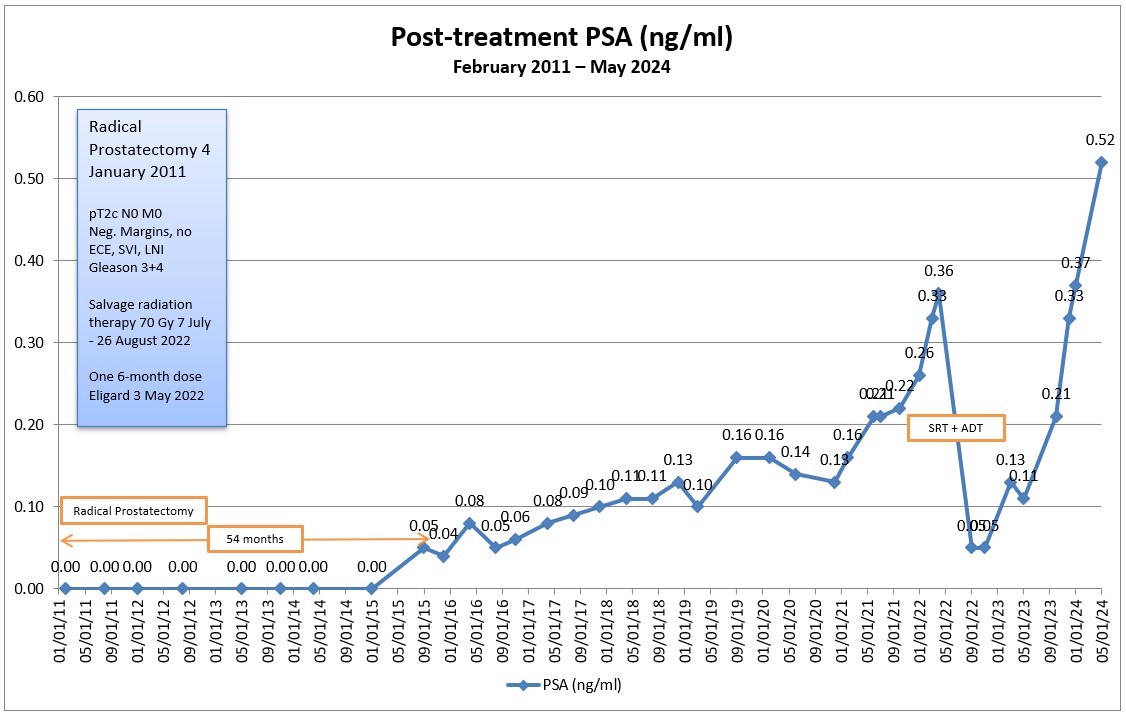
We last left our hero two years ago as he began 35 sessions of salvage radiation therapy on 7 July 2022 in attempt to kill off his recurrent prostate cancer after his surgery in January 2011 ultimately failed. Unfortunately, those little cancer cells have proved themselves to be quite resilient, and the salvage radiation therapy has failed, too. Bummer.
We know this by tracking my prostate-specific antigens (PSA) on a regular basis. After the surgery, my PSA level should have dropped to undetectable (zero) because there was no prostate left to produce the PSA. But the PSA can live on in the cancer cells even without a prostate, and that’s how we know the cancer is still there.
After the radiation, my PSA should have dropped substantially, and it did, at least initially. But about 15 months after the radiation ended, my PSA was on the rise again. It rose enough to the surpass the PSA level when we started the radiation. In May 2024, it continued its upward climb to 0.52 ng/mL, the highest it’s been since the surgery. (In the grand scheme of things, it’s still a low value that many fellow prostate cancer patients would love to have, but the fact that it’s doubling about every six months is a concern.)
There is a relatively new scan that can detect prostate cancer cells at fairly low PSA levels. It works best when the PSA is close to 1.0 ng/mL, but it has detected prostate cancer about 30% of the time at PSA levels in the 0.2–0.3 ng/mL range. I went for this PSMA PET scan in January when my PSA was 0.37 ng/mL, and the scan failed to detect anything.
On the one hand, that’s great because there were no signs of metastasis and no evidence of prostate cancer. But on the other hand, we need to know where the cancer is located and what it’s up to in order to plan our next treatment options. Because it didn’t reveal its ugly head, we can’t make any meaningful treatment decisions right now.
If there are one or two small lesions someplace, we may be able to radiate them again depending on their size and location. But if there aren’t any distinct lesions and my PSA continues to increase, that’s likely the result of micrometastases and that would require a systemic treatment approach (e.g., hormone therapy, immunotherapy, chemotherapy, or any combination thereof).
After reviewing my May PSA results with the urologist, we agreed to punt for six months and do another PSA test in late October. I know that seems counterintuitive—letting the cancer continue to grow without taking action—but there’s a reason for it. I’m predicting my PSA at that point will be in the 0.75–1.0 ng/mL range in October, and we’ll do another PSMA PET scan to see if we can determine what’s going on and then plan from there.
Up until this year, all of my conversations have been with the urologist and radiation oncologist. In February, I met with a medical oncologist for the first time because they’re the ones who deal with the systemic treatments.
Based on my conversations with the urologist and medical oncologist, the next logical treatment option is hormone therapy. Prostate cancer lives off of testosterone, so if we kill off the testosterone, we slow the growth of the cancer cells. (Hormone therapy is not curative, however.) But the timing of starting hormone therapy is important.
If we started the hormone therapy now, it would rapidly knock my PSA down so far that it would make it next to impossible to do the PSMA PET scan in November and get any meaningful results.
The other problem with starting hormone therapy too early is that the prostate cancer can become hormone resistant much in the same way that bacteria can become resistant to antibiotics. Start the treatment too early, and you’ll lose its effectiveness when you really need it later.
There seemed to be a differing of opinions between the urologist and the medical oncologist as to what would trigger the start of hormone therapy. The urologist would hold off until there’s evidence of metastasis; the medical oncologist suggested we’d start when my PSA hit 2.0 ng/mL. We can figure that out when the time comes, but both agreed that hormone therapy (and other therapies) can keep me around another 10–15 years (or more).
Of course, my quality of life may be diminished as a result of the treatments. Hormone therapy can come with a whole host of unpleasant side effects such as fatigue, muscle loss, weight gain, loss of libido, hot flashes, etc. No need to rush into that Disneyland of experiences.
Physically, I am feeling fine. I’m completely asymptomatic when it comes to the cancer, but the side effects from the surgery and radiation are present and are a nuisance more than anything. Psychologically, though, it’s been a bit of an emotional roller coaster ride as I go from PSA test to PSA test, and failed treatment option to failed treatment option. We’re closing in on 14 years since diagnosis, and it does get tiring.
One of my regular blog readers and my urologist both suggested that, at this point, I look at my prostate cancer more as a chronic illness than as a life-threatening disease. I’m still trying to embrace that perspective and, even if I do, the worry will never go away.
There you have it. The latest and greatest in this adventure of living with prostate cancer. Follow along if you want to see my monthly updates, and we’ll probably know more right around the holidays.
Be well!
Header image: Lake Michigan coastline from the John Hancock Center, Chicago, Illinois
A moderator on the HealthUnlocked website shared a link to the new 2024 American Urological Association guidelines for salvage therapy for recurrent prostate cancer:
The suspense of not knowing what my PSA was up to was killing me, so I went a couple of days earlier than I planned to have my PSA test. I was expecting it to go up a bit, but I wasn’t expecting it to leap a tall building in a single bound.
My PSA jumped from 0.21 ng/mL on 31 October to 0.33 ng/mL on 6 December, a 57% increase in five weeks. Ugh. Using the four PSA values from this year and Memorial Sloan Kettering PSA Doubling Time calculator, my PSADT is 6.7 months.
I’d say it’s safe to conclude that the salvage radiation therapy missed the mark, but I’ll confirm that with an in-person appointment with the urologist on Thursday, 14 December and with the radiation oncologist via email.
I’m writing this late on Thursday night, about 20 minutes after seeing the results online, so I’m still shocked and processing it all. I’ll wrap this post up in the morning…
Back at the keyboard Friday morning after a somewhat fitful night of sleep…
Needless to say, this was (and still is) a bit of a gut-punch for me to see the PSA increase so rapidly. It’s definitely got me concerned and wondering where the cancer is if the radiation didn’t even make a dent in it.
So what’s next? I don’t know. I suspect these would be a few possibilities:
First, maybe let the PSA continue to rise a little more until it’s over 0.5 ng/mL but less than 1.0 ng/mL to give a PSMA PET scan a better chance of picking up where the cancer is located. At 1.0 ng/mL, PSMA PET scans can find the cancer about 90% of the time.
If there are only a couple of localized lesions, we may be able to radiate them.
Second, I’m sure androgen deprivation therapy (ADT) is definitely on the horizon, whether we do a scan and radiation or not. My only question would be the timing of the ADT. If it’s given before a scan, would that make it more difficult for the scan to pick up the lesions? I don’t know.
Last, Dr. Mark Scholz of the Prostate Cancer Research Institute, recently posted a video where he talked about a shift in how they approach treating advanced prostate cancer. (I’ll post the video in a separate post.)
Traditionally, treatments were offered sequentially. You’d start with hormone therapy, and when the cancer became resistant, you shifted to a different type of hormone therapy. When that failed, you would move into chemotherapy, a PARP inhibitor (immunotherapy), injectable radiation, and finally clinical trials.
There is research showing that combination therapies may be more effective in staving off the cancer. Instead of just starting out with ADT, it may make sense to combine ADT with radiation or ADT with chemotherapy right out the gate. Yes, there may be increased immediate side effects from the dual treatment, but early studies are showing higher cure rates and longer survival. Additionally, if the combined treatments are successful, this may lead to a better long-term quality of life because you may be able to be taken off ADT.
My appointment with the urologist is on Thursday, 14 December, and you bet I’ll have a ton of questions ready. One of them will be about getting a full-blown medical oncologist who specializes in prostate cancer involved at this point.
In the meantime, I’m going to have to start learning the language of advanced prostate cancer. There are so many different drugs and treatments with weird names that don’t really indicate what they do or how they’re used that it’s tough to keep them straight. Perhaps a spreadsheet may be in order…
I am trying to look for the silver lining in the cloud. I guess that would be that my PSA is still quite low. But the dark part of the cloud is the fact that I’m probably entering the phase where the treatments and their side effects will eventually be worse than the disease when it comes to daily quality of life. I tolerated the six-month dose of Eligard in 2022 pretty well, but it wasn’t without side effects. I guess I’ll cross that bridge when I get to it.
Oh. And I’m open to any and all insights from those who have traveled this path ahead of me.
Well, time to get out of the house and try to put this out of my mind for a brief period. (Translation: Escapism.)
Here is another informative video from the Prostate Cancer Research Institute and Dr. Scholz. It hit too close to home for me, as it describes the dilemma I faced in deciding when to initiate salvage radiation therapy.
Perhaps the key point that Dr. Scholz makes (at 6:08 in the video) is that there’s “a huge advantage of knowing where the cancer is and allowing the radiation therapist to target that spot” as it relates to a newer approach of letting the PSA rise so that modern imaging can determine the location(s).
Later in the video at the 9:40 mark, he goes on to say:
It’s quite tempting in many of the cases that I see to allow the PSA to go a little bit higher knowing that that 0.5 threshold [used by radiation therapists] was set at a time when we didn’t have scans and we didn’t know where the cancer was. There’s such an advantage of knowing where the cancer is and allowing the radiation therapist to target the disease that I tend to liberalize a little bit and allow the PSAs to rise above 0.5 if necessary.
In other words, because of the value in knowing the location of the cancer that can lead to curative outcomes if properly targeted by the radiation therapist, it may be worth allowing the PSA to rise to the point where it can be detected on a scan.
I toyed with the idea of getting a second PSMA PET scan when my PSA hit 0.33 and 0.36, but because it was rising rapidly and because I knew it could take two to four months to get another PSMA PET scan scheduled, I opted to act and go ahead with the salvage radiation therapy. I do have to question if it may have been wise to do the second scan so the RO knew exactly where to aim because, with my PSA rising again, we may have missed our mark.
Will I dwell on that? Nope. I made the best decision I could with the information available at the time.
The bottom line is that we all have to assess our own risk levels and be comfortable with our decisions.
Here’s a great video highlighting the decision-making dilemma that comes with a rising PSA after surgery.
It reinforces that I wasn’t nuts in agonizing over my decision to move forward with the decision for salvage radiation. There are just so many variables that go into the decision, and even the “experts” are really just taking their best guess at it.
The Prostate Cancer Foundation is hosting a Zoom webinar at 4:30 p.m., Pacific Standard Time (Los Angeles) on Tuesday, 17 January 2023 to talk about rising PSA after treatment. The webinar is free and open to all, but you must register in advance.
You can send questions in advance to: webinar@pcf.org.
If you can’t attend, the webinar will be recorded so you can view it on their website later.
I don’t know where the time has gone. It’s hard to believe that we’re approaching two months since ending the salvage radiation therapy.
On the whole, things have improved significantly for me since then. My energy level has returned to pre-zapping levels, except when I’m stupid and stay up way too late at night (that’s something I can control). That’s been a good thing because I’ve been able to get out and enjoy the world again.
As far as the urinary control issues are concerned, they’re much improved, too. I opted to stop the Tamsulosin (Flomax) near the end of September, and that seems to have helped. My frequency is greatly improved. During the day, I can go several hours between runs to the toilet, and at night, I’m only have to empty my bladder one to three times a night. That’s a godsend.
The urgency still can be a bit of an issue. There are times where I don’t have much time to get to the toilet if I let things go a little too long. On a related note, since stopping the Tamsulosin, my leakage / incontinence has improved as well, even with the urgency. That’s a positive, too.
I had a video appointment with my primary care physician about the pain I’ve been experiencing in my back. In short, even though things seems to be slowly improving (even after the call with him on 26 September), he still wants me to have an MRI to see what may be going on. That’s scheduled for this Friday.
I’m not exactly sure how the hormone therapy works as you approach the end of the six month dosage period, but I’m guessing its effects may linger another few months beyond the end of the dosage. Again, I’ve been blessed in that my only real side effect has been the mild fatigue—no weight gain and no hot flashes. (Even though all three of my doctors say my back pain is unrelated to the hormone therapy, I’m still not convinced. There’s a first for everything, right???)
The radiation oncologist’s office wouldn’t schedule my three-month follow-up appointment until the end of October when they had a better handle on the doctor’s November schedule. I’ll get my PSA checked again in November in advance of that appointment, and I have a follow-up with the urologist on 13 December.
It’s good to be back into a more normal state after all of that. Let’s hope that there are no long-term radiation side effects that start popping up two to five years down the road.
Today’s visit with the urologist went about as expected—just a routine review of the salvage radiation therapy, its after-effects, and what’s next.
He was pleased with the drop in my PSA and thought that it may drop even further given how soon after the test was taken after the completion of the radiation. He stressed that we’ll have to establish a nadir in the next year to get a true starting point to determine the effectiveness of the radiation. He was okay with doing another PSA test in November in advance of my radiation oncologist follow-up visit.
Regarding my urinary frequency and urgency, he said I was pretty much where I should be after the radiation, and that it could take up to six months for things to truly calm down. I mentioned that the radiation oncologist put me on tamsulosin / Flowmax, and that it seemed to help a little with my frequency issues.
But I also told him that I stopped taking the tamsulosin over the weekend because my incontinence was up while I was on it and I just wanted to see what it’s like without it. So far, so good.
I did talk about my back and rib pain and once again asked if it could be related to the Eligard. Once again, he thought it was highly unlikely. He also ruled out the possibility that it could be metastases given where my PSA level is at. He did do a bit of a hands-on physical exam to rule out kidney stones (been there, done that, this is not kidney stones). He also made the comment, “Hey, I do plumbing”—I cracked up—and he was glad that I’ll be speaking with my primary care physician about it next week.
He didn’t want to put me on any additional medications for the urinary issues because of side effects that they may have, and we never explicitly spoke about whether to continue the hormone therapy or not. We did, though, talk about this first six-month dose wearing off in the next few months, so it wasn’t as though the topic was completely ignored.
Going forward, I’ll get another PSA test sometime in November; have my follow-up with the radiation oncologist shortly after (yet to be scheduled); and follow-up with urology on 13 December 2022. (I did avoid a 3:30 p.m. appointment like today because traffic sucked driving home.)
Be well.
Header Image: Cathedral Rock and Oak Creek near Sedona, Arizona