Month 164 – Prostate Cancer Update

To my regular readers, you may want to skip this post. This is a high-level update intended for my family and friends who don’t regularly follow this blog (gasp!), and it will be shared with them via my personal social media accounts. If you’re new here, welcome. Feel free to read away.


It’s been a while since I’ve provided any detailed update on what’s going on in the world of my prostate cancer, so here goes.

We last left our hero two years ago as he began 35 sessions of salvage radiation therapy on 7 July 2022 in attempt to kill off his recurrent prostate cancer after his surgery in January 2011 ultimately failed. Unfortunately, those little cancer cells have proved themselves to be quite resilient, and the salvage radiation therapy has failed, too. Bummer.

We know this by tracking my prostate-specific antigens (PSA) on a regular basis. After the surgery, my PSA level should have dropped to undetectable (zero) because there was no prostate left to produce the PSA. But the PSA can live on in the cancer cells even without a prostate, and that’s how we know the cancer is still there.

After the radiation, my PSA should have dropped substantially, and it did, at least initially. But about 15 months after the radiation ended, my PSA was on the rise again. It rose enough to the surpass the PSA level when we started the radiation. In May 2024, it continued its upward climb to 0.52 ng/mL, the highest it’s been since the surgery. (In the grand scheme of things, it’s still a low value that many fellow prostate cancer patients would love to have, but the fact that it’s doubling about every six months is a concern.)
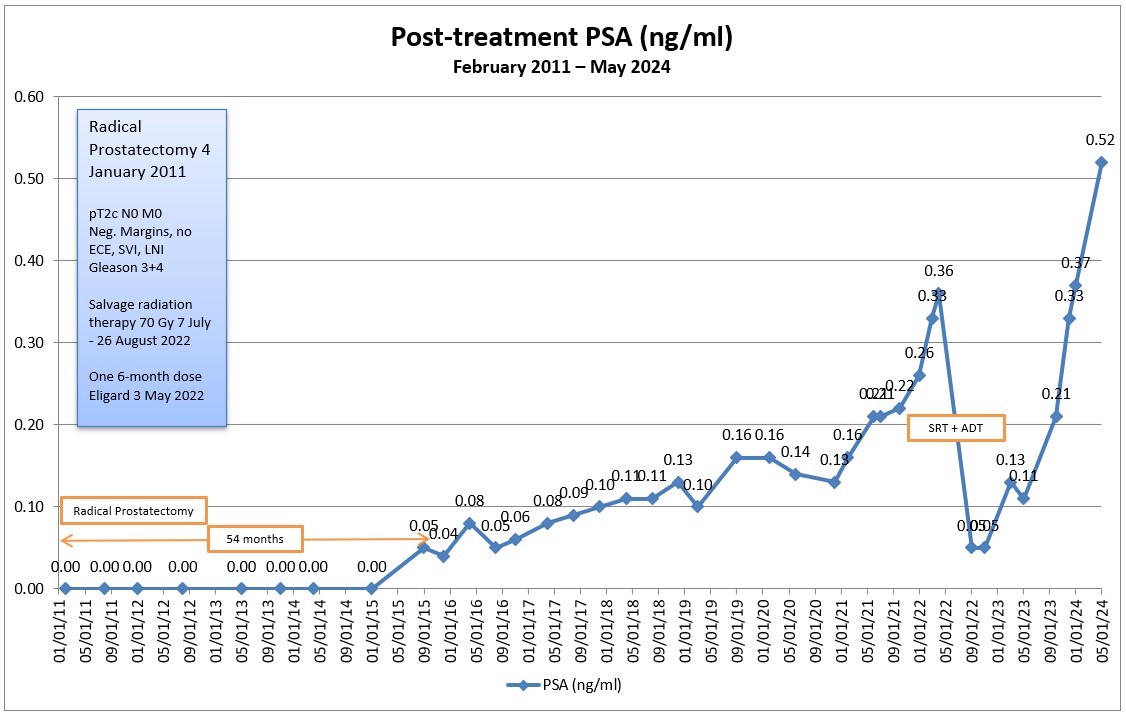
There is a relatively new scan that can detect prostate cancer cells at fairly low PSA levels. It works best when the PSA is close to 1.0 ng/mL, but it has detected prostate cancer about 30% of the time at PSA levels in the 0.2–0.3 ng/mL range. I went for this PSMA PET scan in January when my PSA was 0.37 ng/mL, and the scan failed to detect anything.

On the one hand, that’s great because there were no signs of metastasis and no evidence of prostate cancer. But on the other hand, we need to know where the cancer is located and what it’s up to in order to plan our next treatment options. Because it didn’t reveal its ugly head, we can’t make any meaningful treatment decisions right now.

If there are one or two small lesions someplace, we may be able to radiate them again depending on their size and location. But if there aren’t any distinct lesions and my PSA continues to increase, that’s likely the result of micrometastases and that would require a systemic treatment approach (e.g., hormone therapy, immunotherapy, chemotherapy, or any combination thereof).

After reviewing my May PSA results with the urologist, we agreed to punt for six months and do another PSA test in late October. I know that seems counterintuitive—letting the cancer continue to grow without taking action—but there’s a reason for it. I’m predicting my PSA at that point will be in the 0.75–1.0 ng/mL range in October, and we’ll do another PSMA PET scan to see if we can determine what’s going on and then plan from there.

Up until this year, all of my conversations have been with the urologist and radiation oncologist. In February, I met with a medical oncologist for the first time because they’re the ones who deal with the systemic treatments.

Based on my conversations with the urologist and medical oncologist, the next logical treatment option is hormone therapy. Prostate cancer lives off of testosterone, so if we kill off the testosterone, we slow the growth of the cancer cells. (Hormone therapy is not curative, however.) But the timing of starting hormone therapy is important.

If we started the hormone therapy now, it would rapidly knock my PSA down so far that it would make it next to impossible to do the PSMA PET scan in November and get any meaningful results.

The other problem with starting hormone therapy too early is that the prostate cancer can become hormone resistant much in the same way that bacteria can become resistant to antibiotics. Start the treatment too early, and you’ll lose its effectiveness when you really need it later.

There seemed to be a differing of opinions between the urologist and the medical oncologist as to what would trigger the start of hormone therapy. The urologist would hold off until there’s evidence of metastasis; the medical oncologist suggested we’d start when my PSA hit 2.0 ng/mL. We can figure that out when the time comes, but both agreed that hormone therapy (and other therapies) can keep me around another 10–15 years (or more).

Of course, my quality of life may be diminished as a result of the treatments. Hormone therapy can come with a whole host of unpleasant side effects such as fatigue, muscle loss, weight gain, loss of libido, hot flashes, etc. No need to rush into that Disneyland of experiences.

Physically, I am feeling fine. I’m completely asymptomatic when it comes to the cancer, but the side effects from the surgery and radiation are present and are a nuisance more than anything. Psychologically, though, it’s been a bit of an emotional roller coaster ride as I go from PSA test to PSA test, and failed treatment option to failed treatment option. We’re closing in on 14 years since diagnosis, and it does get tiring.

One of my regular blog readers and my urologist both suggested that, at this point, I look at my prostate cancer more as a chronic illness than as a life-threatening disease. I’m still trying to embrace that perspective and, even if I do, the worry will never go away.

There you have it. The latest and greatest in this adventure of living with prostate cancer. Follow along if you want to see my monthly updates, and we’ll probably know more right around the holidays.

Be well!

Header image: Lake Michigan coastline from the John Hancock Center, Chicago, Illinois

Salvage Therapy for Prostate Cancer: AUA/ASTRO/SUO Guideline (2024)

A moderator on the HealthUnlocked website shared a link to the new 2024 American Urological Association guidelines for salvage therapy for recurrent prostate cancer:

https://www.auanet.org/guidelines-and-quality/guidelines/salvage-therapy-for-prostate-cancer

These are the generally agreed-upon guidelines that practitioners should follow when a patient has recurrent prostate cancer after initial treatment.

Day 4,776 – PSA Results (Not Good)

Well, 💩.

The suspense of not knowing what my PSA was up to was killing me, so I went a couple of days earlier than I planned to have my PSA test. I was expecting it to go up a bit, but I wasn’t expecting it to leap a tall building in a single bound.

My PSA jumped from 0.21 ng/mL on 31 October to 0.33 ng/mL on 6 December, a 57% increase in five weeks. Ugh. Using the four PSA values from this year and Memorial Sloan Kettering PSA Doubling Time calculator, my PSADT is 6.7 months.

I’d say it’s safe to conclude that the salvage radiation therapy missed the mark, but I’ll confirm that with an in-person appointment with the urologist on Thursday, 14 December and with the radiation oncologist via email.

I’m writing this late on Thursday night, about 20 minutes after seeing the results online, so I’m still shocked and processing it all. I’ll wrap this post up in the morning…

Back at the keyboard Friday morning after a somewhat fitful night of sleep…

Needless to say, this was (and still is) a bit of a gut-punch for me to see the PSA increase so rapidly. It’s definitely got me concerned and wondering where the cancer is if the radiation didn’t even make a dent in it.

So what’s next? I don’t know. I suspect these would be a few possibilities:

First, maybe let the PSA continue to rise a little more until it’s over 0.5 ng/mL but less than 1.0 ng/mL to give a PSMA PET scan a better chance of picking up where the cancer is located. At 1.0 ng/mL, PSMA PET scans can find the cancer about 90% of the time.

If there are only a couple of localized lesions, we may be able to radiate them.

Second, I’m sure androgen deprivation therapy (ADT) is definitely on the horizon, whether we do a scan and radiation or not. My only question would be the timing of the ADT. If it’s given before a scan, would that make it more difficult for the scan to pick up the lesions? I don’t know.

Last, Dr. Mark Scholz of the Prostate Cancer Research Institute, recently posted a video where he talked about a shift in how they approach treating advanced prostate cancer. (I’ll post the video in a separate post.)

Traditionally, treatments were offered sequentially. You’d start with hormone therapy, and when the cancer became resistant, you shifted to a different type of hormone therapy. When that failed, you would move into chemotherapy, a PARP inhibitor (immunotherapy), injectable radiation, and finally clinical trials.

There is research showing that combination therapies may be more effective in staving off the cancer. Instead of just starting out with ADT, it may make sense to combine ADT with radiation or ADT with chemotherapy right out the gate. Yes, there may be increased immediate side effects from the dual treatment, but early studies are showing higher cure rates and longer survival. Additionally, if the combined treatments are successful, this may lead to a better long-term quality of life because you may be able to be taken off ADT.

My appointment with the urologist is on Thursday, 14 December, and you bet I’ll have a ton of questions ready. One of them will be about getting a full-blown medical oncologist who specializes in prostate cancer involved at this point.

In the meantime, I’m going to have to start learning the language of advanced prostate cancer. There are so many different drugs and treatments with weird names that don’t really indicate what they do or how they’re used that it’s tough to keep them straight. Perhaps a spreadsheet may be in order…

I am trying to look for the silver lining in the cloud. I guess that would be that my PSA is still quite low. But the dark part of the cloud is the fact that I’m probably entering the phase where the treatments and their side effects will eventually be worse than the disease when it comes to daily quality of life. I tolerated the six-month dose of Eligard in 2022 pretty well, but it wasn’t without side effects. I guess I’ll cross that bridge when I get to it.

Oh. And I’m open to any and all insights from those who have traveled this path ahead of me.

Well, time to get out of the house and try to put this out of my mind for a brief period. (Translation: Escapism.)

Rising PSA After Prostatectomy – PCRI Video

Here is another informative video from the Prostate Cancer Research Institute and Dr. Scholz. It hit too close to home for me, as it describes the dilemma I faced in deciding when to initiate salvage radiation therapy.

Perhaps the key point that Dr. Scholz makes (at 6:08 in the video) is that there’s “a huge advantage of knowing where the cancer is and allowing the radiation therapist to target that spot” as it relates to a newer approach of letting the PSA rise so that modern imaging can determine the location(s).

Later in the video at the 9:40 mark, he goes on to say:

It’s quite tempting in many of the cases that I see to allow the PSA to go a little bit higher knowing that that 0.5 threshold [used by radiation therapists] was set at a time when we didn’t have scans and we didn’t know where the cancer was. There’s such an advantage of knowing where the cancer is and allowing the radiation therapist to target the disease that I tend to liberalize a little bit and allow the PSAs to rise above 0.5 if necessary.

In other words, because of the value in knowing the location of the cancer that can lead to curative outcomes if properly targeted by the radiation therapist, it may be worth allowing the PSA to rise to the point where it can be detected on a scan.

I toyed with the idea of getting a second PSMA PET scan when my PSA hit 0.33 and 0.36, but because it was rising rapidly and because I knew it could take two to four months to get another PSMA PET scan scheduled, I opted to act and go ahead with the salvage radiation therapy. I do have to question if it may have been wise to do the second scan so the RO knew exactly where to aim because, with my PSA rising again, we may have missed our mark.

Will I dwell on that? Nope. I made the best decision I could with the information available at the time.

The bottom line is that we all have to assess our own risk levels and be comfortable with our decisions.

PSA After #ProstateCancer Surgery | #MarkScholzMD #AlexScholz | PCRI

Here’s a great video highlighting the decision-making dilemma that comes with a rising PSA after surgery.

It reinforces that I wasn’t nuts in agonizing over my decision to move forward with the decision for salvage radiation. There are just so many variables that go into the decision, and even the “experts” are really just taking their best guess at it.

PCF Webinar: When Your PSA is Rising after Treatment

The Prostate Cancer Foundation is hosting a Zoom webinar at 4:30 p.m., Pacific Standard Time (Los Angeles) on Tuesday, 17 January 2023 to talk about rising PSA after treatment. The webinar is free and open to all, but you must register in advance.

You can send questions in advance to: webinar@pcf.org.

If you can’t attend, the webinar will be recorded so you can view it on their website later.

https://www.pcf.org/pcf-webinar-series/

Header Image: Anza-Borrego Desert, California

Month 143 – Much Improved

I don’t know where the time has gone. It’s hard to believe that we’re approaching two months since ending the salvage radiation therapy.

On the whole, things have improved significantly for me since then. My energy level has returned to pre-zapping levels, except when I’m stupid and stay up way too late at night (that’s something I can control). That’s been a good thing because I’ve been able to get out and enjoy the world again.

As far as the urinary control issues are concerned, they’re much improved, too. I opted to stop the Tamsulosin (Flomax) near the end of September, and that seems to have helped. My frequency is greatly improved. During the day, I can go several hours between runs to the toilet, and at night, I’m only have to empty my bladder one to three times a night. That’s a godsend.

The urgency still can be a bit of an issue. There are times where I don’t have much time to get to the toilet if I let things go a little too long. On a related note, since stopping the Tamsulosin, my leakage / incontinence has improved as well, even with the urgency. That’s a positive, too.

I had a video appointment with my primary care physician about the pain I’ve been experiencing in my back. In short, even though things seems to be slowly improving (even after the call with him on 26 September), he still wants me to have an MRI to see what may be going on. That’s scheduled for this Friday.

I’m not exactly sure how the hormone therapy works as you approach the end of the six month dosage period, but I’m guessing its effects may linger another few months beyond the end of the dosage. Again, I’ve been blessed in that my only real side effect has been the mild fatigue—no weight gain and no hot flashes. (Even though all three of my doctors say my back pain is unrelated to the hormone therapy, I’m still not convinced. There’s a first for everything, right???)

The radiation oncologist’s office wouldn’t schedule my three-month follow-up appointment until the end of October when they had a better handle on the doctor’s November schedule. I’ll get my PSA checked again in November in advance of that appointment, and I have a follow-up with the urologist on 13 December.

It’s good to be back into a more normal state after all of that. Let’s hope that there are no long-term radiation side effects that start popping up two to five years down the road.

Header Image: Autumn leaves, Santa Fe, New Mexico

Day 4,332 – Urologist Visit

Today’s visit with the urologist went about as expected—just a routine review of the salvage radiation therapy, its after-effects, and what’s next.

He was pleased with the drop in my PSA and thought that it may drop even further given how soon after the test was taken after the completion of the radiation. He stressed that we’ll have to establish a nadir in the next year to get a true starting point to determine the effectiveness of the radiation. He was okay with doing another PSA test in November in advance of my radiation oncologist follow-up visit.

Regarding my urinary frequency and urgency, he said I was pretty much where I should be after the radiation, and that it could take up to six months for things to truly calm down. I mentioned that the radiation oncologist put me on tamsulosin / Flowmax, and that it seemed to help a little with my frequency issues.

But I also told him that I stopped taking the tamsulosin over the weekend because my incontinence was up while I was on it and I just wanted to see what it’s like without it. So far, so good.

I did talk about my back and rib pain and once again asked if it could be related to the Eligard. Once again, he thought it was highly unlikely. He also ruled out the possibility that it could be metastases given where my PSA level is at. He did do a bit of a hands-on physical exam to rule out kidney stones (been there, done that, this is not kidney stones). He also made the comment, “Hey, I do plumbing”—I cracked up—and he was glad that I’ll be speaking with my primary care physician about it next week.

He didn’t want to put me on any additional medications for the urinary issues because of side effects that they may have, and we never explicitly spoke about whether to continue the hormone therapy or not. We did, though, talk about this first six-month dose wearing off in the next few months, so it wasn’t as though the topic was completely ignored.

Going forward, I’ll get another PSA test sometime in November; have my follow-up with the radiation oncologist shortly after (yet to be scheduled); and follow-up with urology on 13 December 2022. (I did avoid a 3:30 p.m. appointment like today because traffic sucked driving home.)

Be well.

Header Image: Cathedral Rock and Oak Creek near Sedona, Arizona

    Zapping Session #16 – Update

    This morning’s session had an unexpected surprise. At the end of the session, the technician told me that my bladder was “borderline” not filled enough, and I found that to be really odd. I used the same bladder-filling timeline and technique this morning that I’ve been using all along. She encouraged me to practice over the weekend.


    I met with the radiation oncologist on Tuesday, which was unusual because our normally scheduled meeting day is Thursdays. He told me he was going away for a few weeks, and I asked him where he was going. Long story short, his wife is from Germany and they were going to visit her family in a town that was about an hour from where my grandfather was born. Also, his wife studied at Würzburg, and my cousin is a professor and doctor at the university hospital in Würzburg. Small world.

    During the meeting, I mentioned that the side effects were beginning to kick in more, and he commented, “Yeah. You’re at the dosage level where they typically start showing up.” I thought that was interesting because I never considered there to be a dosage threshold for side effects. It makes perfect sense though.

    Fatigue

    The fatigue is really kicking in now, although it happens in waves of varying amplitudes. For example, after yesterday’s session (Thursday), I was energetic enough to stop by an event at my former employer and just hang out for a few hours and see how everyone was doing. By mid afternoon, I was a tad tired (70% on my internal “battery”) but was able to keep going through the afternoon, past dinner, and into the evening.

    Today, though, was a considerably different story. As soon as I was done with the session at 10:15 a.m., I ran and bought groceries, had lunch, and by 11:45 a.m. my internal “battery” was down to about 20% and I was napping until about 2:30 p.m. Hard. Even now, as it’s approaching 4 p.m. as I’m writing this, I feel as though my battery is about 50-60% charged even after the nap.

    I may attribute part of the fatigue to my urinary frequency, because it’s definitely increased through the week.

    Wednesday night into Thursday morning, I had to empty my bladder just twice. Last night, I had to empty it four times. That’s four sleep interruptions that would contribute to the fatigue.

    The doctor did offer to put me on Flomax (Tamsulosin) to relax my bladder and hopefully reduce the frequency. For now, I declined his offer because at some point years ago (perhaps even before I was diagnosed), I had been prescribed Flomax and I recall that it wasn’t a very positive experience with its side effects (extreme dizziness).

    Urinary Frequency

    As you saw in a previous post, I was using a spreadsheet to track when I was emptying my bladder, but that was cumbersome to use, especially logging an entry in the middle of the night. I found an app called “Simple Time Tracker” that has a widget that I can have on my phone’s home screen, and all I have to do is tap it to start recording when I go to the toilet and tap it again when I’m done. It automatically records the date and time, and that’s all that I’m after. (The only downside is that I can’t export the data to my spreadsheet.)

    Between 1 a.m. and 4 p.m. today, I’ve made eleven trips to the toilet, and my only fluid intake was about 1.5 liters of water before the zapping session and another 0.5 liters of soda after the session. It’s not like I’m consuming a high volume of liquids to have me going so often.

    Irritation

    My skin irritation remains about the same and applying moisturizing lotion does help. But now I have a general constant mild burning sensation in my urethra and hints of it starting in my rectum. It doesn’t hurt to urinate (yet), but the burning sensation is mildly annoying right now. I also think the irritation in my urethra is triggering my brain to empty my bladder when I really could probably wait a while longer without incident. I’m guessing it will likely worsen as the cumulative dosage increases.

    Emotions

    For one of the first times since starting the hormone therapy, I found myself to be a bit on the emotional side this week. I’m guessing the fatigue contributed to that, too. I’ll leave it at that for now, and I may write about it separately in the days ahead.

    Summary

    After Monday’s session (1 August) I’ll be halfway through the treatments. If the side effects stay at the current level, that can be manageable. If they get worse, I guess I’ll just have to suck it up and power through them like the countless thousands of radiation patients before me.

    Enjoy your weekend!

    Day 4,178 – PSA Results & Stuff

    I went for my pre-physical appointment blood work yesterday and was surprised to have the results back today. It used to take the VA two or three days to post them online.

    In any case, my PSA climbed once again from 0.33 ng/mL on 11 March to 0.36 ng/mL yesterday, 18 April. PSA doubling time dropped from 14.4 months to 12.7 months, indicating a continued acceleration which makes sense.

    I did schedule my mapping with the radiation oncologist and, in my discussions with the urologist about the PSA test, we agreed to reschedule my 10 May appointment into September after the salvage radiation therapy was completed. My schedule now looks like:

    • 21 April – Appointment with PCP for a lube, oil, and filter change.
    • 3 May – Eligard injection.
    • 16 June – Body mapping with radiation oncologist.
    • 13 September – Urology appointment

    We didn’t set an actual start date for the zapping, but I suspect it would be a week or two after the mapping and it would last through July and into August.


    My emotions in the last week or so have run the gamut.

    I can’t seem to get it out of my head that, once I start down this path, my life as I currently know it will be gone. Much of that is probably unfounded and a gross exaggeration, as the rational part of me knows that the chances for long-term, quality of life-impacting side effects are minimal. Yet the emotional side of my pea-sized brain is dwelling on that and I can’t seem to shake it.

    Of course, that leads me to anger over this insidious disease and the impact it has on your life. Aside from the aches and pains associated with my vintage, high mileage body, it’s difficult to reconcile that within me there’s the army of cells wanting to kill me even though I’m feeling generally well. The fact that you have to take drastic action to fight off those cells—again—makes the situation even more aggravating.

    Part of this, too, stems from the timing. I retired at the end of October, and there are things I want to do and places I want to go. The uncertainty of not knowing how my body will react to the hormone therapy and salvage radiation makes me hesitant to plunk down $10,000+ for a bucket-list trip to New Zealand now that its borders are beginning to slowly open. Maybe by October (New Zealand’s spring), I’ll know whether I can endure a fourteen-hour flight.

    I know that, like the countless men before me, I’ll get past this and adapt accordingly whatever the outcome. What choice do we have? In the interim, I’ll continue to play as my body under treatment allows me to play.

    Venting session over. Thanks for listening, and be well.