Advanced prostate cancer often becomes resistant to treatment with hormone therapies as it advances, and this recent discovery by researchers at the University of Chicago suggests that there may be a way to reverse that resistance:
Current treatment options for treatment-resistant neuroendocrine prostate cancer are largely limited to platinum-based chemotherapies, which offer modest survival benefits. The discovery that tRNA modulation can reverse lineage switching suggests that RNA-targeted therapeutics such as synthetic tRNA mimics or small molecules that enhance tRNAArg (UCU)-1 production, could re-sensitize hard-to-treat tumors to existing, widely available androgen receptor-targeted drugs.
You can find the press release here (it contains a link to the original paper):
Well, it didn’t take long for last week’s mini vacation to the Eastern Sierra to chase autumn colors to wear off. This article—a distilled version of the original paper—appeared on one of my timelines shortly after I returned. It shows how quickly and how pervasively some of the significant metabolic side effects of ADT + ARPI therapy appear.
Dyslipidemia (unhealthy or unbalanced level of lipids (fats), such as cholesterol or triglycerides, in your blood)
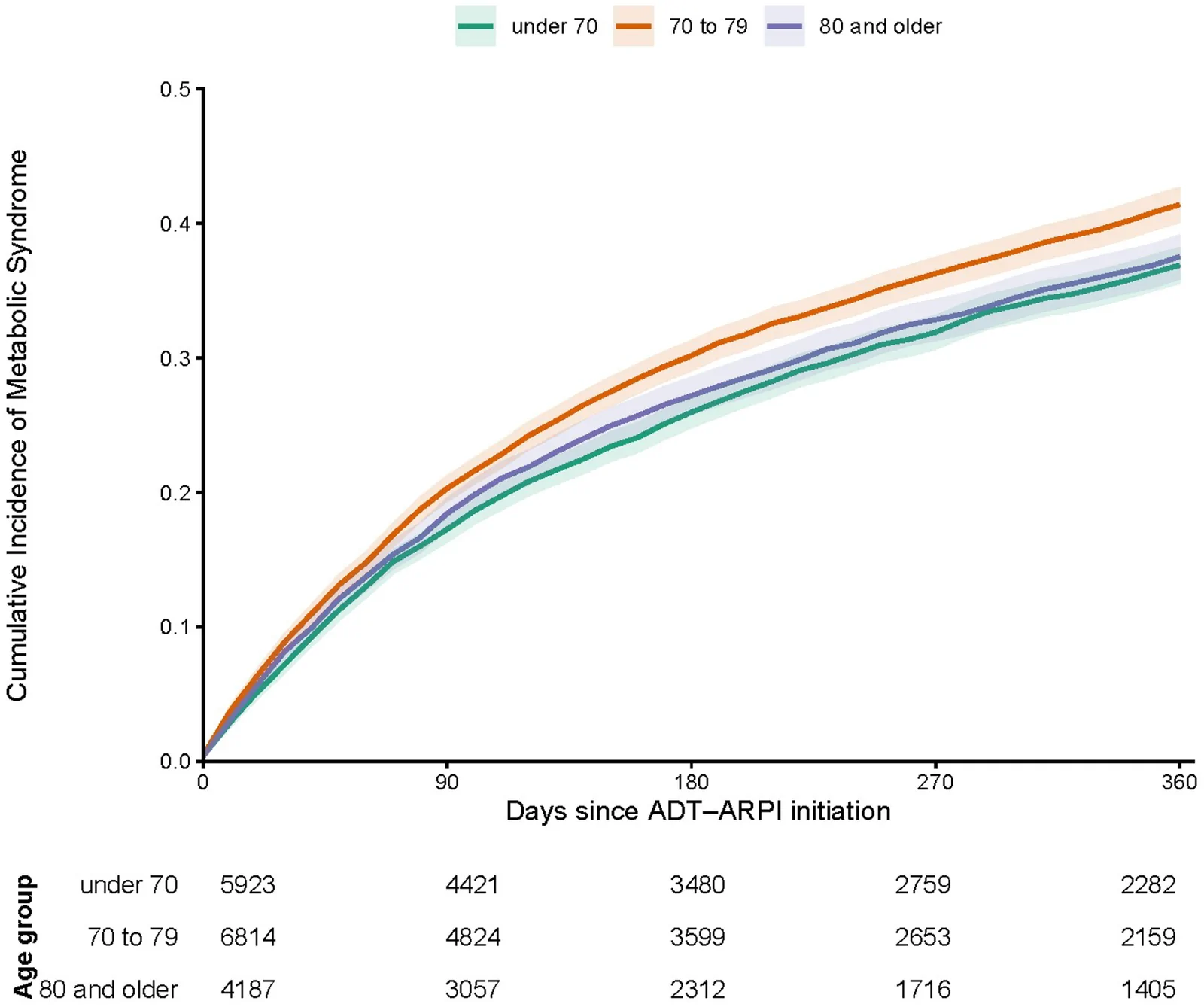
It’s interesting to see that, within 90 days of starting the combination ADT + ARPI therapy, about 15% to 20% of men are experiencing one or more of these side effects, and that number only grows over time, reaching nearly 35% to 40% after a year on treatment.
Cumulative incidence of metabolic syndrome following initiation of concurrent ADT and ARPI therapy, by age group
Shaver AL, Zarrabi KK, Nikita N, Sharma S, Wen KY, Lu-Yao G. Metabolic Dysfunction After Initiation of Androgen Receptor Pathway Inhibitors in Prostate Cancer. JAMA Oncol. 2026 Aug 13:e262790. doi: 10.1001/jamaoncol.2026.2790. Epub ahead of print. PMID: 42593785; PMCID: PMC13474095.
“Hypertension was the most frequently documented outcome,” and that concerns me a bit, as I’m already being treated for hypertension. My blood pressure is currently averaging 106/76, so it’s well-managed on my current treatment plan. It’s a discussion that I’ll have to have when we get to that decision point.
A good follow-up study to this one would be to track how quickly and how far these metabolic syndrome side effects dissipate—if at all—once ADT + ARPI is stopped (i.e., during a hormone therapy holiday).
Be well!
Header image: Minarets near Mammoth Lakes, California
With more trials showing that starting ADT + ARPI hormone therapy early has significant benefits, it’s important to look at the gap between the efficacy and Quality of Life outcomes found in the trials versus what’s happening in the real world.
It’s an interesting discussion that makes you approach starting ADT + ARPI more cautiously.
I stumbled across this video on my YouTube feed and found it to be a great overview of many of the trials that are behind the advances in advanced prostate cancer treatment. The video is apparently part of a larger training course for doctors, so it’s not geared toward patients. Even so, I found it informative and (mostly) understandable.
One thing that I found interesting was that there’s an apparent shift away from the use of the word “castration” in describing the state of the disease and treatment options.
The purpose of this was really to ensure that we were trying to be thoughtful around our patients’ feelings around use of the word “castration” and trying to eliminate that from the terminology.
Instead of describing it as “non-metastatic castrate sensitive prostate cancer (nmCSPC)” it’s now called “androgen pathway modulation sensitive (APMS)” or “androgen pathway modulation naïve (APMN).” Once the cancer becomes resistant, it will be called “androgen pathway modulation resistant (APMR).”
To me, it seems as though they want to sugarcoat the hormone therapy experience with these name changes, and the patient may not grasp the full gravity of what’s about to happen to him when he starts this treatment. I’d definitely understand “castration” before understanding “androgen pathway modulation sensitive.” To be fair, it would be interesting to see how many men turn down hormone therapy because they hear the word “castration.” Maybe that’s the driving force behind the name change.
Because Dr. Rettig works with veteran patients at the VA Los Angeles, it was helpful to me to hear some of his insights working with that group.
Before getting into the conversation with the urologist, I went for my bone density scan last week. The results? I have bones. They’re dense (i.e., normal). Now we have a baseline for future reference for if and when I start down the hormone therapy path.
Yesterday’s meeting with the urologist was unusually animated, if not bordering on contentious. The appointment was late in the afternoon (around 3:45 p.m. when she arrived), so perhaps she had had a crappy day and was ready for it to end.
I tried explaining my conversations with both oncologists, and she kept interrupting, sometimes with questions that made it seem that she wasn’t paying much attention. (She was on her computer reviewing my file as I talked; usually she’ll have reviewed the file before even walking into the exam room.)
At one point she said, “You have three cooks in the kitchen and should probably stick with one,” referring to the fact that I had two oncologists and her trying to manage my case.
When it comes to treatment, she’s still of the opinion to wait until metastasis to start hormone therapy, mainly because of the associated side effects and possible earlier resistance to the therapy. I mentioned that both oncologists recommended intermittent hormone therapy, and she seemed puzzled by that for some unknown reason.
I mentioned that the plan was for me to have another PSA test in the first week of September and, if warranted, a CT scan and bone scan in December. She seemed indifferent and offered no comment one way or the other.
By the end of the appointment, it was pretty clear that she was of the mindset that there’s little that she as a urologist can do at this point in my case management, and that the ball belongs squarely in the court of the oncologists. I agree. She did say, though, that if I start to have urinary symptoms that may be from the radiation or surgery (e.g., strictures, worsening incontinence), to come back to Urology for investigation and possible treatment. We did not set up a follow-up appointment for Urology.
Back in April, the oncologist suggested they take the lead on my case and, after yesterday’s appointment with the urologist, it’s clear that that’s what needs to happen.
I’ve got the PSA test on my calendar on 2 September. We’ll get the results, calculate PSA doubling time, and consult with the oncologists to determine the next steps based on the results.
If my PSA shoots up again like it did between December and March, reducing my PSA DT, I might be more inclined to act. But if it continues on a flatter trend like it did between March and May, I’d be inclined to kick the can down the road another three months.
So I’ll continue to live life in three-month increments until the results tell me it’s time to do something. Good thing I have a lot of hurry-up-and-wait experience from the Navy. 🙂
My visits with the medical oncologists yesterday and today went well, and there was some consensus on how to proceed.
[BLUF: We’re kicking the can down the road three months.]
UCSD Oncologist
The first part of the meeting was getting the doctor up to speed on my case, as he didn’t have any of the history. Of course, nerd me came prepared with a two-page Reader’s Digest chronological summary of my diagnosis and treatment, printouts of my PSA charts, and copies of the PSA doubling time (PSA DT) calculations.
PSA Doubling Time
Because PSA DT is an important number in the decision-making process, I opened the conversation by asking him how many data points should be used in the calculations. He chuckled a bit before saying that one of the downfalls of using PSA DT is you can pick and choose the data that you want to get the answer that you want. So true.
I calculated my PSA DT using 3, 4, and 5 values and came up with different answers:
Number of values used
Going back X months
Calculated PSA DT
3
6
7.6 months
4
9
8.0 months
5
14
9.2 months
He just looked at the curve on my PSA tracking chart and estimated in his head that it was around nine months. In his eyes, that six to nine month PSA DT warrants closer observation and monitoring.
Inconclusive PSMA PET scans
We discussed my four inconclusive PSMA PET scans and [F18] FDG PET scan, and whether he thought that I was PSMA negative. He thought it was unlikely that I was, offering up a case with another patient whose PSA was over 50 ng/mL and still showing up negative on PSMA PET scans.
One of the reasons that we talked about that at some length was that he suggested that Pluvicto / Lutetium-177 might be an option.
I asked about getting an Axumin scan or a Choline-11 scan, and he wasn’t in favor of doing either of those at the moment.
When to Start ADT
We also discussed when to start androgen deprivation (hormone) therapy (ADT). He didn’t have a set of specific criteria that he would use—e.g., specific PSA number, evidence of metastasis—but did focus in on the rate of PSA rise (PSA DT) and “patient motivations and preferences.”
What type of ADT
The doctor was a proponent of intermittent therapy in my case with six to twelve months on, then a similar period off. His goal would be to “maximize time off treatment” as long as my PSA is holding relatively steady and not going bonkers.
He seemed a tad hesitant to start with the combination therapy of ADT + ARPI (Eligard + Enzalutamide), but wasn’t opposed to it, either. He wasn’t a fan of trying the Enzalutamide alone because of its side effects (gynecomastia, in particular) and not seeing any substantial changes in long term outcomes.
Summary
I did share with the doctor the VA MO’s desire to start ADT + ARPI sooner rather than later, and he had a much lower sense of urgency in taking action. And, while I was a bonehead and didn’t explicitly ask him for his recommended course of action, the entire conversation led me to conclude that his preference was for continued close observation.
VA Oncologist
I technically didn’t meet with the oncologist; I met with a nurse practitioner who had reviewed my case with the oncologist just before (and during) my appointment.
Discussion
It was interesting that she opened the conversation with a quick review of my last appointment there, told me my PSA results from last week, and then said something along the lines of, “If you’re not ready to start ADT today, the doctor is okay with monitoring for another three months.”
At that point, I mentioned that I went to the UCSD MO the day before, and I spent a good chunk of time relaying how that meeting went.
I reminded her that I have the bone density scan in a few weeks and I intended to go through with that to establish a baseline even though we might not start ADT right away. She agreed.
I’m still meeting with the VA urologist on 23 June and want to get their thoughts on what’s next.
Summary
We’re going to do another PSA test in September, and the VA MO didn’t want to schedule an appointment with me until December with another PSA test just before that meeting, too. Interestingly, the VA MO also wanted to schedule a regular CT scan and bone scan ahead of the December appointment.
However, if the September PSA test jumps up significantly, we’ll revisit that plan based on the results. That may change doing the CT/Bone scans to another PSMA PET scan.
The Plan
In short, we’re going to kick the can down the road another three months.
More specifically:
Bone density scan – 17 June
Urologist appointment – 23 June
PSA test – First week of September
CT and Bone scan – First week of December
PSA test – First week of December
VA Oncology Appointment – 8 December
Summary
On the whole, I’m pleased with the plan as it stands right now. The UCSD MO emphasized the shared decision-making approach, adding in his notes, “Daniel is very well educated about his illness and understands there is no clearcut right and wrong answer.” Ain’t that the truth (about the no right or wrong answer).
Once I cleared the hurdles of getting set up in the UCSD system, I was impressed by the friendliness and professionalism of their staff in the department. They have a patient portal app that allows access to records and makes communicating about appointments—in both directions—quite easy.
One thing that I’ve noticed with both the VA and UCSD oncology departments is that their empathy and caring nature seems to be a notch or two above that of their respective urology departments. Not that the urology teams aren’t caring or empathetic; it’s just that the oncology folks seem to take it a step further.
I know the VA MO expressed a desire to take the lead on my case at my last appointment, and I’ll mention that to the urologist on the 23rd. And, for now, as pleasant as the experience at UCSD was, I plan on having the VA be my primary source of care.
I went for my PSA test this morning and already have the results this afternoon (a pleasant surprise).
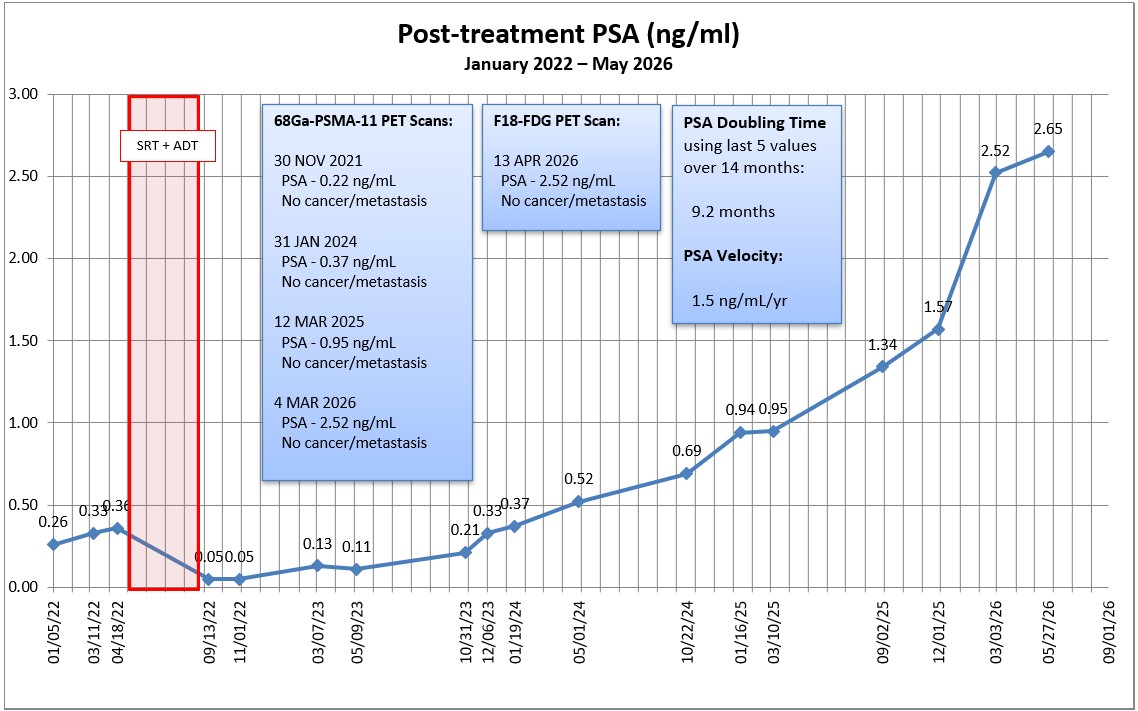
My PSA increased, but not as much as I expected it to. It went from 2.52 ng/mL in March to 2.65 ng/mL today.
If I use the last five PSA values to calculate PSA doubling time going back 14 months, my PSA DT is 9.2 months. If I use the last four PSA values going back only nine months, it’s 8.0 months. Again, the VA medical oncologist used the nine month PSA DT one of the triggers to start hormone therapy.
Armed with these latest results, I should be ready for my upcoming appointments:
Monday, 1 June – UCSD Medical oncologist
Tuesday, 2 June – VA Medical oncologist
Wednesday, 17 June – Bone density scan to establish baseline
Tuesday, 23 June – VA Urologist
I definitely plan on asking the UCSD MO what his thoughts are on an Axumin scan, and whether it’s worth pursuing before we start hormone therapy. If he agrees, I’ll have to add that to the schedule, too.
I also had another testosterone test done to establish a baseline should I opt to start hormone therapy. It came in at 416 ng/dL (reference range 200-800 ng/dL).
Over the holiday weekend, UCSD sent an automated email asking me to complete their electronic check-in process. Sheesh. It took more than an hour of filling out forms, providing history, and updating insurance. The only thing they didn’t ask for was our family cat’s name from when I was five years old. Hopefully, getting all that taken care of in advance makes the appointment go more smoothly.
Late last week, I received a text message asking if I would like to move my urologist appointment from 30 December to today, 23 December, and I agreed.
My appointment was at 3:15 p.m., and I arrived around 2:45 p.m. As I’m walking up to the check-in kiosk, my cell phone rings, and it was the urology department wanting to confirm that I’d be there. That’s the first time that that’s happened, and I told the nurse that I was checking in as we spoke. “Great! We’ll come out and get you.” Apparently, they were antsy to get out of there early on the day before Christmas Eve. So was I.
The head of the department was the one who saw me this time, and we had a really good conversation. Some of the key takeaways:
She was concerned about the increase in my PSA but not panicked, even initially suggesting we just continue to monitor it.
We talked at length about doing another round of imaging to see if we can determine the location of the cancer.
We agreed to do another PSMA PET scan, and we negotiated doing one in March 2026. (She thought that Nuclear Medicine might push back on doing one sooner, i.e., within a year, as the last one I had was in March 2025.) She also mentioned the possibilities of other imaging should the PSMA PET scan come up with no evidence of cancer/metastasis for the fourth time.
We talked about the timing of starting androgen deprivation (hormone) therapy. She wouldn’t start it until there was evidence of metastasis, but was open to starting it earlier if I really wanted to do so.
Lastly, we reviewed my stress incontinence and nocturia issues and talked about my pelvic floor physical therapy.
It was one of the more thorough discussions that I’ve had at the VA, and I’m okay with the plan coming out of the meeting. I’ll go for another PSA test on 1 March; hopefully get the PSMA PET scan scheduled in early March; and have a follow-up with the urologist on 24 March.
I’m glad I got this out of the way before the holiday. I’ve got my answers, plus it frees up next week for me to go out an play if I want.
Merry Christmas, Happy New Year, and be well!
Header image:Hotel del Coronado at Christmas, Coronado, California
In a nutshell, we’re punting the ball another three months down the road.
The doctor commented on the continuing rise in my PSA and said after consulting with the doctor who saw me last time, said that he wanted to recheck my PSA in six months and “wait a year” for another PSMA PET scan. I should have asked for clarification on that, but I think he was referring to waiting a year after my last PSMA PET scan in March 2025 and not a year from today.
I wasn’t entirely comfortable with waiting another six months, so we agreed to test PSA again in December (three months after my September test) and go from there.
We also talked about spot radiation if anything pops up on the scan. He seemed a bit reluctant for that to be an option, and went straight to starting hormone therapy. It’s as though he was making the transition from curative options to management options, and, to be perfectly honest, I believe I made that transition in my own mind once the salvage radiation failed. That doesn’t mean that I wouldn’t try zapping a lesion or two if they popped up on the scan depending on location (no more zapping to the pelvis and risking further bowel complications).
We did talk about my experience with hormone therapy during the salvage radiation, and the timing of starting it this time around. In that discussion, he brought up the topic of bringing in a medical oncologist at some point depending on the scan results and my PSA test results.
We talked at length about my urinary frequency and some options for that. He suggested some pelvic floor therapy might be beneficial, so I said I’d be willing to give that a try.
Overall, I’m okay with where we’re at and the planned course of action for now. I’ll go for my PSA test in early December, and if there’s another significant jump, I’ll press for the PSMA PET scan to be done sooner rather than later.
My next scheduled urologist appointment is 30 December 2025.
I met with the urologist this afternoon to go over my most recent PSA test results and the plan going forward. In a nutshell, we agreed to remain in limbo for another three months and retest the PSA in January and consider a PSMA PET scan if warranted at that point. (She was a bit skeptical that the PSMA PET scan would be conclusive even at my current PSA of 0.69 ng/mL.)
The urologist thought it was a little premature to start talking about androgen deprivation therapy, but recognized that that’s the next likely step down this path. I mentioned that, when I met with the urologist and medical oncologist in February, one suggested ADT at metastases and the other suggested starting at a PSA of 2.0 ng/mL. She said she could understand both positions.
Bottom line is that I continue to be in this sort of “no man’s land” of prostate cancer. We know it’s there; we just don’t know where, and we don’t want to pull the trigger on ADT prematurely. So more waiting.
One other thing that we discussed was radiation proctitis.
Graphic Biology Ahead
I’ve been sitting on this little tidbit for a while now, but I’ve been noticing blood in my stools. It initially appeared as spots a little smaller than a dime coin (~ 1 cm) but, over time, it has subsided to a small streak or a hint of blood. You know me: I had to create a spreadsheet to track it, and it’s been occurring in about ten percent of my bowel movements. That makes me feel better that it isn’t happening each and every time—that might indicate a larger problem if it were happening every time.
Fortunately, I haven’t had the diarrhea or mucus discharge that can come with more severe cases of radiation proctitis.
I mentioned this to my primary care physician during my appointment on 4 November, too. Both he and the urologist recommended a colonoscopy to check out what’s really going on. That joyful experience is scheduled for Friday, 22 November. Yippee!
I did come across this continuing education paper that gives a good overview if you’re really interested in learning more: