Day 4,117 – Radiation Oncologist Consult

This afternoon, I took a leisurely stroll down to my local radiation oncologist’s office…

That sounds like the beginning of a really bad joke, but it’s not. I walked the 0.9 mile / 1.5 km walk from my home to the UCSD Radiation Oncology center for my first consult there.

My original appointment was for 3:30 p.m., but at 11:40 a.m., they called and said they had a cancellation and asked if I could come in at 2 p.m. Sure. Let’s get this over with.

The radiation oncologist (RO) was very welcoming and very direct in talking about my options, which I appreciated very much. He’s been pretty much exclusively zapping prostates since 2010, which helped build up confidence in his experience and abilities. When he mentioned that he studied at University of Chicago (my hometown), we got off topic and talked about deep-dish pizza and Italian beef sandwiches for a moment.

The key points from the conversation:

  • He recommended proceeding with the radiation at 70 Gy for 7 weeks (IMRT/IGRT), but thought it wasn’t necessary to begin it immediately.
  • He said given my numbers and the negative PSMA PET scan, he would zap only the prostate bed and not the pelvic lymph nodes.
  • I should not let my PSA get above 0.5 ng/mL before starting radiation. Of course, starting sooner rather than later would be better.
  • The risk of long-term side effects appears to be lower than what I had in my mind.

When talking about the likelihood of success, the RO chuckled a little when I mentioned the nomogram numbers. Apparently, he isn’t a fan of nomograms. When I mentioned that the urologist at the VA said that salvage radiation was possibly curative, he chuckled at that, too. He was pretty blunt when he said that salvage radiation would be a “50-50 crap shoot” when it comes to long-term suppression of the cancer. The reason we do it, though, is to squash it hard enough and long enough to significantly slow its progression and buy years of life.

We talked at length about quality of life and life expectancy. He asked if I expected to be here in 10 years, to which I replied, “I don’t know.” My dad and his mom both died unexpectedly at the age of 69—that’s only 5 years away. Will I follow in their footsteps? Who knows. He thought that not doing salvage radiation may be an option if my chances of not living another 10 years are good. But if I thought I would live beyond 10 years, then do the radiation now.

It was interesting that throughout the discussion, he talked solely about salvage radiation without mentioning hormone therapy other than it being the next step after radiation. But then near the end of the conversation, he recommended six months of hormone therapy for me starting at the end of radiation to “really knock down the cancer.” I’m not sure I was expecting that.

We agreed that it would be okay to wait until my next PSA test in early April to see what that shows. But he reminded me that the cancer is there and it is growing. He offered me his card and said to call if I had any other questions.

All in all, I’m pleased with how the discussion went. The RO’s candor was refreshing and I was impressed with the UCSD staff and facility. I left feeling more at ease than I was when I went in. (In fact, little gremlins were doing a jig in my stomach a good chunk of the morning before the appointment.) Am I 100% sold that this is the path I want to pursue? Not yet. But I’m much closer to it than I was when I woke up this morning.

The whole, “When do you think you’ll die?” conversation was a little unnerving and simultaneously thought-provoking. It’s been a while since I’ve had a full-blown physical, so it may be worth checking under the hood to see if everything is in order before starting radiation.

In my mind, if the April PSA comes back higher than the 0.26 ng/mL in January, I’d be more inclined to start sooner. But if it comes back at the 0.21-0.22 ng/mL that it was in June, July, or October, I may be inclined to kick the can down the road a little longer. I don’t know.

As I told a friend yesterday, it’s time to go sit on a mountain top and process all of this information.

More to come.

Be well!

Salvage Radiation Therapy Nomograms

I’ve been playing around with two nomograms that offer predictions on the outcome of salvage radiation therapy (SRT). One if from the Memorial Sloan Kettering Cancer Center (MSKCC) and the other is from the Cleveland Clinic (CC). They are similar in design, but the MSKCC nomogram requires more detailed information to be input by the patient, but the CC nomogram provides a more information at the output.

Summary

Both nomograms gave results that are in the same ballpark, with the CC nomogram being a bit more conservative.

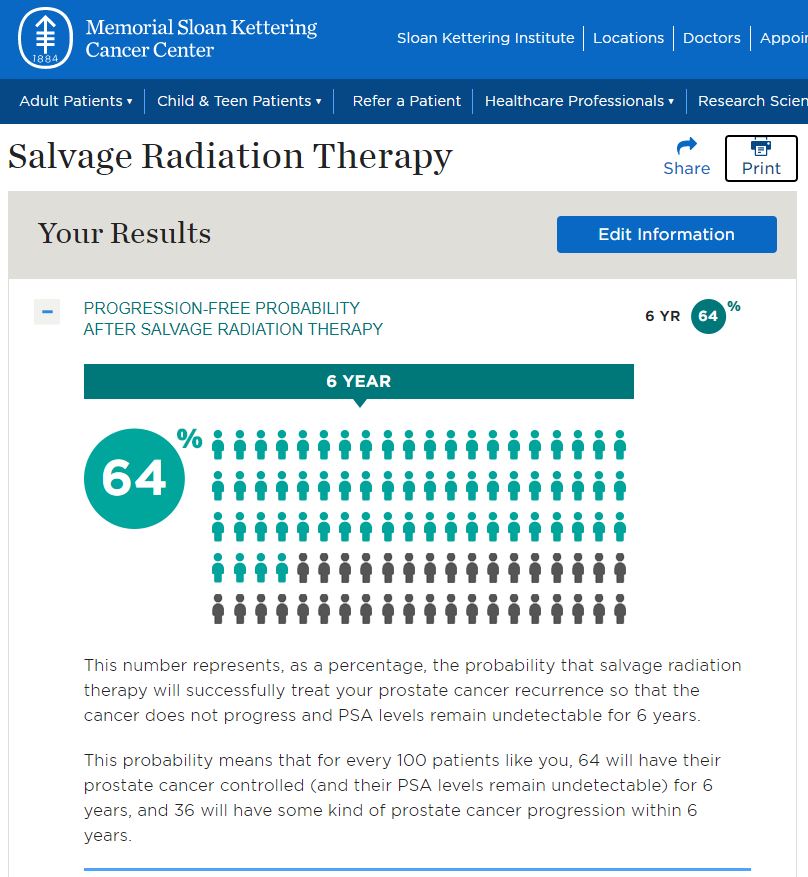
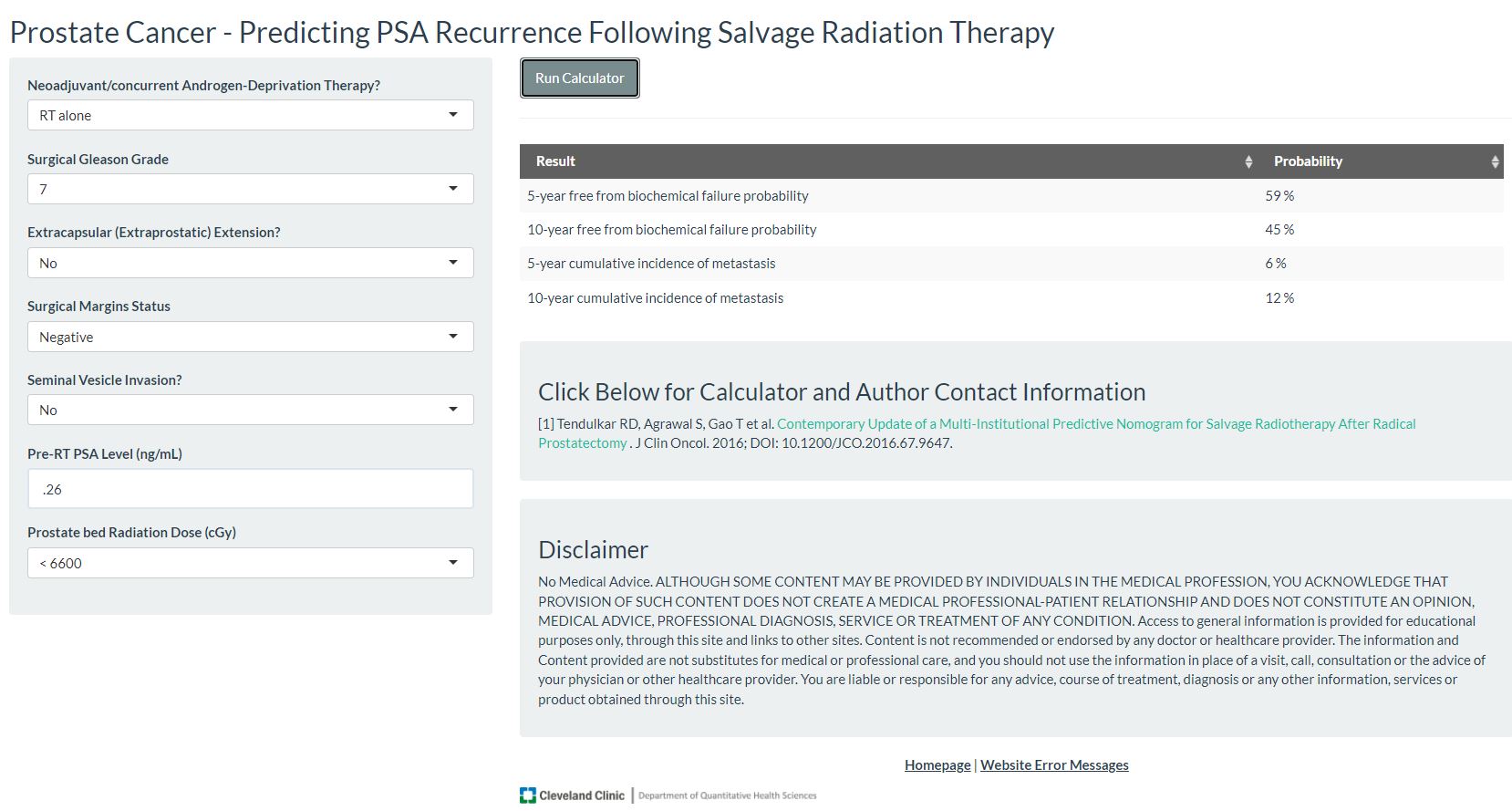
MSKCC said that I would have a 64% chance of being progression-free after 6 years after SRT; CC said that I have a 59% chance of being progression-free after 5 years, and 45% chance of being progression-free at 10 years.

The CC nomogram takes it one step further and estimates a 6% cumulative chance of metastasis at 5 years, and a 12% cumulative chance of metastasis at 10 years.

MSKCC Nomogram

MSKCC Salvage Radiation Therapy Nomogram link: https://www.mskcc.org/nomograms/prostate/salvage_radiation_therapy

In order to use the MSKCC SRT nomogram, you will first need to calculate your PSA Doubling Time, and they specify that you should use the PSA values obtained in the last twelve months.

MSKCC PSA Doubling Time Calculator link: https://www.mskcc.org/nomograms/prostate/psa_doubling_time

The MSKCC SRT nomogram requires you to provide:

  • Pre-surgery PSA value.
  • Most recent PSA value.
  • PSA Doubling Time.
  • How many months have passed before your PSA reached 2.0 ng/mL or higher. [Interesting note: The field only accepts values between 0 and 72 months and, for me, it took 125 months to cross the 0.2 ng/mL threshold. I’m guessing that may mean that my result will be a bit conservative because I had to plug in 72 months instead of 125.]
  • Your Gleason score.
  • Information about your:
    • Surgical margins.
    • Extracapsular extension.
    • Seminal vesicles.
    • Pelvic lymph nodes.
  • Whether your PSA remained elevated post-surgery.
  • The planned radiation dose. (I left this set at their default value of 65 Gy because I had no idea.)
  • Whether you will be undergoing hormone therapy before or along with radiation. (I checked “No” as there has been no discussion of that so far.)

After plugging all of that information in, here are my results:

Cleveland Clinic Nomogram

Cleveland Clinic Salvage Radiation Therapy nomogram link: https://riskcalc.org/ProstateCancerAfterRadicalProstatectomyNew/

The CC nomogram asks you to provide:

  • Whether you will be receiving SRT alone or with concurrent Androgen Deprivation Therapy.
  • Surgical Gleason score.
  • Extracapsular extension.
  • Surgical margin status.
  • Seminal vesicle invasion.
  • Pre-SRT PSA level.
  • Prostate Bed Radiation Dose. [It was interesting to note that CC defaulted this to a dose greater than or equal to 6600 Gy, but it does give you the option to select “<6600”. To be able to compare the CC nomogram results with the MSKCC results, I changed that to be <6600 Gy so the doses would be similar.]

My results are below (click to enlarge):

Interestingly, if I bump up the radiation dose to >=6600 Gy, then my percentages change to 65% free at 5 years and 53% free at 10 years. That makes sense, but do higher radiation doses translate into higher risk of side effects? I’m guessing so. Something to ask the radiation oncologist on Thursday.

Conclusion

Certainly, those are average to good probabilities, but are they good enough to risk impact to quality of life? I don’t know. Of course, the next step is to dig deeper into the risks of real impact on quality of life after salvage radiation.

I’m thankful to everyone who provided information about their own experiences, either here in comments on my previous posts or in other forums. They’ve been very insightful and give me an understanding of the range of possibilities to expect. But each case is unique, and I have to remember that, should I choose this, my case will be different from everyone else’s.

More to come.

Month 135 – Approaching SRT Decision Point

My visit with the urologist this week went about as expected.

We talked about my PSMA PET scan results—negative—and he was of the mindset that those would be the expected results at my PSA level. The scan isn’t reliably sensitive enough when the PSA is hovering around 0.2 ng/ml.

With my steadily increasing PSA, he said that there’s cancer there somewhere. In his view, it’s likely location is still in the prostate bed, but we can’t rule out that there aren’t micro-metastases elsewhere.

In reviewing the totality of my case, he commented, “This is one of the trickier cases I’ve seen.” I don’t believe he was too offended when I replied, “No shit, Sherlock.” I guess my frustration of dealing with this over the years came out a little too strong.

What puzzled him about my case is how long after my surgery the PSA returned and how slowly it was increasing over the years. That led to a discussion about PSA doubling time and how my doubling time is shortening at an accelerating rate.

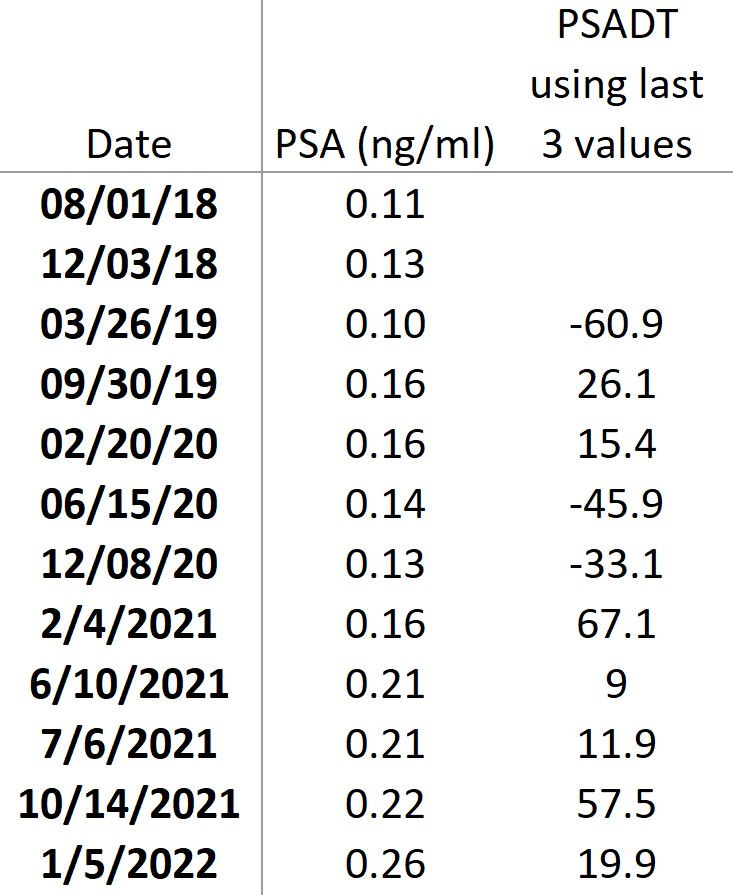
As part of that discussion, I asked him how many data points should be included in the PSA doubling time calculations, and he typically uses only the last three to get a current snapshot of where it is now. (I re-ran my numbers when I got home, and using the last three PSAs, my doubling time is 19.9 months.)

Of course, the engineer in me had to play with that a little, so I went through my PSA spreadsheet and calculated the PSA doubling time if I used the last three values after each test. The results were all over the place:

His recommendation, of course, was salvage radiation to the prostate bed.

He thought that salvage radiation still had a chance of being curative at this point, and given that I’m 64 years old, he thought that I would have plenty of years ahead of me should I choose to go down that path.

We talked about long-term side effects. He thought that there was a 20% to 30% chance that my stress incontinence would worsen, as would my sexual function given where it’s currently at now. He wasn’t confident enough to speak about the chances of rectal issues, at least in the numbers that I was seeking. I expressed concern about the incontinence, and he reminded me that they can take care of that with an artificial sphincter. Great. Another surgery.

I did ask how much longer I could kick this can a little farther down the road, and he didn’t seem to think that that was a good idea at this point. My stomach turned into knots.

We agreed to set up the consult with the radiation oncologist, as well as retest my PSA in early April.

Wednesday afternoon, I received a call from the scheduler trying to set up the radiation oncologist referral. She gave me the option of going to Naval Medical Center San Diego—where I used to work and had a previous referral—or going to University of California San Diego (UCSD). As good a medical treatment facility as NMCSD is, I opted for UCSD. If nothing else than for a second perspective, plus I believe UCSD will have more state-of-the-art equipment and a lower turnover rate in medical teams.

Thursday, morning, UCSD called and we’re set up to meet next Thursday, 17 February 2022. I was a little surprised when they told me that it would be at their Radiation Oncology center that’s about three-quarters of a mile (one kilometer) from my house instead of their main hospital in San Diego.


As you regular readers already know, I’ve been fearful of getting to this point for a while now. Whether my fears are irrational, unfounded or not, I don’t know, but they’re real for me.

My fears center more on having very real, quality of life-impacting side effects from the radiation than on whether or not the radiation will be curative. For some inexplicable reason, my gut intuition is that something will go awry and I’ll be in that 1% or 3% or 10%—or whatever it is—group that gets to experience those side effects impacting quality of life. The radiation oncologist is going to have to give a strong sales pitch to convince me the risks are minimal.

There will be ton of soul-searching and thinking in the days and weeks ahead.

Stay tuned.

Month 134 – PSA Results

Well, happy freakin’ New Year and Happy Birthday! <Sarcasm font>

My PSA continued its upward climb from 0.22 ng/mL in October to 0.26 ng/mL yesterday.

Additionally, my PSA Doubling Time fell from 45.3 months to 41.5 months. Still not bad, but that’s including all of my PSA values from December 2017 through present. That may be giving me a false sense of security, so I ran the numbers for just the last two years (February 2020-present), and that PSA Doubling Time is 26.6 months.

Memorial Sloan Kettering PSA Doubling Time Calculator

What’s really frustrating is that the 68Ga PSMA-11 PET scan just five weeks ago didn’t see anything. Anywhere.

I’m definitely going to have to mull this one over. At what point do the actual PSA value and PSA doubling time outweigh the PSMA PET scan results of not seeing anything? Or do the scan results prevail? I don’t know.


I hope that your 2022 is off to a better start than mine and, yes, I celebrate my 64th trip around the sun this month.

Be well!

Day 3,993 – PSA Results

No surprises here. My PSA went up slightly again from 0.21 ng/mL to 0.22 ng/mL. The only surprise was that I was able to get the results online a day earlier than usual

This also dropped my PSA Doubling Time from 48.1 months to 45.3 months. Not a biggie there, either, but still moving in the wrong direction.

UCLA also required a basic metabolic panel be done in advance in of the PSMA PET scan, so I got that knocked out, too. I’m supposed to bring a copy of the results to the scan and now I can print them out and not rely on the administrative gremlins to get them to me.

My appointment with the urologist is on 9 November and we’ll see how that goes.

Day 3,819 – Doctor’s Visit

The dreaded tools of the DRE trade.

My visit to the urologist this afternoon went just as expected, and even a little better.

With the San Diego VA Medical Center being a teaching hospital, it’s rare that I see the same doctor twice. Because I liked the doctor I saw last time because of the conversation we had and the plan that we mapped out together, I specifically requested to see her again this time. Unfortunately, a young resident showed up in her place.

That actually may have worked to my advantage.

Dr. K started the conversation by asking if I had come to a decision as to whether I wanted to do salvage radiation therapy or hormone therapy. I was a bit taken aback by that—”Haven’t we skipped a few steps here, Doc?”—but then I remembered the way that Dr. L wrote up her notes from my visit with her, it would be easy for him to come to that conclusion.

I filled in a few of the blanks with Dr. K regarding our plan to follow up the negative CT and bone scans with an Axumin or PSMA PET scan in hopes of finding the cancer before making the SRT vs. ADT decision. He dutifully reminded me that either or both scans could come back negative, too, meaning that the cancer was still likely in the pelvis or prostate bed.

Interestingly, when we were talking about the merits of the Axumin and PSMA PET scans, he immediately went to, “Why even bother with the Axumin scan; go straight to the PSMA scan.” I didn’t even have to nudge him in that direction. He and I were on the same page.

To his knowledge, though, SD VAMC had not yet referred anyone to get a PSMA PET scan, but he seemed eager to figure our how to make it happen and have me be the first (or among the first) to be referred. He wasn’t even sure where to begin, so I told him.

Instructions for PSMA Referral

I opened my file folder that I had with me and pulled out the one-page sheet that I had put together, stepping him through the referral process that UCLA had shared with me. It was all there for him, and he asked, “May I keep this?”

He did admit, though, that he had no idea how long it may take to get approval from the hospital team before he could even ask for the referral, so this may play out over a few weeks or longer. Rest assured that I’ll keep on top of this, asking for periodic updates.

I’m pretty excited that we’re moving in the direction of going straight to the PSMA PET scan, but also recognize there can be a number of administrative twists and turns along the way.

In the interim, we agreed to test my PSA again in early November, keeping on a four-month testing cycle. I’m okay with that while we’re trying to sort everything else out.


We also talked about my incontinence episodes becoming more frequent and more substantial in the last 6 weeks or so. He wanted to rule out a urinary tract infection, so he sent me off for some labs and we’ll see what they yield.

These episodes have put me back in incontinence pads for the last few weeks. Before, a sneeze or a cough would yield a few drops; now, they yield a squirt. Not good.

More to monitor and report on going forward.

That’s it for this post.

Be well!

Watch “PSMA After Recurrence, and PSMA Specificity | Answering YouTube Comments With Mark Scholz, MD | PCRI” on YouTube

This video was released today, and the timing could not have been more perfect. Dr. Scholz does make the distinction between the Axumin and PSMA PET scans, confirming that the PSMA PET is more likely to pick up my cancer’s location at my PSA level.

Day 3,910 – Bone Scan Results

As a baby boomer, I grew up with Spock. Both of them.

First, there was Dr. Benjamin Spock, the noted pediatrician who told my parents—and millions of other parents—how to raise and care for their kids. Then, of course, there was the Star Trek Spock, whose existence was rooted in Vulcan logic.

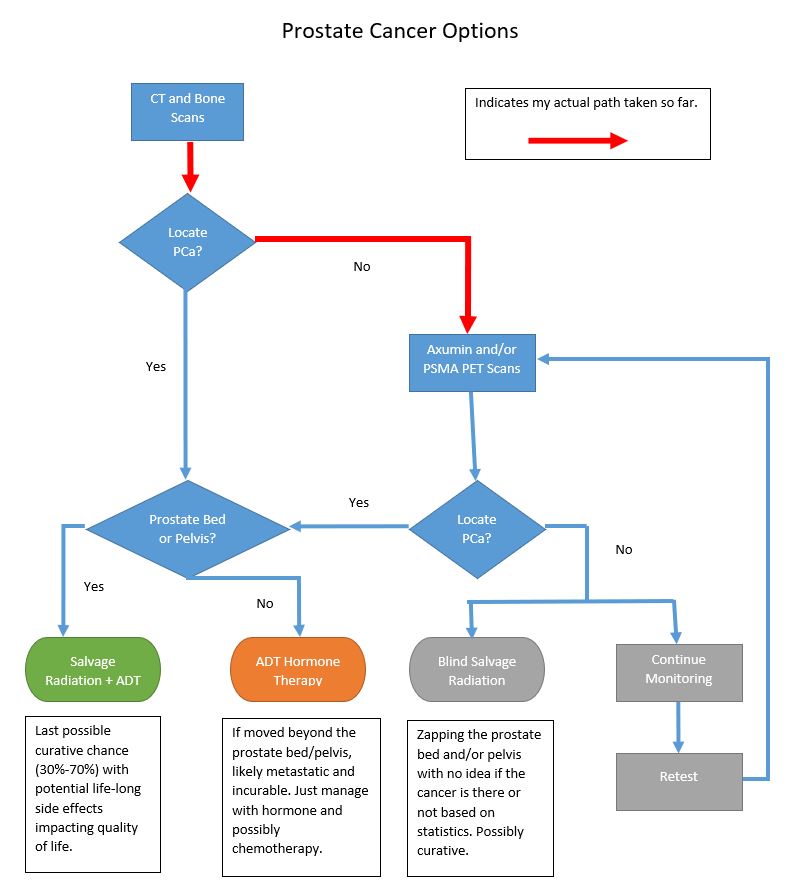
Now I’m not a Trekkie, but if you’ve read any part of this blog, you do know that facts, figures, and logic are high on my priority list, too. I thought, “What better way is there to outline the possible scenarios and decisions that are ahead of me than to put them all in a flow chart.” So here goes:

So let’s step through this.

We start with the CT and Bone scans that happened over the last two weeks. The first question is, “Did those scans determine the location of the prostate cancer (PCa)?”

If the answer is yes, then the next question is, “Was the prostate cancer in the prostate bed and/or pelvis?”

PCa in Prostate Bed/Pelvis

If the answer is yes, the PCa is in the prostate bed and/or pelvis, then Salvage Radiation Therapy (SRT) with or without Androgen Deprivation Therapy (ADT) (Hormone therapy) offers the last possible chance of a true cure. Of course, there are risks associated with SRT that would impact your daily quality of life: bowel control, bladder control, and lack of sexual function. Additionally, depending on which study you look at, SRT may be successful only 30% to 70% of the time. (Green bubble above.)

PCa is Not in Prostate Bed/Pelvis

But if the answer is no, the PCa is outside of the prostate bed and pelvis, that means the PCa is now distant and likely metastasized. If that’s the case, there is no cure and the PCa can only be managed with hormone therapy and perhaps chemotherapy. (Orange bubble above.)

CT and Bone Scans do not Locate the Prostate Cancer

We’ve talked at some length that neither the CT scan nor the bone scan have the sensitivity to pick up the cancer’s location based on my PSA level of 0.21 ng/mL. It was very likely that neither would pick up the cancer at that first decision point on the flow chart, so further investigation is required by using the Axumin or PSMA PET scan.

CT and Bone Scan Results

In fact, neither the CT nor the bone scan picked up the location of the cancer:

No definite scintigraphic evidence of metastatic bone disease and no evidence of a widespread osseous process

So that’s actually good news with the bone scan. It shows that it has not metastasized to the bones, which is definitely a good thing. (Or, at least if there is metastasis to the bones, it’s at a level that’s unable to be picked up by the sensitivity of the scan.)

Next Steps

We follow my red arrows above and run the Axumin or PSMA PET scans (or both) to see if either of those can pick up the location of the cancer. I’ll have that discussion with the urologist on 3 August 2021, and we’ll see when we can get them on the calendar.

If the Axumin and/or PSMA find the cancer in the prostate bed/pelvis, then we go back to the section above and land on SRT as the option. But if it’s found outside the prostate bed/pelvis, then we go back to the other section where we just manage with ADT. (If the lesion outside the pelvis is well-defined, it may be something that could be zapped in its location. Something to explore.)

If the Axumin or PSMA PET scan cannot locate the PCa, then things get fuzzy fast.

Sure, we could go ahead and blindly complete the salvage radiation therapy, hoping that we’re zapping in the correct place. Or, we could continue to monitor for a while longer and then retest to see if the cancer can be pinpointed.

This may have been a bit of an oversimplification of what’s ahead for me, but I’m hoping that it makes sense to you.

Be well!

Day 3,901 – CT Scan Results

Let’s start with the BLUF:

No definite evidence of locally recurrent or metastatic disease within the abdomen or pelvis.

(If you don’t know, BLUF = Bottom Line Up Front).

There was one 9 mm kidney-shaped lymph node that caught their attention, but didn’t think it to be remarkable.

They also commented on a bunch of my other organs and bits and pieces, but nothing seemed too out of the ordinary for any of them aside from a few dents and scratches from 63+ years of normal wear-and-tear and countless miles/kilometers.

The fact that the CT scan didn’t pick anything of substance up is a good thing and a bad thing. Good because it didn’t see anything; bad because it didn’t see anything. The likelihood of it detecting the lesions at my PSA level were small, and we knew that going into this. So even though we didn’t see anything, that doesn’t necessarily mean that it’s not there.

I did get a chuckle out of one line in the report:

Multidetector CT abdomen/pelvis was obtained after the uneventful administration of intravenous contrast.

Uneventful for who??? The radiologist? Sure. I did everything in my power to not puke all over their $300,000 scanner. 😲


I expect we’ll have the same result with bone scan next week, but time will tell.

That’s all for now.

Be well!

Day 3,892 – Scan-a-Palooza

Let the radioactive fun begin!

I was able to schedule my bone and CT scans this morning with considerable ease. In fact, things will happen much sooner than I thought they might. My CT scan is scheduled next Wednesday, 14 July, and my bone scan is scheduled Friday, 23 July.

I have to go for some pre-scan lab work tomorrow afternoon to ensure that my kidneys are working fine and won’t be damaged by one of the contrasts.

I haven’t given up on the Ga-68 PSMA PET scan. In fact, I wrote my health insurance company an email about 4:30 a.m. as I tossed and turned. (Last night was hell. If I slept more than 2 hours—non-consecutively—that was about it.) They tout having a response within 2 business days, so we’ll see if they come through with that.

UCLA is out of network for my insurance company, so I’d have to cough up 40% of the cost if they’re going to cover it at all. I’m okay with that. (For my overseas readers, welcome to U.S. health care systems!)

So that’s the latest and greatest. More to come, I’m sure.

Be well!