Month 172 – PSMA PET & PSA

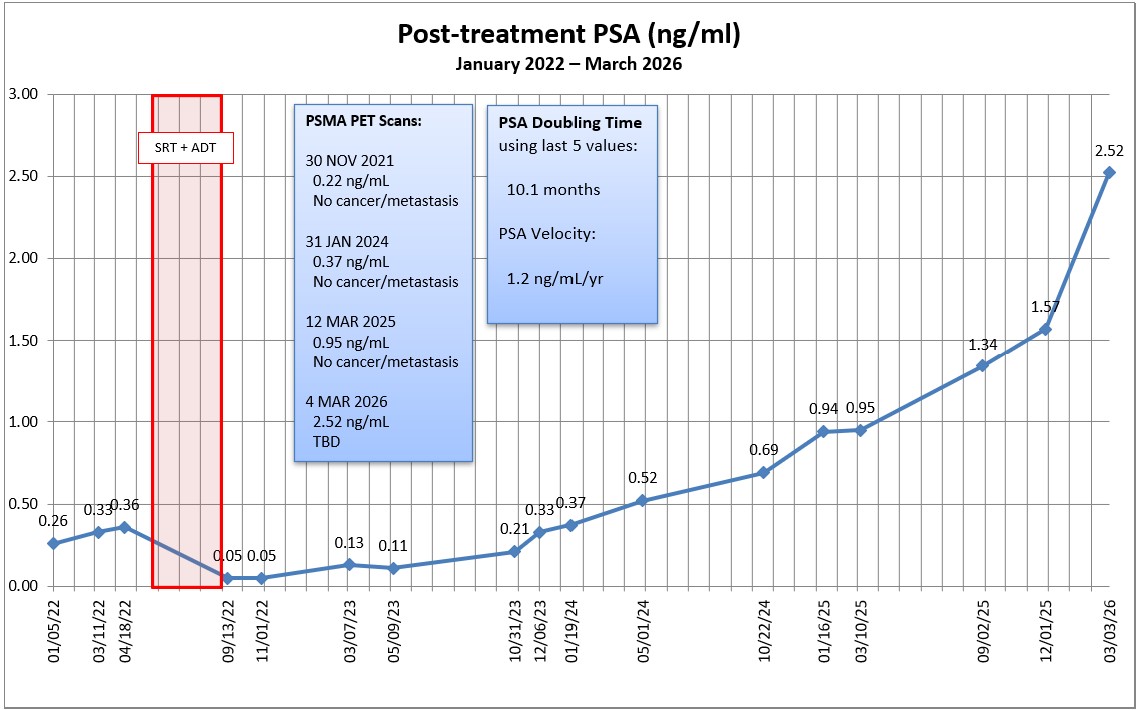
This will be a short update, as not much has really happened in the last month.

Tomorrow, I have my third PSMA PET scan. With luck, we’ll actually find the location of the cancer with this scan. That will help us decide what’s next in this adventure. I suspect I should be able to access the results online within a week or so. If not, I have a follow-up appointment on 1 April with the urologist.

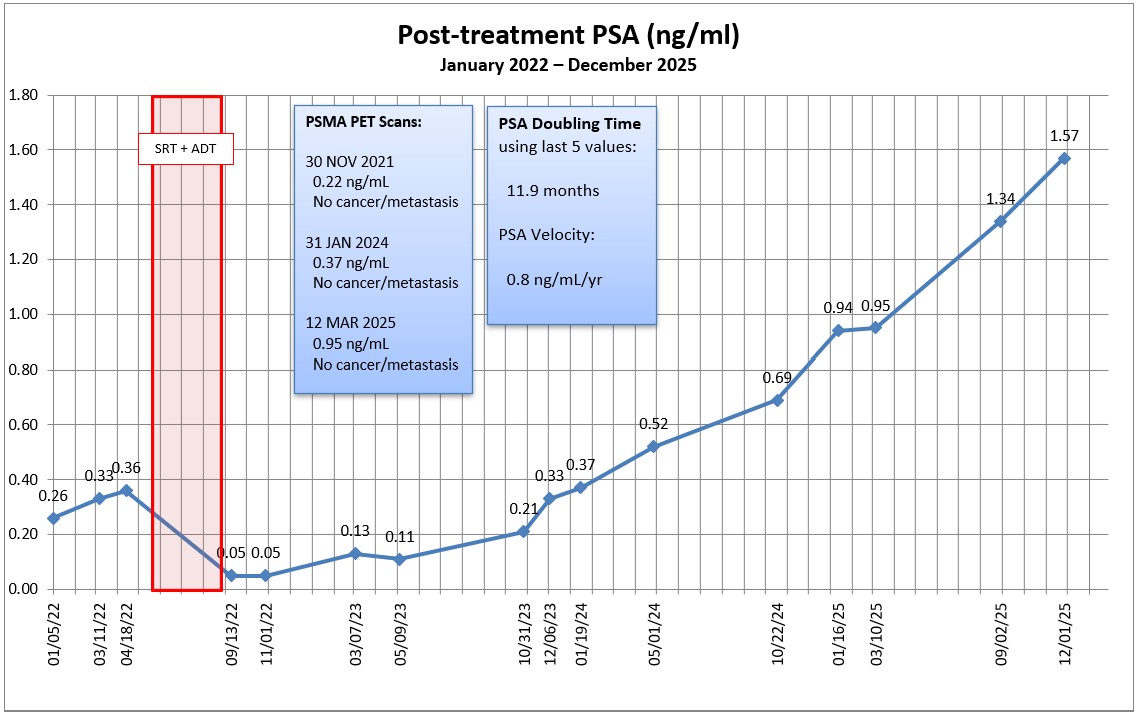
I was going to get my PSA test done next week, but I wasn’t sure what impact a potential government shutdown might have on access to the lab, so I went for the blood draw on Monday. I’m guessing that I’ll break the 1.0 ng/mL threshold with this test.

That’s it for now. More to come in the days ahead.

Header image: Sunset over the Pacific Ocean, Silver Strand State Beach, California

Day 5,214 – Doctor Visit

You may have overachieved when your doctor asks, “Are you a urologist?”

I had a good meeting with the real urologist this morning, and it appears that he actually read the questions I sent to him in advance. That made the discussion easier.

First on my question list was whether a PSMA PET scan was warranted. He agreed that it was, and we’re going to try to get that scheduled soon. He thought that, with my PSA at 0.94 ng/mL, there would be a better chance of actually finding something this time. The only concern is that the VA has required a bone scan ahead of the PSMA PET scan in the past, and he’s going to see if we can skip that. It may take several days for the schedulers to call me.

We did discuss the possibility of further radiation if a lesion is found away from the pelvis. I mentioned that I had had blood in my stools and mild radiation proctitis discovered (and addressed) during my recent colonoscopy. He was not keen on further radiation to the pelvis under those circumstances. Neither am I.

My next question was about the timing of beginning androgen deprivation therapy (ADT). He was pretty squishy on the timing, not knowing exactly where we’re at. I mentioned that, a year ago, the urologist told me that we’d start when my PSA hit 2.0 ng/mL, but the medical oncologist suggested holding off until metastasis. He generally agreed with the concept of starting it later so that the cancer doesn’t become resistant to it prematurely, with one caveat.

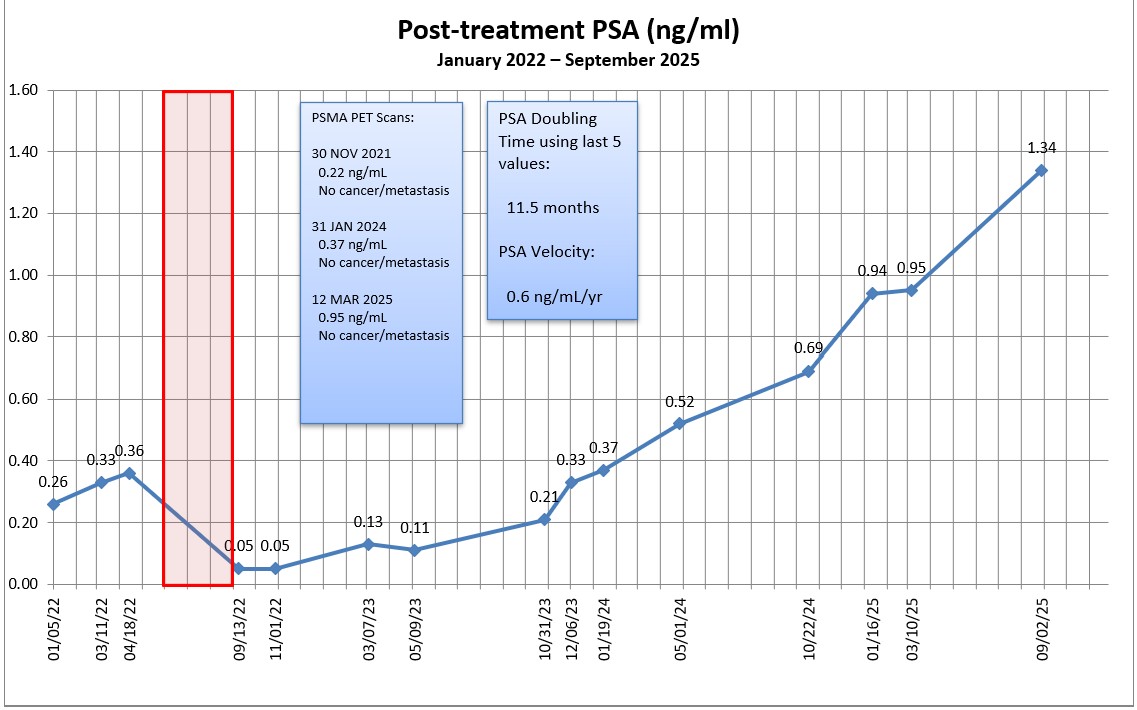
He seemed to give more weight to my PSA doubling time than did other doctors, and that’s when he asked me if I was a urologist. I had presented him my graph showing my PSA progression, and it showed my PSA doubling time. “How did you know how to calculate it?” I told him that I used the Memorial Sloan-Kettering PSA doubling time calculator. To him, my PSADT of 9 months was creeping into “concerning” territory, and might make him a little more inclined to start ADT earlier.

I asked him, “At what point do we call this metastatic disease?” and, “When should we get a medical oncologist (MO) involved?” To the first, he said that all we know is prostate cancer is somewhere in my body, but wouldn’t go so far as to call it metastatic yet. To the second, he was open to brining in a MO if the results of the PSMA PET scan warranted it.

We agreed to the following plan:

  • Get a PSMA PET scan and meet again in six weeks to review the results.
  • Get an updated PSA test before the six week review.
  • Let the results of the scan determine if we get the MO involved at that point.

I have the six-week follow-up appointment scheduled for 1 April 2025. My concern is getting the PSMA PET scan scheduled and completed before then. If I need a bone scan in advance of it, that may complicate or delay the PSMA PET scheduling further. If push comes to shove, I already had an appointment scheduled with urology on 8 May 2025, so that’s not that much of a delay if we can’t get everything scheduled before 1 April. 2025.

It was a productive meeting from my perspective, without any surprises.

More to come as we get things scheduled.

Header image: Cuyamaca Rancho State Park, California

Day 5,183 – PSA Results

I jumped the gun a couple of days and went for my PSA lab work Thursday morning on 16 January. (The three month date since the last PSA test would have been 22 January.)

As a refresher, my PSA in October was 0.69 ng/mL; it’s now 0.94 ng/mL.

I’m going to have to get a little aggressive with the medical team in terms of appointment scheduling. In October, we agreed to retest in three months and go over the results, but the schedulers didn’t have any open appointments until May 2025. Needless to say, that’s too far out so I’ll have to cajole my way into a canceled appointment or ask for a virtual / telehealth appointment sooner.

With my PSA as high as it is, I suspect that another PSMA PET scan would finally reveal some useful information that we can use to plan treatment options.

Header image: Devil’s Golf Course, Death Valley National Park, California

Day 5,118 – Urologist Visit

I met with the urologist this afternoon to go over my most recent PSA test results and the plan going forward. In a nutshell, we agreed to remain in limbo for another three months and retest the PSA in January and consider a PSMA PET scan if warranted at that point. (She was a bit skeptical that the PSMA PET scan would be conclusive even at my current PSA of 0.69 ng/mL.)

The urologist thought it was a little premature to start talking about androgen deprivation therapy, but recognized that that’s the next likely step down this path. I mentioned that, when I met with the urologist and medical oncologist in February, one suggested ADT at metastases and the other suggested starting at a PSA of 2.0 ng/mL. She said she could understand both positions.

Bottom line is that I continue to be in this sort of “no man’s land” of prostate cancer. We know it’s there; we just don’t know where, and we don’t want to pull the trigger on ADT prematurely. So more waiting.

One other thing that we discussed was radiation proctitis.

I’ve been sitting on this little tidbit for a while now, but I’ve been noticing blood in my stools. It initially appeared as spots a little smaller than a dime coin (~ 1 cm) but, over time, it has subsided to a small streak or a hint of blood. You know me: I had to create a spreadsheet to track it, and it’s been occurring in about ten percent of my bowel movements. That makes me feel better that it isn’t happening each and every time—that might indicate a larger problem if it were happening every time.

Fortunately, I haven’t had the diarrhea or mucus discharge that can come with more severe cases of radiation proctitis.

I mentioned this to my primary care physician during my appointment on 4 November, too. Both he and the urologist recommended a colonoscopy to check out what’s really going on. That joyful experience is scheduled for Friday, 22 November. Yippee!

I did come across this continuing education paper that gives a good overview if you’re really interested in learning more:

Radiation Proctitis

So the journey continues. Stay tuned for the next installment.

Header image: San Diego skyline and Mission Bay from Kate Sessions Memorial Park

Day 5,097 – PSA Results

The trend formula on my Excel spreadsheet predicted that my PSA would come in at 0.69 ng/mL, and my PSA came in at exactly 0.69 ng/mL. Not too shabby.

To be honest, that’s a little better than I expected it to be, which I’m not complaining about. At least it hasn’t taken off like a Halloween bat out of Hell.

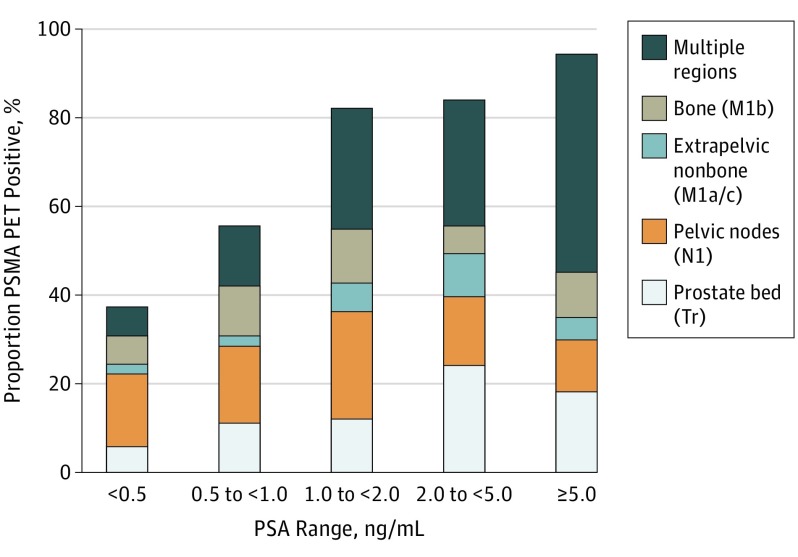
The one question that we’ll have to answer at the appointment with the urologist on 14 November is whether that level is high enough to warrant another PSMA PET scan to see if we can detect any hotspots that may be amenable to radiation. At my current PSA level, there’s about a 70% chance of detecting anything, but if we wait until the PSA is closer to 1.0 ng/mL, there’s a 90% chance of detection. Maybe we wait another three months and go from there? Or, maybe we go ahead with the scan now and I have cool images to include with my Christmas cards.

I’m guessing that that was a small enough increase—keeping my PSA at a low level—that we won’t have to worry about starting androgen deprivation therapy (ADT) quite yet. Of course, I could be wrong.

When I use my last five PSA tests over the last year to calculate PSA doubling time, the PSADT is 7.7 months.

Stay tuned.

PSA Chart since salvage radiation therapy
PSA Chart since diagnosis

Header image: Anza-Borrego Desert State Park, California

Day 5,095 – Let the Waiting Begin

I went for my PSA test this morning, so now the waiting begins for the results to be posted online. I suspect that I’ll be able to access them late Thursday night or Friday.

I also had about four or five other tubes of blood drawn (I can’t watch 🤢) for my annual physical with my primary care physician on 4 November. While there, I also got my high-dose flu shot for old geezers and the updated COVID vaccine. All of that turned me into veritable pin cushion this morning.

As much flak as the VA Healthcare system receives, I have to admit that I’m always impressed with my local clinic. No appointment was needed for either the lab work or the vaccines, and it took just 17 minutes from the time I checked in until my lab work was completed, and another seven minutes to get the vaccines. I was in and out in 24 minutes. I challenge civilian clinics to match that.

More to come soon.

Month 167 – PSA Time

Well, it’s nearly time for the PSA roller coaster to depart the station once again. (You never get off the PSA roller coaster, you just keep riding it in never-ending loops.)

I’m not exactly sure when I’ll go to the lab—either next week (short holiday week) or the week after—but I need to get it done by the end of the month because I have an appointment with my primary care physician on 4 November, and an appointment with the urologist on 14 November. I suspect that I’ll get my seasonal flu shot while I’m at the clinic, too.

If anyone is interested, we could get a pool going to guess where the PSA test results will come in at. 😄 On 1 May 2024, it was 0.52 ng/mL. The “Trend” function on my spreadsheet has it coming in at 0.70 ng/mL using the last five PSA test results from my post-radiation nadir. My money would be on somewhere between 0.80 ng/mL and 1.0 ng/mL.

Other than that, I’m just getting ready for the palm fronds to start falling as we get deeper into autumn here in San Diego. 😂


On a fun note, I attended both of the San Diego Padres Wild Card baseball games on 1 and 2 October, and the crowd went bonkers when we clinched the best-of-three series to win a spot in the playoffs.

We’re playing our arch nemesis, the Los Angeles Dodgers, in Game 5 of the National League Division Series tonight (Friday, 11 October) to see who advances to the National League Championship Series. (We’re tied two games apiece and the winner of tonight’s game will advance. Hope I didn’t jinx ourselves by writing about this. 🤞)

Sorry for the shaky camera work. There was so much happening all over the place, it was tough to know what to focus on.

On an even funnier note, I found this perfect bed for those suffering from hot flashes while on hormone therapy.

Header image: Crepuscular rays at sunset over the Salton Sea, California while hoping to see Comet Tsuchinshan-ATLAS on 10 October 2024. (I didn’t.)

Day 4,923 – PSA Results

No surprise here. In my spreadsheet, I put a placeholder value of 0.50 ng/mL for this PSA test based on the previous trend, and the actual result came in slightly higher at 0.52 ng/mL.

The PSA Doubling Time is dropping as well. Using the last five readings and the Memorial Sloan-Kettering PSA Doubling Time calculator, my PSADT was:

  • 6.7 months on 6 December 2023
  • 6.2 months on 19 January 2024
  • 5.1 months on 1 May 2024

It seems safe to say that the salvage radiation therapy failed to do the trick.

I am trying to describe my reaction to this hour-old news. I guess words that I might use would be: numb, indifferent, resigned. I don’t know. It’s a bit weird. I certainly had zero expectation that my PSA would go down or even hold steady given the previous trend.

You may recall the conversation with the medical oncologist suggested that we monitor and do another PSMA PET scan in six months, which would make it August. The question now is, based on these results, do we stick with that plan? Or do we move to the discussion on the type of androgen deprivation therapy and the timing of ADT?

I did ask the phlebotomist if he was drawing blood for a testosterone baseline test and he said yes. I don’t see the results posted online yet (my record is still going through its once-a-day update as I type this).

Well, it’s after midnight. I’ll sleep on this and perhaps I’ll be a tad more focused in the morning after having processed this.


What’s next:

  • 9 May – Appointment with primary care physician (annual physical)
  • 14 May – Appointment with urologist

Header Image: Scenes from San Diego Bay, San Diego, California

Day 4,878 – Medical Oncologist Meeting

This will be a Reader’s Digest version of a future longer post. My computer died Sunday night and I’m not keen on trying to type out the full report on my phone’s itty-bitty keyboard.

The bottom line for now is to watch my PSA for the next three to six months, perhaps with another PSMA PET scan in six months if my PSA has increased sufficiently to be reasonably assured that the scan could detect something. I’m okay with that approach.

If my next PSA has a sizable increase, we’ll reevaluate.

The meeting lasted around 30 minutes, so there are more details to share once I get access to a computer again.

I’ll go for a PSA test (and get a testosterone baseline) on 1 May in advance of a 9 May meeting with my primary care physician and a 14 May meeting with the urologist.

With luck, I’ll have a full update by the end of the week.

PCRI Video: Combining First and Second Generation ADT

Another timely video from the Prostate Cancer Research Institute talking about the recent EMBARK study that examines combination ADT + enzalutamide therapy versus Lupron alone or enzalutamide alone. (The study was funded by Pfizer and Astellas Pharma, the manufacturers of enzalutamide.)

There were 1,068 patients divided into three groups that were followed for five years. The groups were combination therapy (leuprolide + enzalutamide); leuprolide alone; and enzalutamide alone. The metastasis-free survival rate for each group:

  • Combination therapy: 87.3%
  • Leuprolide alone: 71.4%
  • Enzalutamide alone: 80.0%

One thing the study summary doesn’t address is whether combination therapy accelerates or delays the cancer developing a resistance to ADT. That would be interesting to know. While it doesn’t explicitly say in the summary, it appears that the patients were on the treatments continuously for the five years.

This is something that’s been added to my list of discussion points for my visit with the medical oncologist on 19 March.