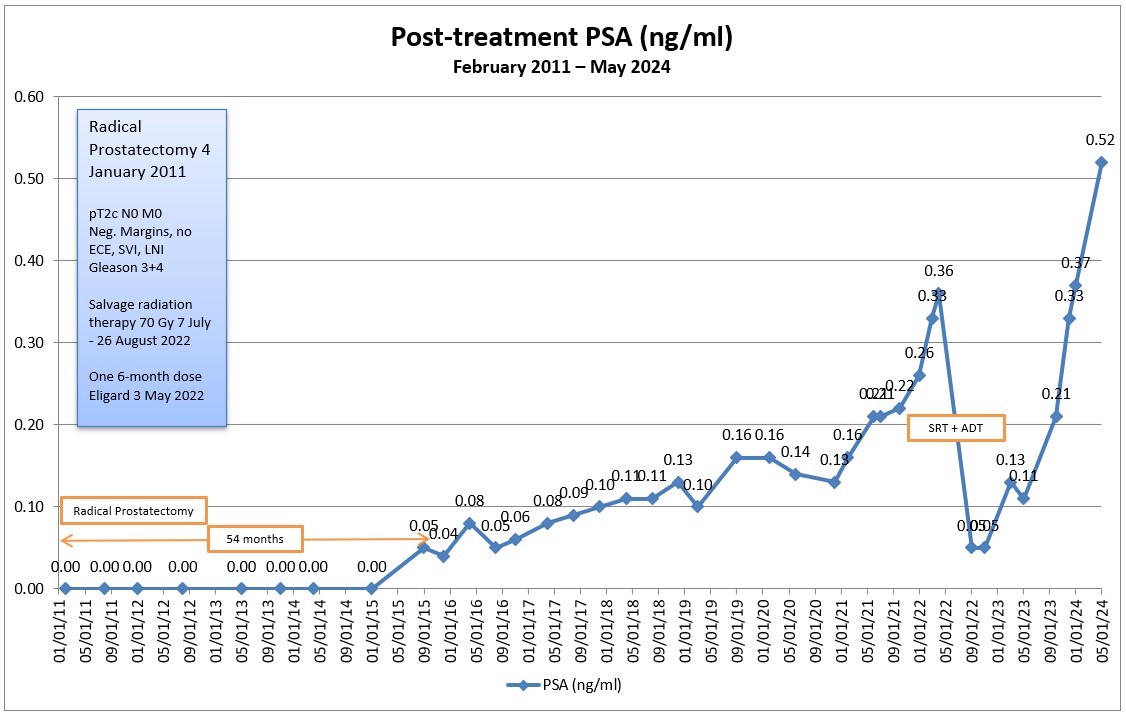
Month 162 – Urologist Visit

The short version from yesterday’s appointment with the urologist (who happens to be the Urology Department head):

Kick the proverbial can(cer) six months down the road and retest PSA then.

Generally speaking, I’m okay with that approach. I mean, really, what else is there to do at this point? We don’t have sufficient data points to make any definitive treatment decisions right now. Of course, I may feel differently after sleeping on this for a few nights.

I have to admit that it was a challenging meeting because the doctor just wanted to rapid-fire through all the discussion points and it was difficult to get my questions out. In the end, though, I prevailed.

She was blasé about the increase in my PSA, saying it went up “a little bit.” (A 41% increase in my mind is a tad beyond “a little bit,” but what do I know?) She didn’t see much value in doing another PSMA PET scan right now because a scan with a PSA of 0.52 ng/mL has about a 50-50 chance of detecting anything. That somewhat aligns with what the medical oncologist (MO) said in February—that it would be better to wait until my PSA was at least 0.7 or 0.8 before doing another scan.

My SWAG (scientific wild-assed guess) is that my PSA will be between 0.75 ng/mL and 1.1 ng/mL in November based on the average increases in my PSA over the last four readings and my PSA doubling time. (Bookmark this prediction for future reference! 😀)

We did talk about androgen deprivation therapy. Her biggest concern was that starting too early would just accelerate the eventual likelihood of resistance later on when ADT is needed the most, so she wouldn’t start ADT until there’s confirmed metastasis. (By comparison, the MO suggested holding off until my PSA hit 2.0 ng/mL.) I did ask if starting ADT early delays metastasis and she said it didn’t, which I thought was interesting.

We talked about whether it would be a monotherapy or a combination therapy, and she suspected we would start with just a monotherapy. She acknowledged that there are several studies out there showing that a combination therapy may lead to better outcomes but, in her mind, they weren’t persuasive enough to launch straight into combination therapy. However, she did say that there are certain circumstances where it may make sense, one of which was if the metastases was in the spine.

I asked about possible radiation of localized lesions and she was not all that enthusiastic about the idea. Her biggest concern was about going through radiation twice and whether that was a wise thing given what damage it may do to my body. “I’d have to defer to the radiation oncologist to make that assessment,” she said. Her fear was additional radiation damage / side effects, and I would have that same concern, too. I would have to consider very carefully zapping anywhere in the pelvic area again given the changes I have already experienced in my bowel habits.

Even if the scan showed one or two lesions that could be zapped, she would also start ADT because “it’s pretty much guaranteed that there would be cancer elsewhere that didn’t light up on the scan.” That makes sense.

Lastly, given where I’m at in this advanced prostate cancer no-man’s land, I was curious how she would label or stage my cancer. With no evidence of metastases on the last scan, she would still have me at Stage 2. (See the American Cancer Society staging of prostate cancer HERE.)

Of course, in my mind, I turned to the actual definition of metastasis:

the spread of a disease-producing agency (such as cancer cells) from the initial or primary site of disease to another part of the body

I don’t have a prostate (initial or primary site) but I do have evidence of cancer, so it must be in “another part of the body.” By that definition, it must mean that I’m metastatic, right? (Yeah, I know… Nothing in the prostate cancer world is that clear.)

I asked the question about staging more as an academic exercise because it really doesn’t matter much what the label or stage is. All I know is that I’m living with this bug growing inside me.


One of my blog followers, Phil, recently commented that his oncologist considered prostate cancer to be more of a chronic illness than a terminal illness, and that stuck with me. I mentioned that to the doctor, and she embraced that view wholeheartedly, telling me that patients like me can be kept around for many years—even decades—and the disease can be managed like hypertension or diabetes.

Intellectually, I already knew that. But, after 13+ years, it’s quite the mental leap to jump from, “I have the Big C and it continues to grow unabated,” to, “Cancer, schmancer. It’s like arthritis in my big toe. No big deal.” But it is a leap I’m trying to make.

You would expect that, after 13+ years of testing, waiting for results, reviewing results, and planning next steps, I’d be used to it by now. It’s routine. But I’m finding it to be more and more emotionally draining with each cycle as the uncertainty drags on. Perhaps it’s because I’m coming to terms with failed treatments when I had hopes for better outcomes, or perhaps it’s because I’m back in the wait-and-see mode. Or maybe it’s just the cumulative effect of being on this roller coaster for so long.

On the positive side, I know that I’ve been blessed. Many fellow prostate cancer patients would love to have their PSAs be at my level; my quality of life is pretty good considering all that my body has been through; and—most important—I’m still here 13+ years after diagnosis.


On a somewhat related note, I finally got my baseline testosterone results back: 424 ng/dL. That was taken almost two years to the day after receiving my six-month Eligard shot in advance of salvage radiation therapy, so I’m guessing that any effect the Eligard may have had on my testosterone level has worn off by now.

From what I can tell, that’s a decent / normal number for a 66-year-old guy.

At least we have a starting point for reference now.


Well, that’s it for this post. Time to go out and play for six months. Be well!


What’s next:

  • Week of 28 October – Get PSA test
  • 4 November – Physical with primary care physician
  • 14 November – Appointment with urologist

Header Image: La Jolla Coast, San Diego, California

Day 4,923 – PSA Results

No surprise here. In my spreadsheet, I put a placeholder value of 0.50 ng/mL for this PSA test based on the previous trend, and the actual result came in slightly higher at 0.52 ng/mL.

The PSA Doubling Time is dropping as well. Using the last five readings and the Memorial Sloan-Kettering PSA Doubling Time calculator, my PSADT was:

  • 6.7 months on 6 December 2023
  • 6.2 months on 19 January 2024
  • 5.1 months on 1 May 2024

It seems safe to say that the salvage radiation therapy failed to do the trick.

I am trying to describe my reaction to this hour-old news. I guess words that I might use would be: numb, indifferent, resigned. I don’t know. It’s a bit weird. I certainly had zero expectation that my PSA would go down or even hold steady given the previous trend.

You may recall the conversation with the medical oncologist suggested that we monitor and do another PSMA PET scan in six months, which would make it August. The question now is, based on these results, do we stick with that plan? Or do we move to the discussion on the type of androgen deprivation therapy and the timing of ADT?

I did ask the phlebotomist if he was drawing blood for a testosterone baseline test and he said yes. I don’t see the results posted online yet (my record is still going through its once-a-day update as I type this).

Well, it’s after midnight. I’ll sleep on this and perhaps I’ll be a tad more focused in the morning after having processed this.


What’s next:

  • 9 May – Appointment with primary care physician (annual physical)
  • 14 May – Appointment with urologist

Header Image: Scenes from San Diego Bay, San Diego, California

Day 4,880 – Full MO Report

My computer issues have been sorted, so here’s the full scoop behind my meeting with the medical oncologist (MO) on Tuesday.

The meeting started with a nurse practitioner (NP) which threw me for a bit of a loop and initial disappointment. Because this was my initial contact with the oncology team, we spent a bit of time reviewing my history and how we got here. She did say that she would bring the MO into the discussion once we went through the preliminaries.

The nurse had actually done a pretty thorough job of reviewing my file prior to the meeting, and was familiar with the recent bone scan and PSMA PET scan results. Her take on my situation was that we were somewhat in limbo with no signs of metastases anywhere, and that the path forward wasn’t so clear-cut. (That actually led to a brief discussion on how metastases is defined in the world of prostate cancer. She was of the school that it’s not metastatic until it shows up on scans, while I pressed and suggested that, because the prostate is gone and the cancer is somewhere, it must, by traditional definition, be metastatic.)

Once we were through with the initial screening, the nurse brought in the MO and introduced her to me. I did ask if she specialized in prostate cancer and she does not; she’s more of a general oncologist. She did say, however, that she reviewed my case with a genitourinary oncologist at the University of California San Diego (UCSD) the day before our meeting. That was a good to know (but not the same as having a seasoned prostate MO in the room).

At that point, the three of us started going down my checklist of questions.

We talked about whether there was value in delaying the start of any treatment until my PSA rose to a level where a scan would detect the location. In the preliminary screening, the NP seemed to be inclined to start the ADT before another PSMA PET scan, and she was a little surprised that the MO said we should do another scan in six months. The MO said that the scan may reveal lesions that could be spot radiated as a treatment option.

That led to me asking about whether there would be value in whole pelvic radiation and, again, without knowing the cancer’s location neither was a fan of pursuing that at this point. Even if we did know the location, they would defer that decision to the radiation oncologist (RO).

Because my PSA is so low (in relative terms), both seemed to be more inclined to start with just ADT and not a combination therapy of ADT plus antiandrogens. The MO acknowledged that the use of combination therapy could be more effective in controlling the cancer, but cautioned about the increased side effects from doing a combination therapy approach. She also mentioned that using combination therapy is generally reserved for when the cancer is more advanced. (I’m not sure that my research agrees with that thought.)

I believe in her discussion with the UCSD GU oncologist that they said they would probably hold off initiating hormone therapy until my PSA reached 2.0 ng/mL. I’m going to have to do a little research to see if that makes sense.

We talked about intermittent therapy and whether that would be appropriate, and the consensus was that, at my low PSA, I would be a good candidate for intermittent ADT. However, that would depend on my PSA doubling time and how my PSA responds to the ADT.

I did ask if cancer in the lymph nodes would be symptomatic and generally speaking, they said, it’s not. I asked because I had had a weird pressure sensation in my groin last month that was new. (Yes, I’m at that point where I ask myself if every new ache, pain, or sensation is related to the cancer when it pops up.)

They noted going through my record that there was no baseline testosterone test, so we all agreed that that would be helpful to have. The NP put the order in to have that done when I get my PSA tested on 1 May 2024.

The MO expressed concern about my recent cardiac work-ups after my October emergency room visit (nothing of substance was found). She reminded me that hormone therapy does have a small but real risk of increasing cardiac events.

In the last part of the meeting, I did ask if I’ll be seeing the same MO going forward, and the short answer was “indirectly.”

You’ve heard me talk before that one of the drawbacks of getting my care through the VA is that it’s a teaching hospital and that I rarely see the same physician/resident twice. It’s good that I get so many differing opinions, but it prevents me from building a long-term relationship with the doctor as well. Different residents will filter through the oncology department, but the MO I met with will be overseeing all of their cases behind the scenes, so she would be tangentially involved.

I was asking because I likened myself to being an orchestra conductor, coordinating the efforts between the urologists, radiation oncologist, my primary care physician, and now the medical oncologist. I was inquiring if she or anyone else at VA would take the lead on coordinating all of these discussions and treatment considerations. She did mention that they do have a “tumor board” that reviews much more advanced cases to map out coordinated treatment plans, but because I don’t have any substantial tumors in the scans, my case wouldn’t come up for review.

Interesting, though, was the fact that the NP and MO both viewed this meeting as me getting a second opinion instead of a hand-off of my case from the urology department to the oncology department. From their perspective, the urology department still has the lead on my case until I decide to move forward with hormone therapy.

One thing the NP brought up early in the conversation was that any treatment plan would have to be aligned with my goals. If my goal was to prevent metastasis (or delay it), then starting hormone therapy sooner would make more sense. But if my goal was to avoid hormone therapy side effects for as long as possible—recognizing the inherent risks—then it may make sense to delay therapy. To be honest, I’m not sure where on that spectrum I want to land.

We wrapped up the meeting, coming to a consensus that:

  • We’ll conduct a PSA test and get a testosterone baseline on 1 May 2024.
  • Calculate the PSA doubling time including the latest results.
  • Evaluate the results and decide whether to schedule another PSMA PET scan.

While I didn’t keep specific track of the meeting, it lasted somewhere between 30 and 45 minutes, which is quite unusual.


I came out of the meeting in good spirits because it was one of the most productive, collaborative meetings I’ve had in a long time. The conversation flowed quite easily, and I attribute that to the fact that women healthcare professionals seem to be much better prepared and much better at listening to a patient’s concerns than some of their male counterparts. This isn’t the first time that I’ve noticed that. (Don’t forget, it was the thoroughness of my female primary care physician that discovered the cancer via a DRE in the first place.)

To be honest, I’m not sure why I felt compelled to mention these observations based on my personal experiences. I just suspect that some prostate cancer patients may be reluctant to discuss problems with their male bits with female healthcare professionals. You might be surprised by the difference in quality of care that you receive, so don’t rule them out.


I have been more than satisfied with my care from the VA so far but, as my cancer advances, I am beginning to wonder if it makes sense to step outside the VA so I can get a team that is dedicated to my case and one that I can build a long-term relationship with.

At the top of my list would be UCSD followed by Scripps/MD Anderson. But the VA already has such close ties to UCSD, it’s almost like I’m getting care from them already. In fact, the MO I saw is a clinical professor of medicine at UCSD, most of the residents I see in urology are from UCSD, and my VA-provided RO is from UCSD but seeing him required “community care” pre-approval. (Community care is generally only approved if the VA doesn’t have the capacity or capability, so it could be tricky arguing to obtain it.)

So while I’m on Medicare and it would be relatively easy (but more expensive) for me to step away from the VA, I would explore options for getting approval to move into community care at the USCD GU medical oncologist through the VA first.

I’m not keen on changing horses in mid-stream, but it may make sense in the long run. I’ll have to think that through.


And now you know why I didn’t want to try and type this out on my phone on Tuesday. 😂 Thanks for reading this far!

Header image: A rare spring snow in Cuyamaca Rancho State Park, San Diego County, California, 14 March 2024

Day 4,820 – PSA Results

Okay. I got antsy and went for my PSA test on Friday instead of next week. As expected, my PSA increased from 0.33 ng/mL on 6 December 2023 to 0.37 ng/mL on 19 January 2024.

The silver lining in that cloud is that the rate of increase slowed a bit and it didn’t increase as much as I expected it would.

Sometimes, I get too nerdy for my own good. There was a 91% increase between the May and October readings, and there was a 57% increase between the October and December readings, so I averaged the two increases (74%) and projected that this increase would land me at just over 0.5 ng/mL. This increase ended up being just 12% over the previous December reading. Fickle PSA.

I ran the numbers through the Memorial Sloan-Kettering PSA Doubling Time calculator again, using the five values from March 2023 (0.13) on. My PSA doubling time dropped from 6.7 months to 6.2 months, and my PSA velocity increased from 0.2 ng/mL/yr to 0.3 ng/mL/yr since calculating it back in December.

I went for the test early because I really wanted to know the PSA value going into the PSMA PET scan that’s scheduled on 31 January 2024. Plus, if it dropped, I would have had time to ask the urologist if it was worth going ahead with the scan at a lower PSA level. (Remember, I went for a PSMA PET scan when my PSA was 0.22 ng/mL, and it didn’t show anything at that PSA level. Why subject myself to another dose of Gallium-68 if the outcome may not produce any useful information?)

My follow-up with the urologist to review the PSMA PET scan and PSA results is on 13 February, and we’ll map out what’s next from there.

So that’s the latest and greatest. More to come.

Header image: The famous Torrey Pines Golf Course, San Diego, California, home to the Farmers Insurance Open golf tournament

Day 4,782 – Doctor Discussions

I’ve had conversations with my radiation oncologist and my urologist this week.

UCSD Radiation Oncologist Discussion

The conversation with the RO was via email, which was fine by me. I’m thankful he takes the time to get back to me. In a nutshell, he said:

  • We’re on the verge of needing to do a PSMA PET scan.
  • We should get the PSMA PET scan before any ADT.1
  • If PSMA PET shows limited site(s) of recurrence, SBRT radiation may be an option to “ablate the larger cancer deposit and work in concert with ADT.”

His recommendation was to get the PSMA PET scan now or to wait one month until early January 2024 and take another PSA test. If it remains steady, “we are good,” but if PSA rises again, it would be time for a PSMA PET scan.

I’ll let him know it took me two months to get my first PSMA PET scan at UCLA after speaking to the scheduling office, so getting it “now” may not be an option.

One other thing I need to nail down is where I can get the scan done again. When I had it in November 2021, the only two facilities in the U.S. that were approved to do the scan were UCLA and UCSF. Since then, far more facilities are capable of doing it, I believe including UCSD.

VA Urologist Discussion

Preparing for the meeting today, I put together an outline of things I wanted to discuss:

  • PSMA PET Scan
    • If the VA would cover the cost this time.
    • If there’s a difference in the tracers used (Ga-68 versus PYLARIFY® (piflufolastat F 18)
  • ADT and the timing
  • Whether they prefer a sequential or combination approach (e.g., include chemotherapy with ADT).
  • Getting a medical oncologist who specializes in prostate cancer involved in the case.

But once I got there, I was definitely off my A-game for some reason, and the conversation was one of the weirder, more disjointed conversations that I’ve had with a VA urologist.

First, he was a new (to me) urologist and he entered the exam room a bit like a bull in a China shop. He didn’t introduce himself and just started out with, “I looked at your PSA and read your email. What questions do you have for me?” Not even so much as a, “Sorry to see your PSA increase after SRT.” That threw me off right there.

It was a bumpy conversation, but we eventually talked about most everything on my list. I’ll save the bit about the scan for last.

Interestingly, he seemed to downplay spot radiation if lesions are found during a scan and was more focused on starting androgen deprivation therapy as the next course of treatment. But he wouldn’t start it until after a scan was completed. He did say under certain specific circumstances, spot radiation may be helpful.

In the discussion about sequential versus combination treatments, he said that they would do a combination. I asked if it would be ADT and chemotherapy, and he said no. It would be ADT and antiandrogen therapy in combination using Eligard for the ADT and one of the following:

I asked about chemotherapy with ADT, and he said that the antiandrogens have taken the place of Docetaxel (Taxotere), which I thought was an odd statement from my limited knowledge. I believe that Taxotere is still very much a treatment option used later in the progression of the cancer. I need to dig into that more.

Concerning shifting my case to a medical oncologist (MO), he said that would happen on its own, as he wasn’t allowed to prescribe the antiandrogen drugs. The MO would also know how to better manage the side effects of the combined therapies.

Now, for the kicker part of the conversation…

He agreed that a PSMA PET scan was the best way forward but—and even he disagreed with this—the VA protocol is to have a bone scan first. The protocol said that, if a bone scan was negative, then a PSMA PET scan could be authorized.

He assured me that, at my PSA level of 0.33 ng/mL, the bone scan would, in fact, be negative. (Doing a quick Dr. Google search, it appears that bone scans start to pick up lesions when the PSA is over 20 ng/mL. Yep, 0.33 vs. 20.

So getting my soapbox and editorializing a bit here… It makes zero sense to get a bone scan in my present circumstances. None. The VA can be very slow to catch up with the times in certain circumstances, and this happens to be one of those times. It just seems to be a waste of time and resources when we already know that the bone scan isn’t sensitive enough to pick up anything at my PSA level. But I’m not sure I’m up for “fighting city hall” to try and get the PSMA PET scan out of the gate.

On a positive note, the VA apparently can now do the PSMA PET scan according to the doctor.

I have to admit that I’m toying with the idea of using my Medicare coverage and going outside the VA for the PSMA PET scan and skipping the VA bone scan altogether. I need to dig into that and see how that would work and how quickly that could happen.

I just want to make sure that I’m not shooting myself in the foot in the process—the VA has to authorize community care in advance for them to continue to cover the costs. I don’t want them to say, “Hey, you chose to go outside the VA system, so now you can pay for all the tests and drugs.” I know Medicare would pick up a good chunk of the costs, but I may be on the hook for more than I bargained for.

The urologist thought the bone scan could be scheduled pretty quickly and, if that’s the case, that may put me closer to a PSMA PET scan faster than if I try to go outside the VA and create new relationships with new providers (although I think my radiation oncologist at UCSD may be able to assist me in ordering one and getting it scheduled).

We ended the conversation with him saying that we’ll do another PSA test in three months. That surprised me a bit given its rapid rise over five weeks. “We know it’s going to increase,” he said, but he did offer to retest in six to eight weeks. I don’t think we ever landed on a firm answer, so I need to chase that down.

In a way, though, it’s probably more important to get the scan(s) done first, and tracking the PSA is secondary to that. Does it really matter if we retest PSA in eight weeks versus twelve weeks? I doubt it.

I left the meeting without:

  • A date to have the bone scan.
  • A follow-up date with the urologist (dependent on scan results).
  • A date for the next PSA test.

Sounds like a productive meeting to me. 😂


One other thing that happened today, which was quite unusual for me, was that I was far more nervous going into it than I should have been. I don’t know what was up with that. I had difficulty articulating my thoughts, and my hand was shaking ever so slightly as I was taking notes. That freaked me out even more. I guess the emotions associated with this new chapter have been a bit more than I expected.

When the meeting was over, I sat in the waiting area for a good ten minutes to just decompress and to scribble down a few more notes while the conversation was fresh in my mind.

Once I calmed down, I went to the Nuclear Medicine department to try to schedule the bone scan, but the scheduler was away and the guy staffing the desk wasn’t familiar with the process. I’ll be back there tomorrow morning for another test2, so I can try scheduling again when I’m there tomorrow.

I’ll keep you posted.


  1. This aligns with what Dr. Scholz says in this video. Taking ADT before the scan may reduce the size of the cancer to the point where the scan can’t pick it up. https://youtu.be/CBILHS0FJfk?si=zaoHCOkm-mWOmdyz&t=525 ↩︎

Day 4,776 – PSA Results (Not Good)

Well, 💩.

The suspense of not knowing what my PSA was up to was killing me, so I went a couple of days earlier than I planned to have my PSA test. I was expecting it to go up a bit, but I wasn’t expecting it to leap a tall building in a single bound.

My PSA jumped from 0.21 ng/mL on 31 October to 0.33 ng/mL on 6 December, a 57% increase in five weeks. Ugh. Using the four PSA values from this year and Memorial Sloan Kettering PSA Doubling Time calculator, my PSADT is 6.7 months.

I’d say it’s safe to conclude that the salvage radiation therapy missed the mark, but I’ll confirm that with an in-person appointment with the urologist on Thursday, 14 December and with the radiation oncologist via email.

I’m writing this late on Thursday night, about 20 minutes after seeing the results online, so I’m still shocked and processing it all. I’ll wrap this post up in the morning…

Back at the keyboard Friday morning after a somewhat fitful night of sleep…

Needless to say, this was (and still is) a bit of a gut-punch for me to see the PSA increase so rapidly. It’s definitely got me concerned and wondering where the cancer is if the radiation didn’t even make a dent in it.

So what’s next? I don’t know. I suspect these would be a few possibilities:

First, maybe let the PSA continue to rise a little more until it’s over 0.5 ng/mL but less than 1.0 ng/mL to give a PSMA PET scan a better chance of picking up where the cancer is located. At 1.0 ng/mL, PSMA PET scans can find the cancer about 90% of the time.

If there are only a couple of localized lesions, we may be able to radiate them.

Second, I’m sure androgen deprivation therapy (ADT) is definitely on the horizon, whether we do a scan and radiation or not. My only question would be the timing of the ADT. If it’s given before a scan, would that make it more difficult for the scan to pick up the lesions? I don’t know.

Last, Dr. Mark Scholz of the Prostate Cancer Research Institute, recently posted a video where he talked about a shift in how they approach treating advanced prostate cancer. (I’ll post the video in a separate post.)

Traditionally, treatments were offered sequentially. You’d start with hormone therapy, and when the cancer became resistant, you shifted to a different type of hormone therapy. When that failed, you would move into chemotherapy, a PARP inhibitor (immunotherapy), injectable radiation, and finally clinical trials.

There is research showing that combination therapies may be more effective in staving off the cancer. Instead of just starting out with ADT, it may make sense to combine ADT with radiation or ADT with chemotherapy right out the gate. Yes, there may be increased immediate side effects from the dual treatment, but early studies are showing higher cure rates and longer survival. Additionally, if the combined treatments are successful, this may lead to a better long-term quality of life because you may be able to be taken off ADT.

My appointment with the urologist is on Thursday, 14 December, and you bet I’ll have a ton of questions ready. One of them will be about getting a full-blown medical oncologist who specializes in prostate cancer involved at this point.

In the meantime, I’m going to have to start learning the language of advanced prostate cancer. There are so many different drugs and treatments with weird names that don’t really indicate what they do or how they’re used that it’s tough to keep them straight. Perhaps a spreadsheet may be in order…

I am trying to look for the silver lining in the cloud. I guess that would be that my PSA is still quite low. But the dark part of the cloud is the fact that I’m probably entering the phase where the treatments and their side effects will eventually be worse than the disease when it comes to daily quality of life. I tolerated the six-month dose of Eligard in 2022 pretty well, but it wasn’t without side effects. I guess I’ll cross that bridge when I get to it.

Oh. And I’m open to any and all insights from those who have traveled this path ahead of me.

Well, time to get out of the house and try to put this out of my mind for a brief period. (Translation: Escapism.)

Day 4,747 – Update

Just a quick update…

The urologist agreed with the radiation oncologist’s recommendation for another PSA test just before my 14 December 2023 appointment, and put the order in the system for me to have the test. I’ll probably try to have the blood drawn on 8 December or so.

I met with my primary care physician today. He had seen my most recent PSA test, and thought the 0.21 ng/mL reading was pretty good post-radiation. But it was clear to me that he didn’t compare that to the previous test and, when I told him it nearly doubled, he agreed that it was a concern.

Regarding my cardiac mystery, he ordered an echocardiogram and a cardiac stress test, and the cardiac department schedulers should call me next week to set that up.

I had worn a Zio patch heart rhythm monitor for two weeks ending this past Monday, 6 November. I shipped the device to the facility that analyzes it that same afternoon, and they just received it this morning according to the shipping tracking number. The doctor said it can take a week to ten days for the data to be downloaded, analyzed by cardiologists, and a report generated.

I’m still having occasional and usually brief episodes (< 10 minutes) of what I would call minor palpitations or fluttering, so I’ll have to keep an eye on that while all of this is going on.

So, we’re back in the test and wait phase for now. Stay tuned for more.

Day 4,742 – RO Response

I emailed the radiation oncologist yesterday and his response at 6:13 a.m. Saturday 😮 was about what I expected:

  • He agreed with another PSA test and recommended doing it in six weeks (mid-December).
  • Reminded me that the current PSA of 0.21 ng/mL is still below the starting point of 0.36 ng/mL at the beginning of radiation, so in his eyes, this is technically not progression, but…
  • He also agreed that the “trajectory means we need to keep a closer eye on it.”

I emailed the urologist to request another PSA test before our appointment on 14 December before I received the response from the RO, and I’m awaiting the urologist’s response. I’ll forward the RO’s recommendation to reinforce my request.

I’m hoping I can get the PSA done on Friday, 8 December or Monday, 11 December in time to have the results for my 14 December appointment. That would be close enough to the RO’s mid-December recommendation. (Why does this crap always seem to happen just before the holidays???)

More to come.

Header image: Anza-Borrego Desert, California

Thirteen Years

Halloween threw an evil trick at me just ahead of my 13th anniversary of being diagnosed: My PSA nearly doubled, jumping from 0.11 ng/mL to 0.21 ng/mL in just under six months (9 May 2023 – 31 October 2023).

Needless to say, that was not the result I was expecting. I was hoping the salvage radiation and androgen deprivation therapy from the summer of 2022 would have helped put this crap behind me or at least do a better job of controlling it.

What does it mean?

I’m trying hard not to get ahead of myself, but the answer seems pretty obvious: the cancer survived the zapping and is thriving. For me, the fact that it essentially doubled in six months is the biggest concern. If my PSA drifted back up to 0.13 ng/mL, even I would say that I was getting ahead of myself, but it doubling is something else—something more conclusive.

Another factor making me think this is the “real deal” is how rapidly my PSA shot up in the months before the SRT. It went from 0.22 ng/mL on 14 October 2021 to 0.36 ng/mL six months later on 18 April 2022.

From my lay person perspective, this is significant because it means that the window on curative options is closing (closed?) and, going forward, we’ll be more focused on management options that try to slow the inevitable growth of the cancer.

It’s not all doom-and-gloom, though. There are plenty of prostate cancer patients who have been on systemic treatments (hormone therapy) for a decade or longer, keeping their cancer in check. The problem is the side effects of the treatment can substantially impact quality of life, and there’s the chance that the cancer becomes resistant to the hormone therapy, much in the same way that bacteria become resistant to antibiotics.

I have an appointment next week on 9 November with my primary care physician, and with the urologist on 14 December, and it will be interesting to hear each of their perspectives. I emailed the radiation oncologist and get his take, too, while also asking for a refund.

What’s Next?

Again, from my limited knowledge and perspective gained by dealing with this for thirteen years, I suspect the doctors will tell me:

  • To re-test the PSA in one to three months to confirm the upward trend and doubling time.
  • If it continues to increase, perhaps schedule another PSMA PET scan to see if we can locate where it’s at or how far it’s spread, if at all.
  • If we can locate it and it’s a single lesion or two, perhaps another round of radiation may be in order to target those specific lesions.
  • If we can’t locate it, I suspect systemic approaches will be used. This would most likely mean extended hormone therapy. It could possibly mean chemotherapy, but I suspect that would be delayed until later.
  • Or it could be a combination of any or all of the above options.

All of those options come with potentially significant impacts on quality of life.

Final Thoughts

This was a crappy end to an equally crappy month.

On Friday, 13 October (lucky day), I found myself in the Emergency Room with symptoms indicating a cardiac event might be happening. Fortunately, there was no sign of heart attack or stroke. The symptoms puzzled the ER doctor, so he prescribed that I wear a Zio patch continuous heart rhythm monitor for two weeks to see if it catches any irregularities. That comes off on Monday, 6 November and will be sent off for analysis.

The kicker, though, was that I had scheduled an 18-day bucket list trip to New Zealand departing the following Monday, 16 October. I still had some minor symptoms on Saturday morning, so I decided the best and safest course of action was to cancel the trip. (Thankfully, I booked a mostly refundable ticket, and had travel insurance for the remainder.) Disappointing, to say the least.

Perhaps it was meant to be, because an expensive plumbing issue arose at my house that would have needed to have been addressed while I was away.

And now, to put the icing on my October crap cake, my PSA doubles. Ugh.

I won’t lie. When I saw the results online, the news hit hard. I was hoping that it would have continued its downward trend, but I also knew that it could go up, too. I just wasn’t expecting it to go up that much so soon. I would have been happy if the salvage radiation had my PSA hanging out at 0.11 ng/mL for the next decade or so. But I guess that’s not meant to be.

To be transparent, I did question for a moment whether holding off on SRT as long as I did was the wrong decision, but I quickly cast that thought aside. I made that decision with the information I had at the time, and with a desire to avoid treatment side effects for as long as I could. Whether it was right or wrong, no one can say. I’m here now and will have to deal with the present facts. No amount of second-guessing will ever change that, so it’s not worth the effort or energy to do so.

What I’m regretting more at the moment, is cancelling the trip to New Zealand. If a PSA test in December or January shows continued increases in my PSA, I’m guessing that we’d start hormone therapy at the very least. Traveling great distances for a long period while on hormone therapy may not make for the best experience. We’ll see. (Aside from the fatigue and heightened emotions, I seem to have tolerated the Eligard fairly well compared to many.)

Lastly, I’m going to have to do more research on what my options will be and what the current treatment protocols are for someone in my situation.

My summer and early autumn hiatus away from posting on this blog—a refreshing break from cancer—appears to be ending as I start what is likely the next chapter in this story. Stay tuned for more.

Header image: Imperial Beach Pier at sunrise; Imperial Beach, California

Month 148 – PSA Results

I went for my next PSA test this week and I truly didn’t know what to expect going into it. My PSA jumped from 0.05 ng/mL on 1 November 2022 to 0.13 ng/mL on 7 March 2023. I’m concerned but not freaked out.

My best guess is that the androgen deprivation therapy effects are wearing off faster than the salvage radiation effects are kicking in. (At least that’s my hope, but what do I know?)

It’s been ten months since I received the six-month dose of Eligard on 3 May 2022, so it makes sense that it would be less impactful on my PSA over time and that my PSA would creep up again. I’m a bit surprised by how big of a jump it was, though.

Of course, I’ll talk to both the urologist and radiation oncologist about this, but that won’t be until May as things stand right now. (I did email the results to the radiation oncologist, and he replied, “I would not read too much into a single PSA value”).

Our follow-up testing and appointment scheduling between the VA urologist and the UCSD radiation oncologist is getting a bit out of whack, and I need to try to rein that in. It’s difficult to do the four-month follow-ups suggested by the doctor when appointment availability is six to eight months out. (I’ll spare you the details.)

My appointment with the VA is on 30 May, and I don’t have a firm date for the UCSD six month follow-up yet, but that should be in May as well.


In other news, my bowels seem to be calming down, with me returning to bowel movements once or twice a day. The intestinal gas still happens, but that comes and goes, too. Urinary frequency is pretty much back to where it was before the radiation, and I can usually make it through the night now with zero to one trips to the toilet.

Be well!

Header Image: Sedona, Arizona