Day 5,774 – PSA Results & Thoughts on ADT + ARPI

I went for my PSA test this morning, 1 September, and it was 3.32 ng/mL, up from 2.65 ng/mL back in May.
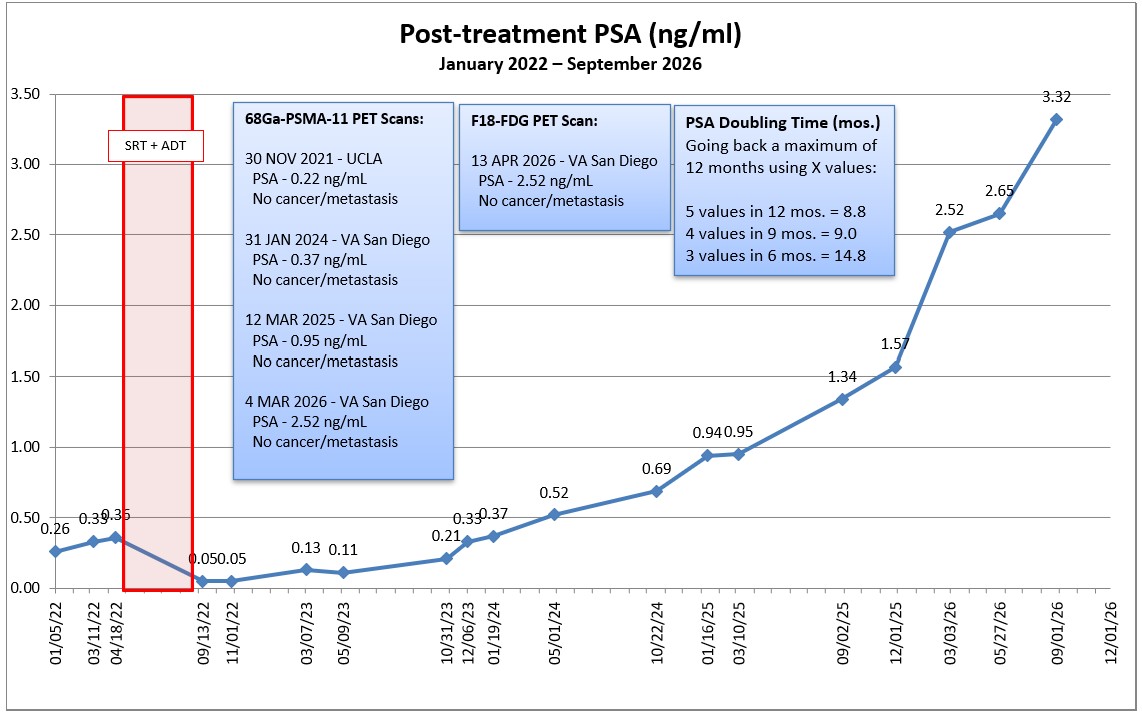
I expected my PSA to go up, and I guessed it would be around 3.0 ng/mL, so the amount it went up was a bit of a surprise. It’s closing in on my PSA level at initial diagnosis, 5.0 ng/mL.

PSA Doubling Time

Seeing as both the VA and UCSD medical oncologists (MO) stressed the importance of using PSA doubling time (PSADT) to guide treatment decisions during my meetings with them in June, I really wanted to try to nail down how it should be calculated.

The Memorial Sloan-Kettering PSADT Calculator is a great tool that I’ve been using, but it doesn’t provide any guidance on how many data points should be used over what period of time. I finally found some definitive guidance:

PSA values need not be consecutively rising and all values obtained over a maximum period of 12 months should be included in the calculation. The maximum period of the past 12 months is recommended to reflect the patient’s current disease activity, since in some men PSADT may change over time. Minimum requirements for the calculation are 3 PSA values obtained over 3 months with a minimum of 4 weeks between measurements.1

Based on those guidelines, my PSADT is:

Number of PSA Values UsedGoing back over X monthsPSA Doubling Time (Months)
36
(3 March 2026)
14.8
49
(1 December 2025)
9.0
512
(2 September 2025)
8.8
Source: MSKCC PSA Doubling Time Calculator

You can see that I’m sitting right around that nine-month PSADT point that’s the suggested trigger for action. I’m going to keep my mouth shut and ask my MO to calculate the PSADT and see what number they come up with.

Obviously, I’m concerned, but not panicked by this jump in my PSA. I’ll email the MO to see if we should stick to the current plan of having a CT scan on 23 November, or move it to an earlier date. Or to have another PSMA PET scan. In my mind, I’d like to have at least one more scan to try and see if we can determine what we’re dealing with before leaping into combination hormone therapy.

Combination Therapy

The MO’s were really encouraging action if my PSADT was nine months or less because, with faster doubling times, there is high risk of metastasis and prostate cancer-specific mortality. The action that they’re recommending is intermittent combination therapy using androgen deprivation therapy (ADT) plus an androgen receptor pathway inhibitor (ARPI). The specific drugs they’re recommending are Eligard® (leuprolide acetate) (ADT) and Xtandi® (enzalutamide) (ARPI). The Eligard® would stop the production of testosterone, and the Xtandi® would block the cancer cells from absorbing testosterone.

The reason that the MOs want to use the combination therapy is because of the results that were shown in the EMBARK trial. Using Eligard® and Xtandi® together had 87.3% of patients in the trial reach the five-year point metastasis-free. Using just Eligard® alone—the old standard of care—just 71.4% of patients were metastasis-free at five years. The combination therapy won’t prevent progression to metastasis; it just slows it down. This short (2 min.) video from the New England Journal of Medicine gives a good overview:

The combination therapy would be given intermittently, with nine months on the medication and, if my PSA drops to a certain level (usually below 0.2 ng/mL) and stays there, there wouldn’t be a need to restart the combination therapy until there’s a rise in my PSA.

The one thing that I couldn’t find or confirm in my research was if there was a specific PSA level where, if you exceed it, this combination therapy should be started. The UCSD MO seemed okay with waiting until it was as high as 5 to 10 ng/mL if the PSADT didn’t indicate high risk.

Xtandi® (enzalutamide) is just one of several drugs known as Androgen Receptor Pathway Inhibitors (ARPIs). Two others that are commonly used include ERLEADA® (apalutamide) and NUBEQA® (darolutamide). Each has its own similar, but slightly different side effects.

Side Effects / Adverse Events

Messing around with your hormones can have substantial and sometimes debilitating side effects and, when using combination therapy, they can be additive. The National Cancer Institute has defined five grades of adverse events based on their severity:

GradeImpact
Grade 1Mild; asymptomatic or mild symptoms; clinical or diagnostic observations only; intervention not indicated.
Grade 2Moderate; minimal, local or noninvasive intervention indicated; limiting instrumental ADL or mild/moderate impact on age appropriate normal daily activity (pediatric)*.
Grade 3Severe or medically significant but not immediately life threatening; hospitalization or prolongation of hospitalization indicated; disabling; limiting self-care ADL or severe impact on age appropriate normal daily activity (pediatric)**
Grade 4Life-threatening consequences; urgent intervention indicated.
Grade 5Death related to AE.
Notes:Activities of Daily Living (ADL):
*Instrumental ADL refers to preparing meals, shopping for groceries or
clothes, using the telephone, managing money, etc.
**Self-care ADL refers to bathing, dressing and undressing, feeding self,
using the toilet, taking medications.
Source: CTCAE and Adverse Event Reporting

Clearly, a patient would want to steer clear of any Grade 3 or 4 side effects if possible. When you look at the grades of adverse events in the summaries of each of the drugs below, you’ll see that the percentages of patients experiencing an adverse event at all grade levels can be quite high in some cases. Bottom line: ADT + ARPI will adversely impact you and your quality of life in some shape or form. It’s just a matter of degrees.

ERLEADA® (apalutamide) Side Effects

The most common side effects include:

  • Feeling very tired
  • Joint pain
  • Rash
  • Decreased appetite
  • Fall
  • Weight loss
  • High blood pressure
  • Hot flash
  • Diarrhea
  • Fracture

Some of the possible, more severe side effects include:

  • Heart disease, stroke, or mini-stroke
  • Fractures and falls
  • Lung problems
  • Seizures
  • Severe skin reactions

And you can see what percent of the time that patients experienced some of these side effects by adverse event grade in section 6.1 of the prescribing information HERE or in these tables HERE. Some of the Grade 3 or 4 adverse events occurred as much as 8% of the time.

NUBEQA® (darolutamide) Side Effects

The most common side effects include:

  • Increase in liver function tests
  • Decreased white blood cells (neutropenia)
  • Feeling more tired than usual

Some of the possible, more severe side effects include:

  • Heart Disease
  • Seizure

And you can see what percent of the time that patients experienced some of these side effects by adverse event grade in section 6.1 of the prescribing information HERE. Some of the Grade 3 or 4 adverse events occurred as much as 4% of the time.

Xtandi® (enzalutamide) Side Effects

The most common side effects include:

  • Muscle and joint pain
  • Feeling more tired than usual
  • Hot flashes
  • Constipation
  • Decreased appetite
  • Diarrhea
  • High blood pressure
  • Bleeding problems
  • Falls
  • Bone fractures
  • Headache

Some of the possible, more severe side effects include:

  • Seizure
  • Posterior Reversible Encephalopathy Syndrome (PRES) (Involves the brain with seizure or quickly worsening symptoms such as headache, decreased alertness, confusion, reduced eyesight, blurred vision or other visual problems)
  • Allergic reactions
  • Heart disease
  • Falls and bone fractures
  • Swallowing problems or choking (because of the size of the pills)

And you can see what percent of the time that patients experienced some of these side effects by adverse event grade in section 6.1 of the prescribing information HERE. Some of the Grade 3 or 4 adverse events occurred as much as 9% of the time.

Eligard® (leuprolide acetate) Side Effects

The most common side effects include:

  • Hot flashes
  • Fatigue (tiredness)
  • Testicular atrophy
  • Weakness
  • Muscle pain
  • Dizziness
  • Clamminess
  • Testicular shrinkage
  • Decreased erections
  • Enlargement of breasts
  • Decrease in bone density

Some of the possible, more severe side effects include:

  • Heart attack
  • Elevated blood sugar and increased risk of developing diabetes
  • Convulsions

And you can see what percent of the time that patients experienced some of these side effects by adverse event grade in section 6.1 of the prescribing information HERE.

Anecdotal Side Effect Experiences

One of the side effects that isn’t specifically mentioned above was cognitive decline. In a study, it was shown:

Patients with advanced prostate cancer treated with enzalutamide (Xtandi) had a significantly greater decline in cognitive function compared with those who received darolutamide (Nubeqa), according to results from a phase II trial.

Median cognitive change in the maximally changed cognitive domain (MCCD) from baseline to 24 weeks was -15.8% for those receiving darolutamide versus -36.1% for those receiving enzalutamide (P=0.009), reported Alicia Morgans, MD, MPH, of the Dana-Farber Cancer Institute and Harvard Medical School in Boston.2

I’m a member of an online support forum for advanced prostate cancer on HealthUnlocked, and one of the common themes of other patients who have been on Xtandi® (enzalutamide) is significant “brain fog.” Many had such severe side effects that they stopped taking Xtandi® (enzalutamide), with one patient calling it “poison.”

Now, I take what’s said in forums like that with more than a grain of salt. There’s definitely some selection bias going on—patients who are having difficulties with their treatments are more likely to talk about them in a forum than those whose treatments are going well. We just don’t know how many are out there who have minimal side effects and tolerate the treatments well.

Drug Interactions

I surprise medical professionals when they ask me to list my current prescriptions because I only have one: amlodipine to manage hypertension. I checked on Drugs.com to see if any of the four drugs above will interact with the amlodipine:

  • Eligard® (leuprolide acetate) = Unknown interactions
  • ERLEADA® (apalutamide) = Major interaction
  • NUBEQA® (darolutamide) = Minor interaction
  • Xtandi® (enzalutamide) = Major interaction

Because a well-known side effect of ADT is osteoporosis/bone density loss, patients are usually given calcium and vitamin D supplements to slow or minimize the loss. Interactions with calcium and vitamin D:

  • Eligard® (leuprolide acetate) = Unknown interactions
  • ERLEADA® (apalutamide) = No information
  • NUBEQA® (darolutamide) = Unknown interaction
  • Xtandi® (enzalutamide) = Moderate interaction

Clearly, we’re going to have to have a discussion about the amlodipine before starting anything because it has made a difference. My systolic number has dropped by 33 points and my diastolic number has dropped by 24 points. Part of that may be the amlodipine, and part may be the fact that I’ve lost 44 lbs. / 20 kg since starting the amlodipine (or both).

Timing of Starting ADT + ARPI Therapy

You may recall back in April, I shared an AnCan Foundation video of a seminar featuring Dr. Ravi Madan and Dr. Melissa Abel from the National Cancer Institute (NCI). In it, they raise the notion that with new PSMA PET scans, we may be moving too quickly to treat biochemically recurrent prostate cancer and may be overtreating patients, subjecting them to the side effects of ADT either unnecessarily or prematurely.

From the video notes:

Dr. Paul Schellhammer, said in the meeting, ‘it’s like listening 15 years ago to the folks who began to promote active surveillance (in first line treatment).” Dr. Madan and Dr. Abel have collected solid data from around 150 patients that suggests men with slow PSA doubling times can “play the long game” as Dr. Ravi calls it, and defer active treatment when their disease recurs.

Just like the concept of active surveillance, this approach does seem counterintuitive. It’s a novel take that probably isn’t that widely accepted yet, but when you watch the video and look at the data, it makes sense. They’re not saying that treatment won’t be required at some point; they’re just making a case for delaying the treatment in order to maintain quality of life, especially if nothing is showing up on scans.

One difference in their approach is that they define a high risk PSA doubling time to be in the three to six month range, instead of the widely accepted less than nine month range.

Dr. Madan wrote a very interesting paper on this topic that I highly encourage you to read. It was published in the Journal of Clinical Oncology in September 2022, With New Technology Comes Great Responsibility: Prostate-Specific Membrane Antigen Imaging in Recurrent Prostate Cancer

Summary

I have to admit that the NCI doctors have me thinking more and more about the timing of starting this combination therapy because, let’s face it, no one leaps at the opportunity to go on hormone therapy given the “fun” side effects that it brings.

When I was on Eligard® (leuprolide acetate) during my salvage radiation therapy, I tolerated it probably better than most men do. I had mild to moderate fatigue; was more emotional; lost most of my libido; but avoided hot flashes, weight gain, and some of the other common side effects. The unknown is adding the ARPI to the mix.

Of the three ARPI agents available, Xtandi® (enzalutamide) seems to be the worst when it comes to side effects and patient experiences relayed in the prostate cancer forum. Of course, that’s the ARPI that the VA apparently uses in its treatment. NUBEQA® (darolutamide) seems to have the similar results when it comes to delaying metastasis with fewer side effects,3 so you can bet I’ll be having a conversation about this option with the medical oncologist when the time comes.

If you were to ask me right now what I plan on doing, my short answer is, “I don’t know.”

On the one hand, my PSADT hovering right around the action point and has been for some time now. Is that alone reason to act?

In his video, Dr. Madan basically concluded that, if your PSADT is >6 months and you don’t have any cancer showing up on scans, you can just continue to monitor the PSA without starting the hormone therapy—in other words, active surveillance for biochemical recurrence. As I recall, he observed patients for several years with increasing PSAs and consistently negative scans. Do I roll the dice based on his research and conclusions?

That’s one of the reasons that I want to have at least one more scan before committing one way or the other.

Once again, I’m in yet another decision dilemma with the science pulling in different directions.

Depending on what the VA MO says, I may also solicit the input of the UCSD MO one more time and go from there. I’m also open to thoughts and experiences from you.

More to come, that’s for sure.

Be well!


  1. Arlen PM, Bianco F, Dahut WL, D’Amico A, Figg WD, Freedland SJ, Gulley JL, Kantoff PW, Kattan MW, Lee A, Regan MM, Sartor O; Prostate Specific Antigen Working Group. Prostate Specific Antigen Working Group guidelines on prostate specific antigen doubling time. J Urol. 2008 Jun;179(6):2181-5; discussion 2185-6. doi: 10.1016/j.juro.2008.01.099. Epub 2008 Apr 18. PMID: 18423743; PMCID: PMC2667701. ↩︎
  2. https://www.medpagetoday.com/meetingcoverage/asco/121394 ↩︎
  3. Nubeqa Combo Improves Outcomes in Metastatic Prostate Cancer ↩︎

Header image: Boats in San Diego Harbor, California

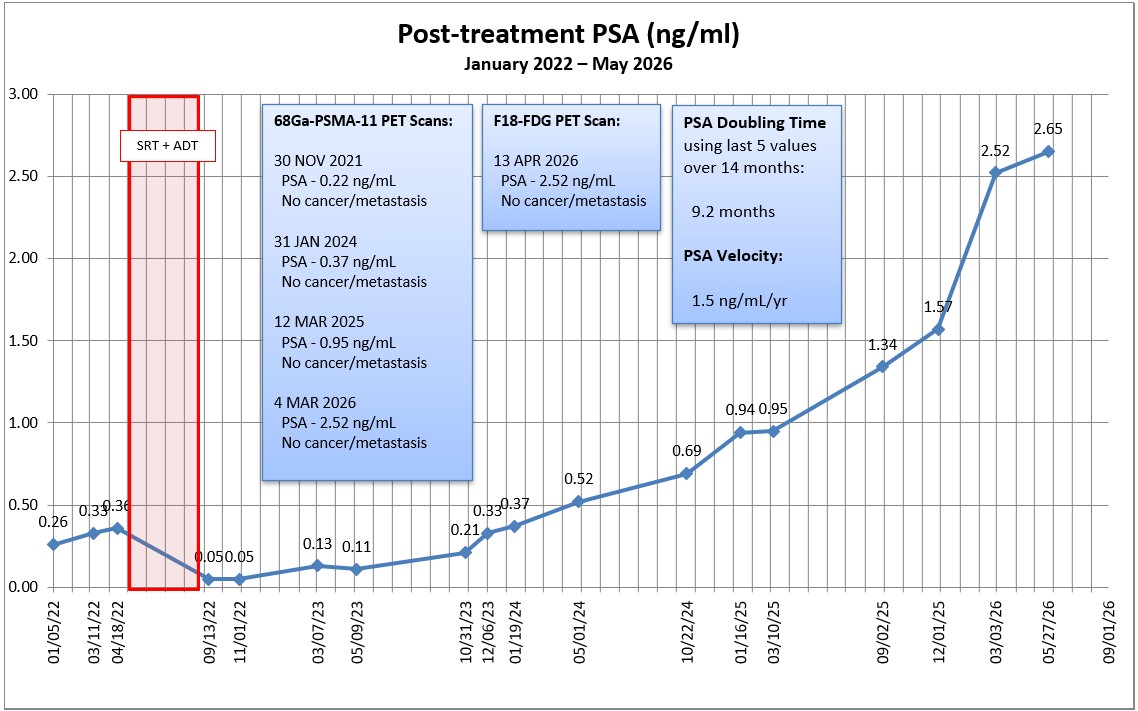
Day 5,677 – PSA Results

I went for my PSA test this morning and already have the results this afternoon (a pleasant surprise).

My PSA increased, but not as much as I expected it to. It went from 2.52 ng/mL in March to 2.65 ng/mL today.

If I use the last five PSA values to calculate PSA doubling time going back 14 months, my PSA DT is 9.2 months. If I use the last four PSA values going back only nine months, it’s 8.0 months. Again, the VA medical oncologist used the nine month PSA DT one of the triggers to start hormone therapy.

Armed with these latest results, I should be ready for my upcoming appointments:

Monday, 1 June – UCSD Medical oncologist

Tuesday, 2 June – VA Medical oncologist

Wednesday, 17 June – Bone density scan to establish baseline

Tuesday, 23 June – VA Urologist

I definitely plan on asking the UCSD MO what his thoughts are on an Axumin scan, and whether it’s worth pursuing before we start hormone therapy. If he agrees, I’ll have to add that to the schedule, too.

I also had another testosterone test done to establish a baseline should I opt to start hormone therapy. It came in at 416 ng/dL (reference range 200-800 ng/dL).


Over the holiday weekend, UCSD sent an automated email asking me to complete their electronic check-in process. Sheesh. It took more than an hour of filling out forms, providing history, and updating insurance. The only thing they didn’t ask for was our family cat’s name from when I was five years old. Hopefully, getting all that taken care of in advance makes the appointment go more smoothly.

More to come. Be well!

Header image: Lake Sara, Effingham, Illnois

Day 5,613 – Doctor Appointment

Those of us of a certain age may remember the “Stump the Band” segment on the Johnny Carson show, where audience members asked the band to play some obscure song. Well, today was my turn at “Stump the Urologist.”

It was a very productive meeting that lasted nearly 40 minutes which was unusual. I came equipped with hard copies of my PSA chart, the MSKCC PSA doubling time (PSA-DT) calculator results, and my list of questions. He was impressed and really pleased with the chart in particular.

We started talking about how my four PSMA PET scans were all inconclusive, and I steered the conversation to whether I might be one of the 10% for whom PSMA PET scans don’t work. He seemed to be a bit skeptical at first, but he also said it was a possibility.

Given that my PSA increased substantially and my PSA-DT was decreasing, I wondered if it would be better to jump into ADT sooner or if there’s still value in trying to find the cancer’s location with imaging. He was of the opinion to continue to try to find it before starting ADT.

I had a series of questions that really dealt specifically with ADT, and he said it was a bit premature to think about those and that they would be better answered by a medical oncologist. I knew that I was jumping the gun with some of them, but I thought I’d ask anyway. During that part of the conversation, I did mention that I tolerated the ADT probably better than most when I had it for my salvage radiation therapy, but that I wasn’t eager to jump into it earlier than necessary.

After that, he took control of the conversation and asked me about my status when it came to sexual function and incontinence, and offered up options to deal with both if I was interested.

Then we returned to the topic of next steps, and that’s where I played “Stump the Urologist.” (Who, by the way, was a full-blown internist and not a resident.) He grabbed my PSA chart and excused himself for a few minutes as he went off to consult with the department head.

When he returned, I was a bit surprised when he put his faith in the results of the PSMA PET scan, saying it has the best sensitivity and the best specificity of any scan out there. He said that they had moved away from the Axumin scans because they were the old technology.

I politely pushed back, reminding him that a PSMA PET scan should have had an 80% – 90% chance of finding my cancer at my PSA level if I had the PSMA protein for the 68-Gallium tracer to lock onto. But if I don’t have that PSMA protein, the sensitivity and specificity of the scan won’t matter because nothing will ever light up. He really couldn’t argue against that.

I went back to the topic of ADT and mentioned that I met with a medical oncologist (MO) two years ago, and received conflicting opinions on when to start ADT. The MO said she would start my ADT when my PSA hit 2.0 ng/mL (a urologist said she wouldn’t start it until there was evidence of metastasis). Today’s urologist said he looks for one of three “triggers” to begin ADT: PSA > 10.0 ng/mL 😲; PSA-DT less than six months; or evidence of metastasis.

I also mentioned that the VA MO that I saw two years ago was a general oncologist and not someone who specialized in genitourinary cancers and, as helpful as she was, she had to consult with a UCSD MO who specifically deals with prostate cancer. I sowed the seed of eliminating the VA MO as a middleman if they have to consistently consult the UCSD doctor (who is highly regarded in the field), and suggested that I could just see him directly. I’m not sure if that will take root.

Finally, I did ask a very basic question given how elusive this has been: Is this even cancer? He said that, if I hadn’t had a prostatectomy, that there might be other explanations for the rising PSA. But he was confident that we are, in fact, dealing with cancer.

That led to a follow-up question of: Is it metastatic? Based on the information we have, he said it’s not. He seemed to squirm a bit when I asked about it being micro-metastatic, because, in his mind, that wasn’t very well-defined.

Before mapping out a plan, I have to admit that my ego puffed up a tad when he said, “You’re the best educated patient I’ve seen in weeks.” He also admitted that my case was a bit puzzling to them and not something they routinely see.

We agreed on three actions:

  • The doctor is going to explore how and where I can get an Axumin scan, and if the VA will authorize it if I have to go outside the VA. That may take a day or two to get an answer. I mentioned that I’d be willing to use Medicare and go out on my own if necessary.
  • He is doing a referral to get me seen by the VA oncology team to get them familiar with my case. I suspect it will take a few days to hear from the scheduler.
  • We do another PSA test in June and meet to see where we’re at.

All in all, this was a good meeting with a robust discussion about my case that has all of us scratching our heads as to what’s going on and what to do next. Frustrating? Yes, to a degree. But, as we discussed during the meeting, nothing is black-and-white in the world of prostate cancer.

More to come.

Be well!


For my readers outside the U.S. who may not be familiar with Johnny Carson, I was going to link a random video clip of his “Stump the Band” segment above and, when I searched YouTube, this—of all clips—was the one that popped up first. I think you’ll see the related humor in it once you watch it. 😂

Header image: Anza-Borrego Desert State Park, California

Day 5,593 – PSA Surprises

I went for my PSA test Tuesday morning and came away with two surprises.

First, I was able to get my results online at 11:52 p.m., Tuesday night (yes, I’m a night owl). I’ve never had the VA turn them around that quickly before.

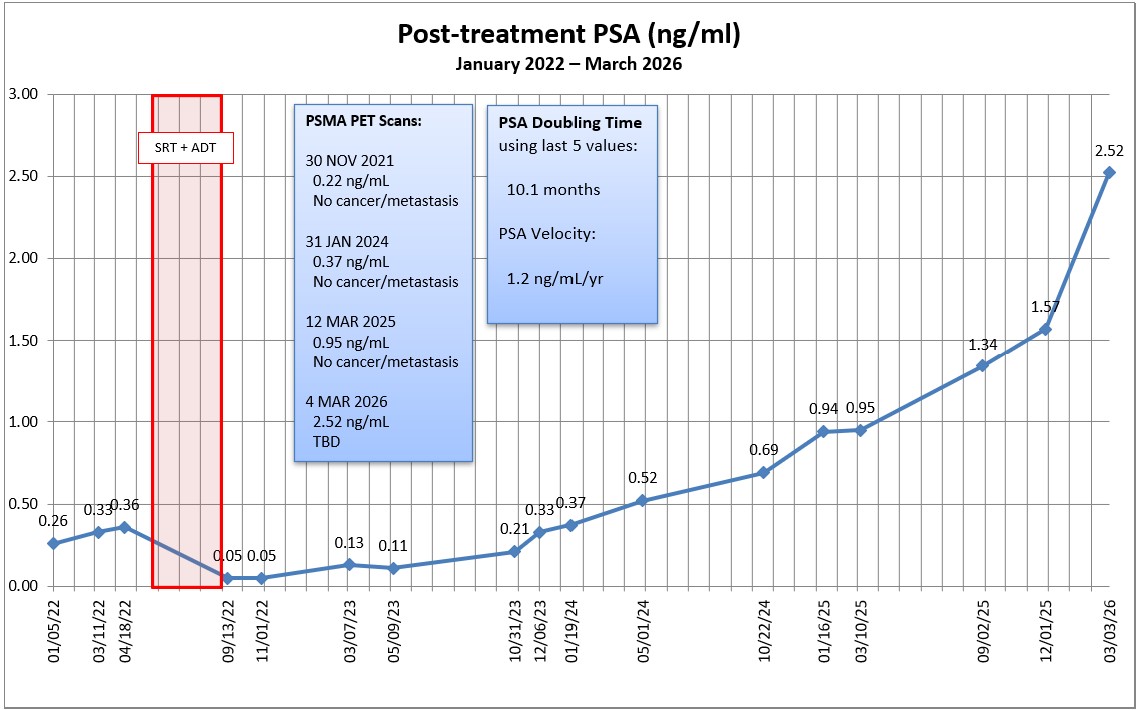
Second, my PSA jumped significantly to 2.52 ng/mL from 1.57 ng/mL on 1 December 2025. That gives a PSA doubling time of 10.1 months using the last 5 readings (back to January 2025).

I expected an increase, but not that much of an increase. On the positive (?) side, that should make finding lesions with my PSMA PET scan in 10 hours much easier. (It’s now 12:30 a.m., Wednesday as I’m typing this.)

I suspect it will take a week or so for my PSMA PET scan results to be posted, and I’ll update once I have them.

Time to turn out the lights and try to sleep.

Be well!

Header image: Sunset near Dateland, Arizona

Day 5,502 – PSA Results

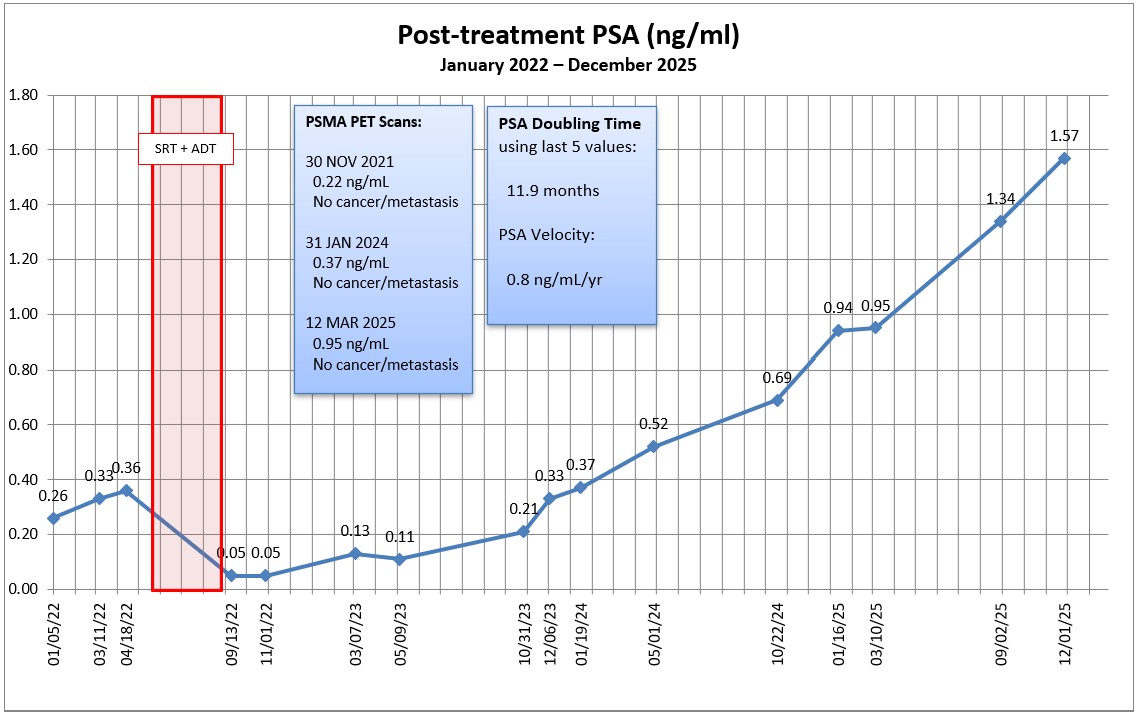
It’s that time again. My PSA came back at 1.57 ng/mL, up from 1.34 ng/mL in September.

PSA doubling time using the last five values increased slightly from 11.5 months in September to 11.9 months now. PSA Velocity went from 0.6 to 0.8 ng/mL/yr.

My appointment to review the results is on 30 December 2025, and I’ll be sure to talk about another PSMA PET scan to see if we can determine what’s going on before we start down the androgen deprivation (hormone) therapy path.


On an unrelated note, I managed to take a little drive through the country from San Diego to visit family in southeastern Wisconsin and back last month. You can check out the full story HERE if you’re bored.

Header image: Utah canyons along I-70

Month 179 – Urologist Discussion

Well, that went about as I expected.

In a nutshell, we’re punting the ball another three months down the road.

The doctor commented on the continuing rise in my PSA and said after consulting with the doctor who saw me last time, said that he wanted to recheck my PSA in six months and “wait a year” for another PSMA PET scan. I should have asked for clarification on that, but I think he was referring to waiting a year after my last PSMA PET scan in March 2025 and not a year from today.

I wasn’t entirely comfortable with waiting another six months, so we agreed to test PSA again in December (three months after my September test) and go from there.

We also talked about spot radiation if anything pops up on the scan. He seemed a bit reluctant for that to be an option, and went straight to starting hormone therapy. It’s as though he was making the transition from curative options to management options, and, to be perfectly honest, I believe I made that transition in my own mind once the salvage radiation failed. That doesn’t mean that I wouldn’t try zapping a lesion or two if they popped up on the scan depending on location (no more zapping to the pelvis and risking further bowel complications).

We did talk about my experience with hormone therapy during the salvage radiation, and the timing of starting it this time around. In that discussion, he brought up the topic of bringing in a medical oncologist at some point depending on the scan results and my PSA test results.

We talked at length about my urinary frequency and some options for that. He suggested some pelvic floor therapy might be beneficial, so I said I’d be willing to give that a try.

Overall, I’m okay with where we’re at and the planned course of action for now. I’ll go for my PSA test in early December, and if there’s another significant jump, I’ll press for the PSMA PET scan to be done sooner rather than later.

My next scheduled urologist appointment is 30 December 2025.

Be well!

Header image: Sunset, Imperial Beach, California

Day 5,410 – PSA Test

I went for my PSA blood draw this morning on the day after our Labor Day holiday weekend. I thought the clinic might be packed, but I was pleasantly surprised. It took 9 minutes from checking in at the kiosk to walking out the door.

I’m guessing that I should be able to access my results online on Friday or Saturday. The trend function on my PSA tracking spreadsheet suggests that my PSA will increase from 0.95 ng/mL back in March to 1.09 ng/mL today. We’ll see if the actual results are anywhere close.

You may recall that my last urologist appointment was on 1 April 2025, and we scheduled the six-month follow-up on 30 September. A few weeks ago, the VA canceled that September appointment and the earliest re-schedule slot was on 30 December. I haven’t called to squeal about that yet because I wanted to see what the results of the PSA test are first.

If the results go from 0.95 ng/mL to 1.0 or so—even the quasi predicted 1.09 ng/mL—it doesn’t seem that urgent and I’ll just email the urologist and have a discussion as to next steps from there. I’ll also look at any changes in PSA doubling time to help determine urgency. But if the results really jump substantially, e.g., 1.4, 1.6, 2.0, etc., then I’ll work to get that 30 December appointment moved up to a much earlier date.

I suspect another PSMA PET (or other) scan may be in my future to see if we can finally determine what’s going on inside of me.

Stay tuned for the results later in the week.

Be well and enjoy this moment of Zen.

Header image: Imperial Beach, California

Day 5,256 – Doctor Visit

I had my post-PSMA PET scan visit with the urologist today, and I wasn’t really sure what to expect going into it.

The doctor (same as last time) shared the scan results saying that they’re something I should celebrate. I mentioned, though, that I have had three scans and were inconclusive despite the rising PSA numbers. He was quick to reply by saying that the scan not showing evidence of prostate cancer or metastasis was conclusive.

I understand where he’s coming from, but until we know where the cancer is, I’m going to have a difficult time accepting that perspective.

I did ask whether there was some sort of test that can determine if my cancer doesn’t express PSMA, and he said that there wasn’t. Something in my pea-sized brain tells me I need to double check him on that.

I also asked if there could be another explanation beyond the cancer that would explain my rising PSA. He ruled out the possibility of some residual prostate tissue being left behind after the surgery as being the cause based on my PSA kinetics over time.

In terms of what’s next, we’re kicking the can six months down the road for another PSA test and follow-up. I was a bit surprised that he wanted to wait six months, and suggested doing the test in three or four months. He was a bit insistent on the six month window. He felt comfortable with my current situation—the slight increase in my last PSA test from the previous one and my PSA doubling time—that waiting six months wouldn’t be a problem. He also argued that having a longer period between tests would better reflect what’s going on.

As we wrapped up, he reminded me that the scan results were good news, and I know that he’s right in that regard. I’ll work on changing my own perspective going forward (even though those little cancer bugs are still doing their thing inside me.)

My follow-up appointment is on 30 September 2025.

That’s it for today. Be well!

Header image: Cherry Blossoms, Japanese Friendship Garden, San Diego, California

Day 5,237 – PSA and PSMA PET Scan Results

I’m so over this.

Click to enlarge

On the whole, the news is good. My PSA just barely bumped up from 0.94 ng/mL in January to 0.95 ng/mL in March and, taking the last five readings, that increased my PSA doubling time from 7.7 months to 10 months.

The PSMA PET scan revealed “no evidence of prostate cancer or metastatic disease.”

So, if the news is good, why am I “so over this?”

I was really hoping that this third PSMA PET scan would bring some clarity as to where the cancer was located so we could know how to proceed—even if it meant revealing metastatic disease. It’s frustrating because we know the cancer is somewhere and because we know the PSA almost tripled between 19 January 2024 and 16 January 2025, but we don’t have enough information to do anything about it. It’s just more waiting in limbo.

Of course, having had three PSMA PET scans all turn up negative makes me question if I’m in that “lucky” category of ten percent of patients whose prostate cancer doesn’t express PSMA, making the scans useless for me. It’s something that I’ll definitely discuss with the doctor at my next appointment on 1 April 2025. I vaguely recall that there’s some sort of genomic test that may be able to assess if I really do fall into that ten percent. I’ll have to do some research on that.

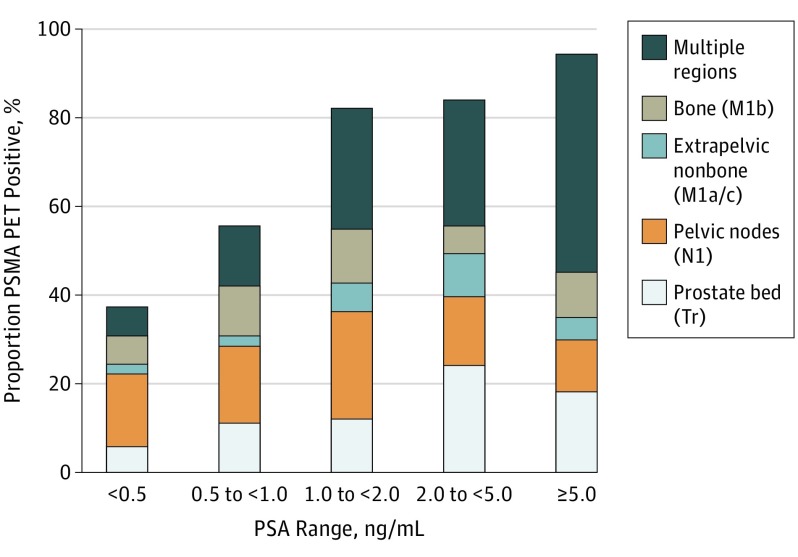
Maybe, too, I’ve placed too much faith in the scan’s ability to detect anything at my PSA level. But with a PSA level hovering around 1.0 ng/mL I thought we would have a decent chance of detecting something (chart below).

Detection Rate on a Patient Basis Stratified by PSA and Region Tr indicates prostate bed only; N1, pelvic nodes only; M1, extrapelvic only. Proportion of patients with 68Ga-PSMA-11 PET positive findings were stratified by PSA range and region of disease in accordance with PROMISE. https://pubmed.ncbi.nlm.nih.gov/30920593/

Needless to say, I’m truly glad that my PSA didn’t rocket even higher and that my scan didn’t light up like Times Square. Having definitive answers, though, would be the icing on the cake.


As far as the PSMA PET scan itself, it was pretty easy and took two hours to go through the entire process. I was instructed to drink 500 ml of water starting 2 hours before the scheduled scan time, and that was the only preparation needed.

I arrived at the hospital at 8 a.m. and was brought back to a radiation-proofed exam room where the technician started and IV at around 8:15 a.m. The 68Ga tracer was ready for injection around 8:40 a.m.

Around 9:30 a.m., the technician brought me back to the scanner where I got positioned on the bed and we began the scan which took 45 minutes. The scanner was very quiet (I could have dozed off) and large enough that it wasn’t claustrophobic. I was out of there by 10:15 a.m. and on my way home. Piece of cake.


On a related note, this was the longest it’s ever taken me to get the PSA test results posted online (hence the delay in this post). I actually called the clinic to get them over the phone because they still weren’t available online today (Thursday). The nurse I spoke with was very helpful and said, “We’re facing staffing issues and, well…” stopping herself in mid-sentence, probably remembering that the call was being recorded and not wanting to make a statement about the current environment for VA employees at the moment. I fear that this may be a precursor of things to come.

Be well!