Month 184 – PSMA Explained & Next Steps

After last week’s PSMA PET scan, I did a little more digging into how the scans work, and why they don’t work for 10% to 20% of patients.

Prostate specific membrane antigen (PSMA) is a protein that’s found in healthy prostate cells, and it continues to exist in prostate cancer cells in most, but not all, cases.

PSMA in Imaging

Researchers found a way to attach a radioactive tracer to the PSMA proteins which would light up when seen in a PET scan, indicating the presence of cancer. Gallium-68 is the most commonly used tracer, with fluorine-18 also being used.

When the tracer is injected into the patient, it seeks out cells that have expressed the PSMA protein and attaches to them. The PET scanner then looks for areas where there is a build-up of the tracer to indicate where the cancer is located.

I’m going to use a grossly over-simplified analogy based on my reading as a lay person.

We all know that magnets are attracted to steel or iron. Imagine that the cancer cells with the PSMA protein are small steel ball bearings, and the radioactive tracer is a bunch of tiny magnets. Inject the magnets into your system, and they go in search of the steel ball bearings. When they find them, they attach, and the PET scan can see where all the magnets are located.

But for those patients whose cancer cells do not have the PSMA protein, that essentially means that the cancer cells are plastic balls, and the magnets that were injected will never attach to them. The PET scan won’t see any build-up of magnets/cancer cells.

Based on my experience with four PSMA PET scans, I believe that I’m in that 10% group and that my cancer cells do not express the PSMA protein—they’re the plastic balls.

PSMA in Treatment

In addition to using PSMA positive cells for imaging purposes, researchers have also recently developed a treatment that uses the PSMA positive cells. It goes by the brand name Pluvicto, but also known as Lutetium-177–PSMA-617.

It’s only used on patients with castration-resistant prostate cancer that have PSMA proteins.

The difference between using gallium-68 or fluorine-18 and lutetium-177 is that the lutetium is a radioactive material that attaches to the PSMA protein cells and delivers beta particle radiation to kill the cells.

This means that for those patients whose cancer doesn’t express the PSMA protein, this treatment option would not be available.

Alternative Imaging

On the good news front, there are other imaging options out there, one of which is Axumin (18F-fluciclovine). Instead of targeting PSMA in the cancer cells, it looks at the amino acids.

Axumin scans aren’t as sensitive as PSMA PET scans, but they are more sensitive than choline-11 scans.

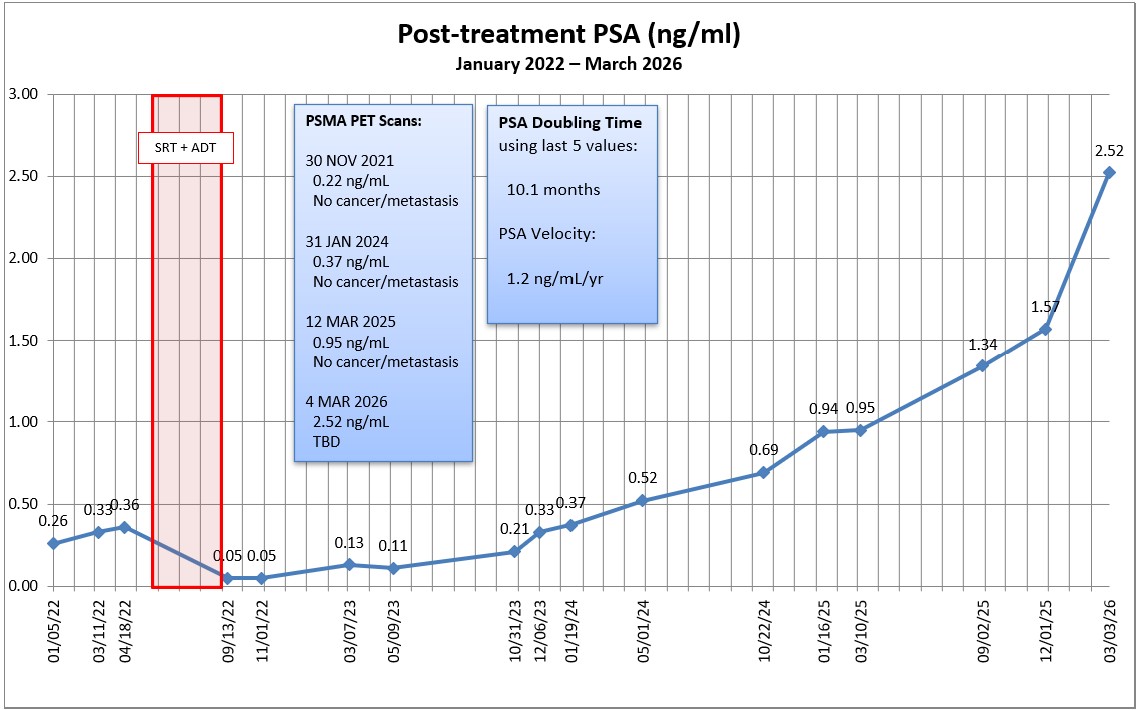
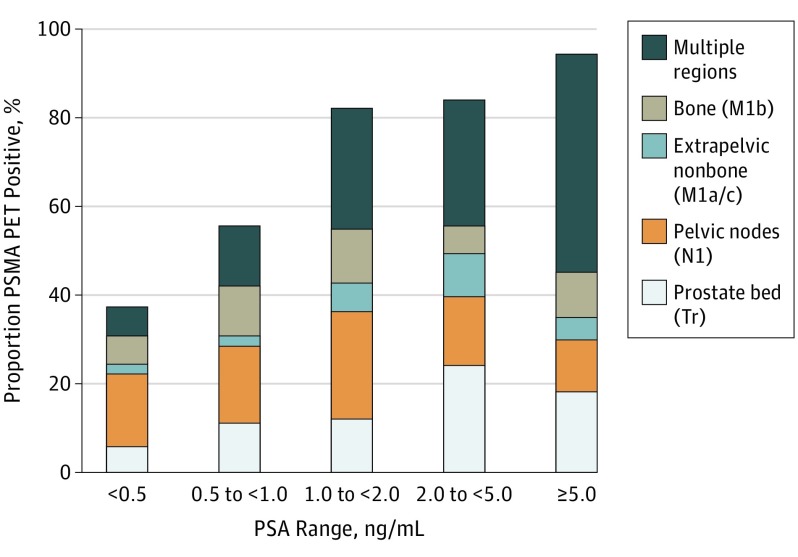
At my current PSA level (2.52 ng/mL), the Axumin scan should have a decent chance of finding something.

In a conversation in a prostate cancer forum, I learned that one patient had used the gallium-68 tracer for his PSMA PET scans with the same results as mine, but they switched to PYLARIFY (piflufolastat F 18) as the tracer (which also attaches to the PSMA) and found four lesions using the different radiotracer. I know that one anecdotal case doesn’t mean much, but it’s something I can ask my team about.

Skip Imaging?

You may recall that, at one point, I had conflicting guidance from the urologist and oncologist on when to start androgen deprivation (hormone) therapy (ADT). One said when we saw metastasis, and the other said when my PSA hit 2.0 ng/mL. Clearly, I’ve passed the 2.0 threshold with my latest PSA results.

I went back and recalculated my PSA doubling time using only the last four values dating back to 10 March 2025. (The fourth and fifth values that I used before are 0.94 (January 2025) and 0.95 (March 2025), so having them so close may have skewed the results a little. When I used all five data points, my PSADT was 10.1 months; when I use the last four data points, it’s 8.9 months.

Given I’m past the PSA threshold (for one doctor) and the fact my PSADT is less than 10 months, I’m also wondering if there’s any value in continuing in the efforts to try and find the lesions. Or is is better, given how my PSA is increasing, to go ahead and just resign myself to the fact that I have micrometastases someplace and start the ADT sooner rather than later? In the time that it takes to schedule another scan, regardless of the type, my PSA could be well over 3.0 and even pushing 4.0.

That leads me to another question. If we do start the ADT and it knocks my PSA down to <0.1 like it did when I had it for salvage radiation therapy, does that mean that scans wouldn’t be able to locate the cancer while on ADT?

To my way of thinking, knowing where the cancer is at is important, even if it means letting the PSA run unabated for a short while longer. But what the hell do I know? I’m all ears for experiences from others that may have been in the same or similar situation.

Summary

Again, this is my lay person interpretation of things that I’ve researched, so please take this with a pound of salt. If you know I’m wrong on my interpretation, please let me know and provide references as to why I’m wrong. I want to learn.

You can rest assured, though, that this will be a part of my conversation with my team on 24 March.

Stay tuned for more.

Be well.

Header image: Desert wildflowers, Anza-Borrego Desert State Park, California

Day 5,593 ¾ – Scan Results

In the hour or so since my last post, my scan results were posted online:

“No evidence of recurrent prostate cancer or metastatic disease.”

<Sigh>

Needless to say, I have mixed emotions about these results.

I just want an explanation so that we can figure out next steps. After four scans with the same results, I’m of the mindset that I’m in the 10% of patients for whom PSMA PET scans don’t work.

You can bet I’ll be talking about other imaging options during my upcoming appointment, as well as any other plausible explanations for what’s going on.

At this point, I’m tired, frustrated, and stymied.

Day 5,593 ½ – Scan No. 4 Completed

My fourth PSMA PET scan is in the books. If I keep this up, I should join a PSMA PET scan loyalty club—have five scans and get the sixth one free.

It started with me drinking 500 ml of water two hours before the the scan. On arrival, I was weighed (I guess to help calculate how much Gallium-68 to inject?), and the tech started an IV. He walked away and wheeled in a cart with a small, lined box containing the injection syringe, and pushed the glow juice into my arm through the IV.

Once the juice was in, he removed the IV, and I leaned back in my recliner for the hour-long wait for the juice to make its way through my system. At the end of the hour, we headed to the scanner room where I emptied my pockets, jumped on the scanner table, and got strapped in so my arms wouldn’t move.

The scanner wasn’t claustrophobic for me, and it took 41 minutes to run up my body (they start at the thighs and work their way up to the head).

When I was through, I hopped off the table, collected my things, and headed home.

I have to admit that when I walked out of the hospital, I was really surprised by how much my body and mind unwound from the apparent subconscious nervous tension I was harboring. Going into it, I didn’t seem fazed by it all. It was routine for me. Heck, I’m on a first-name basis with the nuclear medicine tech (we’ll call him Sam) because he’s done all three of my scans at the VA. But apparently my subconscious had a different experience. Oh well. Nothing a good nap won’t cure.


I asked Sam how quickly the results would be available, and he said it could be as soon as this afternoon, but within 48 hours if they’re not.

From my previous scans with Sam, I’ve learned to not even think of asking him if he saw anything of concern during the course of the scan. He resoundingly (and rightly) always answered that it’s up to the doctor to interpret and provide the results.

I’ve also come to know that, for Sam, bedside manners seem to be optional. He’s not unprofessional in any way, but he is all business and sometimes even borders on the grumpy side. As I was leaving, Sam said something in such a way that he let his tough façade down. His voice became just a hint softer as he said, “You take care now” in a caring way.

Of course, that caught my attention and got my mind racing. I’m really, really, really trying not to read too much into that and get ahead of the actual results, but he said it two more times before I left. That makes me wonder what he saw that may have changed his demeanor.

Of course, my exhausted Gallium-68-infused brain may be making all this crap up, and I may get a good laugh out of it in a day or two. Or not.

As usual, stay tuned for the next chapter in this saga. I have my appointment to go over the results on 24 March.

Be well!

Header image: Anza-Borrego Desert, California

Day 5,593 – PSA Surprises

I went for my PSA test Tuesday morning and came away with two surprises.

First, I was able to get my results online at 11:52 p.m., Tuesday night (yes, I’m a night owl). I’ve never had the VA turn them around that quickly before.

Second, my PSA jumped significantly to 2.52 ng/mL from 1.57 ng/mL on 1 December 2025. That gives a PSA doubling time of 10.1 months using the last 5 readings (back to January 2025).

I expected an increase, but not that much of an increase. On the positive (?) side, that should make finding lesions with my PSMA PET scan in 10 hours much easier. (It’s now 12:30 a.m., Wednesday as I’m typing this.)

I suspect it will take a week or so for my PSMA PET scan results to be posted, and I’ll update once I have them.

Time to turn out the lights and try to sleep.

Be well!

Header image: Sunset near Dateland, Arizona

Month 183 – Flu Bug

The next time I come down with the flu, I’ll be sure to send out some insider trading information: Buy stock in incontinence pads, ASAP.

Just over three weeks ago, the flu bug came home to roost, and it kicked my ass. Chills, aches, fever, and coughing. Lots and lots of coughing. The worst symptoms lasted about eight days, but the coughing remained after the chills, aches, and fever were gone.

Of course, coughing is one of my stress incontinence triggers. A small, light cough, and I can hold my own. But these were heavy, cough-up-your-toenails coughs which caused significant incontinence issues. It sucked. I was going through multiple incontinence pads each day and night.

A friend had the same bug back in December, and she said it took three weeks for the coughing to subside. That seems to be my experience, too. I’m finally just about back to normal.

Oh well. I survived and it’s behind me.


In three weeks, I’ll go for my next PSA test (2 March) and the PSMA PET scan (4 March). It will be interesting to get the results of both.

I’m hoping that the PSMA PET scan shows something this time. My last PSA on 1 December 2025 was 1.57 ng/mL, and I’m guessing this one will be approaching the 1.7 to 1.9 range. At that PSA level, there should be a slightly better than 80% chance of finding something.

An old boss was known for saying, “If you can’t stand the answer, don’t ask the question.” As eager as I am to have an answer, I’m not so sure how I’ll respond if the answer comes back, “It’s metastasized.” Logically, I know that’s the likely next step in the progression. Psychologically—emotionally—I’m trying to prepare myself for that possibility.

Yes, I know that hormone therapy and other advanced treatment options will be able to keep me around for a long time even if it has metastasized, so I’m not worried about keeling over in the next six months. I guess it’s the fact that I’ll have passed a point of no return, and my future will become a balancing act between slowing the cancer’s spread and maintaining a decent quality of life. C’ést la vie.

Of course, if the PSMA PET scan comes back without any evidence of cancer or metastasis, it may be time to try a different imaging method. That will kick this can a few more months down the road.

With luck, it will all come together when I meet with the urologist on 24 March and we go from there.

Be well!

Header image: Silver Strand State Beach, Coronado, California

Month 182 – PSMA PET Scheduled

I held off on this post until I was able to get my PSMA PET scan scheduled this week.

I had been playing phone tag with the scheduler and, when I finally got to speak with him, I learned that they normally don’t schedule until 30 days in advance of the request date. Because the order for the scan said March, they weren’t going to call until next month. Fortunately, because we were already on the phone, the scheduler went ahead and put me on the calendar for 4 March 2026.

That should give enough time to interpret the results before my 24 March appointment with the urologist. I’ll go for a PSA test just before the scan on 2 March.

I continue with my pelvic floor physical therapy every other week. I’m not sure that it’s been having an effect on my incontinence, so I’ll have to ask how long it takes before I have any truly noticeable improvement.

Other than that, there’s not much else to report. Just another day living with prostate cancer.

Be well.

Header image: Anza-Borrego Desert, California

Day 5,522 – Urologist Appointment

Late last week, I received a text message asking if I would like to move my urologist appointment from 30 December to today, 23 December, and I agreed.

My appointment was at 3:15 p.m., and I arrived around 2:45 p.m. As I’m walking up to the check-in kiosk, my cell phone rings, and it was the urology department wanting to confirm that I’d be there. That’s the first time that that’s happened, and I told the nurse that I was checking in as we spoke. “Great! We’ll come out and get you.” Apparently, they were antsy to get out of there early on the day before Christmas Eve. So was I.

The head of the department was the one who saw me this time, and we had a really good conversation. Some of the key takeaways:

  • She was concerned about the increase in my PSA but not panicked, even initially suggesting we just continue to monitor it.
  • We talked at length about doing another round of imaging to see if we can determine the location of the cancer.
  • We agreed to do another PSMA PET scan, and we negotiated doing one in March 2026. (She thought that Nuclear Medicine might push back on doing one sooner, i.e., within a year, as the last one I had was in March 2025.) She also mentioned the possibilities of other imaging should the PSMA PET scan come up with no evidence of cancer/metastasis for the fourth time.
  • We talked about the timing of starting androgen deprivation (hormone) therapy. She wouldn’t start it until there was evidence of metastasis, but was open to starting it earlier if I really wanted to do so.
  • Lastly, we reviewed my stress incontinence and nocturia issues and talked about my pelvic floor physical therapy.

It was one of the more thorough discussions that I’ve had at the VA, and I’m okay with the plan coming out of the meeting. I’ll go for another PSA test on 1 March; hopefully get the PSMA PET scan scheduled in early March; and have a follow-up with the urologist on 24 March.

I’m glad I got this out of the way before the holiday. I’ve got my answers, plus it frees up next week for me to go out an play if I want.

Merry Christmas, Happy New Year, and be well!

Header image: Hotel del Coronado at Christmas, Coronado, California

Month 181 – Physical Therapy for Incontinence

I’m of the mind that PT stands for Pain & Torture, not physical therapy. (Okay. I exaggerate.)

During my appointment with the urologist back on 7 October, we talked about how my incontinence seemed to be slowly worsening post-radiation. One of the options that he offered up was pelvic floor therapy, and I decided to give that a try.

Unfortunately, the VA doesn’t offer that therapy in-house, so they had to arrange for community care. That process took until mid-November to get the appointment set up, and I just had my first appointment last week.

I was expecting more instruction on Kegel exercises, perhaps with the biofeedback device that they used on me pre-surgery to train me on how to do the exercises. But that’s not what’s happened so far.

The physical therapist explained that many of the muscle groups in your legs and torso can have an impact on your pelvic floor muscles, too, as they’re all connected as part of a larger system. By stretching and strengthening them, we could see improvements in the pelvic floor. At first, it sounded like a bit of phooey to me, but I’m approaching this with an open mind and giving it a shot.

I’ve had just two sessions so far, and we’ve focused mainly on stretching exercises impacting my hamstrings, glutes, calves, and torso, as well as doing squats and walking on a treadmill. Some of the stretches are bordering on turning me into a contortionist, which this soon-to-be 68-year-old body is fighting tooth-and-nail (hence, “Pain & Torture”). But they’re low impact and we’re taking it slowly so I don’t injure myself.

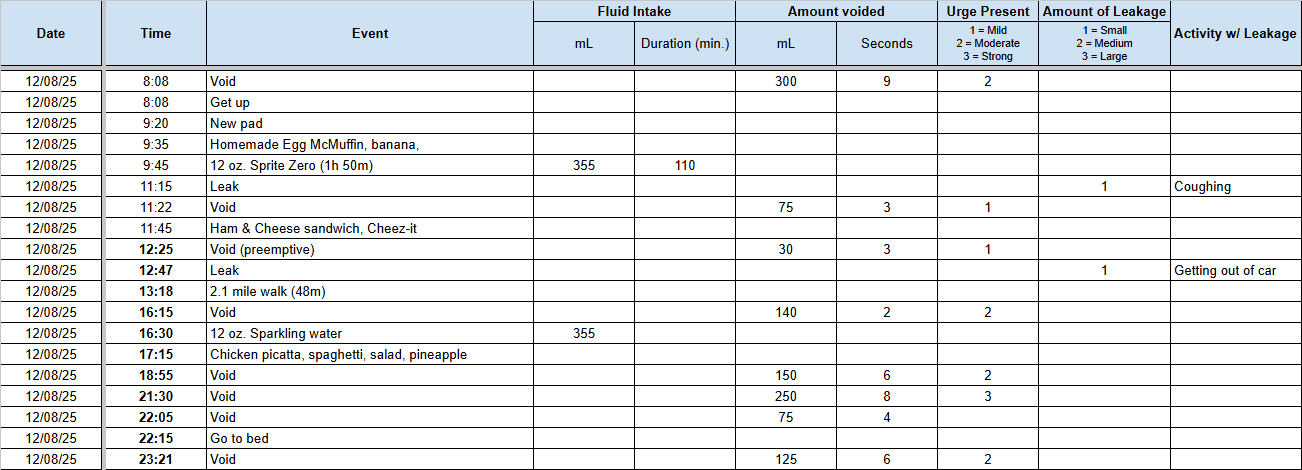
The other thing that she had me doing was documenting my fluid intake, output, and number of incontinence leaks for at least three days. We’re trying to establish a baseline against which we can measure any improvements. She had a hardcopy log which I quickly converted into a tracking spreadsheet. (You know I had to!)

She also made some recommendations to improve my diet and the types/quantities of beverages that I consume (less soda, more water).

Of course, I have to keep up with these exercises daily at home.

On the one hand, I’m a bit skeptical about this approach but, on the other hand, I do feel as though that, even after one week, I’ve noticed that I seem to be having fewer leak episodes and, the ones that I do have, seem to be smaller in size. We’ll let my spreadsheet determine if there’s a true trend, or if this is all in my head.

I have another appointment next week and then, in the new year, she mentioned that we might cut back to every other week sessions or even monthly sessions, depending on the progress that’s made.

One thing that I am a little concerned about is the potential cost of this.

Yes, the VA is covering the costs, but what many don’t realize is that some of us, based on our eligibility criteria, have to pay co-pays for our visits. Seeing the specialists—including the urologist—costs $50 per visit. Seeing a PT every week would rack up significant costs over time, and I’m not sure if the VA has an out-of-pocket cap on how much a veteran pays. (I’ll have to check into that.)

Assuming the holidays don’t mess it up, my appointment with the urologist to review my PSA results is on 30 December. We’ll definitely be talking about another PSMA PET scan and getting medical oncologists involved in my case.

—Dan

Header image: Botanical Building in holiday lights, Balboa Park, San Diego, California

Day 5,502 – PSA Results

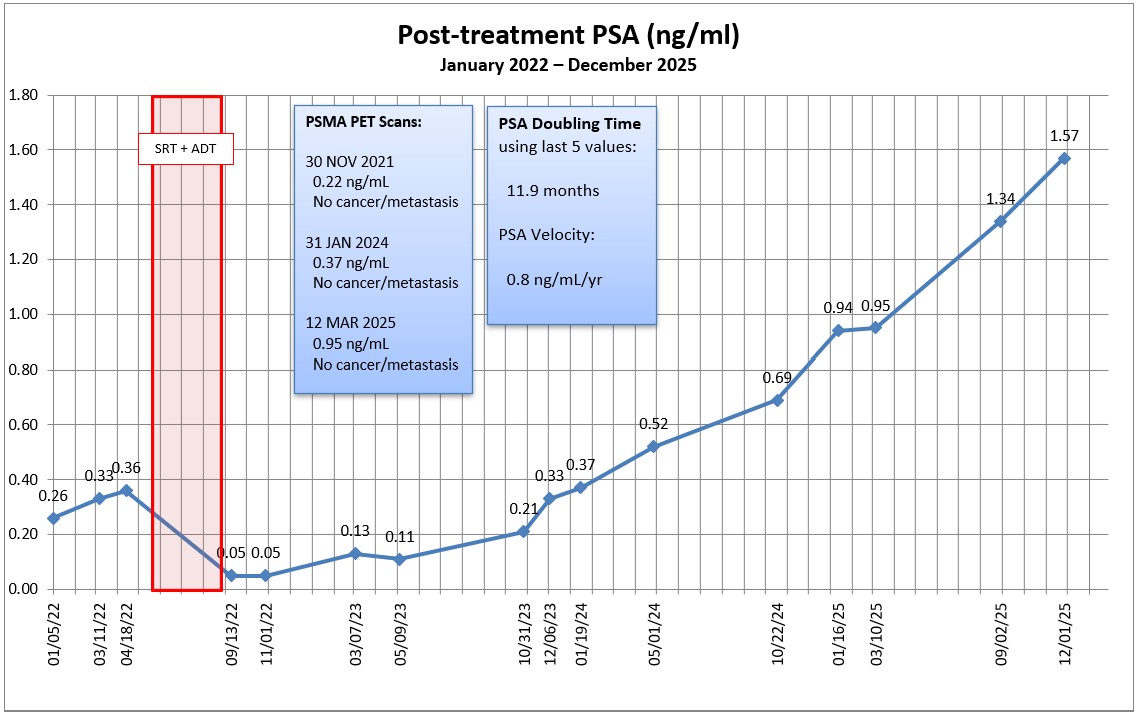
It’s that time again. My PSA came back at 1.57 ng/mL, up from 1.34 ng/mL in September.

PSA doubling time using the last five values increased slightly from 11.5 months in September to 11.9 months now. PSA Velocity went from 0.6 to 0.8 ng/mL/yr.

My appointment to review the results is on 30 December 2025, and I’ll be sure to talk about another PSMA PET scan to see if we can determine what’s going on before we start down the androgen deprivation (hormone) therapy path.


On an unrelated note, I managed to take a little drive through the country from San Diego to visit family in southeastern Wisconsin and back last month. You can check out the full story HERE if you’re bored.

Header image: Utah canyons along I-70

Fifteen Years

It’s been fifteen years since I was told those three little life-altering words on 11 November 2010: You have cancer.

The good news is that I’m still here and able to write about it. The bad news is that I’m still writing about it. (I want a refund.)

Fifteen years of being poked and prodded. Fifteen years of being scanned and zapped. Fifteen years of riding an emotional roller coaster waiting for the next test or scan result. Fifteen years of researching far more than I ever imagined researching. Fifteen years of making decisions that impact the quality and quantity of my life, and hoping they were the right choices.

In other words, fifteen years of fun. <sarcasm font>

On the positive side, it’s fifteen years of getting to know how strong I can be. It’s fifteen years of adapting to new circumstances and making the best of them. It’s fifteen years of learning to not look back and question decisions already made. It’s fifteen years of forming new relationships with those in the same boat. Most important, it’s fifteen years of waking up every morning and starting a new day when so many others with this disease didn’t get that option.

And, because I valued others with prostate cancer sharing their experiences, it’s fifteen years of telling my story via a silly little blog that I had no idea would keep going for this long. Mind-blowing. Helping others by sharing my story was my way of making lemonade out of lemons.

In three weeks I’ll have my next PSA test. Hopefully, with the follow-up appointment on 30 December, we can map out the next steps to keep me around for another fifteen years.

Finally, sincere thanks to every one who has supported me over the last fifteen years. I appreciate it more than you know.

Be well.

Header image: Milford Sound, New Zealand