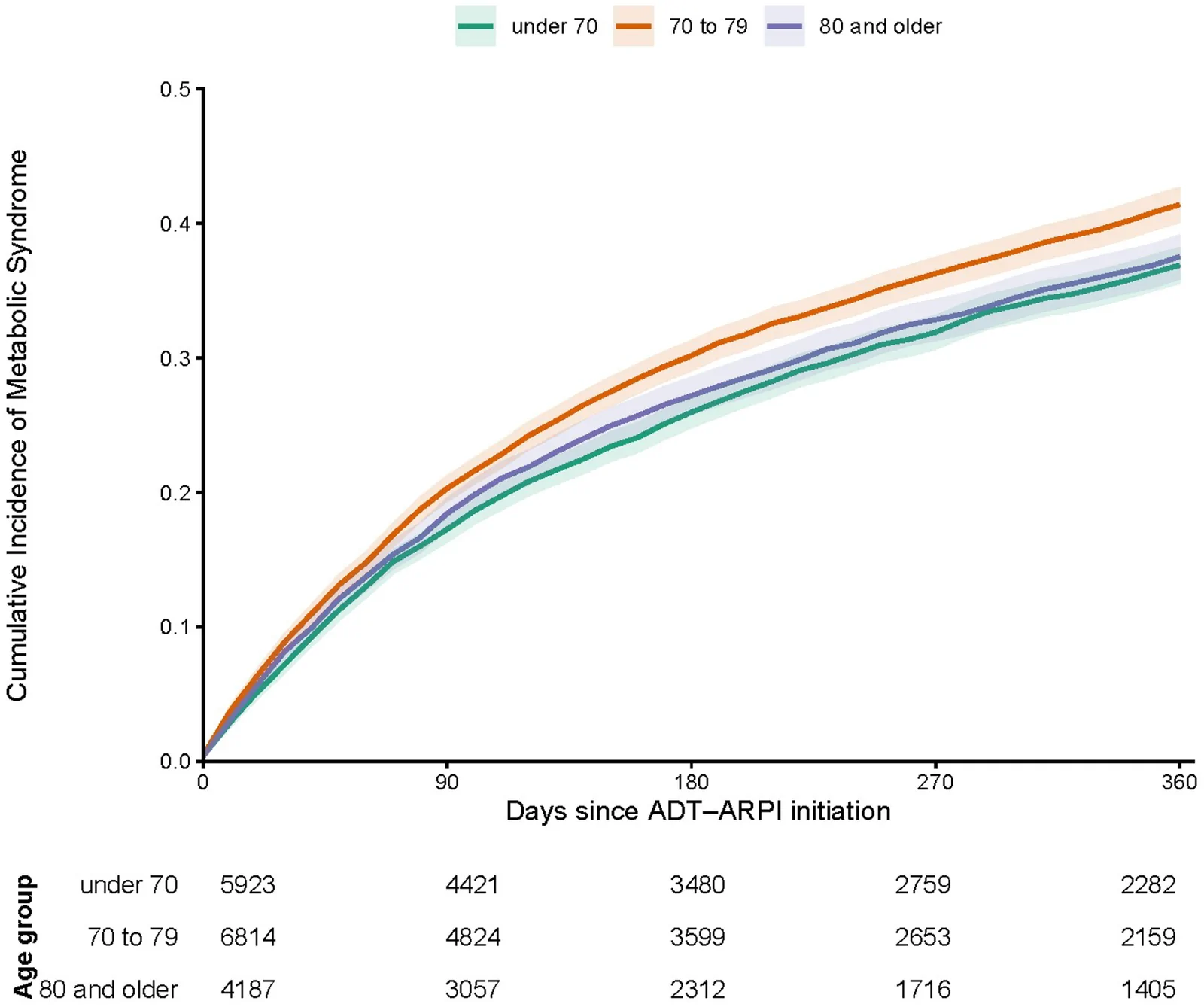
Well, it didn’t take long for last week’s mini vacation to the Eastern Sierra to chase autumn colors to wear off. This article—a distilled version of the original paper—appeared on one of my timelines shortly after I returned. It shows how quickly and how pervasively some of the significant metabolic side effects of ADT + ARPI therapy appear.
Dyslipidemia (unhealthy or unbalanced level of lipids (fats), such as cholesterol or triglycerides, in your blood)
It’s interesting to see that, within 90 days of starting the combination ADT + ARPI therapy, about 15% to 20% of men are experiencing one or more of these side effects, and that number only grows over time, reaching nearly 35% to 40% after a year on treatment.
Cumulative incidence of metabolic syndrome following initiation of concurrent ADT and ARPI therapy, by age group
Shaver AL, Zarrabi KK, Nikita N, Sharma S, Wen KY, Lu-Yao G. Metabolic Dysfunction After Initiation of Androgen Receptor Pathway Inhibitors in Prostate Cancer. JAMA Oncol. 2026 Aug 13:e262790. doi: 10.1001/jamaoncol.2026.2790. Epub ahead of print. PMID: 42593785; PMCID: PMC13474095.
“Hypertension was the most frequently documented outcome,” and that concerns me a bit, as I’m already being treated for hypertension. My blood pressure is currently averaging 106/76, so it’s well-managed on my current treatment plan. It’s a discussion that I’ll have to have when we get to that decision point.
A good follow-up study to this one would be to track how quickly and how far these metabolic syndrome side effects dissipate—if at all—once ADT + ARPI is stopped (i.e., during a hormone therapy holiday).
Be well!
Header image: Minarets near Mammoth Lakes, California
With more trials showing that starting ADT + ARPI hormone therapy early has significant benefits, it’s important to look at the gap between the efficacy and Quality of Life outcomes found in the trials versus what’s happening in the real world.
It’s an interesting discussion that makes you approach starting ADT + ARPI more cautiously.
I overachieved on this post. Normally, reporting PSA results would be quite simple and short. Not this time. The act of writing helps me organize my research and rationalize treatment decisions. Thanks for your indulgence!
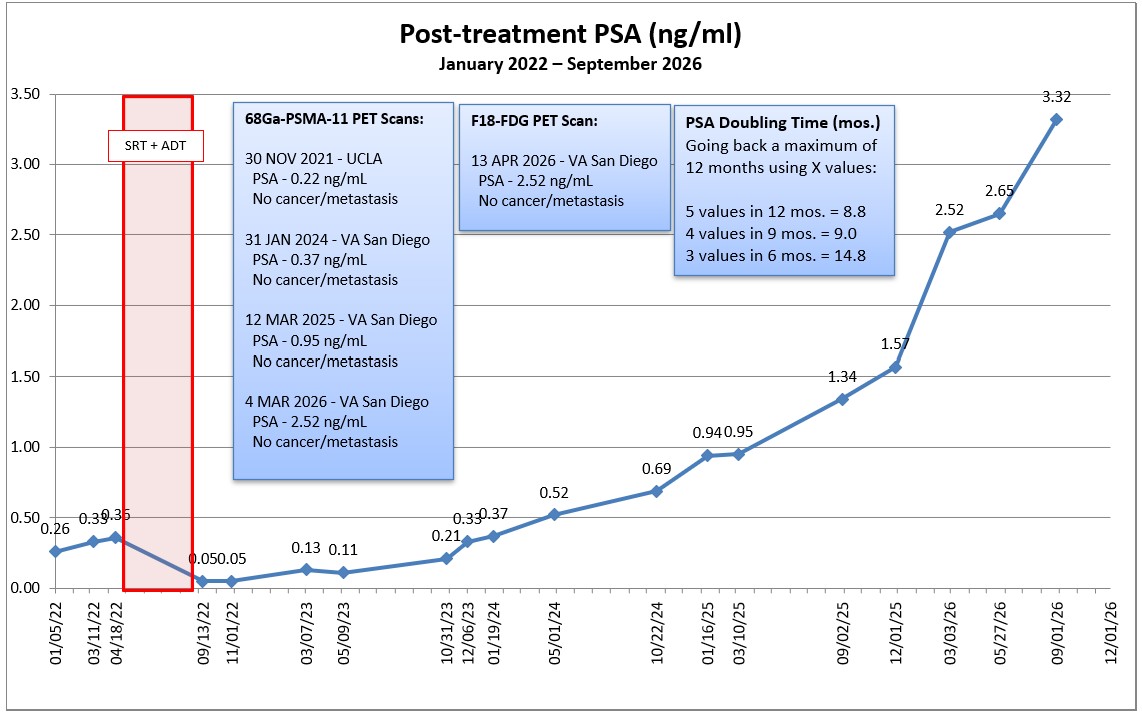
I went for my PSA test this morning, 1 September, and it was 3.32 ng/mL, up from 2.65 ng/mL back in May.
I expected my PSA to go up, and I guessed it would be around 3.0 ng/mL, so the amount it went up was a bit of a surprise. It’s closing in on my PSA level at initial diagnosis, 5.0 ng/mL.
PSA Doubling Time
Seeing as both the VA and UCSD medical oncologists (MO) stressed the importance of using PSA doubling time (PSADT) to guide treatment decisions during my meetings with them in June, I really wanted to try to nail down how it should be calculated.
The Memorial Sloan-Kettering PSADT Calculator is a great tool that I’ve been using, but it doesn’t provide any guidance on how many data points should be used over what period of time. I finally found some definitive guidance:
PSA values need not be consecutively rising and all values obtained over a maximum period of 12 months should be included in the calculation. The maximum period of the past 12 months is recommended to reflect the patient’s current disease activity, since in some men PSADT may change over time. Minimum requirements for the calculation are 3 PSA values obtained over 3 months with a minimum of 4 weeks between measurements.1
You can see that I’m sitting right around that nine-month PSADT point that’s the suggested trigger for action. I’m going to keep my mouth shut and ask my MO to calculate the PSADT and see what number they come up with.
Obviously, I’m concerned, but not panicked by this jump in my PSA. I’ll email the MO to see if we should stick to the current plan of having a CT scan on 23 November, or move it to an earlier date. Or to have another PSMA PET scan. In my mind, I’d like to have at least one more scan to try and see if we can determine what we’re dealing with before leaping into combination hormone therapy.
Combination Therapy
The MO’s were really encouraging action if my PSADT was nine months or less because, with faster doubling times, there is high risk of metastasis and prostate cancer-specific mortality. The action that they’re recommending is intermittent combination therapy using androgen deprivation therapy (ADT) plus an androgen receptor pathway inhibitor (ARPI). The specific drugs they’re recommending are Eligard® (leuprolide acetate) (ADT) and Xtandi® (enzalutamide) (ARPI). The Eligard® would stop the production of testosterone, and the Xtandi® would block the cancer cells from absorbing testosterone.
The reason that the MOs want to use the combination therapy is because of the results that were shown in the EMBARK trial. Using Eligard® and Xtandi® together had 87.3% of patients in the trial reach the five-year point metastasis-free. Using just Eligard® alone—the old standard of care—just 71.4% of patients were metastasis-free at five years. The combination therapy won’t prevent progression to metastasis; it just slows it down. This short (2 min.) video from the New England Journal of Medicine gives a good overview:
The combination therapy would be given intermittently, with nine months on the medication and, if my PSA drops to a certain level (usually below 0.2 ng/mL) and stays there, there wouldn’t be a need to restart the combination therapy until there’s a rise in my PSA.
The one thing that I couldn’t find or confirm in my research was if there was a specific PSA level where, if you exceed it, this combination therapy should be started. The UCSD MO seemed okay with waiting until it was as high as 5 to 10 ng/mL if the PSADT didn’t indicate high risk.
Xtandi® (enzalutamide) is just one of several drugs known as Androgen Receptor Pathway Inhibitors (ARPIs). Two others that are commonly used include ERLEADA® (apalutamide) and NUBEQA® (darolutamide). Each has its own similar, but slightly different side effects.
Side Effects / Adverse Events
Messing around with your hormones can have substantial and sometimes debilitating side effects and, when using combination therapy, they can be additive. The National Cancer Institute has defined five grades of adverse events based on their severity:
Grade
Impact
Grade 1
Mild; asymptomatic or mild symptoms; clinical or diagnostic observations only; intervention not indicated.
Grade 2
Moderate; minimal, local or noninvasive intervention indicated; limiting instrumental ADL or mild/moderate impact on age appropriate normal daily activity (pediatric)*.
Grade 3
Severe or medically significant but not immediately life threatening; hospitalization or prolongation of hospitalization indicated; disabling; limiting self-care ADL or severe impact on age appropriate normal daily activity (pediatric)**
Activities of Daily Living (ADL): *Instrumental ADL refers to preparing meals, shopping for groceries or clothes, using the telephone, managing money, etc. **Self-care ADL refers to bathing, dressing and undressing, feeding self, using the toilet, taking medications.
Clearly, a patient would want to steer clear of any Grade 3 or 4 side effects if possible. When you look at the grades of adverse events in the summaries of each of the drugs below, you’ll see that the percentages of patients experiencing an adverse event at all grade levels can be quite high in some cases. Bottom line: ADT + ARPI will adversely impact you and your quality of life in some shape or form. It’s just a matter of degrees.
Some of the possible, more severe side effects include:
Heart disease, stroke, or mini-stroke
Fractures and falls
Lung problems
Seizures
Severe skin reactions
And you can see what percent of the time that patients experienced some of these side effects by adverse event grade in section 6.1 of the prescribing information HERE or in these tables HERE. Some of the Grade 3 or 4 adverse events occurred as much as 8% of the time.
Some of the possible, more severe side effects include:
Heart Disease
Seizure
And you can see what percent of the time that patients experienced some of these side effects by adverse event grade in section 6.1 of the prescribing information HERE. Some of the Grade 3 or 4 adverse events occurred as much as 4% of the time.
Some of the possible, more severe side effects include:
Seizure
Posterior Reversible Encephalopathy Syndrome (PRES) (Involves the brain with seizure or quickly worsening symptoms such as headache, decreased alertness, confusion, reduced eyesight, blurred vision or other visual problems)
Allergic reactions
Heart disease
Falls and bone fractures
Swallowing problems or choking (because of the size of the pills)
And you can see what percent of the time that patients experienced some of these side effects by adverse event grade in section 6.1 of the prescribing information HERE. Some of the Grade 3 or 4 adverse events occurred as much as 9% of the time.
Some of the possible, more severe side effects include:
Heart attack
Elevated blood sugar and increased risk of developing diabetes
Convulsions
And you can see what percent of the time that patients experienced some of these side effects by adverse event grade in section 6.1 of the prescribing information HERE.
Anecdotal Side Effect Experiences
One of the side effects that isn’t specifically mentioned above was cognitive decline. In a study, it was shown:
Patients with advanced prostate cancer treated with enzalutamide (Xtandi) had a significantly greater decline in cognitive function compared with those who received darolutamide (Nubeqa), according to results from a phase II trial.
Median cognitive change in the maximally changed cognitive domain (MCCD) from baseline to 24 weeks was -15.8% for those receiving darolutamide versus -36.1% for those receiving enzalutamide (P=0.009), reported Alicia Morgans, MD, MPH, of the Dana-Farber Cancer Institute and Harvard Medical School in Boston.2
I’m a member of an online support forum for advanced prostate cancer on HealthUnlocked, and one of the common themes of other patients who have been on Xtandi® (enzalutamide) is significant “brain fog.” Many had such severe side effects that they stopped taking Xtandi® (enzalutamide), with one patient calling it “poison.”
Now, I take what’s said in forums like that with more than a grain of salt. There’s definitely some selection bias going on—patients who are having difficulties with their treatments are more likely to talk about them in a forum than those whose treatments are going well. We just don’t know how many are out there who have minimal side effects and tolerate the treatments well.
Drug Interactions
I surprise medical professionals when they ask me to list my current prescriptions because I only have one: amlodipine to manage hypertension. I checked on Drugs.com to see if any of the four drugs above will interact with the amlodipine:
Because a well-known side effect of ADT is osteoporosis/bone density loss, patients are usually given calcium and vitamin D supplements to slow or minimize the loss. Interactions with calcium and vitamin D:
Clearly, we’re going to have to have a discussion about the amlodipine before starting anything because it has made a difference. My systolic number has dropped by 33 points and my diastolic number has dropped by 24 points. Part of that may be the amlodipine, and part may be the fact that I’ve lost 44 lbs. / 20 kg since starting the amlodipine (or both).
Timing of Starting ADT + ARPI Therapy
You may recall back in April, I shared an AnCan Foundation video of a seminar featuring Dr. Ravi Madan and Dr. Melissa Abel from the National Cancer Institute (NCI). In it, they raise the notion that with new PSMA PET scans, we may be moving too quickly to treat biochemically recurrent prostate cancer and may be overtreating patients, subjecting them to the side effects of ADT either unnecessarily or prematurely.
From the video notes:
Dr. Paul Schellhammer, said in the meeting, ‘it’s like listening 15 years ago to the folks who began to promote active surveillance (in first line treatment).” Dr. Madan and Dr. Abel have collected solid data from around 150 patients that suggests men with slow PSA doubling times can “play the long game” as Dr. Ravi calls it, and defer active treatment when their disease recurs.
Just like the concept of active surveillance, this approach does seem counterintuitive. It’s a novel take that probably isn’t that widely accepted yet, but when you watch the video and look at the data, it makes sense. They’re not saying that treatment won’t be required at some point; they’re just making a case for delaying the treatment in order to maintain quality of life, especially if nothing is showing up on scans.
One difference in their approach is that they define a high risk PSA doubling time to be in the three to six month range, instead of the widely accepted less than nine month range.
I have to admit that the NCI doctors have me thinking more and more about the timing of starting this combination therapy because, let’s face it, no one leaps at the opportunity to go on hormone therapy given the “fun” side effects that it brings.
When I was on Eligard® (leuprolide acetate) during my salvage radiation therapy, I tolerated it probably better than most men do. I had mild to moderate fatigue; was more emotional; lost most of my libido; but avoided hot flashes, weight gain, and some of the other common side effects. The unknown is adding the ARPI to the mix.
Of the three ARPI agents available, Xtandi® (enzalutamide) seems to be the worst when it comes to side effects and patient experiences relayed in the prostate cancer forum. Of course, that’s the ARPI that the VA apparently uses in its treatment. NUBEQA® (darolutamide) seems to have the similar results when it comes to delaying metastasis with fewer side effects,3 so you can bet I’ll be having a conversation about this option with the medical oncologist when the time comes.
If you were to ask me right now what I plan on doing, my short answer is, “I don’t know.”
On the one hand, my PSADT hovering right around the action point and has been for some time now. Is that alone reason to act?
In his video, Dr. Madan basically concluded that, if your PSADT is >6 months and you don’t have any cancer showing up on scans, you can just continue to monitor the PSA without starting the hormone therapy—in other words, active surveillance for biochemical recurrence. As I recall, he observed patients for several years with increasing PSAs and consistently negative scans. Do I roll the dice based on his research and conclusions?
That’s one of the reasons that I want to have at least one more scan before committing one way or the other.
Once again, I’m in yet another decision dilemma with the science pulling in different directions.
Depending on what the VA MO says, I may also solicit the input of the UCSD MO one more time and go from there. I’m also open to thoughts and experiences from you.
More to come, that’s for sure.
Be well!
Arlen PM, Bianco F, Dahut WL, D’Amico A, Figg WD, Freedland SJ, Gulley JL, Kantoff PW, Kattan MW, Lee A, Regan MM, Sartor O; Prostate Specific Antigen Working Group. Prostate Specific Antigen Working Group guidelines on prostate specific antigen doubling time. J Urol. 2008 Jun;179(6):2181-5; discussion 2185-6. doi: 10.1016/j.juro.2008.01.099. Epub 2008 Apr 18. PMID: 18423743; PMCID: PMC2667701. ↩︎
We last left our hero with the beginning of a head cold after his scan and oncologist meeting. And, boy, what a head cold that turned out to be.
Normally, a typical head cold lasts a week or so and you’re back to normal. Not this time. This was the most stubborn virus, hanging on for three weeks and change. It was ugly. So ugly, in fact, that I went to the doctor for help.
The cold started out with a light fever and lots and lots of coughing. Of course, when you have your prostate plucked from your pelvis and they zap what’s left, stress incontinence is an issue. If I have a light cough, I’m generally okay, but with this virus, I was having deep coughs where it seemed as though I was trying to turn my lungs inside out. I had to switch to the heavy-duty incontinence pads and, even then, I blew out two of them with coughing fits, leaking into my underwear and jeans. Messy and not fun.
The doctor gave me something to calm the dry coughs, and that had a bit of a positive effect. But then my sinuses filled, my nose was running, and I was coughing up phlegm so I switched to something else to deal with that.
Long story shorter, it’s pretty much all behind me now, and that’s a good thing. Maybe I’ll go back to the COVID days and wear masks when riding packed transit or wandering the halls of hospitals.
While I was down for the count, I had plenty of time to dig into more about androgen deprivation therapy (ADT), its pros and cons, and the timing of starting it. Sadly, I could find information that supported pretty much any perspective you wanted, which really isn’t all that helpful.
On the whole, it appears the current thinking is to start ADT sooner rather than later, and to use a doublet therapy, i.e., ADT + ARPI. This seems to delay time to metastasis, but has the obvious cost of substantial side effects.
On a related note, I called UCSD on 30 April to set up a second opinion appointment with the medical oncologist that’s well-respected and that the VA called to consult on my case two years ago. Because I was already in their system, that helped a little. I had to update my insurance information, and they said they’d get back to me in 2-3 business days. They didn’t, so I called back today, 11 May. They put me on the “high priority” call-back list this afternoon to be called back “between now and 48 hours.” Okie-dokie. And they say scheduling appointments at the VA is difficult…
I’ve got a number of appointments coming up at the end of May and into June:
27 May – PSA Test and other pre-ADT labs ordered by the oncologist
2 June – Meeting with VA medical oncologist
17 June – Dexa Scan bone density scan for baseline
23 June – Meeting with VA urologist
With luck, I’ll be able to add the UCSD medical oncologist to that list as well.
I really want the PSA test results—specifically, the PSA doubling time—to be a guide into what happens next and when.
One of the other things that I dug into a bit when I was down with the cold was how many values to use when calculating PSADT. As expected, there were dozens of different answers. Grr. My pea-sized engineer’s brain decided that I’ll use the last four PSA values if they cover at least a year. To me, that would render more useful information that shows the latest trend versus loading in all data points that may skew the results to show something less aggressive. But what do I know?
Using the Memorial Sloan-Kettering PSADT calculator and four data points over the last year, my PSADT is 8.9 months. Using a second calculator I found, it’s 8.21 months. For grins and giggles, I plugged in the last two years worth of data, and my PSADT was 10.4 months. Doing my research on ADT, PSADTs in the 6-9 month range seemed to be a trigger for action.
My PSA in March was 2.52 ng/mL, and I suspect it will be approaching 3.0 ng/mL at the end of May.
Obviously, this summer will be a series of data collection, evaluation, and big decision-making. Yippee! <sarcasm font>
I’m not sure how I managed it, but I picked up a nasty head cold after yesterday’s meeting with the oncologist. Perhaps it was from being at the hospital two days in a row, or from me riding our commuter-packed light rail system to get to the hospital (stops right at the hospital) that did me in, but whatever bug I caught kicked in around 5 p.m. yesterday.
Around 7 p.m. tonight, I was nursing the head cold, watching the ballgame on television when my phone rang, and I was surprised to see it was a call from the VA.
It was the head of the urology department inquiring about continuing my pelvic floor therapy at a community provider. (You may recall that I started that back in December, and the original end date of the therapy was 2 April.) I told her that the therapist and I agreed that I had plateaued and didn’t see a need for me to continue.
Not one to miss an opportunity, I mentioned me meeting with the oncologists yesterday and asked her for her take on whether starting hormone therapy would be appropriate. I also mentioned the negative scan results. She was more of the mindset of waiting until there was evidence of spread, and she said, “I wouldn’t chase numbers,” when I mentioned my current PSA level.
She noted that I had the follow-up with the oncologists on 2 June and a follow-up with urology on 23 June, and said we can review things then.
Once again, the “experts” offer differing approaches, and it’s up to us, the patient, to pick and choose what’s best. After 15 years, it’s not a surprise, but it still is frustrating at times. MO Jr. did mention that it may be appropriate to convene the “Tumor Board” to get all the key players in the same room and review the case for the best course of action.
At this point, I’m inclined to get the PSA test at the end of May and, with that new information, try to push to get everyone in the same room for a discussion of next steps forward. Or at least have them convene the Tumor Board without me.
In the meantime, I’m just going to curl up in a ball and try to get the worst of this head cold behind me before the weekend.
As soon as I hung up the phone with the doctor yesterday, I started memorializing our conversation in Google Keep while waiting for my turn in the barber’s chair, and that was the outline I used for last night’s post about the conversation.
As I said last night, I had planned on documenting the conversation in an email to the doctor this morning. I drafted what I thought was an accurate, reasoned response but, before I was going to send it, I wanted to see if I could get his take on the conversation in my patient notes. I logged onto the patient portal and found his notes from the conversation.
Apparently, the doctor and I have had a massive disconnect.
He mentioned our discussion about Axumin scans, saying, “that this is not recommended at this time given prior negative PSMA PET imaging and the limited likelihood that Axumin would provide additional clinically actionable information.”
He also referenced our discussion about Pylarify scans, saying, “he recently underwent PSMA PET and that repeat advanced imaging would not be expected to change immediate management. Will review timing/appropriateness of repeat PSMA-based imaging if PSA continues to rise.”
He closed his comments with a recommendation to see Hematology/Oncology.
It was like a sucker punch to the gut—I had a genuine physical reaction to reading his notes.
This tells me two things.
First, he is not convinced that there is such a thing as a PSMA-negative patient for whom PSMA PET scans won’t work. That view is reinforced by his comments yesterday that he was confident my cancer expresses PSMA. In his mind, the 68Ga-PSMA-11 PET scan is definitive in its findings.
Second, it tells me that he isn’t pursuing any alternate imaging at all. Just let my PSA continue to increase and try again with another PSMA PET scan.
Needless to say, I discarded my draft e-mail to him, stepped away for most of the day, and have just been trying to process how to proceed. Of course, I’ll re-write my email to him politely highlighting the disconnect between our versions of the conversation.
I wish I could understand his reluctance to believe that I may be PSMA-negative. A quick search last night gave me a handful of papers from reputable organizations on the topic:
Of course, there’s a lot of gobbledygook that goes way over my head in those papers, but the common theme is that PSMA-negative patients do exist and that affects imaging. They only possible distinction that I’ve come up with from briefly skimming those papers is that more aggressive cancers seem to express more PSMA than less aggressive cancers. Maybe the doctor could confirm that or educate me.
Of course, the Prostate Cancer Research Institute has a video on this very topic:
What’s next? I’m thinking that I’m going to pursue two parallel paths, one within the VA and one outside of it. Both will likely take weeks if not months to pursue. (I’m not panicking about this, but I also don’t want to keep kicking the can down the road without doing anything to guide our decision-making, especially seeing as my PSA doubling time seems to be shrinking.)
Within the VA, I’m going to:
Write the urologist and let him know that I came away from our phone call with a completely different take.
Push to get the appointment with Oncology and hope to enlist them as an ally in trying to get an alternate scan sooner rather than later. In the in-person meeting, the urologist seemed to be deferential to their opinion.
If neither of those result in any action, I’ll meet with the patient advocate at the VA and see if that can break the log jam either within the VA or by allowing me to gain community care outside of the VA.
Outside the VA, I’ll look at:
Identifying what’s needed to become a patient at UCSD. It may not require much, as they did my salvage radiation therapy almost four years ago.
Try to set up an appointment with the medical oncologist that the VA consulted when we talked two years ago.
Get his take on alternate imaging.
I will tread very carefully because I don’t want to screw up any eligibility for care within the VA by going outside the VA or create confusion as to who is really taking the lead on my care. That’s why it’s really best that, if the VA can’t or won’t pursue additional screening, that they are the ones who initiate the request for community care. It’s something I need to research.
So that’s how I’m going into the weekend. How about you?
My fourth PSMA PET scan is in the books. If I keep this up, I should join a PSMA PET scan loyalty club—have five scans and get the sixth one free.
It started with me drinking 500 ml of water two hours before the the scan. On arrival, I was weighed (I guess to help calculate how much Gallium-68 to inject?), and the tech started an IV. He walked away and wheeled in a cart with a small, lined box containing the injection syringe, and pushed the glow juice into my arm through the IV.
Once the juice was in, he removed the IV, and I leaned back in my recliner for the hour-long wait for the juice to make its way through my system. At the end of the hour, we headed to the scanner room where I emptied my pockets, jumped on the scanner table, and got strapped in so my arms wouldn’t move.
The scanner wasn’t claustrophobic for me, and it took 41 minutes to run up my body (they start at the thighs and work their way up to the head).
When I was through, I hopped off the table, collected my things, and headed home.
I have to admit that when I walked out of the hospital, I was really surprised by how much my body and mind unwound from the apparent subconscious nervous tension I was harboring. Going into it, I didn’t seem fazed by it all. It was routine for me. Heck, I’m on a first-name basis with the nuclear medicine tech (we’ll call him Sam) because he’s done all three of my scans at the VA. But apparently my subconscious had a different experience. Oh well. Nothing a good nap won’t cure.
I asked Sam how quickly the results would be available, and he said it could be as soon as this afternoon, but within 48 hours if they’re not.
From my previous scans with Sam, I’ve learned to not even think of asking him if he saw anything of concern during the course of the scan. He resoundingly (and rightly) always answered that it’s up to the doctor to interpret and provide the results.
I’ve also come to know that, for Sam, bedside manners seem to be optional. He’s not unprofessional in any way, but he is all business and sometimes even borders on the grumpy side. As I was leaving, Sam said something in such a way that he let his tough façade down. His voice became just a hint softer as he said, “You take care now” in a caring way.
Of course, that caught my attention and got my mind racing. I’m really, really, really trying not to read too much into that and get ahead of the actual results, but he said it two more times before I left. That makes me wonder what he saw that may have changed his demeanor.
Of course, my exhausted Gallium-68-infused brain may be making all this crap up, and I may get a good laugh out of it in a day or two. Or not.
As usual, stay tuned for the next chapter in this saga. I have my appointment to go over the results on 24 March.
Late last week, I received a text message asking if I would like to move my urologist appointment from 30 December to today, 23 December, and I agreed.
My appointment was at 3:15 p.m., and I arrived around 2:45 p.m. As I’m walking up to the check-in kiosk, my cell phone rings, and it was the urology department wanting to confirm that I’d be there. That’s the first time that that’s happened, and I told the nurse that I was checking in as we spoke. “Great! We’ll come out and get you.” Apparently, they were antsy to get out of there early on the day before Christmas Eve. So was I.
The head of the department was the one who saw me this time, and we had a really good conversation. Some of the key takeaways:
She was concerned about the increase in my PSA but not panicked, even initially suggesting we just continue to monitor it.
We talked at length about doing another round of imaging to see if we can determine the location of the cancer.
We agreed to do another PSMA PET scan, and we negotiated doing one in March 2026. (She thought that Nuclear Medicine might push back on doing one sooner, i.e., within a year, as the last one I had was in March 2025.) She also mentioned the possibilities of other imaging should the PSMA PET scan come up with no evidence of cancer/metastasis for the fourth time.
We talked about the timing of starting androgen deprivation (hormone) therapy. She wouldn’t start it until there was evidence of metastasis, but was open to starting it earlier if I really wanted to do so.
Lastly, we reviewed my stress incontinence and nocturia issues and talked about my pelvic floor physical therapy.
It was one of the more thorough discussions that I’ve had at the VA, and I’m okay with the plan coming out of the meeting. I’ll go for another PSA test on 1 March; hopefully get the PSMA PET scan scheduled in early March; and have a follow-up with the urologist on 24 March.
I’m glad I got this out of the way before the holiday. I’ve got my answers, plus it frees up next week for me to go out an play if I want.
Merry Christmas, Happy New Year, and be well!
Header image:Hotel del Coronado at Christmas, Coronado, California
In a nutshell, we’re punting the ball another three months down the road.
The doctor commented on the continuing rise in my PSA and said after consulting with the doctor who saw me last time, said that he wanted to recheck my PSA in six months and “wait a year” for another PSMA PET scan. I should have asked for clarification on that, but I think he was referring to waiting a year after my last PSMA PET scan in March 2025 and not a year from today.
I wasn’t entirely comfortable with waiting another six months, so we agreed to test PSA again in December (three months after my September test) and go from there.
We also talked about spot radiation if anything pops up on the scan. He seemed a bit reluctant for that to be an option, and went straight to starting hormone therapy. It’s as though he was making the transition from curative options to management options, and, to be perfectly honest, I believe I made that transition in my own mind once the salvage radiation failed. That doesn’t mean that I wouldn’t try zapping a lesion or two if they popped up on the scan depending on location (no more zapping to the pelvis and risking further bowel complications).
We did talk about my experience with hormone therapy during the salvage radiation, and the timing of starting it this time around. In that discussion, he brought up the topic of bringing in a medical oncologist at some point depending on the scan results and my PSA test results.
We talked at length about my urinary frequency and some options for that. He suggested some pelvic floor therapy might be beneficial, so I said I’d be willing to give that a try.
Overall, I’m okay with where we’re at and the planned course of action for now. I’ll go for my PSA test in early December, and if there’s another significant jump, I’ll press for the PSMA PET scan to be done sooner rather than later.
My next scheduled urologist appointment is 30 December 2025.
I had my post-PSMA PET scan visit with the urologist today, and I wasn’t really sure what to expect going into it.
The doctor (same as last time) shared the scan results saying that they’re something I should celebrate. I mentioned, though, that I have had three scans and were inconclusive despite the rising PSA numbers. He was quick to reply by saying that the scan not showing evidence of prostate cancer or metastasis was conclusive.
I understand where he’s coming from, but until we know where the cancer is, I’m going to have a difficult time accepting that perspective.
I did ask whether there was some sort of test that can determine if my cancer doesn’t express PSMA, and he said that there wasn’t. Something in my pea-sized brain tells me I need to double check him on that.
I also asked if there could be another explanation beyond the cancer that would explain my rising PSA. He ruled out the possibility of some residual prostate tissue being left behind after the surgery as being the cause based on my PSA kinetics over time.
In terms of what’s next, we’re kicking the can six months down the road for another PSA test and follow-up. I was a bit surprised that he wanted to wait six months, and suggested doing the test in three or four months. He was a bit insistent on the six month window. He felt comfortable with my current situation—the slight increase in my last PSA test from the previous one and my PSA doubling time—that waiting six months wouldn’t be a problem. He also argued that having a longer period between tests would better reflect what’s going on.
As we wrapped up, he reminded me that the scan results were good news, and I know that he’s right in that regard. I’ll work on changing my own perspective going forward (even though those little cancer bugs are still doing their thing inside me.)
My follow-up appointment is on 30 September 2025.
That’s it for today. Be well!
Header image: Cherry Blossoms, Japanese Friendship Garden, San Diego, California