Month 185 – Scan Results & Oncologist Meeting

It’s been a busy two days hanging out at the doctor’s offices between the scan and the oncologist. Here’s a summary of each, my final thoughts, and a quick explainer about hormone therapy for the uninitiated at the end.

18F-FDG PET Scan

“No evidence of metabolically active malignancy or metastatic disease.”

Well, I hate to say it, but I’m not necessarily surprised by that result. I didn’t have high hopes of getting a definitive answer going into the scan given its lower sensitivity and lower specificity, but I thought it was definitely worth the effort.

As far as the procedure itself was concerned, it was slightly different than the 68Ga-PSMA-11 PET scan. I had to fast for at least 6 hours (no food, just water) before the injection of the 18F-FDG tracer. They also had to measure my blood glucose level to ensure it was under 200 mg/dL (it was). If it was over, the scan would have been canceled.

There was a one-hour waiting period for the tracer to distribute through my body, and the scan itself took 45 minutes. Seeing as I had to get up at 4:30 a.m. for my 7 a.m. appointment, that hour in the recliner was much needed.

Oncologist

I actually met with two medical oncologists this morning, the resident about to complete his training (MO Jr.) and the full-blown MO Sr. who focuses on prostate and breast cancer. It was a good, nearly hour-long discussion. In a nutshell:

  • It was disappointing that the imaging didn’t show anything and, even though it would be nice to know where the cancer is located, MO Sr. felt it was time to start systemic treatment.
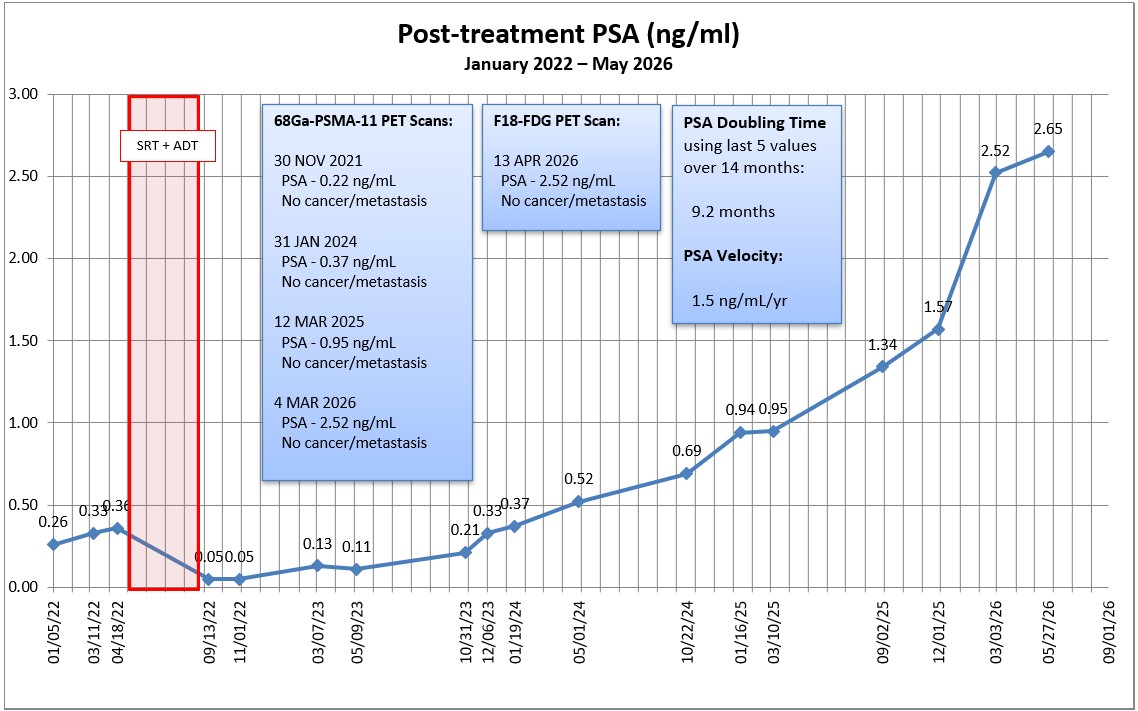
  • MO Sr.’s triggers for starting hormone therapy were a PSA greater than 2.0 ng/mL (I’m at 2.52) and a PSA doubling time less than 9 months (I’m at 8.9 months).
  • MO Sr. said that, with my numbers, I’m at “higher risk” for this to get away from us and metastasize.
  • MO Jr. said that the window for curative options has closed and that treatment going forward would be “palliative.” (I already knew that curative options were out the window.)
  • Both agreed it’s time for them (Oncology) to take the lead on my case at this point, with Urology still available in a supporting role.
  • Both suggested dual therapy involving androgen deprivation therapy (ADT) using Eligard (leuprolide acetate) and and androgen receptor pathway inhibitor (ARPI) using Xtandi (enzalutamide) as the current standard of care. [See explanation below if you’re unfamiliar.]
  • MO Sr. also suggested intermittent therapy over continuous therapy, using a 9-month schedule to start.

If she had her way, I believe MO Sr. would have had me start the therapy in the next week or so. I tapped on the brakes on that idea. I told her that Urology wanted another PSA test done in early June, and I thought it would be good to get that done before starting anything. Also, I’m traveling in May and I simply wanted to postpone anything until after I return. Six weeks won’t make that much of a difference.

We agreed, in concept, to the following:

  • No more scans to try to located the cancer for now.
  • Get pre-therapy lab work done the week after Memorial Day to establish baseline testosterone and PSA levels (among others) ahead of therapy.
  • Get a Dexa bone density scan to get a baseline prior to starting treatment (extended ADT can weaken bone density).
  • Meet on 2 June to review the results and make the final decision as to whether to start treatment.

Final Thoughts

It’s only been a few hours since the meeting, and I’m still trying to absorb it all and process it. Of course, after 15+ years of dealing with this, I knew we would eventually get to this point. Am I ready or willing to take the advice of the National Cancer Institute doctors in the video I shared recently to just monitor and delay treatment? I don’t know. It’s something that I’ll have to contemplate over the next six weeks or so.

I will say that I was pretty impressed with the Oncology Department as a whole. You’re assigned a care coordinator and given their direct phone number for all questions or concerns, and both doctors were good at listening and engaging in a real conversation. It seemed like they were a bit more empathetic over all, and that’s a good thing.

Certainly a lot to take in in the days and weeks ahead. I’m open to thoughts and feedback.

Be well!

—Dan


Hormone Therapy Explained

For those who aren’t really familiar with how prostate cancer works and what role hormone therapy plays, here’s a grossly over-simplified explainer.

Prostate cancer feeds off of testosterone and, as long as there’s a supply of testosterone, the cancer will continue to grow.

There are two ways to deprive the cancer of testosterone. The first is to stop or slow the production of testosterone. The second is to block the cancer cells from receiving the testosterone. The current standard of care is to use both methods simultaneously.

Let’s say the cancer cells are in the bottom of your favorite travel mug, thirsty for testosterone. If you put the mug under running water from your tap, the cells get the water (testosterone) they need and the cancer grows. But if you turn the tap off, the water (testosterone) stops flowing, and the cells in the bottom of the mug can’t grow. This is called androgen deprivation therapy (ADT).

The other way to stop the cancer cells in the bottom of the mug from getting water (testosterone), is to simply put the lid on and block the water from entering the mug. This is called androgen receptor pathway inhibitors (ARPI).

If you do both simultaneously, you can really slow the growth of the cancer. But we also know that some taps have slow leaks that drip water and, if the lid is slightly open, water (testosterone) and still make it to the cancer cells inside the mug.

There are two ways of turning the tap off. One, an orchiectomy, is a radical, surgical and permanent removal of the testes. But the adrenal glands also produce a small amount of testosterone, too, so the flow isn’t completely stopped.

The other is to use an ADT drug to have the brain tell the testes to stop producing testosterone. The drug is given via an injection in typically one, three, or six month doses, and it has significant side effects: hot flashes, mood swings, fatigue, loss of libido, loss of muscle strength, and loss of bone density, to name a few.

The way to put a lid on the mug is through an ARPI drug that’s usually taken in pill form daily. In my case, MO Sr. was recommending Xtandi (enzalutamide) as the ARPI. It has its own host of side effects: muscle and joint pain, fatigue, falls and bone fractures, headaches, high blood pressure and others.

The good news is that this combined treatment option can keep the cancer at bay for years (as long as you stay on it for years). However, at some point, the cancer can become resistant to the drugs, and you may have to move to stronger treatment options like chemotherapy.

Again, this is an oversimplification for those new to the topic.

Header image: Anza-Borrego Desert, California

Day 5,621 – Oncology Appointment Set

The scheduler called this afternoon and we set up an appointment with the medical oncologist (MO) on Tuesday, 14 April 2026.

Hopefully, I can enlist the MO as an ally in trying to get an alternate scan to see if we can find out what’s happening with the cancer.

I did write to the urologist on Monday to let him know that I came away from the phone call with a different understanding of what’s next compared to what he wrote in his summary notes. (My emails are included in my medical chart, and I wanted to be on the record that we had a disconnect in communications.)

I did my best to keep my emotion out of what I wrote, and tried to present it as me wanting him to further explain his viewpoint. I wrote, in part:

I agree with you that PSMA PET scans have become the gold standard for most patients. But we also know from multiple studies that 5% – 10% of patients don’t express PSMA and the scans won’t work for them.

I believe the fact that I’ve had four 68-Ga-PSMA-11 PET scans that haven’t located my cancer is strong, objective evidence that I may be in that small group of patients for whom the scans don’t work (barring any other possible test/proof that shows I don’t express PSMA). The last two scans should have had an 80% – 90% chance of detection at my respective PSA levels.

Please help me understand more definitively why you believe PSMA PET scans work for me, and what further evidence you would need to convince you that I may be in that group for whom the scans don’t work.

Finally, you stated that there was “limited likelihood that Axumin would provide additional clinically actionable information.” How would we know that unless we try? Axumin scans have an 80% chance of detecting something at PSA levels over 2.0 ng/mL.

We banked on PSMA PET scans to provide that clinically actionable information, yet time after time, they haven’t.

I’ll let you be the judge as to whether I kept the emotion out of my email. Again, the email to him went out Monday afternoon, so I wouldn’t expect a response for a few more days (if he’s even inclined to respond). I’m not sure if it was coincidence or if he pushed Oncology to call me because I did note at the end of my email that I hadn’t heard from them yet.

We’ll have to see how this plays out. More to come.

Be well.

Header image: Anza-Borrego Desert, California

Day 5,613 – Doctor Appointment

Those of us of a certain age may remember the “Stump the Band” segment on the Johnny Carson show, where audience members asked the band to play some obscure song. Well, today was my turn at “Stump the Urologist.”

It was a very productive meeting that lasted nearly 40 minutes which was unusual. I came equipped with hard copies of my PSA chart, the MSKCC PSA doubling time (PSA-DT) calculator results, and my list of questions. He was impressed and really pleased with the chart in particular.

We started talking about how my four PSMA PET scans were all inconclusive, and I steered the conversation to whether I might be one of the 10% for whom PSMA PET scans don’t work. He seemed to be a bit skeptical at first, but he also said it was a possibility.

Given that my PSA increased substantially and my PSA-DT was decreasing, I wondered if it would be better to jump into ADT sooner or if there’s still value in trying to find the cancer’s location with imaging. He was of the opinion to continue to try to find it before starting ADT.

I had a series of questions that really dealt specifically with ADT, and he said it was a bit premature to think about those and that they would be better answered by a medical oncologist. I knew that I was jumping the gun with some of them, but I thought I’d ask anyway. During that part of the conversation, I did mention that I tolerated the ADT probably better than most when I had it for my salvage radiation therapy, but that I wasn’t eager to jump into it earlier than necessary.

After that, he took control of the conversation and asked me about my status when it came to sexual function and incontinence, and offered up options to deal with both if I was interested.

Then we returned to the topic of next steps, and that’s where I played “Stump the Urologist.” (Who, by the way, was a full-blown internist and not a resident.) He grabbed my PSA chart and excused himself for a few minutes as he went off to consult with the department head.

When he returned, I was a bit surprised when he put his faith in the results of the PSMA PET scan, saying it has the best sensitivity and the best specificity of any scan out there. He said that they had moved away from the Axumin scans because they were the old technology.

I politely pushed back, reminding him that a PSMA PET scan should have had an 80% – 90% chance of finding my cancer at my PSA level if I had the PSMA protein for the 68-Gallium tracer to lock onto. But if I don’t have that PSMA protein, the sensitivity and specificity of the scan won’t matter because nothing will ever light up. He really couldn’t argue against that.

I went back to the topic of ADT and mentioned that I met with a medical oncologist (MO) two years ago, and received conflicting opinions on when to start ADT. The MO said she would start my ADT when my PSA hit 2.0 ng/mL (a urologist said she wouldn’t start it until there was evidence of metastasis). Today’s urologist said he looks for one of three “triggers” to begin ADT: PSA > 10.0 ng/mL 😲; PSA-DT less than six months; or evidence of metastasis.

I also mentioned that the VA MO that I saw two years ago was a general oncologist and not someone who specialized in genitourinary cancers and, as helpful as she was, she had to consult with a UCSD MO who specifically deals with prostate cancer. I sowed the seed of eliminating the VA MO as a middleman if they have to consistently consult the UCSD doctor (who is highly regarded in the field), and suggested that I could just see him directly. I’m not sure if that will take root.

Finally, I did ask a very basic question given how elusive this has been: Is this even cancer? He said that, if I hadn’t had a prostatectomy, that there might be other explanations for the rising PSA. But he was confident that we are, in fact, dealing with cancer.

That led to a follow-up question of: Is it metastatic? Based on the information we have, he said it’s not. He seemed to squirm a bit when I asked about it being micro-metastatic, because, in his mind, that wasn’t very well-defined.

Before mapping out a plan, I have to admit that my ego puffed up a tad when he said, “You’re the best educated patient I’ve seen in weeks.” He also admitted that my case was a bit puzzling to them and not something they routinely see.

We agreed on three actions:

  • The doctor is going to explore how and where I can get an Axumin scan, and if the VA will authorize it if I have to go outside the VA. That may take a day or two to get an answer. I mentioned that I’d be willing to use Medicare and go out on my own if necessary.
  • He is doing a referral to get me seen by the VA oncology team to get them familiar with my case. I suspect it will take a few days to hear from the scheduler.
  • We do another PSA test in June and meet to see where we’re at.

All in all, this was a good meeting with a robust discussion about my case that has all of us scratching our heads as to what’s going on and what to do next. Frustrating? Yes, to a degree. But, as we discussed during the meeting, nothing is black-and-white in the world of prostate cancer.

More to come.

Be well!


For my readers outside the U.S. who may not be familiar with Johnny Carson, I was going to link a random video clip of his “Stump the Band” segment above and, when I searched YouTube, this—of all clips—was the one that popped up first. I think you’ll see the related humor in it once you watch it. 😂

Header image: Anza-Borrego Desert State Park, California

Day 4,880 – Full MO Report

My computer issues have been sorted, so here’s the full scoop behind my meeting with the medical oncologist (MO) on Tuesday.

The meeting started with a nurse practitioner (NP) which threw me for a bit of a loop and initial disappointment. Because this was my initial contact with the oncology team, we spent a bit of time reviewing my history and how we got here. She did say that she would bring the MO into the discussion once we went through the preliminaries.

The nurse had actually done a pretty thorough job of reviewing my file prior to the meeting, and was familiar with the recent bone scan and PSMA PET scan results. Her take on my situation was that we were somewhat in limbo with no signs of metastases anywhere, and that the path forward wasn’t so clear-cut. (That actually led to a brief discussion on how metastases is defined in the world of prostate cancer. She was of the school that it’s not metastatic until it shows up on scans, while I pressed and suggested that, because the prostate is gone and the cancer is somewhere, it must, by traditional definition, be metastatic.)

Once we were through with the initial screening, the nurse brought in the MO and introduced her to me. I did ask if she specialized in prostate cancer and she does not; she’s more of a general oncologist. She did say, however, that she reviewed my case with a genitourinary oncologist at the University of California San Diego (UCSD) the day before our meeting. That was a good to know (but not the same as having a seasoned prostate MO in the room).

At that point, the three of us started going down my checklist of questions.

We talked about whether there was value in delaying the start of any treatment until my PSA rose to a level where a scan would detect the location. In the preliminary screening, the NP seemed to be inclined to start the ADT before another PSMA PET scan, and she was a little surprised that the MO said we should do another scan in six months. The MO said that the scan may reveal lesions that could be spot radiated as a treatment option.

That led to me asking about whether there would be value in whole pelvic radiation and, again, without knowing the cancer’s location neither was a fan of pursuing that at this point. Even if we did know the location, they would defer that decision to the radiation oncologist (RO).

Because my PSA is so low (in relative terms), both seemed to be more inclined to start with just ADT and not a combination therapy of ADT plus antiandrogens. The MO acknowledged that the use of combination therapy could be more effective in controlling the cancer, but cautioned about the increased side effects from doing a combination therapy approach. She also mentioned that using combination therapy is generally reserved for when the cancer is more advanced. (I’m not sure that my research agrees with that thought.)

I believe in her discussion with the UCSD GU oncologist that they said they would probably hold off initiating hormone therapy until my PSA reached 2.0 ng/mL. I’m going to have to do a little research to see if that makes sense.

We talked about intermittent therapy and whether that would be appropriate, and the consensus was that, at my low PSA, I would be a good candidate for intermittent ADT. However, that would depend on my PSA doubling time and how my PSA responds to the ADT.

I did ask if cancer in the lymph nodes would be symptomatic and generally speaking, they said, it’s not. I asked because I had had a weird pressure sensation in my groin last month that was new. (Yes, I’m at that point where I ask myself if every new ache, pain, or sensation is related to the cancer when it pops up.)

They noted going through my record that there was no baseline testosterone test, so we all agreed that that would be helpful to have. The NP put the order in to have that done when I get my PSA tested on 1 May 2024.

The MO expressed concern about my recent cardiac work-ups after my October emergency room visit (nothing of substance was found). She reminded me that hormone therapy does have a small but real risk of increasing cardiac events.

In the last part of the meeting, I did ask if I’ll be seeing the same MO going forward, and the short answer was “indirectly.”

You’ve heard me talk before that one of the drawbacks of getting my care through the VA is that it’s a teaching hospital and that I rarely see the same physician/resident twice. It’s good that I get so many differing opinions, but it prevents me from building a long-term relationship with the doctor as well. Different residents will filter through the oncology department, but the MO I met with will be overseeing all of their cases behind the scenes, so she would be tangentially involved.

I was asking because I likened myself to being an orchestra conductor, coordinating the efforts between the urologists, radiation oncologist, my primary care physician, and now the medical oncologist. I was inquiring if she or anyone else at VA would take the lead on coordinating all of these discussions and treatment considerations. She did mention that they do have a “tumor board” that reviews much more advanced cases to map out coordinated treatment plans, but because I don’t have any substantial tumors in the scans, my case wouldn’t come up for review.

Interesting, though, was the fact that the NP and MO both viewed this meeting as me getting a second opinion instead of a hand-off of my case from the urology department to the oncology department. From their perspective, the urology department still has the lead on my case until I decide to move forward with hormone therapy.

One thing the NP brought up early in the conversation was that any treatment plan would have to be aligned with my goals. If my goal was to prevent metastasis (or delay it), then starting hormone therapy sooner would make more sense. But if my goal was to avoid hormone therapy side effects for as long as possible—recognizing the inherent risks—then it may make sense to delay therapy. To be honest, I’m not sure where on that spectrum I want to land.

We wrapped up the meeting, coming to a consensus that:

  • We’ll conduct a PSA test and get a testosterone baseline on 1 May 2024.
  • Calculate the PSA doubling time including the latest results.
  • Evaluate the results and decide whether to schedule another PSMA PET scan.

While I didn’t keep specific track of the meeting, it lasted somewhere between 30 and 45 minutes, which is quite unusual.


I came out of the meeting in good spirits because it was one of the most productive, collaborative meetings I’ve had in a long time. The conversation flowed quite easily, and I attribute that to the fact that women healthcare professionals seem to be much better prepared and much better at listening to a patient’s concerns than some of their male counterparts. This isn’t the first time that I’ve noticed that. (Don’t forget, it was the thoroughness of my female primary care physician that discovered the cancer via a DRE in the first place.)

To be honest, I’m not sure why I felt compelled to mention these observations based on my personal experiences. I just suspect that some prostate cancer patients may be reluctant to discuss problems with their male bits with female healthcare professionals. You might be surprised by the difference in quality of care that you receive, so don’t rule them out.


I have been more than satisfied with my care from the VA so far but, as my cancer advances, I am beginning to wonder if it makes sense to step outside the VA so I can get a team that is dedicated to my case and one that I can build a long-term relationship with.

At the top of my list would be UCSD followed by Scripps/MD Anderson. But the VA already has such close ties to UCSD, it’s almost like I’m getting care from them already. In fact, the MO I saw is a clinical professor of medicine at UCSD, most of the residents I see in urology are from UCSD, and my VA-provided RO is from UCSD but seeing him required “community care” pre-approval. (Community care is generally only approved if the VA doesn’t have the capacity or capability, so it could be tricky arguing to obtain it.)

So while I’m on Medicare and it would be relatively easy (but more expensive) for me to step away from the VA, I would explore options for getting approval to move into community care at the USCD GU medical oncologist through the VA first.

I’m not keen on changing horses in mid-stream, but it may make sense in the long run. I’ll have to think that through.


And now you know why I didn’t want to try and type this out on my phone on Tuesday. 😂 Thanks for reading this far!

Header image: A rare spring snow in Cuyamaca Rancho State Park, San Diego County, California, 14 March 2024

Day 4,878 – Medical Oncologist Meeting

This will be a Reader’s Digest version of a future longer post. My computer died Sunday night and I’m not keen on trying to type out the full report on my phone’s itty-bitty keyboard.

The bottom line for now is to watch my PSA for the next three to six months, perhaps with another PSMA PET scan in six months if my PSA has increased sufficiently to be reasonably assured that the scan could detect something. I’m okay with that approach.

If my next PSA has a sizable increase, we’ll reevaluate.

The meeting lasted around 30 minutes, so there are more details to share once I get access to a computer again.

I’ll go for a PSA test (and get a testosterone baseline) on 1 May in advance of a 9 May meeting with my primary care physician and a 14 May meeting with the urologist.

With luck, I’ll have a full update by the end of the week.

Month 160 – Getting Ready

My first meeting with a medical oncologist is a week from Tuesday, on 19 March, so I’ve been putting together a series of questions to ask.

I’d like to leave the meeting with an understanding of whether there’s value in delaying the start of hormone therapy so my PSA can get high enough for a PSMA PET scan to locate the cancer so we know exactly what we’re dealing with, or if it’s better to start hormone therapy sooner rather than later.

I’d also like to understand whether they would want to start with just ADT or with a combination therapy of ADT and antiandrogen therapy and how to manage the side effects from both options.

I’m sure I’ll post an update after the meeting.

On an unrelated general health note, I’ve been pretty faithful about getting in a daily walk this year. I started out with short walks and now I’m up to 6 km / 3.7 miles per day. So far this year, I’ve logged about 240 km / 149 miles. Not bad for this old geezer who was always picked last for the team in school PE classes.

Stay tuned for more.