Month 159 – Meeting with Urologist

Today’s meeting with the urologist went about as I expected it would. In a nutshell, we agreed to punt for another three months and see where we’re at with a new PSA test at that time.

We talked about the clean PSMA PET scan results and the fact that we remain in this inconclusive gray area right now that doesn’t bode well for making decisions about the next steps. He did suggest that I could start ADT now if I wanted to do so, and he debated about whether it would be appropriate to start ADT with abiraterone. He leaned toward just starting without abiraterone if ADT is what I wanted to do, but I also sensed that he felt no need to rush into this given the negative scan results.

One interesting comment that he made (and I wish I had taken better notes) was along the lines of ADT alone has not been shown to extend life expectancy. The unsaid implication was, “Why go through the side effects of ADT now if studies show there’s no discernable difference in the outcome?” That’s something that I need to dig into a little more.

One interesting thing that’s popped up in my conversations with others in prostate cancer forums or here is testosterone level testing. In all my years of being treated, my testosterone level has never been tested, so we talked about that. It’s something that we can do just prior to starting ADT to establish a baseline reference point.

I mentioned my email conversation with the radiation oncologist, and talked about the possibility of zapping a lesion should it show up on a PSMA PET scan in the future. The urologist seemed a bit indifferent to that approach (probably an occupational hazard).

During the conversation, I mentioned that my PSA doubling time using the last four values was at just over six months, and he commented that that was “not insignificant.”

We did discuss whether there was value in knowing where the cancer was located at this point, or to just know that the cancer is somewhere and proceed with systemic treatment without knowing its location. My concern is that starting ADT would make finding the location next to impossible on a PSMA PET scan if my PSA is knocked down to near zero.

He kept using the term “metastatic” throughout the conversation which, I suppose, is technically correct. If the cancer is someplace other than where it started, it’s metastatic. But I’ve also learned that there is a lot of gray area in the prostate cancer world when it comes to classifying how and what your cancer is.

I also asked for a consult with a medical oncologist to get his/her insights on where I’m at and what should be done next and he was going to put that request in for the consult.

I have a three-month follow-up appointment and PSA test scheduled for 14 May 2024, so the saga continues.


About an hour after I returned home from my appointment, the PCRI posted this very timely video on micro-metastatic prostate cancer.

I’ll probably publish this video as a stand-alone post so it’s easier to find.

Header Image: La Jolla Shoreline, La Jolla, California

Day 4,832 – PSMA PET Scan Results

No evidence of recurrent prostate cancer or metastatic disease.

I know I should be excited but, at the same time, I don’t think I’ve been so frustrated by “good” news. Thanks to the steady increase in my PSA, we know something is happening somewhere, and I was really hoping this scan would end the game of cat-and-mouse that we’ve been playing trying to determine where the cancer is and what to do next. It didn’t.

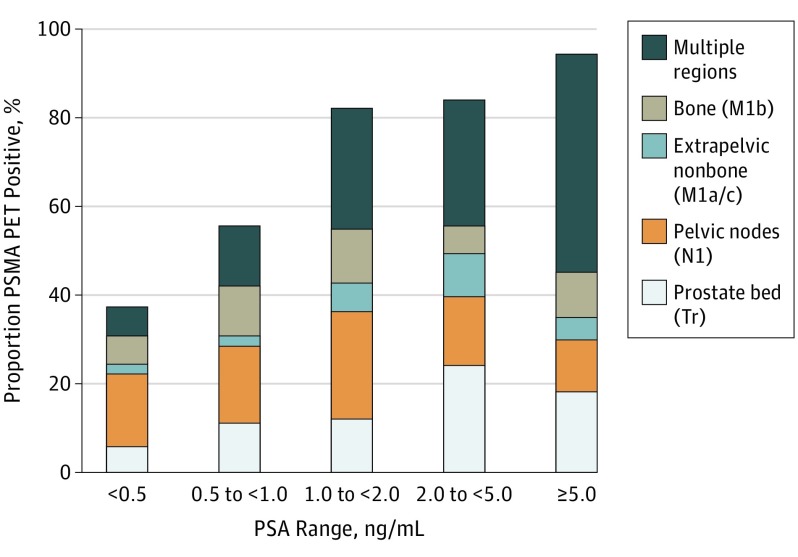
Even though I recognized going into the scan that, at my PSA level (0.37 ng/mL), there was an approximate 40% chance of detecting something, I was hopeful it would come up with something this time. Silly me and my expectations.

Detection Rate on a Patient Basis Stratified by PSA and Region Tr indicates prostate bed only; N1, pelvic nodes only; M1, extrapelvic only. Proportion of patients with 68Ga-PSMA-11 PET positive findings were stratified by PSA range and region of disease in accordance with PROMISE. https://pubmed.ncbi.nlm.nih.gov/30920593/

The other thing I’m beginning to wonder is if I’m in that 10% of patients for whom PSMA PET scans don’t work. (You may recall that being mentioned in this video from the PCRI: Rising PSA After Prostatectomy.) I have to dig into that more to see if it’s just PSMA PET scans that use Gallium-68 as the tracer, or if that applies to any PSMA PET scan regardless of the tracer used. I’m guessing it’s the latter.

Choline and Axumin scans are another option, but they don’t start reliably picking up cancer locations until the PSA is at 1.0 ng/mL or higher. Assuming my current PSA doubling time (6.2 months) remains steady, that means waiting another 11 months before I hit 1.0 ng/mL for those scans to have a chance of seeing anything.

I’ll be putting together my list of questions for the urologist appointment on 13 February (I’m open to suggestions). I suspect we’ll have a good discussion on subsequent PSA testing, the value of knowing where the cancer is located at this point, and when to start hormone therapy.

Again, the silver lining in this is that my scan didn’t light up like the Las Vegas strip. I need to keep that in mind.

Happy Friday!

Day 4,820 – PSA Results

Okay. I got antsy and went for my PSA test on Friday instead of next week. As expected, my PSA increased from 0.33 ng/mL on 6 December 2023 to 0.37 ng/mL on 19 January 2024.

The silver lining in that cloud is that the rate of increase slowed a bit and it didn’t increase as much as I expected it would.

Sometimes, I get too nerdy for my own good. There was a 91% increase between the May and October readings, and there was a 57% increase between the October and December readings, so I averaged the two increases (74%) and projected that this increase would land me at just over 0.5 ng/mL. This increase ended up being just 12% over the previous December reading. Fickle PSA.

I ran the numbers through the Memorial Sloan-Kettering PSA Doubling Time calculator again, using the five values from March 2023 (0.13) on. My PSA doubling time dropped from 6.7 months to 6.2 months, and my PSA velocity increased from 0.2 ng/mL/yr to 0.3 ng/mL/yr since calculating it back in December.

I went for the test early because I really wanted to know the PSA value going into the PSMA PET scan that’s scheduled on 31 January 2024. Plus, if it dropped, I would have had time to ask the urologist if it was worth going ahead with the scan at a lower PSA level. (Remember, I went for a PSMA PET scan when my PSA was 0.22 ng/mL, and it didn’t show anything at that PSA level. Why subject myself to another dose of Gallium-68 if the outcome may not produce any useful information?)

My follow-up with the urologist to review the PSMA PET scan and PSA results is on 13 February, and we’ll map out what’s next from there.

So that’s the latest and greatest. More to come.

Header image: The famous Torrey Pines Golf Course, San Diego, California, home to the Farmers Insurance Open golf tournament

Androgen Deprivation Therapy and Prostate Cancer

With androgen deprivation therapy (ADT) a near certainty in my future, I’ve been trying to get smarter about it. In my research, I came across this video from Dr. Eric Small at the University of California San Francisco (UCSF), that gives an introductory overview of ADT.

If you’re not familiar with some of the lingo and drug names, it may be like taking a sip of water from a fire hose, but Dr. Small gets the concepts across pretty clearly.

After watching the video, my pea-sized brain came up with what may be an oversimplified, imperfect analogy that may make Dr. Small cringe. (I’m happy to be corrected if this analogy is out to lunch!)

We know that prostate cancer needs testosterone to survive and grow, and the testes and adrenal glands both produce testosterone. So how do we cut off the supply of testosterone from those two sources to the cancer cells?

Imagine that the cancer is your backyard swimming pool (even a kiddie pool). Pools (cancer cells) need water (testosterone) to do what they do best. Your testes are one hose that fills the pool, and your adrenal glands are the second hose that fills the pool.

If we don’t want water (testosterone) in the pool (cancer), we shut off the spigots on the hoses to stop the flow. To turn off the spigot from the testes, we use one set of drugs (Lupron, Eligard, Zoladex, Firmagon, or Orgovyx). To turn off the spigot from the adrenal glands, we use a different drug, Abiraterone.

But there’s another way to stop the pool from getting water, and that’s to place a watertight cover over the top of it. That’s what the antiandrogen drugs do—they cover the pool and stop the water from getting in. These drugs are Flutamide, Nilutamide, Bicalutamide, Enzalutamide, Apalutamide, or Darolutamide.

ADT blocks the production of testosterone and antiandrogen drugs prevent the cancer cells from receiving the testosterone.

I’m sure more research is in my future, and I’ll be certain to share what I learn. In the meantime, don’t giggle too much at my analogy.

Month 116 – Cancer Treatment Decisions

One of my regular readers of this blog and I have amazingly similar stories when it comes to our diagnosis and treatment. We were both diagnosed around the same age, our PSA levels were quite close to each other, and we both opted for surgery. Both of us had undetectable PSAs well after the surgery—until we didn’t. His PSA became detectable around the three year point, and mine became detectable at a few months shy of five years.

He opted to begin salvage radiation therapy (SRT) along with androgen deprivation therapy (ADT) when his PSA hit 0.08 ng/ml. And, if you’ve been following my blog for any amount of time, you already know that I’ve been punting that decision after nearly every PSA test, with my PSA bouncing around in the 0.14-0.16 ng/ml range without seeking SRT or ADT yet.

Who made the right decision?

Both of us.

When cancer is initially introduced into your vocabulary—and even long after—you’ll be faced with a myriad of decisions to make. Is treatment warranted, or can I go on active surveillance? If treatment is needed, do I opt for surgery, radiation, or one of the newer methods available? Which doctor has the most experience? Which hospital has the right equipment? The list goes on and on.

Many of those same questions are applicable in the case of recurrence, too.

When it comes time to make some of those decisions, remember first and foremost that it’s your body, your family, and your circumstances. You—and not anyone else—have the final say.

Do your research using reliable, trusted sources and don’t be afraid to ask the doctor questions or call them out on something you’re not comfortable with. Seek multiple opinions from the doctors that could provide the different treatment options to you (keeping in mind, of course, that some may push their own specialty over others).

Talk to other patients or read their silly blogs to see what their experience has been, knowing that each individual cancer case is unique and will not apply directly to your own situation.

Don’t let the words “prostate cancer” scare you into acting immediately. Unless your Gleason score is an 8 or 9, you do have a bit of time to do this research and consulting with different specialists. I made my decision to have surgery rather quickly and never consulted with a radiation oncologist to see if that would be a viable first treatment option for me. Do I regret that? No. But, with a Gleason 6, I should have slowed things down and have had the meeting anyway.

One of the options that is often overlooked is to do nothing. Okay, it’s not exactly doing nothing—you’ll definitely want to be on active surveillance—but you don’t have to leap right into a treatment option if your cancer is  low grade / not aggressive. My sense is that more and more doctors are beginning to embrace that approach to avoid over-treatment.

That brings me to my final point. Once you make a decision, don’t look back. Embrace it and move forward. If you’ve done your homework correctly, you’ll know in advance what the consequences of that decision may be, and you’ll be more accepting of them if and when they do come.

If my PSA continues to slowly increase and, at some point my body scan lights up like a Christmas tree because I haven’t started SRT, I’ll probably curse like the sailor I once was and say, “I knew this was a possibility. What’s next?” But I’ll also know that I will have had six or seven or more years of high quality of life without any short or long-term side effects from SRT and/or ADT, and that is of great importance to me. As much science as there is in the treatment of prostate cancer, in the end, it’s an educated crap shoot.

Who made the correct decision?

Both of us. One of us. Neither of us.

Time will tell.

Stay Well! Wear A Mask! Wash Your Hands! Stay Home!

Article on PSA and Aggressiveness of Prostate Cancer

An excellent article about PSA and being able to determine the aggressiveness of prostate cancer.

https://www.statnews.com/2017/05/04/prostate-cancer-research-psa/

Month 75 – Distracted from Cancer

It’s good to be distracted. I’ve barely thought about prostate cancer since the holidays, and that’s been fantastic. What’s not fantastic is the reason for the distraction. One word: Trump.

I’ll not turn this into a political blog, but suffice it to say, I’m not a fan. But, seeing as the repeal of the Affordable Care Act (ACA) is on the top of the new administration’s “To-do” list, some passing thoughts on the topic here are not out of line.

When I decided to leave my job five years ago and move from Indiana to San Diego (about 15 months after my surgery), my health insurance was intact through COBRA coverage. (For those readers outside the U.S., the Consolidated Omnibus Budget Reconciliation Act (COBRA) of 1985 gave employees who left their company the right to continue their health insurance coverage through their former employer’s health plan for up to 18 months after leaving.)

My COBRA coverage ended in September 2013, just a few months before the ACA’s requirement to cover individuals with preexisting conditions kicked in on 1 January 2014. I tried to purchase insurance on my own long before the September expiration of my coverage, but was told that I was uninsurable because of my prostate cancer diagnosis or, if they would cover me, the monthly premiums would have been north of $2,500 USD per month.

I’m a veteran of the U.S. Navy, so in May or June of 2013, I turned to the Veterans Administration (VA) to see if I would be eligible for care.

For those who don’t know, there is a tiered eligibility system in place to determine your eligibility and your level of care with the VA. Not all veterans will be eligible for care. Fortunately (?) for me, I served in-theater in the Persian Gulf during Operation Desert Shield/Desert Storm during the first Gulf War. That made me eligible for coverage under the VA, and it’s where I’ve been getting my cancer care ever since.

We’ve already heard discussions of lifetime caps on coverage being reimposed; debates over preexisting conditions; and a host of other changes that scare the crap out of most people, cancer patients in particular. The administration has already imposed an across-the-board federal government hiring freeze at a time when the VA healthcare system is struggling to provide quality care to all the veterans from the Iraq and Afghanistan wars, as well as to veterans like me. It’s simply bonkers (that’s a technical term).

So I’ll climb down off my soapbox now and thank the new administration for pushing the notion of cancer recurrence pretty much completely out of my mind for the last two months. There are bigger things for me to deal with than piddly little ol’ cancer.

Month 61 – Letter to the Newly Diagnosed

A few weeks ago, one of my blog’s readers, a three-time cancer survivor, emailed me with a suggestion for a post topic: An open letter to the newly diagnosed, offering insights and support based on my own experience. I found the idea intriguing, so here goes…


Dear Newly Diagnosed Cancer Patient,

“You have cancer.” Three little words that will change the lives of you and your family forever. It’s terrifying. It’s bewildering. It’s overwhelming. It sucks.

Oregon Sunset 2Cry a little. Cry a lot. But strive to get through the initial shock and emotional reaction as quickly as you can. You’ve got work to do.

Don’t bother trying to answer the question, “Why?” You’ll spend too much energy to never get the answer. You’ll need to focus that energy on what’s ahead.

Don’t be ashamed that you have cancer. Have open and honest conversations about it with those around you; don’t bottle it up. Find a tidbit of humor in the situation and inject it into the conversation. When you do, people will feel more comfortable around you. Recognize, however, that some people will find being around cancer too difficult and will withdraw. Let them go, for their sake and yours. Most will return once they’ve had time to process what’s happening.

Relationships will be put to the test and may change. Remember that this isn’t all about you. It’s about those closest to you, too, and sometimes it can be more than they can bear. You’ll have to be the strong one for them. Don’t be surprised when some of your most casual acquaintances become your biggest supporters. Embrace them.

Become your own advocate. Research, research, and research some more. You may have the best medical team in the world, but question them. While they’re highly trained medical professionals, they’re still human. They may have their own self-interests in mind. If you ask a radiation oncologist what the best treatment option will be, he or she will likely say radiation. If you ask a surgeon, the answer will likely be surgery. You have to be comfortable with what’s right for you, knowing all the potential risks, side effects, and complications.

Seek out other patients who have had your cancer, whether a friend, a family member, or in a support group (or even through a blog). They can be the greatest resource available to you. They can tell you their first-hand experience and how the cancer and the treatment impacts their daily life. Recognize that each case is unique, so take their input with a grain of salt and realize you may not have the same result.

You can research and consult with your medical team until the cows come home, but at some point you’re going to have to make a decision. You. It’s your body and your life. You have to be comfortable that your research was thorough, and that you’ll make the best decision possible with the information at hand at that point in time. Then place your trust in your medical team to do the best they can.

You will be stressed. You’ll have “cancer” on the mind 24/7. Figure out ways to distract yourself from the cancer thoughts even for a few hours. Go to a movie, take a drive through the country, take a hike—whatever works for you. The stress can wear you down physically. Get plenty of rest after those sleepless nights; watch your nutrition. You’ve got to be as healthy as you can going into the challenges ahead.

All of this is far easier said than done. I know. Friends and family will offer assistance; take them up on their offers. They’re not there to pity you; they’re there to offer genuine help and support. Don’t let pride get in the way.

While we all hope for the best possible outcome, the harsh reality is that not everyone survives cancer. Make sure your affairs are in order, especially advanced medical directives, and that your family understands  and will honor your desires.

Being told you have cancer is not the end; it’s the beginning of a process.

In my case, I was diagnosed with Stage IIb prostate cancer, and the diagnosis was the beginning of my process to determine what treatment option was best for me. But even if you’re diagnosed with late Stage IV cancer and are considered to be terminal, it’s still the beginning of the process to figure out the best options for your remaining time.

Lastly, even if your cancer allows for successful treatment, cancer will always be in your thoughts long after the treatment ends. I’m five years out from my diagnosis and treatment, and a little “recurrence cloud” follows me around every day, as I wonder whether or not the cancer will return. Once you introduce cancer into your vocabulary, it’s there for good, whether the actual disease is there or not.

I wish you and your family all the best as you begin your own journey.

Dan