Month 172 – PSMA PET & PSA

This will be a short update, as not much has really happened in the last month.

Tomorrow, I have my third PSMA PET scan. With luck, we’ll actually find the location of the cancer with this scan. That will help us decide what’s next in this adventure. I suspect I should be able to access the results online within a week or so. If not, I have a follow-up appointment on 1 April with the urologist.

I was going to get my PSA test done next week, but I wasn’t sure what impact a potential government shutdown might have on access to the lab, so I went for the blood draw on Monday. I’m guessing that I’ll break the 1.0 ng/mL threshold with this test.

That’s it for now. More to come in the days ahead.

Header image: Sunset over the Pacific Ocean, Silver Strand State Beach, California

Month 164 – Prostate Cancer Update

To my regular readers, you may want to skip this post. This is a high-level update intended for my family and friends who don’t regularly follow this blog (gasp!), and it will be shared with them via my personal social media accounts. If you’re new here, welcome. Feel free to read away.


It’s been a while since I’ve provided any detailed update on what’s going on in the world of my prostate cancer, so here goes.

We last left our hero two years ago as he began 35 sessions of salvage radiation therapy on 7 July 2022 in attempt to kill off his recurrent prostate cancer after his surgery in January 2011 ultimately failed. Unfortunately, those little cancer cells have proved themselves to be quite resilient, and the salvage radiation therapy has failed, too. Bummer.

We know this by tracking my prostate-specific antigens (PSA) on a regular basis. After the surgery, my PSA level should have dropped to undetectable (zero) because there was no prostate left to produce the PSA. But the PSA can live on in the cancer cells even without a prostate, and that’s how we know the cancer is still there.

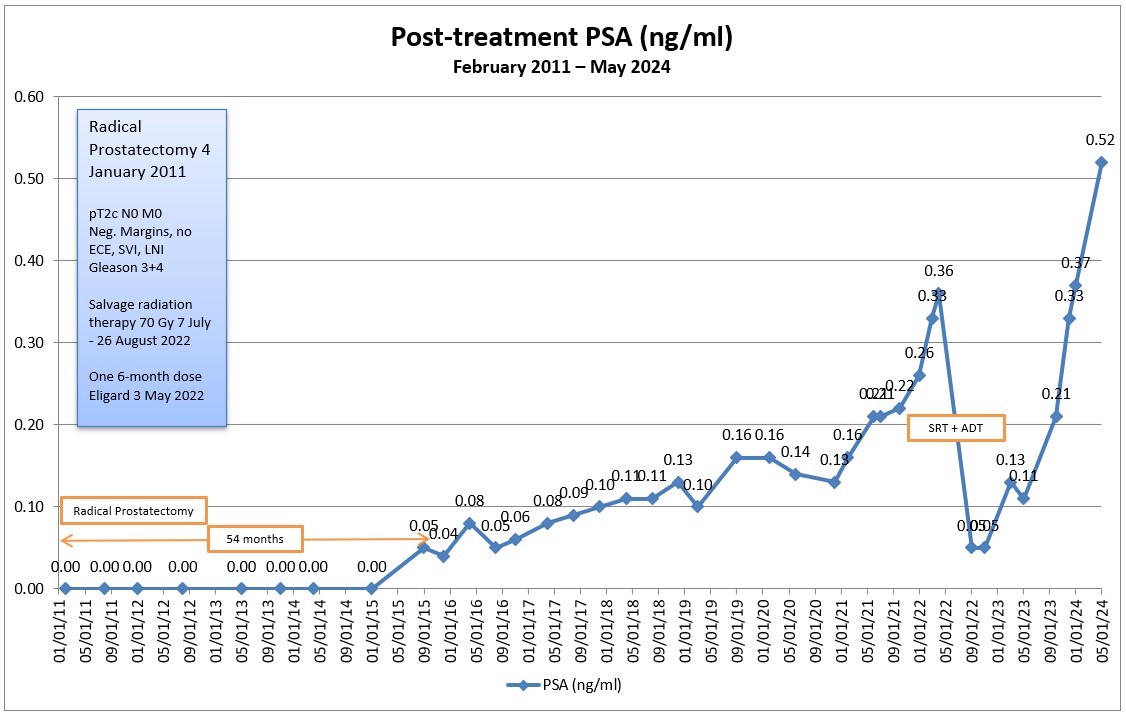
After the radiation, my PSA should have dropped substantially, and it did, at least initially. But about 15 months after the radiation ended, my PSA was on the rise again. It rose enough to the surpass the PSA level when we started the radiation. In May 2024, it continued its upward climb to 0.52 ng/mL, the highest it’s been since the surgery. (In the grand scheme of things, it’s still a low value that many fellow prostate cancer patients would love to have, but the fact that it’s doubling about every six months is a concern.)

There is a relatively new scan that can detect prostate cancer cells at fairly low PSA levels. It works best when the PSA is close to 1.0 ng/mL, but it has detected prostate cancer about 30% of the time at PSA levels in the 0.2–0.3 ng/mL range. I went for this PSMA PET scan in January when my PSA was 0.37 ng/mL, and the scan failed to detect anything.

On the one hand, that’s great because there were no signs of metastasis and no evidence of prostate cancer. But on the other hand, we need to know where the cancer is located and what it’s up to in order to plan our next treatment options. Because it didn’t reveal its ugly head, we can’t make any meaningful treatment decisions right now.

If there are one or two small lesions someplace, we may be able to radiate them again depending on their size and location. But if there aren’t any distinct lesions and my PSA continues to increase, that’s likely the result of micrometastases and that would require a systemic treatment approach (e.g., hormone therapy, immunotherapy, chemotherapy, or any combination thereof).

After reviewing my May PSA results with the urologist, we agreed to punt for six months and do another PSA test in late October. I know that seems counterintuitive—letting the cancer continue to grow without taking action—but there’s a reason for it. I’m predicting my PSA at that point will be in the 0.75–1.0 ng/mL range in October, and we’ll do another PSMA PET scan to see if we can determine what’s going on and then plan from there.

Up until this year, all of my conversations have been with the urologist and radiation oncologist. In February, I met with a medical oncologist for the first time because they’re the ones who deal with the systemic treatments.

Based on my conversations with the urologist and medical oncologist, the next logical treatment option is hormone therapy. Prostate cancer lives off of testosterone, so if we kill off the testosterone, we slow the growth of the cancer cells. (Hormone therapy is not curative, however.) But the timing of starting hormone therapy is important.

If we started the hormone therapy now, it would rapidly knock my PSA down so far that it would make it next to impossible to do the PSMA PET scan in November and get any meaningful results.

The other problem with starting hormone therapy too early is that the prostate cancer can become hormone resistant much in the same way that bacteria can become resistant to antibiotics. Start the treatment too early, and you’ll lose its effectiveness when you really need it later.

There seemed to be a differing of opinions between the urologist and the medical oncologist as to what would trigger the start of hormone therapy. The urologist would hold off until there’s evidence of metastasis; the medical oncologist suggested we’d start when my PSA hit 2.0 ng/mL. We can figure that out when the time comes, but both agreed that hormone therapy (and other therapies) can keep me around another 10–15 years (or more).

Of course, my quality of life may be diminished as a result of the treatments. Hormone therapy can come with a whole host of unpleasant side effects such as fatigue, muscle loss, weight gain, loss of libido, hot flashes, etc. No need to rush into that Disneyland of experiences.

Physically, I am feeling fine. I’m completely asymptomatic when it comes to the cancer, but the side effects from the surgery and radiation are present and are a nuisance more than anything. Psychologically, though, it’s been a bit of an emotional roller coaster ride as I go from PSA test to PSA test, and failed treatment option to failed treatment option. We’re closing in on 14 years since diagnosis, and it does get tiring.

One of my regular blog readers and my urologist both suggested that, at this point, I look at my prostate cancer more as a chronic illness than as a life-threatening disease. I’m still trying to embrace that perspective and, even if I do, the worry will never go away.

There you have it. The latest and greatest in this adventure of living with prostate cancer. Follow along if you want to see my monthly updates, and we’ll probably know more right around the holidays.

Be well!

Header image: Lake Michigan coastline from the John Hancock Center, Chicago, Illinois

Salvage Therapy for Prostate Cancer: AUA/ASTRO/SUO Guideline (2024)

A moderator on the HealthUnlocked website shared a link to the new 2024 American Urological Association guidelines for salvage therapy for recurrent prostate cancer:

https://www.auanet.org/guidelines-and-quality/guidelines/salvage-therapy-for-prostate-cancer

These are the generally agreed-upon guidelines that practitioners should follow when a patient has recurrent prostate cancer after initial treatment.

Month 159 – Meeting with Urologist

Today’s meeting with the urologist went about as I expected it would. In a nutshell, we agreed to punt for another three months and see where we’re at with a new PSA test at that time.

We talked about the clean PSMA PET scan results and the fact that we remain in this inconclusive gray area right now that doesn’t bode well for making decisions about the next steps. He did suggest that I could start ADT now if I wanted to do so, and he debated about whether it would be appropriate to start ADT with abiraterone. He leaned toward just starting without abiraterone if ADT is what I wanted to do, but I also sensed that he felt no need to rush into this given the negative scan results.

One interesting comment that he made (and I wish I had taken better notes) was along the lines of ADT alone has not been shown to extend life expectancy. The unsaid implication was, “Why go through the side effects of ADT now if studies show there’s no discernable difference in the outcome?” That’s something that I need to dig into a little more.

One interesting thing that’s popped up in my conversations with others in prostate cancer forums or here is testosterone level testing. In all my years of being treated, my testosterone level has never been tested, so we talked about that. It’s something that we can do just prior to starting ADT to establish a baseline reference point.

I mentioned my email conversation with the radiation oncologist, and talked about the possibility of zapping a lesion should it show up on a PSMA PET scan in the future. The urologist seemed a bit indifferent to that approach (probably an occupational hazard).

During the conversation, I mentioned that my PSA doubling time using the last four values was at just over six months, and he commented that that was “not insignificant.”

We did discuss whether there was value in knowing where the cancer was located at this point, or to just know that the cancer is somewhere and proceed with systemic treatment without knowing its location. My concern is that starting ADT would make finding the location next to impossible on a PSMA PET scan if my PSA is knocked down to near zero.

He kept using the term “metastatic” throughout the conversation which, I suppose, is technically correct. If the cancer is someplace other than where it started, it’s metastatic. But I’ve also learned that there is a lot of gray area in the prostate cancer world when it comes to classifying how and what your cancer is.

I also asked for a consult with a medical oncologist to get his/her insights on where I’m at and what should be done next and he was going to put that request in for the consult.

I have a three-month follow-up appointment and PSA test scheduled for 14 May 2024, so the saga continues.


About an hour after I returned home from my appointment, the PCRI posted this very timely video on micro-metastatic prostate cancer.

I’ll probably publish this video as a stand-alone post so it’s easier to find.

Header Image: La Jolla Shoreline, La Jolla, California

Day 4,776 – PSA Results (Not Good)

Well, 💩.

The suspense of not knowing what my PSA was up to was killing me, so I went a couple of days earlier than I planned to have my PSA test. I was expecting it to go up a bit, but I wasn’t expecting it to leap a tall building in a single bound.

My PSA jumped from 0.21 ng/mL on 31 October to 0.33 ng/mL on 6 December, a 57% increase in five weeks. Ugh. Using the four PSA values from this year and Memorial Sloan Kettering PSA Doubling Time calculator, my PSADT is 6.7 months.

I’d say it’s safe to conclude that the salvage radiation therapy missed the mark, but I’ll confirm that with an in-person appointment with the urologist on Thursday, 14 December and with the radiation oncologist via email.

I’m writing this late on Thursday night, about 20 minutes after seeing the results online, so I’m still shocked and processing it all. I’ll wrap this post up in the morning…

Back at the keyboard Friday morning after a somewhat fitful night of sleep…

Needless to say, this was (and still is) a bit of a gut-punch for me to see the PSA increase so rapidly. It’s definitely got me concerned and wondering where the cancer is if the radiation didn’t even make a dent in it.

So what’s next? I don’t know. I suspect these would be a few possibilities:

First, maybe let the PSA continue to rise a little more until it’s over 0.5 ng/mL but less than 1.0 ng/mL to give a PSMA PET scan a better chance of picking up where the cancer is located. At 1.0 ng/mL, PSMA PET scans can find the cancer about 90% of the time.

If there are only a couple of localized lesions, we may be able to radiate them.

Second, I’m sure androgen deprivation therapy (ADT) is definitely on the horizon, whether we do a scan and radiation or not. My only question would be the timing of the ADT. If it’s given before a scan, would that make it more difficult for the scan to pick up the lesions? I don’t know.

Last, Dr. Mark Scholz of the Prostate Cancer Research Institute, recently posted a video where he talked about a shift in how they approach treating advanced prostate cancer. (I’ll post the video in a separate post.)

Traditionally, treatments were offered sequentially. You’d start with hormone therapy, and when the cancer became resistant, you shifted to a different type of hormone therapy. When that failed, you would move into chemotherapy, a PARP inhibitor (immunotherapy), injectable radiation, and finally clinical trials.

There is research showing that combination therapies may be more effective in staving off the cancer. Instead of just starting out with ADT, it may make sense to combine ADT with radiation or ADT with chemotherapy right out the gate. Yes, there may be increased immediate side effects from the dual treatment, but early studies are showing higher cure rates and longer survival. Additionally, if the combined treatments are successful, this may lead to a better long-term quality of life because you may be able to be taken off ADT.

My appointment with the urologist is on Thursday, 14 December, and you bet I’ll have a ton of questions ready. One of them will be about getting a full-blown medical oncologist who specializes in prostate cancer involved at this point.

In the meantime, I’m going to have to start learning the language of advanced prostate cancer. There are so many different drugs and treatments with weird names that don’t really indicate what they do or how they’re used that it’s tough to keep them straight. Perhaps a spreadsheet may be in order…

I am trying to look for the silver lining in the cloud. I guess that would be that my PSA is still quite low. But the dark part of the cloud is the fact that I’m probably entering the phase where the treatments and their side effects will eventually be worse than the disease when it comes to daily quality of life. I tolerated the six-month dose of Eligard in 2022 pretty well, but it wasn’t without side effects. I guess I’ll cross that bridge when I get to it.

Oh. And I’m open to any and all insights from those who have traveled this path ahead of me.

Well, time to get out of the house and try to put this out of my mind for a brief period. (Translation: Escapism.)

Rising PSA After Prostatectomy – PCRI Video

Here is another informative video from the Prostate Cancer Research Institute and Dr. Scholz. It hit too close to home for me, as it describes the dilemma I faced in deciding when to initiate salvage radiation therapy.

Perhaps the key point that Dr. Scholz makes (at 6:08 in the video) is that there’s “a huge advantage of knowing where the cancer is and allowing the radiation therapist to target that spot” as it relates to a newer approach of letting the PSA rise so that modern imaging can determine the location(s).

Later in the video at the 9:40 mark, he goes on to say:

It’s quite tempting in many of the cases that I see to allow the PSA to go a little bit higher knowing that that 0.5 threshold [used by radiation therapists] was set at a time when we didn’t have scans and we didn’t know where the cancer was. There’s such an advantage of knowing where the cancer is and allowing the radiation therapist to target the disease that I tend to liberalize a little bit and allow the PSAs to rise above 0.5 if necessary.

In other words, because of the value in knowing the location of the cancer that can lead to curative outcomes if properly targeted by the radiation therapist, it may be worth allowing the PSA to rise to the point where it can be detected on a scan.

I toyed with the idea of getting a second PSMA PET scan when my PSA hit 0.33 and 0.36, but because it was rising rapidly and because I knew it could take two to four months to get another PSMA PET scan scheduled, I opted to act and go ahead with the salvage radiation therapy. I do have to question if it may have been wise to do the second scan so the RO knew exactly where to aim because, with my PSA rising again, we may have missed our mark.

Will I dwell on that? Nope. I made the best decision I could with the information available at the time.

The bottom line is that we all have to assess our own risk levels and be comfortable with our decisions.

Day 4,747 – Update

Just a quick update…

The urologist agreed with the radiation oncologist’s recommendation for another PSA test just before my 14 December 2023 appointment, and put the order in the system for me to have the test. I’ll probably try to have the blood drawn on 8 December or so.

I met with my primary care physician today. He had seen my most recent PSA test, and thought the 0.21 ng/mL reading was pretty good post-radiation. But it was clear to me that he didn’t compare that to the previous test and, when I told him it nearly doubled, he agreed that it was a concern.

Regarding my cardiac mystery, he ordered an echocardiogram and a cardiac stress test, and the cardiac department schedulers should call me next week to set that up.

I had worn a Zio patch heart rhythm monitor for two weeks ending this past Monday, 6 November. I shipped the device to the facility that analyzes it that same afternoon, and they just received it this morning according to the shipping tracking number. The doctor said it can take a week to ten days for the data to be downloaded, analyzed by cardiologists, and a report generated.

I’m still having occasional and usually brief episodes (< 10 minutes) of what I would call minor palpitations or fluttering, so I’ll have to keep an eye on that while all of this is going on.

So, we’re back in the test and wait phase for now. Stay tuned for more.

PSA After #ProstateCancer Surgery | #MarkScholzMD #AlexScholz | PCRI

Here’s a great video highlighting the decision-making dilemma that comes with a rising PSA after surgery.

It reinforces that I wasn’t nuts in agonizing over my decision to move forward with the decision for salvage radiation. There are just so many variables that go into the decision, and even the “experts” are really just taking their best guess at it.

Month 148 – PSA Results

I went for my next PSA test this week and I truly didn’t know what to expect going into it. My PSA jumped from 0.05 ng/mL on 1 November 2022 to 0.13 ng/mL on 7 March 2023. I’m concerned but not freaked out.

My best guess is that the androgen deprivation therapy effects are wearing off faster than the salvage radiation effects are kicking in. (At least that’s my hope, but what do I know?)

It’s been ten months since I received the six-month dose of Eligard on 3 May 2022, so it makes sense that it would be less impactful on my PSA over time and that my PSA would creep up again. I’m a bit surprised by how big of a jump it was, though.

Of course, I’ll talk to both the urologist and radiation oncologist about this, but that won’t be until May as things stand right now. (I did email the results to the radiation oncologist, and he replied, “I would not read too much into a single PSA value”).

Our follow-up testing and appointment scheduling between the VA urologist and the UCSD radiation oncologist is getting a bit out of whack, and I need to try to rein that in. It’s difficult to do the four-month follow-ups suggested by the doctor when appointment availability is six to eight months out. (I’ll spare you the details.)

My appointment with the VA is on 30 May, and I don’t have a firm date for the UCSD six month follow-up yet, but that should be in May as well.


In other news, my bowels seem to be calming down, with me returning to bowel movements once or twice a day. The intestinal gas still happens, but that comes and goes, too. Urinary frequency is pretty much back to where it was before the radiation, and I can usually make it through the night now with zero to one trips to the toilet.

Be well!

Header Image: Sedona, Arizona

Day 4,332 – Urologist Visit

Today’s visit with the urologist went about as expected—just a routine review of the salvage radiation therapy, its after-effects, and what’s next.

He was pleased with the drop in my PSA and thought that it may drop even further given how soon after the test was taken after the completion of the radiation. He stressed that we’ll have to establish a nadir in the next year to get a true starting point to determine the effectiveness of the radiation. He was okay with doing another PSA test in November in advance of my radiation oncologist follow-up visit.

Regarding my urinary frequency and urgency, he said I was pretty much where I should be after the radiation, and that it could take up to six months for things to truly calm down. I mentioned that the radiation oncologist put me on tamsulosin / Flowmax, and that it seemed to help a little with my frequency issues.

But I also told him that I stopped taking the tamsulosin over the weekend because my incontinence was up while I was on it and I just wanted to see what it’s like without it. So far, so good.

I did talk about my back and rib pain and once again asked if it could be related to the Eligard. Once again, he thought it was highly unlikely. He also ruled out the possibility that it could be metastases given where my PSA level is at. He did do a bit of a hands-on physical exam to rule out kidney stones (been there, done that, this is not kidney stones). He also made the comment, “Hey, I do plumbing”—I cracked up—and he was glad that I’ll be speaking with my primary care physician about it next week.

He didn’t want to put me on any additional medications for the urinary issues because of side effects that they may have, and we never explicitly spoke about whether to continue the hormone therapy or not. We did, though, talk about this first six-month dose wearing off in the next few months, so it wasn’t as though the topic was completely ignored.

Going forward, I’ll get another PSA test sometime in November; have my follow-up with the radiation oncologist shortly after (yet to be scheduled); and follow-up with urology on 13 December 2022. (I did avoid a 3:30 p.m. appointment like today because traffic sucked driving home.)

Be well.

Header Image: Cathedral Rock and Oak Creek near Sedona, Arizona