Day 5,623 – FDG 18 PET Scan

Well, that was a surprise at 3 p.m. on Good Friday afternoon.

A resident from the urology department called to let me know that she had reviewed my email with the original urologist and, after consulting with the nuclear medicine department, they came to the conclusion that I made a strong case for me getting an alternate scan.

Unfortunately, the VA doesn’t offer the Axumin scans, but they do offer Fludeoxyglucose F18 (FDG) PET scans which are also reliant on PSMA for the ligand to attach itself to.

She said that the F18 ligand interacts differently than the 68-gallium does, so it’s possible that it will attach to the PSMA molecules on the cancer cells. (In a prostate cancer forum, one patient was in a similar situation. The 68-gallium scans didn’t work for him, but a Pylarify PSMA PET scan did.)

I know from earlier reading that F18 FDG scans aren’t as sensitive and may not work best in a recurrent cancer situation, but they definitely won’t pick anything up if we don’t do them. She offered to put the order in to do one, and I said yes.

I’ll give nuclear medicine a few days next week to receive and process the order before calling them to schedule the scan.

I thanked the doctor at the end of the call and she, in turn, thanked me for advocating for myself.

I’ll post more when the date is scheduled, and I’ll be putting my list of questions together for the medical oncologist appointment on 14 April.

Be well!

A little reading: Is There Utility for FDG PET in Prostate Cancer?

Header image: Anza-Borrego Desert, California

Day 5,621 – Oncology Appointment Set

The scheduler called this afternoon and we set up an appointment with the medical oncologist (MO) on Tuesday, 14 April 2026.

Hopefully, I can enlist the MO as an ally in trying to get an alternate scan to see if we can find out what’s happening with the cancer.

I did write to the urologist on Monday to let him know that I came away from the phone call with a different understanding of what’s next compared to what he wrote in his summary notes. (My emails are included in my medical chart, and I wanted to be on the record that we had a disconnect in communications.)

I did my best to keep my emotion out of what I wrote, and tried to present it as me wanting him to further explain his viewpoint. I wrote, in part:

I agree with you that PSMA PET scans have become the gold standard for most patients. But we also know from multiple studies that 5% – 10% of patients don’t express PSMA and the scans won’t work for them.

I believe the fact that I’ve had four 68-Ga-PSMA-11 PET scans that haven’t located my cancer is strong, objective evidence that I may be in that small group of patients for whom the scans don’t work (barring any other possible test/proof that shows I don’t express PSMA). The last two scans should have had an 80% – 90% chance of detection at my respective PSA levels.

Please help me understand more definitively why you believe PSMA PET scans work for me, and what further evidence you would need to convince you that I may be in that group for whom the scans don’t work.

Finally, you stated that there was “limited likelihood that Axumin would provide additional clinically actionable information.” How would we know that unless we try? Axumin scans have an 80% chance of detecting something at PSA levels over 2.0 ng/mL.

We banked on PSMA PET scans to provide that clinically actionable information, yet time after time, they haven’t.

I’ll let you be the judge as to whether I kept the emotion out of my email. Again, the email to him went out Monday afternoon, so I wouldn’t expect a response for a few more days (if he’s even inclined to respond). I’m not sure if it was coincidence or if he pushed Oncology to call me because I did note at the end of my email that I hadn’t heard from them yet.

We’ll have to see how this plays out. More to come.

Be well.

Header image: Anza-Borrego Desert, California

Day 5,616 – Ugh.

As soon as I hung up the phone with the doctor yesterday, I started memorializing our conversation in Google Keep while waiting for my turn in the barber’s chair, and that was the outline I used for last night’s post about the conversation.

As I said last night, I had planned on documenting the conversation in an email to the doctor this morning. I drafted what I thought was an accurate, reasoned response but, before I was going to send it, I wanted to see if I could get his take on the conversation in my patient notes. I logged onto the patient portal and found his notes from the conversation.

Apparently, the doctor and I have had a massive disconnect.

He mentioned our discussion about Axumin scans, saying, “that this is not recommended at this time given prior negative PSMA PET imaging and the limited likelihood that Axumin would provide additional clinically actionable information.”

He also referenced our discussion about Pylarify scans, saying, “he recently underwent PSMA PET and that repeat advanced imaging would not be expected to change immediate management. Will review timing/appropriateness of repeat PSMA-based imaging if PSA continues to rise.”

He closed his comments with a recommendation to see Hematology/Oncology.

It was like a sucker punch to the gut—I had a genuine physical reaction to reading his notes.

This tells me two things.

First, he is not convinced that there is such a thing as a PSMA-negative patient for whom PSMA PET scans won’t work. That view is reinforced by his comments yesterday that he was confident my cancer expresses PSMA. In his mind, the 68Ga-PSMA-11 PET scan is definitive in its findings.

Second, it tells me that he isn’t pursuing any alternate imaging at all. Just let my PSA continue to increase and try again with another PSMA PET scan.

Needless to say, I discarded my draft e-mail to him, stepped away for most of the day, and have just been trying to process how to proceed. Of course, I’ll re-write my email to him politely highlighting the disconnect between our versions of the conversation.


I wish I could understand his reluctance to believe that I may be PSMA-negative. A quick search last night gave me a handful of papers from reputable organizations on the topic:

The clinical characteristics of patients with primary non‐prostate‐specific membrane antigen‐expressing prostate cancer on preoperative positron emission tomography/computed tomograph

Finding Metastatic Prostate Cancer that Doesn’t Make PSMA

The Blind Spot of Prostate-Specific Membrane Antigen Positron Emission Tomography Staging? Intraductal Carcinoma of the Prostate Is Overrepresented in Patients With No Uptake Pattern on Prostate-Specific Membrane Antigen Positron Emission Tomography and High-Grade Prostate Cancer

The oncological characteristics of non-prostate-specific membrane antigen (PSMA)-expressing primary prostate cancer on preoperative PSMA positron emission tomography/computed tomography

Normal Variants, Pitfalls, and Artifacts in Ga-68 Prostate Specific Membrane Antigen (PSMA) PET/CT Imaging

Of course, there’s a lot of gobbledygook that goes way over my head in those papers, but the common theme is that PSMA-negative patients do exist and that affects imaging. They only possible distinction that I’ve come up with from briefly skimming those papers is that more aggressive cancers seem to express more PSMA than less aggressive cancers. Maybe the doctor could confirm that or educate me.

Of course, the Prostate Cancer Research Institute has a video on this very topic:


What’s next? I’m thinking that I’m going to pursue two parallel paths, one within the VA and one outside of it. Both will likely take weeks if not months to pursue. (I’m not panicking about this, but I also don’t want to keep kicking the can down the road without doing anything to guide our decision-making, especially seeing as my PSA doubling time seems to be shrinking.)

Within the VA, I’m going to:

  1. Write the urologist and let him know that I came away from our phone call with a completely different take.
  2. Push to get the appointment with Oncology and hope to enlist them as an ally in trying to get an alternate scan sooner rather than later. In the in-person meeting, the urologist seemed to be deferential to their opinion.
  3. If neither of those result in any action, I’ll meet with the patient advocate at the VA and see if that can break the log jam either within the VA or by allowing me to gain community care outside of the VA.

Outside the VA, I’ll look at:

  1. Identifying what’s needed to become a patient at UCSD. It may not require much, as they did my salvage radiation therapy almost four years ago.
  2. Try to set up an appointment with the medical oncologist that the VA consulted when we talked two years ago.
  3. Get his take on alternate imaging.

I will tread very carefully because I don’t want to screw up any eligibility for care within the VA by going outside the VA or create confusion as to who is really taking the lead on my care. That’s why it’s really best that, if the VA can’t or won’t pursue additional screening, that they are the ones who initiate the request for community care. It’s something I need to research.

So that’s how I’m going into the weekend. How about you?

Be well.

Header image: Anza-Borrego Desert, California

Day 5,615 – Doctor Call

As I was driving to the barber to get my hair cut (both of them), my phone rang. Normally, I avoid phone conversations when I’m driving—even the hands-free, Bluetooth variety—but when the Caller ID popped up on the infotainment screen as being the VA Medical Center, I answered because I thought it might be the Oncology scheduler calling to set up an appointment.

Instead, the call was from the urologist I met on Tuesday to talk about his research and efforts to pursue an Axumin scan. (I sent an email to him yesterday saying that I did a little legwork for him and learned that UCSD still does Axumin PET scans in case the VA didn’t.)

In a nutshell, he contacted the VA nuclear medicine department and, according to him, they were very elusive with him in saying whether they even had the ability to do the scan at the VA and, even if they did, if they would do it considering the PSMA PET scans have replaced it in their minds.

Then the doctor again put his faith in the PSMA PET scan and thought that the Axumin scan wouldn’t provide any useful information. He also mentioned that he looked at the 10% of patients not having PSMA protein and said, from his quick research, it seemed to only been identified in a single study. Unfortunately, that was said at a time when I was more focused on driving than listening, and I’m sure I didn’t fully understand what he was trying to convey.

I was finally able to safely park and give 100% of my attention to the conversation, and he said one other thing that puzzled me. He seemed confident that, because my PSA was rising, I did, in fact, have the PSMA protein. I’m not sure that I agree with that and need to do some digging.

We did talk about having a Pylarify PSMA PET scan which uses a different tracer than the 68-Ga-PSMA-11 PET scans. He thought that that could be a possibility, but wasn’t sure that the VA offered it yet. He knew it had been FDA-approved, but thought that the VA hadn’t developed the protocols for its use yet. I mentioned that when I spoke with UCSD yesterday, they said they had the ability to do Pylarify scans, too.

I asked him about how I might get a referral from him/the VA for me to get the scan on my own, and he thought that there may be a number of bureaucratic hoops to jump through to make that happen, including determining if something was “medically necessary.” He wasn’t exactly sure of the process, especially if I was going to use my own insurance (Medicare).

I just wanted him to confirm that, in his view, there was value in getting a scan to learn the location of the cancer and what it’s doing. He agreed.

I told him that my goal was to find the cancer and, if there were one or two lesions, to do spot radiation to knock them down if they’re in a suitable zapping location. That may help delay the start of ADT. (Or not. I’m not sure if they put patients on ADT when going after oligometastatic lesions.)

Finally, he did ask if I had been scheduled with the oncologist yet, and I have not. He was interested in hearing what they had to say about scans.

Needless to say, the waters have been muddied and I’m a little less confident that I know what’s going to happen next.

I’ll send him an email in the morning recapping our conversation, with an emphasis on his agreement that having a scan at this point is important. Translation: Medical necessity. I’ll also let him know that I’m open to trying any scan that he thinks will work.

I may also ask him to explain again why he is convinced that I have the PSMA protein and why he’s skeptical of the 10% number.

I’ll also try to connect with the oncology schedulers and get that appointment on the books.

I may also look at what it takes to get myself in as a patient at UCSD through either their urology or medical oncology departments. Because UCSD did my salvage radiation therapy in 2022, I may still be in their system, so it may be less difficult than starting from scratch. I’ll have to figure out how to share my VA health records with UCSD if needed.

The saga goes on…

Be well.

Header image: Anza-Borrego Desert, California

Month 184 – PSMA Explained & Next Steps

After last week’s PSMA PET scan, I did a little more digging into how the scans work, and why they don’t work for 10% to 20% of patients.

Prostate specific membrane antigen (PSMA) is a protein that’s found in healthy prostate cells, and it continues to exist in prostate cancer cells in most, but not all, cases.

PSMA in Imaging

Researchers found a way to attach a radioactive tracer to the PSMA proteins which would light up when seen in a PET scan, indicating the presence of cancer. Gallium-68 is the most commonly used tracer, with fluorine-18 also being used.

When the tracer is injected into the patient, it seeks out cells that have expressed the PSMA protein and attaches to them. The PET scanner then looks for areas where there is a build-up of the tracer to indicate where the cancer is located.

I’m going to use a grossly over-simplified analogy based on my reading as a lay person.

We all know that magnets are attracted to steel or iron. Imagine that the cancer cells with the PSMA protein are small steel ball bearings, and the radioactive tracer is a bunch of tiny magnets. Inject the magnets into your system, and they go in search of the steel ball bearings. When they find them, they attach, and the PET scan can see where all the magnets are located.

But for those patients whose cancer cells do not have the PSMA protein, that essentially means that the cancer cells are plastic balls, and the magnets that were injected will never attach to them. The PET scan won’t see any build-up of magnets/cancer cells.

Based on my experience with four PSMA PET scans, I believe that I’m in that 10% group and that my cancer cells do not express the PSMA protein—they’re the plastic balls.

PSMA in Treatment

In addition to using PSMA positive cells for imaging purposes, researchers have also recently developed a treatment that uses the PSMA positive cells. It goes by the brand name Pluvicto, but also known as Lutetium-177–PSMA-617.

It’s only used on patients with castration-resistant prostate cancer that have PSMA proteins.

The difference between using gallium-68 or fluorine-18 and lutetium-177 is that the lutetium is a radioactive material that attaches to the PSMA protein cells and delivers beta particle radiation to kill the cells.

This means that for those patients whose cancer doesn’t express the PSMA protein, this treatment option would not be available.

Alternative Imaging

On the good news front, there are other imaging options out there, one of which is Axumin (18F-fluciclovine). Instead of targeting PSMA in the cancer cells, it looks at the amino acids.

Axumin scans aren’t as sensitive as PSMA PET scans, but they are more sensitive than choline-11 scans.

At my current PSA level (2.52 ng/mL), the Axumin scan should have a decent chance of finding something.

In a conversation in a prostate cancer forum, I learned that one patient had used the gallium-68 tracer for his PSMA PET scans with the same results as mine, but they switched to PYLARIFY (piflufolastat F 18) as the tracer (which also attaches to the PSMA) and found four lesions using the different radiotracer. I know that one anecdotal case doesn’t mean much, but it’s something I can ask my team about.

Skip Imaging?

You may recall that, at one point, I had conflicting guidance from the urologist and oncologist on when to start androgen deprivation (hormone) therapy (ADT). One said when we saw metastasis, and the other said when my PSA hit 2.0 ng/mL. Clearly, I’ve passed the 2.0 threshold with my latest PSA results.

I went back and recalculated my PSA doubling time using only the last four values dating back to 10 March 2025. (The fourth and fifth values that I used before are 0.94 (January 2025) and 0.95 (March 2025), so having them so close may have skewed the results a little. When I used all five data points, my PSADT was 10.1 months; when I use the last four data points, it’s 8.9 months.

Given I’m past the PSA threshold (for one doctor) and the fact my PSADT is less than 10 months, I’m also wondering if there’s any value in continuing in the efforts to try and find the lesions. Or is is better, given how my PSA is increasing, to go ahead and just resign myself to the fact that I have micrometastases someplace and start the ADT sooner rather than later? In the time that it takes to schedule another scan, regardless of the type, my PSA could be well over 3.0 and even pushing 4.0.

That leads me to another question. If we do start the ADT and it knocks my PSA down to <0.1 like it did when I had it for salvage radiation therapy, does that mean that scans wouldn’t be able to locate the cancer while on ADT?

To my way of thinking, knowing where the cancer is at is important, even if it means letting the PSA run unabated for a short while longer. But what the hell do I know? I’m all ears for experiences from others that may have been in the same or similar situation.

Summary

Again, this is my lay person interpretation of things that I’ve researched, so please take this with a pound of salt. If you know I’m wrong on my interpretation, please let me know and provide references as to why I’m wrong. I want to learn.

You can rest assured, though, that this will be a part of my conversation with my team on 24 March.

Stay tuned for more.

Be well.

Header image: Desert wildflowers, Anza-Borrego Desert State Park, California

Day 5,593 ¾ – Scan Results

In the hour or so since my last post, my scan results were posted online:

“No evidence of recurrent prostate cancer or metastatic disease.”

<Sigh>

Needless to say, I have mixed emotions about these results.

I just want an explanation so that we can figure out next steps. After four scans with the same results, I’m of the mindset that I’m in the 10% of patients for whom PSMA PET scans don’t work.

You can bet I’ll be talking about other imaging options during my upcoming appointment, as well as any other plausible explanations for what’s going on.

At this point, I’m tired, frustrated, and stymied.

Day 5,593 ½ – Scan No. 4 Completed

My fourth PSMA PET scan is in the books. If I keep this up, I should join a PSMA PET scan loyalty club—have five scans and get the sixth one free.

It started with me drinking 500 ml of water two hours before the the scan. On arrival, I was weighed (I guess to help calculate how much Gallium-68 to inject?), and the tech started an IV. He walked away and wheeled in a cart with a small, lined box containing the injection syringe, and pushed the glow juice into my arm through the IV.

Once the juice was in, he removed the IV, and I leaned back in my recliner for the hour-long wait for the juice to make its way through my system. At the end of the hour, we headed to the scanner room where I emptied my pockets, jumped on the scanner table, and got strapped in so my arms wouldn’t move.

The scanner wasn’t claustrophobic for me, and it took 41 minutes to run up my body (they start at the thighs and work their way up to the head).

When I was through, I hopped off the table, collected my things, and headed home.

I have to admit that when I walked out of the hospital, I was really surprised by how much my body and mind unwound from the apparent subconscious nervous tension I was harboring. Going into it, I didn’t seem fazed by it all. It was routine for me. Heck, I’m on a first-name basis with the nuclear medicine tech (we’ll call him Sam) because he’s done all three of my scans at the VA. But apparently my subconscious had a different experience. Oh well. Nothing a good nap won’t cure.


I asked Sam how quickly the results would be available, and he said it could be as soon as this afternoon, but within 48 hours if they’re not.

From my previous scans with Sam, I’ve learned to not even think of asking him if he saw anything of concern during the course of the scan. He resoundingly (and rightly) always answered that it’s up to the doctor to interpret and provide the results.

I’ve also come to know that, for Sam, bedside manners seem to be optional. He’s not unprofessional in any way, but he is all business and sometimes even borders on the grumpy side. As I was leaving, Sam said something in such a way that he let his tough façade down. His voice became just a hint softer as he said, “You take care now” in a caring way.

Of course, that caught my attention and got my mind racing. I’m really, really, really trying not to read too much into that and get ahead of the actual results, but he said it two more times before I left. That makes me wonder what he saw that may have changed his demeanor.

Of course, my exhausted Gallium-68-infused brain may be making all this crap up, and I may get a good laugh out of it in a day or two. Or not.

As usual, stay tuned for the next chapter in this saga. I have my appointment to go over the results on 24 March.

Be well!

Header image: Anza-Borrego Desert, California

Day 5,237 – PSA and PSMA PET Scan Results

I’m so over this.

Click to enlarge

On the whole, the news is good. My PSA just barely bumped up from 0.94 ng/mL in January to 0.95 ng/mL in March and, taking the last five readings, that increased my PSA doubling time from 7.7 months to 10 months.

The PSMA PET scan revealed “no evidence of prostate cancer or metastatic disease.”

So, if the news is good, why am I “so over this?”

I was really hoping that this third PSMA PET scan would bring some clarity as to where the cancer was located so we could know how to proceed—even if it meant revealing metastatic disease. It’s frustrating because we know the cancer is somewhere and because we know the PSA almost tripled between 19 January 2024 and 16 January 2025, but we don’t have enough information to do anything about it. It’s just more waiting in limbo.

Of course, having had three PSMA PET scans all turn up negative makes me question if I’m in that “lucky” category of ten percent of patients whose prostate cancer doesn’t express PSMA, making the scans useless for me. It’s something that I’ll definitely discuss with the doctor at my next appointment on 1 April 2025. I vaguely recall that there’s some sort of genomic test that may be able to assess if I really do fall into that ten percent. I’ll have to do some research on that.

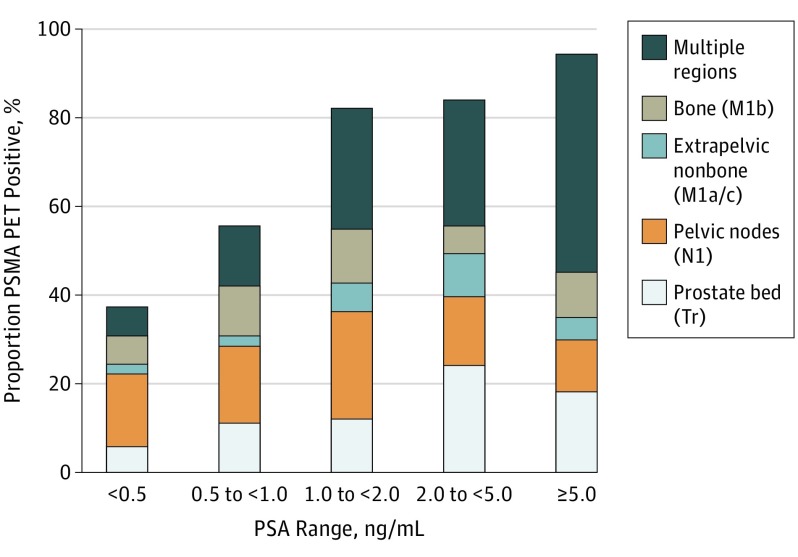
Maybe, too, I’ve placed too much faith in the scan’s ability to detect anything at my PSA level. But with a PSA level hovering around 1.0 ng/mL I thought we would have a decent chance of detecting something (chart below).

Detection Rate on a Patient Basis Stratified by PSA and Region Tr indicates prostate bed only; N1, pelvic nodes only; M1, extrapelvic only. Proportion of patients with 68Ga-PSMA-11 PET positive findings were stratified by PSA range and region of disease in accordance with PROMISE. https://pubmed.ncbi.nlm.nih.gov/30920593/

Needless to say, I’m truly glad that my PSA didn’t rocket even higher and that my scan didn’t light up like Times Square. Having definitive answers, though, would be the icing on the cake.


As far as the PSMA PET scan itself, it was pretty easy and took two hours to go through the entire process. I was instructed to drink 500 ml of water starting 2 hours before the scheduled scan time, and that was the only preparation needed.

I arrived at the hospital at 8 a.m. and was brought back to a radiation-proofed exam room where the technician started and IV at around 8:15 a.m. The 68Ga tracer was ready for injection around 8:40 a.m.

Around 9:30 a.m., the technician brought me back to the scanner where I got positioned on the bed and we began the scan which took 45 minutes. The scanner was very quiet (I could have dozed off) and large enough that it wasn’t claustrophobic. I was out of there by 10:15 a.m. and on my way home. Piece of cake.


On a related note, this was the longest it’s ever taken me to get the PSA test results posted online (hence the delay in this post). I actually called the clinic to get them over the phone because they still weren’t available online today (Thursday). The nurse I spoke with was very helpful and said, “We’re facing staffing issues and, well…” stopping herself in mid-sentence, probably remembering that the call was being recorded and not wanting to make a statement about the current environment for VA employees at the moment. I fear that this may be a precursor of things to come.

Be well!

Gallium supply to the U.S. cut off by China

This headline on the AP News feed caught my attention this morning:

China bans exports to US of gallium, germanium, antimony in response to chip sanctions

When you read the article, it omits any reference to gallium being used in medical diagnostics, so I have to wonder if this ban will adversely impact the ability to do 68Ga PSMA PET scans.

That question led me to a quick Google search on the production of 68Ga that yielded:

I’m no nuclear physicist or radiopharmaceutical guy but, given that process outlined above, it sounds to this layperson that PSMA PET scans could possibly be impacted.

Or I could be completely out to lunch, reading far too much into the story.

It’s definitely something to keep and eye on going forward, as I’m guessing another PSMA PET scan is in my future in January or February.

Day 4,832 – PSMA PET Scan Results

No evidence of recurrent prostate cancer or metastatic disease.

I know I should be excited but, at the same time, I don’t think I’ve been so frustrated by “good” news. Thanks to the steady increase in my PSA, we know something is happening somewhere, and I was really hoping this scan would end the game of cat-and-mouse that we’ve been playing trying to determine where the cancer is and what to do next. It didn’t.

Even though I recognized going into the scan that, at my PSA level (0.37 ng/mL), there was an approximate 40% chance of detecting something, I was hopeful it would come up with something this time. Silly me and my expectations.

Detection Rate on a Patient Basis Stratified by PSA and Region Tr indicates prostate bed only; N1, pelvic nodes only; M1, extrapelvic only. Proportion of patients with 68Ga-PSMA-11 PET positive findings were stratified by PSA range and region of disease in accordance with PROMISE. https://pubmed.ncbi.nlm.nih.gov/30920593/

The other thing I’m beginning to wonder is if I’m in that 10% of patients for whom PSMA PET scans don’t work. (You may recall that being mentioned in this video from the PCRI: Rising PSA After Prostatectomy.) I have to dig into that more to see if it’s just PSMA PET scans that use Gallium-68 as the tracer, or if that applies to any PSMA PET scan regardless of the tracer used. I’m guessing it’s the latter.

Choline and Axumin scans are another option, but they don’t start reliably picking up cancer locations until the PSA is at 1.0 ng/mL or higher. Assuming my current PSA doubling time (6.2 months) remains steady, that means waiting another 11 months before I hit 1.0 ng/mL for those scans to have a chance of seeing anything.

I’ll be putting together my list of questions for the urologist appointment on 13 February (I’m open to suggestions). I suspect we’ll have a good discussion on subsequent PSA testing, the value of knowing where the cancer is located at this point, and when to start hormone therapy.

Again, the silver lining in this is that my scan didn’t light up like the Las Vegas strip. I need to keep that in mind.

Happy Friday!