Month 181 – Physical Therapy for Incontinence

I’m of the mind that PT stands for Pain & Torture, not physical therapy. (Okay. I exaggerate.)

During my appointment with the urologist back on 7 October, we talked about how my incontinence seemed to be slowly worsening post-radiation. One of the options that he offered up was pelvic floor therapy, and I decided to give that a try.

Unfortunately, the VA doesn’t offer that therapy in-house, so they had to arrange for community care. That process took until mid-November to get the appointment set up, and I just had my first appointment last week.

I was expecting more instruction on Kegel exercises, perhaps with the biofeedback device that they used on me pre-surgery to train me on how to do the exercises. But that’s not what’s happened so far.

The physical therapist explained that many of the muscle groups in your legs and torso can have an impact on your pelvic floor muscles, too, as they’re all connected as part of a larger system. By stretching and strengthening them, we could see improvements in the pelvic floor. At first, it sounded like a bit of phooey to me, but I’m approaching this with an open mind and giving it a shot.

I’ve had just two sessions so far, and we’ve focused mainly on stretching exercises impacting my hamstrings, glutes, calves, and torso, as well as doing squats and walking on a treadmill. Some of the stretches are bordering on turning me into a contortionist, which this soon-to-be 68-year-old body is fighting tooth-and-nail (hence, “Pain & Torture”). But they’re low impact and we’re taking it slowly so I don’t injure myself.

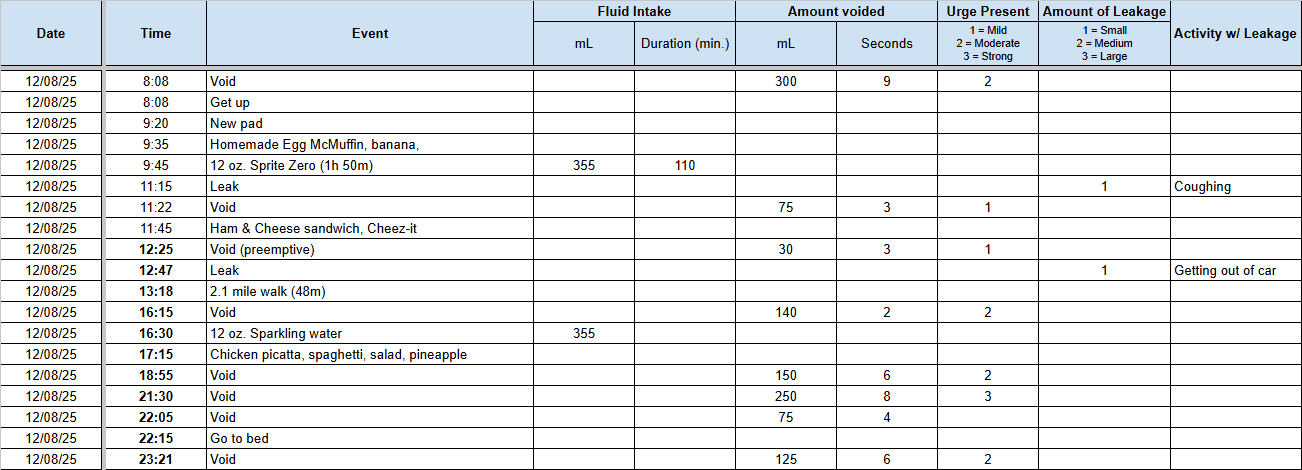
The other thing that she had me doing was documenting my fluid intake, output, and number of incontinence leaks for at least three days. We’re trying to establish a baseline against which we can measure any improvements. She had a hardcopy log which I quickly converted into a tracking spreadsheet. (You know I had to!)

She also made some recommendations to improve my diet and the types/quantities of beverages that I consume (less soda, more water).

Of course, I have to keep up with these exercises daily at home.

On the one hand, I’m a bit skeptical about this approach but, on the other hand, I do feel as though that, even after one week, I’ve noticed that I seem to be having fewer leak episodes and, the ones that I do have, seem to be smaller in size. We’ll let my spreadsheet determine if there’s a true trend, or if this is all in my head.

I have another appointment next week and then, in the new year, she mentioned that we might cut back to every other week sessions or even monthly sessions, depending on the progress that’s made.

One thing that I am a little concerned about is the potential cost of this.

Yes, the VA is covering the costs, but what many don’t realize is that some of us, based on our eligibility criteria, have to pay co-pays for our visits. Seeing the specialists—including the urologist—costs $50 per visit. Seeing a PT every week would rack up significant costs over time, and I’m not sure if the VA has an out-of-pocket cap on how much a veteran pays. (I’ll have to check into that.)

Assuming the holidays don’t mess it up, my appointment with the urologist to review my PSA results is on 30 December. We’ll definitely be talking about another PSMA PET scan and getting medical oncologists involved in my case.

—Dan

Header image: Botanical Building in holiday lights, Balboa Park, San Diego, California

Month 177 – Urinary Changes (?) & Appt. Update

Ugh. Monday night was brutal.

Excuse my use of the vernacular, but I had to pee seven times through the night, and that’s a record for me.

I did what I call a preemptive pee before going to bed at 10:02 p.m., and then got up to pee again at 12:11 a.m., 1:06 a.m., 1:47 a.m., 2:48 a.m., 3:49 a.m., and 7:07 a.m.1 It’s nuts. And exhausting.

I also try to keep track of my fluid intake and to slow it down before going to bed. Monday, I joined a friend for happy hour and had two pints of beer between 4 p.m. and 6 p.m., and then had another 12-ounce can of soda at 7:40 p.m.

While Monday night’s experience isn’t typical, I have noticed a trend in that general direction since the salvage radiation therapy three years ago, and in the last few months in particular.

Because it wasn’t a huge issue, I wasn’t doing dedicating tracking, but I would say that I was going to the toilet one to three times a night, and maybe four times on a bad night. Recently, it seems it’s more like two to four times per night.


In writing the above, I was going to make the comment that I stay away from caffeinated sodas because I thought that caffeine was a diuretic. I went to confirm that via a Google search, and then went a little deeper into the rabbit hole and asked if beer was a diuretic.

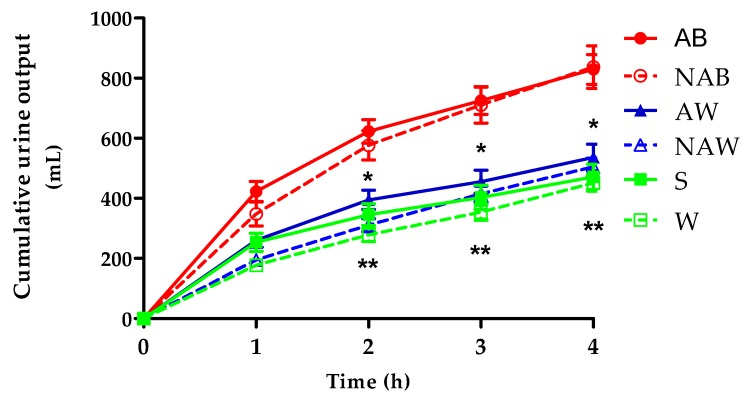
Of course, the answer came back that alcohol, in general, is a diuretic which I think I kinda-sorta knew but had forgotten. In that search, I came across a study entitled, The Diuretic Action of Weak and Strong Alcoholic Beverages in Elderly Men: A Randomized Diet-Controlled Crossover Trial.

It was a small study involving 20 men that measured, among other things, urine output at four and 24 hours after drinking alcoholic and non-alcoholic versions of beer and wine; spirits; and water. The one thing that surprised me was how much cumulative urine output there was for both beer and non-alcoholic beer, especially when the test subjects were given only 250 ml of beer (a U.S. pint is 473 ml). There was essentially no difference in output between the alcoholic beer (AB) and the non-alcoholic beer (NAB).

One question that I would have for the researchers is that, if alcohol is a diuretic, why is there essentially no difference between the alcoholic and non-alcoholic beer outputs?

Needless to say, this little exercise opened my eyes and I’ll definitely consider the timing and quantity of any beer consumption going forward.


On a related note, Tuesday, I had a 16-ounce soda around 6:30 p.m. that took until 8 p.m. to finish, and I only peed 3 times through the night.

Also on a related note, it seems that my flow, while constant and steady, seems to have slightly less pressure behind it. That has me wondering if there are post-radiation strictures forming or if there may be a growth forming in the area as my PSA increases. That, or it could all be in my head. I’ll keep an eye out for changes over time.


My next appointment with the urologist was scheduled on 30 September, but I received a call from the VA this morning cancelling the appointment. I can’t recall the VA having cancelled an appointment on me at any other time during the 12 years I’ve been going there. (They have, however, called me if an earlier appointment became available.)

The scheduler said that the urology clinic would be closed for the day so that they could interview new residents. I found that interesting because I recently read an article that doctors and nurses who were extended job offers by the VA between January and March 2025 were rejecting those offers at a rate of nearly 40%, which is quadruple the rejection rate during the same period in 2024. Given the uncertainty and instability that this administration has placed on the VA with its announced cuts, medical professionals simply don’t want to risk working there.

The first available appointment for me was 30 December 2025, so I booked it.

I did confirm with scheduler that there is an order in for a PSA test, and I can go in for the lab work on or after 1 September 2025. I mentioned to her that, if the PSA results came back significantly worse, I would be writing the urology clinic and asking for an appointment much sooner.


That’s it for now. Remember, that September is Prostate Cancer Awareness Month, so please share your story with others just to educate and increase awareness.

Be well!


1 I use an app called Simple Time Tracker to record each time I pee and when I drink. I use a widget on my phone’s home screen to just tap once which makes it very easy to record the event. The app, though, is set up to measure the duration of the event, so I have to tap a second time to stop recording the duration. Of course, it has the ability to export the data to—you guessed it—a spreadsheet.

Header image: Petco Park, home of the San Diego Padres baseball team, San Diego, California

Day 5,188 – A Wee Problem

I’ve been debating whether to write this post but figured that I’ve never shied away from sharing the gory details of the total prostate cancer experience. So if you don’t want to read about my latest adventure with incontinence, you can check out the trip report of my trip to Death Valley last week.

In fact, the issue began as a result of my trip to Death Valley.

After four days of standing in the middle of the desert pretty much solo the entire time, I returned home Wednesday evening. Thursday morning, I can off to the clinic for my PSA test (it took 7 minutes and 38 seconds from check-in to walking out the door). But by Thursday afternoon, I was feeling a bit wonky.

By Thursday night, I was down for the count with a full-blown head cold/flu. I was both baffled by how I contracted it, and annoyed that I had. It had been several years since I’ve had a cold or flu.

Unfortunately, one of the symptoms that hit me hard and caused the incontinence issues was a nagging tickle in the back of my throat that had me coughing pretty consistently and, in many cases, pretty intensely. It sucked.

It sucked because coughing is perhaps the greatest trigger for my stress incontinence. The harder I cough, the more I leak.

I wear Depend Shields in my daily life, and I can get by with one or two pads a day. But by the weekend, the coughing and resultant leaking exceeded their capacity. I had one coughing fit that had me fill the pad, overflow, and soak my jeans. Not fun. Through the weekend and into early this week, I was going through multiple pads a day and doing several loads of laundry.

I toyed with the idea of running to the store to get Depend Guards, the pads with more absorbency and capacity, but I didn’t want to risk embarrassing myself in the middle of Aisle 12 at the grocery store. Plus, I was probably as contagious as Typhoid Mary, so that wouldn’t have been a good thing, either.

I was taking some cold/flu medicine that helped reduce the cough—the root cause of my issue—and I just rode out the storm for a few more days. Today, a week after this all kicked in, I’m back to my good ol’ self getting by with the occasional drip and dribble.

The lessons learned for me are to keep the cough medicine on hand to help reduce the root cause, and to keep a supply of Depend Guards on hand to do a better job of controlling the mess.

Now you know why I may have been hesitant to share this. But, hey, it’s for educational purposes, right?


On a related note, I was successful in getting my appointment to review my PSA results moved to an earlier date. It’s now 18 February 2025 (four weeks is better than four months). I’m okay with that.


Unless you’ve been living under a rock the last two weeks, you already know that southern California has been ablaze with wildfires. Luckily, up until this point, they have stayed clear of San Diego for the most part. Until today.

This little gem popped up about 6 miles / 10 km from my house this afternoon:

View of the Border Fire on Otay Mountain taken from the vacant lot down the street from my house.

It’s grown to about 600 acres / 240 hectares in about six hours, and we’re expecting high Santa Ana winds this evening. It’s in a very mountainous area, and air crews have been working the scene all afternoon. Luckily, it’s adjacent to a large reservoir, so there’s plenty of water for the helicopters to access. We also have rain in the forecast for the weekend for the first time in months (San Diego has had the driest start to the wet season since they began keeping records in 1850. We’ve had only 0.14 inch / 3 mm of rain since 1 July 2024.)

Of course, I’m concerned and I’ve made preparations to leave if need be. But given the location, the fact that the reservoir is between me and the fire, and the prevailing winds are keeping the smoke south of me, I’m hopeful that my neighborhood will be unaffected.

I’ll keep everyone updated over the next day or two.

Be well.

Header image: Courtyard at The Ranch at Death Valley National Park, California

Day 5,134 – Clean Pathology Report

Just a quick update to report that the two polyps removed from my colon during the colonoscopy came back as “tubular adenoma” polyps, which are the pretty normal, precancerous polyps that are found in most patients. Less than 9% of tubular adenomas become cancerous.

The doctor recommends doing a follow-up colonoscopy in three years.

On a related note, the blood in my stools has virtually disappeared since the procedure. There have been only two incidents where there was even a faint hint of blood, so that’s a good thing.

Hard to believe that December starts tomorrow. How’d that happen?!?

Be well.

Day 5,127 – Colonoscopy Results

No one can say I do things half-assed. I got a perfect 9/9 score on the Boston Bowel Preparation Scale. Clean as a whistle! 🙂 (I didn’t even know that there was such a scale.)

Yesterday’s colonoscopy went well, although it was a little different from the last one I had six years ago. The last one, I was knocked out with anesthesia and don’t remember the procedure at all. This one, I had “moderate (conscious) sedation” and was able to have conversations with the team and watch the procedure on a monitor, although my mind was drifting in and out of focus throughout.

Before we started, I had a good conversation with the doctor about my salvage radiation therapy and the possibility of radiation proctitis given the occasional blood in my stools. She was appreciative of the detailed information to help her in doing the procedure. I really stressed that I didn’t want the scope or the inflation of my colon to do more damage than what may already be there.

There were two polyps that were removed during the procedure and will be sent off for pathology. The first was in the transverse colon, and the second in the sigmoid colon, not far from the rectum. (I didn’t think to ask how long it will take for the pathology to come back, but I’m assuming it will be about two weeks.)

The sigmoid polyp was described as, “erythematous and friable.” Erythematous means the mucosa is red and inflamed due to a buildup of blood in dilated capillaries; friable describes how easily the mucosa can be damaged by a biopsy instrument or endoscope.

Because I didn’t read her printed report—with 13 color photos and map of my colon—until I got home, I didn’t get to ask if she thought that could have been caused or aggravated by the radiation therapy being closer to the rectum.

She also found “a few non-bleeding small angioectasias in the rectum, consistent with chronic radiation proctitis,” which are dilated, thin-walled blood vessels (think spider veins) that can occur anywhere in the gastrointestinal (GI) tract. I watched her zap those with “argon plasma coagulation (APC).” She described that as cauterizing the vessels to stop them from possibly bleeding into the GI tract.

Pending the outcome of the pathology on the polyps, she recommended a follow-up colonoscopy in three years. Yippee!

Time will tell if the sigmoid colon polyp removal and APC did the trick to stop the blood in my stools (hopefully, there are no new side effects from the APC). I guess time will tell on both counts.

Next up: Get through the holidays and PSA test sometime in late January.

Happy Thanksgiving! (I’ll get a 0/9 score after Thanksgiving dinner. 🤣)

Header Image: San Diego, California skyline at dusk.

Day 5,118 – Urologist Visit

I met with the urologist this afternoon to go over my most recent PSA test results and the plan going forward. In a nutshell, we agreed to remain in limbo for another three months and retest the PSA in January and consider a PSMA PET scan if warranted at that point. (She was a bit skeptical that the PSMA PET scan would be conclusive even at my current PSA of 0.69 ng/mL.)

The urologist thought it was a little premature to start talking about androgen deprivation therapy, but recognized that that’s the next likely step down this path. I mentioned that, when I met with the urologist and medical oncologist in February, one suggested ADT at metastases and the other suggested starting at a PSA of 2.0 ng/mL. She said she could understand both positions.

Bottom line is that I continue to be in this sort of “no man’s land” of prostate cancer. We know it’s there; we just don’t know where, and we don’t want to pull the trigger on ADT prematurely. So more waiting.

One other thing that we discussed was radiation proctitis.

I’ve been sitting on this little tidbit for a while now, but I’ve been noticing blood in my stools. It initially appeared as spots a little smaller than a dime coin (~ 1 cm) but, over time, it has subsided to a small streak or a hint of blood. You know me: I had to create a spreadsheet to track it, and it’s been occurring in about ten percent of my bowel movements. That makes me feel better that it isn’t happening each and every time—that might indicate a larger problem if it were happening every time.

Fortunately, I haven’t had the diarrhea or mucus discharge that can come with more severe cases of radiation proctitis.

I mentioned this to my primary care physician during my appointment on 4 November, too. Both he and the urologist recommended a colonoscopy to check out what’s really going on. That joyful experience is scheduled for Friday, 22 November. Yippee!

I did come across this continuing education paper that gives a good overview if you’re really interested in learning more:

Radiation Proctitis

So the journey continues. Stay tuned for the next installment.

Header image: San Diego skyline and Mission Bay from Kate Sessions Memorial Park

Fourteen Years

Yep. It really has been fourteen years that I’ve been on this adventure. That’s a good thing considering that too many men don’t make it this far after their diagnosis. Of course, it would be better if none of us ever had to go down this path in the first place, but these are the cards that we’ve been dealt and we’re forced to soldier on.

In the past, I’ve railed against people who said that prostate cancer is an “easy cancer.” My views on that may be evolving over time into it being an easier cancer. Even that may not be an accurate way of describing it.

The treatment for other common cancers can be much more aggressive, adversely impacting quality life in much harsher ways much earlier on than some of the initial treatments for prostate cancer. With prostate cancer, you may have a snip-snip here or a zap-zap there and you’re on your merry way for years with a few possible side effects. With other cancers, you may have surgery, radiation, and chemotherapy all coming right out of the gate and, in many cases, your chances of making it to five years are quite low (see five-year survival charts below).

However, with prostate cancer you can be on this ride for decades before you get to the harsher advanced treatments like hormone therapy and chemotherapy. In the interim, though, you’re dealing with the physical impacts of early treatment (incontinence, impotence, etc.), as well as the psychological and emotional stress associated with each new PSA test result every three to twelve months over those same decades. Over time, both of those impacts—the physical and emotional—take their toll.

Don’t get me wrong. I am thankful that, out of all the cancers out there, I had to get the one with one of the highest survival rates of all of them. I guess I just want folks to know that it’s still cancer, and it’s cancer that you have to deal with—in ways big and small—on a daily basis for decades.

It may be easier, but it isn’t easy.

Month 161 – Crappy Development

If you’ve been reading this blog from the beginning, you already know that no detail is spared in the telling of this prostate cancer tale. If you haven’t read some of the early, gory details, well, buckle up, Buttercup.

Let’s talk bowels and 💩.

LAST CHANCE. If you don’t want to follow along, check out my travel website HERE or my photography website HERE.


One of the known possible long-term side effects of radiation when it comes to prostate cancer is issues with your rectum and bowels, and those side effects can manifest themselves years after the radiation was completed. (It’s been 19 months since my last zapping session in August 2022.)

Something has changed with my bowels in the last few months, and I’m wondering if this is the beginning of those side effects.

The engineer in me is trying to evaluate different variables to see if these changes could be the result of something else.

As a baseline, I used to have one bowel movement a day in the morning and I was good for the day. Also, I’m a creature of habit, and my diet really hasn’t changed at all, so that’s likely not a contributing factor.

One other thing is the timing of the onset of my symptoms. It’s about the same time that I started my daily walking regimen in earnest in February. I doubt they’re related, but it is noteworthy.

So what’s different? Well:

  • About half the time, I’m now having two to three bowel movements a day. One recent day, there were five over the course of the entire day.
  • My stools have changed from well-formed “logs” to thin, soft “snakes” or “ropes” that tend to fall apart.
  • I find myself having short periods where I’m quite gassy and flatulent without any likely dietary cause (e.g., not eating frijoles for breakfast, lunch, and dinner).

The silver lining in this cloud is that I haven’t had any increases in bowel urgency, so this is quite manageable at the moment. I will admit, though, that there have been a few times when I’ve been on my daily walks when I felt the need to pass gas, and I felt I was on the edge of getting more than I bargained for if I did. Luckily, no accidents yet.

I haven’t done a ton of research on this yet, but a study out of Sweden, Salvage radiotherapy after radical prostatectomy: functional outcomes in the LAPPRO trial after 8-year follow-up, looked at the long-term side effects of salvage radiation therapy. The summary of their conclusions on bowel function:

Fecal leakage was more common after radiotherapy as found in answers to question about ‘accidentally leaked liquid stool’ with 4.5% in Radiotherapy group versus 2.6% in Control group, ‘accidentally leaked liquid stool’ once a week or daily, Odds ratio (95% CI): 1.90 [1.38; 2.62]), ‘mucus from anus’, 6.8% versus 1.5% (4.14 [2.98; 5.76]), ‘leakage of feces in clothes’, 5.6% versus 2.4%, (2.18 [1.18; 4.04]), respectively in Radiotherapy and Control groups (Figures 2, 3A and 3B and Tables S2 and S3 in the Supplement). Bleeding from the anus was more common after salvage radiotherapy, 8.6% versus 1.2% in control (3.21 [2.32; 4.44]) as was flatulence, 25% versus 14% (1.82 [1.40; 2.37]), whereas distress due to bowel symptoms did not differ, 7.8% versus 6% (1.27 [0.90; 1.80]). Defecation urgency was more common in the group given salvage radiotherapy as reported in answers to questions about need ‘to rush to the toilet’, 14% versus 5% (3.22 [2.46; 4.21]), ‘open your bowels again within 1 hour’, 17% versus 9.4% (1.53 [1.18; 1.98]). There was no statistically significant difference in ‘how often do your open your bowels’, 3% versus 2.5% (1.23 [0.92; 1.64]).

Carlsson, S., Bock, D., Lantz, A., Angenete, E., Koss Modig, K., Hugosson, J., Bjartell, A., Steineck, G., Wiklund, P., & Haglind, E. . (2023). Salvage radiotherapy after radical prostatectomy: functional outcomes in the LAPPRO trial after 8-year follow-up. Scandinavian Journal of Urology58, 11–19. https://doi.org/10.2340/sju.v58.7318

Another silver lining: no fecal leakage, mucus, or rectal bleeding so far. Woo-hoo!

Needless to say, this will be part of my conversation with my primary care physician on 9 May and with the urologist on 14 May. I’ll likely rope the radiation oncologist into the conversation, too.

I was reluctant to talk about this earlier because I wasn’t sure if this was a temporary thing or something longer term. This has been pretty persistent for about two months now, so I thought it was time to talk about it. As long as things don’t worsen, I can live with what’s happening right now (although I would prefer that I didn’t have to if I’m being perfectly honest).


I’ll have to admit that I’ve been feeling a general sense of anger and perhaps regret about this whole situation.

The source of those emotions isn’t from the side effects themselves, per se, but rather from this entire process that tends to move patients in the direction of what is considered to be overtreatment.

I may flesh this out in a longer, separate blog post one day, but when I see the likes of Dr. Scholz and others beginning to say, “Hmm. Maybe we should let the PSA rise so we can find out where the cancer is at before we start the treatments that could have life-long side effects adversely impacting the quality of life,” I get annoyed. Annoyed because I’m beginning to agree with that line of thought more and more, instead of the old, “It’s better to attack it while the PSA is low even though we don’t know exactly what’s going on.”

It’s frustrating because, my gut instinct all along was to delay until we knew where the cancer’s location, and I let the more rapid increases in my PSA, my shortening PSA doubling time, and the current “industry” guidance to act sooner rather than later get the better of me.

The frustration will continue as I move into the next chapter. I’ve been looking for studies on the best time to start androgen deprivation therapy (ADT) for someone in my situation and, from what I’ve seen so far, the guidance seems to run the full spectrum of starting early or delaying for years. Throw in the decision of whether it’s just ADT or ADT plus some sort of antiandrogen therapy, too.

I get that there are advances in research and technologies and that things are constantly changing. But at this point, I’d be happy for a clear path forward without adding additional side effects. (But I’m experienced and knowledgeable enough to know that’s just a pipe dream at this point.)

Rant over. Time to invest in some toilet paper company stock.


What’s next?

  • 1 May – PSA test
  • 9 May – Appointment with primary care (routine physical)
  • 14 May – Appointment with urologist.
  • TBD – Another PSMA PET scan if my PSA warrants it OR wait another three months for the next PSA test.


Month 149 – Slow Flow?

I may be stepping into new post-radiation territory for me—emphasis on may. That, or it could all be in my head.

Over the two or so weeks, I’ve noticed that when I go to empty my bladder, there are times where my urine flow seems to be a tiny bit slower and weaker that it was not too long ago. The engineer in me really wants a quantitative way to measure it to confirm whether or not my mind is playing tricks on me, but that isn’t going to happen.

Fortunately, there is no pain when urinating or blood in the urine, nor are there any issues with intermittent flow.

I’m hoping that this isn’t an early sign of radiation-induced strictures that are starting to form that have to be dealt with at some point in the future.

On the plus side of things, my frequency of needing to run to the bathroom is down considerably, especially at night. I can make it through most nights without having to run to the toilet more than once, if at all. But that means that my bladder is full in the morning, and the flow coming out on that initial morning pee isn’t as “fast and furious” as it was a few weeks ago.


I’m still waiting to hear from the radiation oncologist’s office concerning my six-month follow-up appointment which, should happen in May. I do have an appointment with the VA urologist on 30 May, and I may try to get another PSA test done before then.

Other than that, not much else to report this month. Be well!

Header Image: Spring in the Neighborhood

Month 147 – Delayed Reactions?

It’s hard to believe that it’s been over five months since I wrapped up my salvage radiation therapy (SRT) and concurrent androgen deprivation therapy (ADT). For the most part, things have been good, but two things have popped up along the way. One insignificant, the other has me wondering what the future will hold.

Where Oh Where is My Body Hair?

The first seems to be a delayed reaction of the ADT/hormone therapy which was administered nine months ago on 3 May 2022. It seems the loss of testosterone is taking a toll on my body hair.

Maybe this has been going on for a while and I just now noticed it (I mean, really, who monitors the status of their body hair on a regular basis???).

I wasn’t a very hirsute guy to begin with, but I noticed in the shower the other day that what little chest hair that I did have has been diminished by at least half to two-thirds. A little oddball patch of hair on my back right below my collar line is now pretty much gone, and let’s just say that there’s less hair in a few places further south.

Is it a big deal? Of course not. Just superficial, but I find it interesting that it appears to be happening so long after the Eligard injection. Maybe that’s normal for ADT. I’m not going to worry about it (unless my beard starts falling out, then I may be a little concerned).

GI Changes?

The second issue has to deal with what I’ll probably imprecisely call gastrointestinal changes or perhaps a prelude to the thing I dreaded most: radiation proctitis. Whether they’re related to the radiation therapy or not, I don’t know yet. I thought radiation proctitis took longer to take root, but I could be wrong.

I haven’t changed my diet much compared to pre- and post-radiation, so I don’t think it’s diet causing these issues. (Although I did buy a bag of pistachios recently and, with hindsight, they may have aggravated them.)

Pre-radiation, I was a pretty regular guy when it came to bowel movements. Once in the morning and I was good until the next morning. Now, five months after radiation, I’m noticing that I’m having two to four bowel movements a day about a third to half of the days. Some of those extra bowel movements come on with some urgency. So far, it’s not been an issue or caused an accident, but it does raise some concern as to what it may be like a year or two from now if it is, in fact, related to the radiation therapy.

The other GI issue that has popped up is that I seem to have more intestinal gas than I used to. (And, no, it’s not related to San Diego’s wonderful Mexican cuisine!)

The thing that concerns me about being so gassy is the fact that, when I pass gas, it comes out with less effort than it used to. In fact, sometimes, it almost just slips out and I have to wonder if it’s going to be only gas that comes out, and nothing extra (fart vs. shart). My concern is about rectal control over the long term if I’m experiencing something like this now. Again, something to monitor (you know me—I’ve started a tracking spreadsheet) and discuss with the doctor.

What’s Next?

My last PSA test was on 1 November, and we agreed to check it again in March, so I’ll figure out a date to hit the lab for the bloodwork. You may recall that post-radiation PSAs taken in September and November both came in at 0.05 ng/mL, so we’ll it will be interesting to see if it goes down, stays the same, or goes up again. Any wagers???

I should be meeting with the radiation oncologist again in May for my six-month follow-up from the last meeting.

That’s a Wrap

That’s about it for this month. You may recall that last month, I spent my birthday in Death Valley National Park. After visiting there, I headed over to Zion National Park for a short visit. You can check it out by clicking HERE.

Header Image: Canyon in Zion National Park along the Virgin River