Month 87 – Adapting and Researching

Ever since my December meeting with my doctor to review the latest uptick in my PSA reading to 0.10 ng/ml where he told me I need to begin to think about salvage radiation therapy, it’s as though the clock has been turned back to when I was first diagnosed. That makes this all very real once again. We’re getting closer to having to make a decision to move from monitoring to action.

My emotions have been all over the place—from mad as hell at the world to ready to bawl at the drop of a hat—and I felt compelled to research as much as I could, as fast as I could even though my next PSA and doctor’s appointments aren’t until April. On the good news front, the peaks and valleys on the emotional roller coaster have diminished some over the last two months. They’re still there, but not as bad as they initially were.

IMG_4828
San Diego at Night

I’ve been spending a good amount of time (perhaps too much) researching and hanging out in the advanced prostate cancer section of various online support groups. That’s been both helpful and a tad frightening. It’s been helpful because I’m new(er) to the advanced prostate cancer discussion, and I’ve been learning more about the different treatment options, protocols, and latest research. It’s been frightening because reading the first-hand stories—while valuable and necessary—has stoked my fears of the treatment side effects.

I did come across one thing in my research that I’ll definitely discuss with my doctor in April.

We know biochemical recurrence after prostatectomy has been widely defined at 0.2 ng/ml for quite some time, yet more and more research is indicating that salvage therapy should begin early in order to have the best chance of success. Some suggest starting SRT before hitting the 0.2 ng/ml threshold.

Of course, as we all know in the field of prostate cancer, nothing is clear-cut. You can easily find research that has conflicting recommendations.

I came across Stephen J. Freedland’s 2005 study (co-authored by Alan Partin and Patrick Walsh—heavy hitters in the prostate cancer world from Johns Hopkins) that shows I may not have to do anything other than continue to be monitored given my status (PSA = 7, PSADT > 15 months, time to recurrence > 3 years). In fact, he writes:

“It is amazing to me that for a man who has all the low-risk features – if his PSA doubling time is greater than 15 months, his Gleason score is below 8, his PSA comes back after three years – his odds of being alive 15 years later are 94 percent.” These men do not need treatment, he adds. “If we know that 94 percent of these men are alive and well 15 years after surgery with no further treatment, anything we do to treat them is unlikely to improve on that, and probably would only affect the quality of life.”

That’s quite encouraging for someone fearful of side effects and loss of quality of life. Combine that with the Pound study done in 1999 that said it takes on average eight years to metastasis after BCR and, on average, another five years to death after metastasis without any additional treatment, and you’re building a stronger case for doing nothing other than continued monitoring for those of us who are averse to treatment side effects. At least in my mind at the moment.

You can read an abbreviated summary of the Freedland study in the Johns Hopkins newsletter, Prostate Cancer Discovery, here, and the full study as published in JAMA here.

I’m slowly adapting to this new path that I’m on, and I’ll work to find the right balance to stay away from the online support groups and the Google machine to maintain a sense of sanity. I fear, however, that controlling the emotional roller coaster is going to be far more challenging from this point forward (steer clear or pass the tissues). Just a hunch.


One related footnote. I’ve not yet met with a radiation oncologist since my PSA started going up in September 2015. If it stays the same or goes up again in April, I’ll ask the urologist for the referral just to start the conversation and learn more from his/her perspective.

Three Weeks

It was an emotionally draining day at work today.

We provide support to patients and their families at a local hospital, and a case worker came to our office looking for activities for a patient in his early twenties and his parents to do over the weekend. Normally, that’s a common request. However, the case worker explained that the patient had only a few weeks left on this planet, and the doctor was urging him and his parents to get out of the hospital and do something—anything—with their remaining time together.

I was crushed.

I’m pretty good about compartmentalizing patient stories and not letting them affect me too much. Not this time. It hit too close to home, at least conceptually. Of course, the young age of the patient added to my reaction as well.

If your doctor told you to go out and make the most of your last three weeks on Earth, what would you do?

Talk about a reality check on your own mortality.

Month 86 – Struggling

First things, first. I’m struggling to thaw out after spending five days in frigid (-4° F / -20° C) Chicago with my sister and her family this past weekend. You may well be asking, “Who in their right mind flies from San Diego to Chicago in January?!?” Sadly, that would be me.

I contemplated returning for Christmas but had sticker shock on the cost of the airfare, so I opted to return for my birthday last week at a quarter of the cost. This birthday was one of those annoying milestone birthdays—the 30th anniversary of my 30th birthday—and that definitely warranted an appropriate celebration. Of course, anyone in our situation knows that any birthday you’re around to celebrate is a good birthday.

But what I’m really struggling with is this whole notion of recurrence and what to do about it.

I’d like to think that throughout my life I’ve been a generally optimistic, my glass is half full kind of guy, but one with a healthy dose of reality attached to that optimism. Hope for the best, plan for the worst, and recognize the inevitable. I understand the value of a positive attitude, however, I’m increasingly finding that I have a diminishing tolerance of false optimism. “You got this. You’re going to kick cancer’s ass!” Really? Are you sure about that? How do you know? And at what cost? The $109,989.11 invested in my prostatectomy (the real number, mostly paid by the insurance company) doesn’t seem to be paying off.

The costs that I’m talking about aren’t just financial, either. There are emotional and physical costs as well.

With salvage radiation therapy (SRT)—the only option that still has a curative potential—there’s the risk of increased incontinence, loss of sexual function, bowel control issues, and fatigue during the treatments. Chatting with other patients in online forums or through their own blogs, some of these issues don’t manifest themselves until well after the SRT treatments end. And all of this for a 30%-55% chance of having no evidence of disease five or six years after SRT ends.

With androgen deprivation therapy (ADT) (hormone therapy), there’s the loss of libido and sexual function, mood swings impacting relationships, hot flashes, loss of muscle mass, increased risk of osteoporosis, and significant depression. Of course, ADT is not curative, so you get to suffer through those substantial side effects for a longer period because ADT prolongs your life.

It’s easy to get excited when you see your PSA plummet after starting ADT, as it impacts those androgen-dependent cancer cells. But guess what? There are also androgen-independent cells floating around that the ADT won’t impact at all, and it’s those cells that will start driving the PSA back up again and that will ultimately kick your ass.

Being a data-driven numbers guy, I’m also struggling with how to quantify these potential impacts on quality of life.

When you’re in an online or even in-person support group, you have to remember that there’s a self-selection bias taking place that will skew your perspective to the bad. Think about it. Almost everyone who’s in the group is there because they’re at some stage of dealing with this disease and having issues that need answers. Who you don’t see are those patients who are outside of the group who have success stories in dealing with their cancer and have simply stepped away from that chapter of their life.

For me, I want to know the ratio of who’s in the group versus those who are outside the group. Is it like an iceberg with 10% of the patients in the group being the visible ones and 90% of the success stories out of sight? Is it 50-50? 30-70? 60-40? Knowing the answer to that helps me understand the risks better.

I’ve stumbled across a few studies that talk about the likelihood of potential side effects from SRT but I would like to see more. The risks do seem to be relatively low from what I recall and from what my doctor is telling me, but forgive me if I’m skittish about accepting even low risk given where I’m at. (My surgeon forewarned me that there was a 20% chance the cancer would return; I guess I’m just not feeling all that lucky at the moment given my track record.)

Similarly, with ADT, it seems that most everyone suffers some form of side effects, but each person is impacted differently. Again, the numbers guy in me would love to see some sort of study that says, “While on ADT, my quality of life has been reduced by __% in each of the following areas…” I’ve heard patients say that they are “just a shell of the person I was once” or that the ADT has them remaining in bed 20 hours a day. Of course, there are others who seem to have only mild side effects with negligible impact on their daily lives. What’s the distribution like between those two extremes? Knowing the answer to that would be very helpful in decision making.

Given all that, I’m struggling with one more thing, and it may scare or even offend some readers.

“You’ve got plenty to live for. You need to fight. You need to be strong. You need to be a warrior and defeat this disease,”—all things that I’ve heard along the way. There’s this pervasive attitude that other patients, family members, and the healthcare system have that we must do everything we can to go on living for as long as we can at all costs.

Why?

Please don’t panic and think that I’m ready to check out tomorrow. I’m not. There is plenty to live for, and that is precisely why I ask the question.

Is being a shell of yourself and staying in bed 20 hours a day really living, or is it merely existing? Would you rather live a more full, active life for 8-10 years, or merely exist for 20 years?

What about the impact on your significant other and those closest to you? Yes, they’ll be by your side every step of the way. Do you think they would rather remember your last years as being present and engaged for 8-10 years, or withdrawn, moody, depressed, and barely capable of functioning for 20 years?

What about the financial impact on your family? Would you rather take a few bucket list trips with your significant other and family in your remaining 8-10 years, or would you rather take out a second mortgage on your home to pay for the drugs and latest technology tests that will keep you existing for 20 years, placing a financial burden on those who survive you?

Before you send me all sorts of hate mail, I know those are extreme examples and that there are many shades of gray between the extremes, but, in the absence of studies or data that mitigate those examples, that’s what’s rattling around inside my analytical, pragmatic mind at the moment—right or wrong. It’s just the way I’m wired. The good news is that I have time to find those studies and data that hopefully will give me the information I feel I need to make decisions going forward.

It takes strength to go through the radiation, ADT, and chemotherapy if that’s the path that you choose. It also, however, takes strength to say, “No. I’d rather live without those debilitating side effects for as long as I can, even if it means it will be for a shorter period of time.”

Thirteen years ago, my mother was diagnosed with mesothelioma, the incurable cancer associated with asbestos exposure. She was given the option to participate in some clinical trials that may have extended her life three to twelve months, but she refused. “I don’t want to be someone’s pin cushion when the end result will be the same.” She wanted to retain control over her life for as long as she could, and she did so to the best of her ability. Sadly, though, it was only a matter of months before she died, but she went out on her own terms.

That’s how you kick cancer’s ass.

I would like to think that I’ll be able to do the same.


Just a note. Because I knew I would be traveling, I wrote this post over a week ago. While I was in Chicago, a fellow prostate cancer patient, Mark Bradford, replied to a question in an online support group, and it’s complementary to the topic of this post. The question posed was, “At what point do you get tired of fighting?” He replied:

I dislike framing this as a fight. You have a disease, and you seek treatment for [it] till you decide to stop. Being in treatment is not fighting and stopping treatment is not giving up. I was inoperable from the beginning and stage 4 soon after. My outcome was certain, so my priority was quality of life over quantity. I did HT [hormone therapy] until it stopped working, and cannabis oil throughout. I refused chemo as it would not cure me or significantly extend my life. Don’t let anyone say you’re giving up if you decide it’s time to stop treatment. I could not afford alternatives, so my choices were limited. If you have the means, do whatever seems right to you. But accepting reality is not giving up.

I don’t think that I could agree more with Mark’s comment about framing this as a fight and about being in treatment or stopping treatment.

Mark is nearing the end of his life, and you can read his very poignant blog, God’s 2 by 4: Mark Bradford’s Cancer Journal.

Another patient, Dan Cole, answered simply and succinctly: “Live the life you choose to live. That is winning the fight.”

I know I’m getting way ahead of where I should be given my current status but, if nothing else, this disease certainly causes you to prematurely contemplate your own mortality.

Day 2,459 – PSA Results

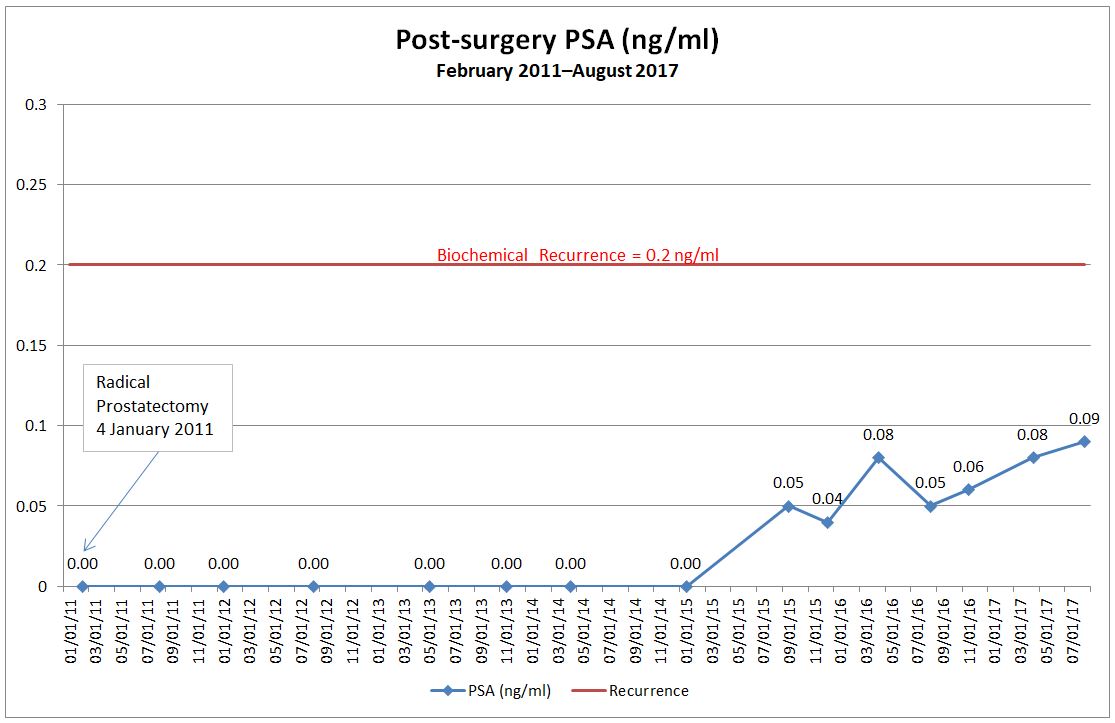
My silly little trend line that I slapped on my PSA tracking chart wasn’t so silly after all. It was dead on target. My latest PSA: 0.09 ng/ml.

Crap. (Or some other four-letter expletive.)

Even though I expected this (thanks, trend line), I’m still absorbing the significance of yet another increase in my PSA.

In a way, I’m glad to see the results that I have. Certainly not because I want the cancer to come back, but because it removes some of the doubt caused by the yo-yo readings last year. Now I can come to terms with the likelihood that I really am headed down the recurrence path, and I can focus on what’s ahead.

So those are my thoughts in the first 30 minutes since seeing the results online. I’m sure there will be more thoughts to follow. I have to admit that I’m unusually unemotional about this at the moment. That’s good.

I’m sure I’ll have more thoughts to share once this sinks in.


Day 2,343–A Struggle

I’m surprised by how much getting my PSA results 30 hours ago affected me yesterday and today. It’s been a real struggle.

Anger. That’s the word of the last 24 hours. I just want to scream, “Would you make up your fucking mind already?!?! Either come back and let’s battle this cancer shit head-on, or get the fuck out of my life once and for all!!” (Told you I’m pissed.) It’s the uncertainty that comes with each test result that’s getting to me. And the fact that this will happen every four months for the foreseeable future is growing really tiresome.

Logic tells the data-driven part of me that I’m okay—that I’m still considered to be cancer-free for now. It’s probably because I am so data-driven that I’m getting so angered and frustrated. Cancer doesn’t always follow a logical path; it doesn’t always fit neatly into cells in a spreadsheet. I need be better at accepting that fact. (You would have thought that I would have learned this after 6+ years of dealing with this.)

Cancer sucks.


Sorry if I offended with my language, but when I started this blog, it was intended to be a raw sharing of thoughts and emotions, and it’s something that I needed to do today, otherwise my head would explode. Really.

And, no, I’m not wishing for the cancer to come back. I’m grateful that I’m still here and able to whine about it. Truly. I guess frayed nerves, anger, and frustration are small prices to pay for longevity.


Day 2,210 – PSA Test Time

Time to buckle up for the next ride on the PSAnxiety roller coaster. I had my blood drawn this morning for my next PSA test. Now we wait, typically three days before seeing the results online.

On the good news front, I’ve been completely unemotional leading up to this PSA test. I’m not sure why, but it’s been a refreshing change from the last PSA tests.

My appointment with my doctor is on 29 December, and I’ll post my results as soon as I have them (and geekily update my spiffy little PSA chart).

Month 69 – On Reflection

It’s been a week since my last PSA results came in—it seems like eons ago—and I really have been able to just ignore them for pretty much the entire time. That’s good.

With the yo-yo movement in my PSA over the last 4 tests, I can’t conclude much of anything aside from the fact that there will be more PSA testing in my future.

PSA Trend 20160803

The engineer in me reflected on the last year of testing looking for some logical explanation.

I do remember that a year ago, just before the September test, I made the mistake of having an orgasm within 24 hours of the test. I thought that may have explained in the increase from undetectable to 0.05 ng/ml. But then the doctor threw in the possibility of the new ultra sensitive PSA test skewing the results. Two variables that weren’t present for the previous undetectable test.

For the December and April tests, I eliminated one variable by abstaining from orgasms for a nearly a week before the blood draw. The doctor asked me to abstain for two weeks for the August test, and I did.

If the next PSA test 3–4 months from now stays in the 0.05–0.08 range, I’ll be more inclined to think that this is a result in the change to the ultra sensitive test and nothing more. (Part of me wants to go to another lab for an independent test and see what it produces, but that will just introduce one more variable when we’re trying to eliminate them.)

At 0.05–0.08 ng/ml, I’m still well below the widely accepted biochemical recurrence threshold of 0.2 ng/ml. That generally makes me breathe a sigh of relief, and I think that I can come to terms with living with those numbers if that’s all it is.

But a UCLA study published in May 2015 showed that, under certain conditions, the ultra sensitive PSA threshold of 0.03 ng/ml was a good predictor of recurrence.  Yes, it was a small (247 patients) retrospective study, but that little fact has stuck in the back of my mind and gives me concern. (I wrote in more detail about it in my Day 1,768 post.)

There was also a Johns Hopkins study published in February 2016 that also indicated that low PSA levels measured by an ultra-sensitive PSA test were predictors of recurrence.

So I’m going to just wait until the doctor appointment on 23 August and see what she has to say about all this. It will be interesting—maybe even entertaining.

Day 2,093 – The Results

PSA Trend 20160803The results are in: 0.05 ng/ml.

I simultaneously breathed a humongous sigh of relief and got pissed off. “Will you make up your freakin’ mind already!?!?” Yes, I’m elated that my PSA actually came down from 0.08 to 0.05, but I’m pissed that this raises more questions than it will answer, and that I’m going to have to keep riding this wild roller coaster for the foreseeable future.

This round was particularly tough, emotionally. I usually never get worked up in advance of the blood draw but, before heading off to the clinic Monday morning, I was so nervous that I ate one spoonful of yogurt and decided that, if I continued, I’d be seeing that yogurt again going in the opposite direction.

When I finally saw that the results had been uploaded to my provider’s website tonight, my hand on the mouse was shaking and I truly didn’t want to click on the link to get the news. Not good. (By the way, I learned that my provider only uploads the data once a day, around midnight Eastern Time. That sucks.)

It will be interesting to see what the urologist has to say on 23 August. I’m sure part of it will be, “Let’s retest in December.” Yippee. I’m still quite concerned that I have a detectable PSA (albeit a low value) where I didn’t have before. What’s up with that?

Well, I’m spent. It’s time to call it a night. Thanks to everyone for your kind words, thoughts, and prayers.

Month 67 – Back to “Normal”

What a two months it’s been.

I’m finally back into a more normal routine after getting knocked off my horse with my PSA increasing to 0.08 ng/ml in April. The raw emotions have subsided and have been replaced with a constant, low-grade concern as I wait for my next PSA test.

One ironic thing that won’t let me completely purge the notion of cancer from my mind is the fact that my office is in a hospital and, every morning on the way to my office, I walk down a long corridor that leads directly to the “Radiation/Oncology” suite. And every day, I’m reminded that radiation may be in my future.

The urologist set my next appointment for 23 August, but she put the blood draw order into the system for any time after 1 July. I won’t go that early.

The engineer in me wants to make sure that the PSA tests are evenly spaced for easier analysis (geek, I know). The last two tests were almost exactly 4 months apart (3 December 2015 & 6 April 2016), so I plan on going in for the blood draw on or about 3 August to keep things consistent. It might make calculating PSA doubling times easier.


Just as I was putting the finishing touches on this post, I came across this article: Is standardization of the PSA cut point for biochemical recurrence after surgery a good idea?

Yet another study offering conflicting and confusing guidance. <sigh>


When you introduce cancer into your vocabulary, it’s impossible not to think about the end of life at the same time. Sure, none of us want to jump the gun and rush things, but it’s a natural extension of the word cancer.

My father died peacefully in his sleep 19 years ago next week. My mother, on the other hand, went through a grueling end ten years ago as mesothelioma and emphysema took away her ability to breathe.

When it comes our time to go, most of us would opt to die as my father did—quietly and quickly. Sure, it was hell on those of us who remained behind because no one ever expected it to happen; he was just 69 years old. For him, however, there was no extended suffering or pain.

The California End of Life Option Act went into effect this week, and I’m thankful that I now live in a state where I can have a say in how my life ends if this cancer thing ultimately gets the better of me.

Yes, I’m getting waaaaaay ahead of myself. The only question is whether more courage is required to make that end-of-life decision or to suffer through cancer running its natural course.

Mom wasn’t afraid of dying, but her biggest fear was that of suffering at the end. Her fears came true. I know she would have jumped at the chance to make her own determination on how to avoid that suffering if the option was available to her.

Again, I hope that I don’t have to worry about this for a very, very long time. I’ll settle on worrying about the next PSA test results for now.

Day 2,017 – Bone Scan

Today was the big bone scan day and all went according to plan. Get juiced up at 10 a.m. and come back at 1 p.m. for the scan. Near the end, I asked the technician, “Do you see anything that warrants concern?”

“Nope. Clean as a whistle,” he replied. I breathed a giant sigh of relief.

Of course, the technician’s interpretation is not the official interpretation, but I’ll take it for now.

Interestingly, after getting injected with the radioactive glow juice and before the actual scan, I went down to the urology department to make an appointment with the urologist, and there was this 30-something pregnant woman filled with attitude and for whom empathy was a foreign concept. When I asked to make the appointment, she pulled up the calendar and saw that I was already scheduled for late August. “You don’t need an appointment. You’re already on the calendar.”

I tried explaining that waiting 3 months for the results of a test that I was taking today was NOT going to happen, especially considering those results could show possible metastasis (at least in my mind). She had none of my argument initially, but eventually went off in a huff to talk to the doctor about setting up an appointment earlier. It’s set for 2 June. It kind of pissed me off, but I chalked it up to the kid in her womb kicking her in the kidney. (Way to go, kid!)

But now that I know what the technician told me, I’m going to email the urologist and have her confirm the official results. If everything was clean, I’ll cancel the 2 June appointment and just go back into wait until the next PSA test mode.


After leaving Ms. Panties-in-a-Wad, I had three hours to kill, and I opted to walk a mile and a half to the University Towne Center shopping mall. I figured it would help calm me plus help distribute the glow juice through my body.

As I’m walking along the north side of La Jolla Village Drive, the sidewalk just stopped and a narrow dirt path was all that was left to walk on for a city block. I thought that it was odd that posh La Jolla couldn’t afford 600 feet of concrete for us poor pedestrians.

As I was walking that path with waist-high weeds on either side, I had a flashback to my childhood. A friend of mine and I would play in the “prairie,” which was nothing more than a couple of adjacent, overgrown vacant city lots. There were dirt paths and mounds for our bikes, and the same tall weeds. It was a place for a youngster’s imagination to run wild with adventures.

After lunch, I made it back to the hospital for the actual scan. I arrived about 25 minutes before the scheduled time, and the technician was standing right there when I checked in. “Let’s do this,” he said, and off we went. Fine by me.

As I reclined onto the table, I couldn’t help but notice this colorful butterfly painted on the ceiling directly above the scanner. For some crazy reason, the German word for butterfly, Schmetterling, popped into my head and just stayed there.

Once the scan began, I started emerging from the tube, and the only thing that I could see what that silly Schmetterling on the ceiling. I thought, “Hmm, a metamorphosis? Emerging from my tubular steel and plastic cocoon and turning into a butterfly?”

So that was my day. How was yours?