Life After Radical Prostatectomy: 84 Months Later

So it’s been 84 months since my radical prostatectomy. How am I doing?

Status

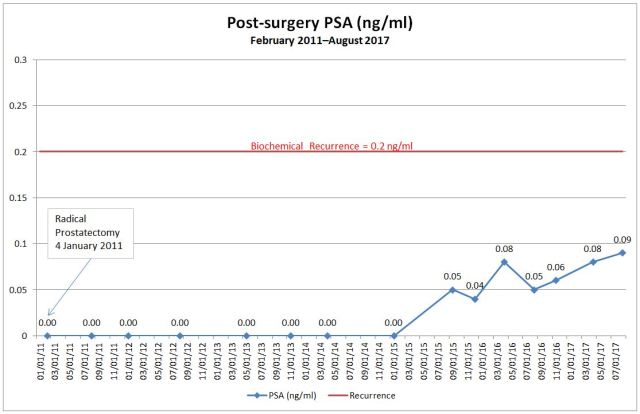
With my PSA increasing steadily over the last two years to the point where it’s now at 0.10 ng/ml, it appears that I’m on the path to recurrence. Needless to say, that’s not the outcome that I had in mind when I started this journey, but my surgeon did warn that approximately 20% of prostatectomy patients have the cancer return.

Emotions

My visit to the doctor in December went just as I expected it would, with one exception. I left the office feeling as though the wind had been knocked out of me. This whole notion of recurrence took on a whole new meaning when the doctor suggested that we’re going to have to start thinking about radiation in the future. It’s becoming real again. Since then, I’ve been doing okay. Not great. Not horrible. Okay.

Incontinence

I remain “dry” 98% of the time. There have been a few very long days at work where my body tired and, combined with the physical exertion at the end of the day, I was a bit more prone to leak. Rarely do I need to get up to go to the bathroom in the middle of the night—I can last 6-7 hours most nights.

Sexual Function

I continue to do so-so in the ED department. Remember, I have only one nerve bundle remaining, but I can get an 80%–90% erection most of the time. Some days are better; others are worse.

I do find that my libido is still there, and there are times through the day where I can feel things stirring down below. Not enough to obtain a natural erection—those days are gone—but enough that with a little stimulation, it would be much easier to achieve an erection.

Summary

Recurrence is the fear of every cancer patient because now your options become more limited and the costs of dealing with it—emotional, physical, and financial—begin to increase significantly. It’s time that I start seriously preparing for the trip down this fork in the road. The good news is that I have time with my PSA doubling time as long as it is.
Day 2,596 – Doctor Visit

I met with my doctor this afternoon to review my increasing PSA results, and it went just about as expected. There’s increasing concern, but things are progressing slowly enough that we can continue on the four month test cycle for now. That means I’ll be doing this all over again in April.

There were a few reality check moments in the conversation, though. I’ll get to those in a moment.

One thing I need to learn to do is shut up—at least for the first part of the meeting with the doctor. I’m not very good at letting the doctor talk and offer up his thoughts and recommendations and then ask the questions that I have. I just launch into a barrage of questions based on the research that I’ve done and assault the poor guy. On a positive note, he really didn’t dispute anything that I told him nor did he tell me that I was completely out to lunch on certain issues.

We reviewed the success rate for SRT, with various studies showing it to be 35%-55% effective at being progression-free at 5 or 6 years. (Here’s one.) We also discussed the potential side effects of SRT, and he did seem to believe that the risks were lower than I thought they may be.

The conundrum of starting SRT early versus knowing where to radiate based on imaging came up as well. My sense was that he’d prefer to start SRT while the PSA is less that 0.2 ng/ml, and certainly before it reaches 0.5 ng/ml, assuming that the cancer remained in the prostate bed. Doing so, he said, offers the best chance for success. He suggested that, if we wait until it would be detectable on even the most sensitive imaging (which can’t detect anything reliably until the PSA hits the 1.5-2.0 range), that radiation would do little if any good at that point, as the cancer will likely have spread. Androgen deprivation therapy (ADT) would be the treatment option of choice at that point, and ADT is not curative. It only prolongs life (with substantial side effects impacting quality of life).

The reality check moment for me came with his comment about waiting too long to the point where SRT wouldn’t be effective, and that ADT would be my primary treatment option. That really was an, “Oh, shit,” moment for me. It’s very easy to sit here and speculate how I will act in hypotheticals, but at some point in the future, I am going to have to make real world decisions that affect my longevity and quality of life.

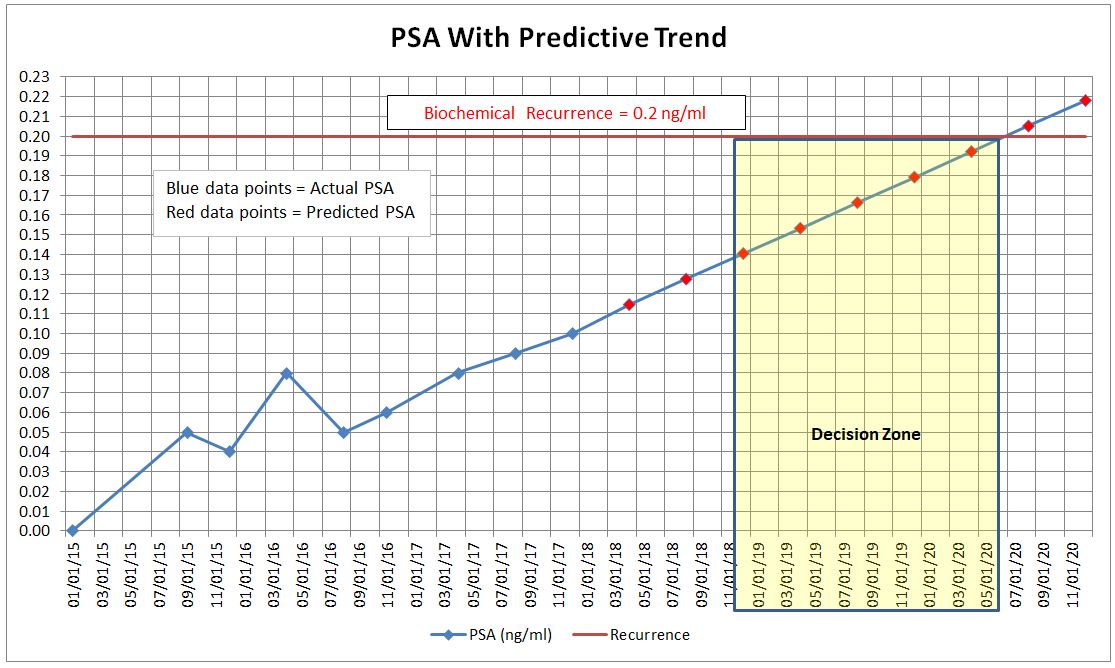
Based on my slow PSA doubling time (around 16 months), if my PSA progresses at its current rate, I’ll have 12 to 28 months to think about this and make my decision, based on whether I want to act if my PSA is around 0.15 or let it go all the way to 0.20. (See my “decision zone” in yellow below—yes, I had to geek out in my spreadsheet once again.) If I want to wait until it’s all the way to 0.5, I’ll have even more time.

Of course, one option is to do nothing. A study in 1999 showed that it took, on average, 8 years after PSA levels began to rise to reach metastasis, and another 5 years after metastasis to death.

The bottom line is that this is becoming increasingly real and that there will be some tough decisions in the next year or two. Of course, those decisions are mine and mine alone, and will be based on a variety of factors, not least of which will be my risk tolerance and any treatment’s impact to quality of life.

On that happy note, I wish you a Merry Christmas and a happy 2018! 🙂


Thanks, too, to those who took time to answer my questions in my salvage radiation therapy survey a few weeks ago. Your insights were quite helpful to me.

Month 85–Learning about Salvage Radiation Therapy

Now that I’m officially halfway to the widely accepted 0.2 ng/ml definition of biochemical recurrence, it’s time to dig deeper into the most likely next step for me: Salvage Radiation Therapy (SRT).

I’ve already done considerable research on reputable websites and through reading studies or books, but the one area that I would like more information about is from those who have actually gone through SRT after a prostatectomy. Having those first-hand insights can be invaluable.

If you have had a radical prostatectomy and subsequent salvage radiation therapy because your PSA was on the rise just as mine is, please take a few minutes to answer my questions about your experience in my:

Salvage Radiation Therapy Questionnaire

It’s only 9 questions long and should take just a few minutes to complete. I’ll be truly grateful for your input.


If I’m being perfectly honest, I have real reservations and concerns about starting SRT. Like most everything else in dealing with prostate cancer, it seems to be yet another crap shoot with questionable outcomes at potentially significant cost to quality of life.

Based on my research, SRT doesn’t seem to have all that high of a success rate, with 30%–50% of patients being progression-free at 5 or 6 years after receiving SRT. That means that 50%–70% of the patients have the cancer remain and, as an added bonus, those patients now have increased incontinence and erectile dysfunction issues, as well as potential bowel control issues.

Before we start zapping my body with radiation, I want to know with a high degree of certainty that we’re zapping the actual location of the cancer. That poses two problems.

First, studies show that the earlier you start SRT, the higher the success rate. In fact, I would not be surprised to find a few survey respondents who have started SRT at a PSA level lower than my 0.10 ng/ml. The assumption is that any remaining cancer will be in the prostate bed or pelvic region, and that’s where they focus the radiation. But how do you know that it hasn’t spread beyond the pelvis at those PSA levels? You don’t. (That 30%-50% success rate tells me it isn’t the best assumption to be making.)

That brings us to the second problem. Current imaging techniques won’t locate the cancer until the PSA is at much higher levels. Even a choline-PET scan won’t consistently detect tumors until PSA reaches 2.0 ng/ml (it may be able to detect down to 1.0 ng/ml, but the number of false readings goes up considerably).

Do I risk all those nasty life-long side effects on the assumption that the cancer is still in the prostate bed, or do I wait until imaging technology can accurately detect the cancer’s location?

I’ll have a thorough discussion with my doctor next week when we review my latest PSA results, so it will be interesting to get that input. I’ll keep you posted.

Thanks again if you’ve taken time to complete my questionnaire.

Day 2,583–PSA Results

PSA 20171204My December PSA results came back just as predicted by my spreadsheet’s silly little trendline: 0.10 ng/ml.

The bad news is that it keeps climbing; the good news is that the doubling rate appears to be about 16 months. My follow-up appointment with my doctor is 19 December 2017 where we’ll probably agree to continue to monitor every 3-4 months for the time being.

Interestingly, from an emotional perspective, this has been pretty much a non-event for me. I’ve resigned myself to the fact that the likely explanation for the increasing PSA is the return of the cancer, so at this point, it’s only confirmation of something that I already suspect/accept/know.

That’s it for now. I’m sure I’ll have more thoughts in this month’s regular post on 11 December.

Day 2,581 – PSA Test Time

Yes, it’s that time again—time for my next PSA test. I had the blood drawn this morning, and I should be able to get the results online in three days.

My last reading was 0.09 ng/ml and, if you put a trend line over the last four readings, this reading should come out somewhere around 0.105 ng/ml. Let’s see how accurate its predictive powers are.

Stay tuned.

PSA Tracker 20170802

Seven Years

It’s been seven years since my prostate cancer diagnosis, and the fact that I’m still alive and kickin’ seven years later with relatively minor side effects from the surgery makes me realize how good that I’ve got it when I compare my situation to other prostate cancer patients. I say that not to boast or gloat; rather to acknowledge how blessed I am.

With an ever-so-slowly-rising PSA in my recent past, I know that the path ahead may become increasingly rocky and that my situation can change for the worse in the not too distant future. Or it may not.

As the navigator of the USS Brewton, I planned ahead and selected the best route for our ship to meet its mission. Now, in my current predicament, I wanted to take some time and reflect on what’s next for me and how I want to navigate my way through it all. (And I’m not talking treatment options; I’m talking life.)

Life is filled with competing interests and obligations and, if this silly cancer shortens the number of my days remaining, I want to make sure that those interests and obligations are prioritized. I don’t think that I’ve squandered the last seven years by any stretch of the imagination, but I’m not sure that I’ve gotten the most out of them, either.

The best way for me to evaluate my priorities and map out a course was to escape my daily routine and go on a trip where I could be alone with my thoughts. So I do what I always do when I need to clear my head of the daily noise: I get in my car and drive.

My road trip last month through the Sierra Nevada mountains was transformative for me.

Sunrise on Mount Whitney

Once I started climbing over the boulders of the Alabama Hills in the pre-dawn darkness in hopes of capturing the sun illuminating the face of Mount Whitney, my photography became my singular focus of the trip (excuse the pun). It was refreshing to concentrate on something other than cancer. Not only was it refreshing, it was fun!

There was also something rejuvenating about being surrounded by nature, even on those brisk 24° F / -4° C Lake Tahoe mornings. You couldn’t help but feel alive.

Through all of it, I never directly tackled my self-imposed homework assignment. I never sat down and wrote a list of priorities (as I’m usually wont to do). In the end, I didn’t need to. Just the act of being, of playing, and of focusing on something other than cancer did that for me in a way that was far more powerful than had I sat down and created a spreadsheet. And that is what has been transformational for me.

As I enter my eighth year of this adventure, rather than worrying about the latest study on defining biochemical recurrence or what the results of my next PSA test in the first week of December will be, I’m going to worry about how, where, and when I can push myself to be better at my photography, all while enjoying the great natural world around us (except, of course, those rocky shoals us navigators avoided at all costs).

There are some other professional and personal goals that I want to tackle as well, but I’m going to keep those to myself for now.

It also means that I may be stepping away from some things that, while still meaningful to me, just don’t carry the weight that they used to. There just aren’t enough hours in a week to do it all.

That trip reminded me that there is life outside of cancer. I needed that reminder. Badly.

Sierra Sunrises, Solitude, and Sorrow

If anyone’s interested, here’s the write-up on my recent trip through the Alabama Hills, Manzanar National Historic Site, Ancient Bristlecone Pine Forest, Bodie State Historic Park, Lake Tahoe, Reno, and western Nevada, including an emotional stop in Las Vegas. —Dan

Dan's avatarTravelin' Dan

Sometimes the vacation you had imagined in your head doesn’t develop as you thought it would, and that’s not always a bad thing.

This was meant to be a trip where the primary mission was photographing some of our natural wonders. Inspired by landscape photographer, Thomas Heaton out of the U.K., I wanted to slow down, look for compositions, set up the tripod, and take the shot. I had done a little homework, determining sunrise, sunset, and moonrise times throughout the trip at the locations I wanted to visit, and I was keen on being in Lake Tahoe for the full moon.

Of course, the secondary mission for this trip was to see something new—to color in another part of my travel map that was empty. In this case, I was looking to experience western Nevada and bits of Arizona and California on US 95.

My initial concept for this…

View original post 5,221 more words

Month 83 – Forgetting about Cancer

I’ve really got nothing to report this month other than the fact that I just spent the last 9 days on the road on a wonderful vacation through the eastern Sierra Nevada mountains, Lake Tahoe, and western Nevada.

The purpose of the trip was to get out and do some serious photography, and focusing on that allowed me to forget about PSA tests, cancer, and all the other crap that goes with it for a while. It was refreshing.

I usually publish a full-blown write-up of my trip on my other blog, Travelin’ Dan, but my creative juices must still be on vacation, because I’m struggling to put that post together at the moment. I also need to sort through 768 photos and process the best for the blog.

In the meantime, here’s a sneak peak at some of what you may see later when I finish my trip overview. Enjoy!


PCF Article: New Biomarker Predicts Metastatic Prostate Cancers

Here’s an interesting article from the Prostate Cancer Foundation about a potentially exciting development in the ability to determine which prostate cancer tumors are more likely to metastasize.

New Biomarker Predicts Metastatic Prostate Cancers

Month 82 – Reviewing PSA Results with Doctor

At this afternoon’s visit to the doctor to review my August PSA results, he asked, “How are you doing?” I replied, “I’m hoping you’re going to tell me.” “With a PSA of 0.09, you’re doing fine.”

I have to admit that I wasn’t quite psychologically prepared for that answer. Nor was I really prepared for the conversation that followed. But before getting into that, the bottom line was just as I expected: Continue to monitor PSA on a four-month cycle, which has me back in the lab in early December.

This was a new doctor that I hadn’t seen before and he was definitely more seasoned than the last one that I had. Still, all those years of experience could have taught him some better communication skills. He talked in broad generalities and in circles—even in response to my direct questions—and that was more than frustrating.

On the topic of recurrence, he didn’t think that I should be so quick to assume that an increasing PSA is indicative of recurrent cancer. He offered up the possibility that it could have been some benign prostate tissue left behind after the surgery and has grown enough where it’s detectable on the PSA test. Or, it could be cancer.

On the topic of PSA tests in general, he reminded me that the really old threshold for biochemical recurrence was 0.4 ng/ml before it was lowered to 0.2 ng/ml. It seemed that he valued the ultra-sensitive PSA test only as it related to the post-surgery pathology. If the pathology was bad, he seemed to put more stock in the ultra-sensitive PSA; but if the pathology was good, he seemed less inclined to put stock in it.

In other words, if you had a 4+3 Gleason score, positive margins, seminal vesicle involvement, or lymph node involvement—or some combination thereof—he would be more likely to consider acting on a 0.09 ng/ml PSA. But it my case with a 3+4 Gleason, negative margins, and no seminal vesicle or lymph involvement, my sense was that his response to my 0.09 PSA was a pretty nonplussed, “Meh.” Or, if my PSA gets to “around 0.13 ng/ml,” we might start exploring treatment options.

On the topic of doing additional testing such as scans to see if there is cancer anywhere, he said that nothing would show up on a scan or MRI with a PSA of 0.09. I want to dig into that some more.

On the topic of salvage treatments, he thought that, given my pathology, the first step would be “a little radiation.” (I’m not sure if sprawling out on the beach for 7 weeks qualifies for “a little radiation,” but it may be worth asking.) He wouldn’t do ADT (hormone therapy) in conjunction with the radiation, again, given my pathology.

Lastly, at one point during the conversation, he quite confidently made the bold prediction that I wouldn’t die from prostate cancer. You think I’d be jumping for joy. I’m not. Perhaps its my experience as a seasoned patient that’s telling me to withhold judgment on that one for the time being.

All in all, this is good news. My lack of enthusiastically embracing it, however, comes from the fact that, rather than eliminating variables to consider, I feel that this meeting introduced a few more, and that just muddied the waters. Emotionally, at this point, I just want this stupid disease to pick a path and stay on it. I may also check with the VA to see if there’s any way I can pick one doctor that I can build a relationship with rather than this new-doctor-a-quarter routine.