In my 12+ years of dealing with prostate cancer, I’ve heard a lot of theories about what causes it and what actions we can take to control or slow its growth—some of them legitimate, some at the very end of the weirdness spectrum.
I found this 7-minute video from 2019 to be pretty interesting considering how many times I’ve heard that sugar is related to the cancer growth. According to this, sugar in and of itself has little to no impact on prostate cancer growth (but may have an impact on other cancers). I’m guessing that a quick Dr. Google search would reveal other videos or studies with differing viewpoints, so take this with a grain of salt. (See what I did there???)
We all have to recognize that there are going to be differing opinions. We just have to make decisions based on what’s best for us and our own situations.
It’s hard to believe that it’s been over five months since I wrapped up my salvage radiation therapy (SRT) and concurrent androgen deprivation therapy (ADT). For the most part, things have been good, but two things have popped up along the way. One insignificant, the other has me wondering what the future will hold.
Where Oh Where is My Body Hair?
The first seems to be a delayed reaction of the ADT/hormone therapy which was administered nine months ago on 3 May 2022. It seems the loss of testosterone is taking a toll on my body hair.
Maybe this has been going on for a while and I just now noticed it (I mean, really, who monitors the status of their body hair on a regular basis???).
I wasn’t a very hirsute guy to begin with, but I noticed in the shower the other day that what little chest hair that I did have has been diminished by at least half to two-thirds. A little oddball patch of hair on my back right below my collar line is now pretty much gone, and let’s just say that there’s less hair in a few places further south.
Is it a big deal? Of course not. Just superficial, but I find it interesting that it appears to be happening so long after the Eligard injection. Maybe that’s normal for ADT. I’m not going to worry about it (unless my beard starts falling out, then I may be a little concerned).
GI Changes?
The second issue has to deal with what I’ll probably imprecisely call gastrointestinal changes or perhaps a prelude to the thing I dreaded most: radiation proctitis. Whether they’re related to the radiation therapy or not, I don’t know yet. I thought radiation proctitis took longer to take root, but I could be wrong.
I haven’t changed my diet much compared to pre- and post-radiation, so I don’t think it’s diet causing these issues. (Although I did buy a bag of pistachios recently and, with hindsight, they may have aggravated them.)
Pre-radiation, I was a pretty regular guy when it came to bowel movements. Once in the morning and I was good until the next morning. Now, five months after radiation, I’m noticing that I’m having two to four bowel movements a day about a third to half of the days. Some of those extra bowel movements come on with some urgency. So far, it’s not been an issue or caused an accident, but it does raise some concern as to what it may be like a year or two from now if it is, in fact, related to the radiation therapy.
The other GI issue that has popped up is that I seem to have more intestinal gas than I used to. (And, no, it’s not related to San Diego’s wonderful Mexican cuisine!)
The thing that concerns me about being so gassy is the fact that, when I pass gas, it comes out with less effort than it used to. In fact, sometimes, it almost just slips out and I have to wonder if it’s going to be only gas that comes out, and nothing extra (fart vs. shart). My concern is about rectal control over the long term if I’m experiencing something like this now. Again, something to monitor (you know me—I’ve started a tracking spreadsheet) and discuss with the doctor.
What’s Next?
My last PSA test was on 1 November, and we agreed to check it again in March, so I’ll figure out a date to hit the lab for the bloodwork. You may recall that post-radiation PSAs taken in September and November both came in at 0.05 ng/mL, so we’ll it will be interesting to see if it goes down, stays the same, or goes up again. Any wagers???
I should be meeting with the radiation oncologist again in May for my six-month follow-up from the last meeting.
That’s a Wrap
That’s about it for this month. You may recall that last month, I spent my birthday in Death Valley National Park. After visiting there, I headed over to Zion National Park for a short visit. You can check it out by clicking HERE.
Header Image: Canyon in Zion National Park along the Virgin River
This month I’ve managed to make it to my 65th birthday and am fully enrolled in Medicare. Woo-hoo!
Normally, I don’t let age get to me too much, but turning 65 hit me a little harder than most milestone birthdays. I guess it’s the idea of being a true “senior citizen now.
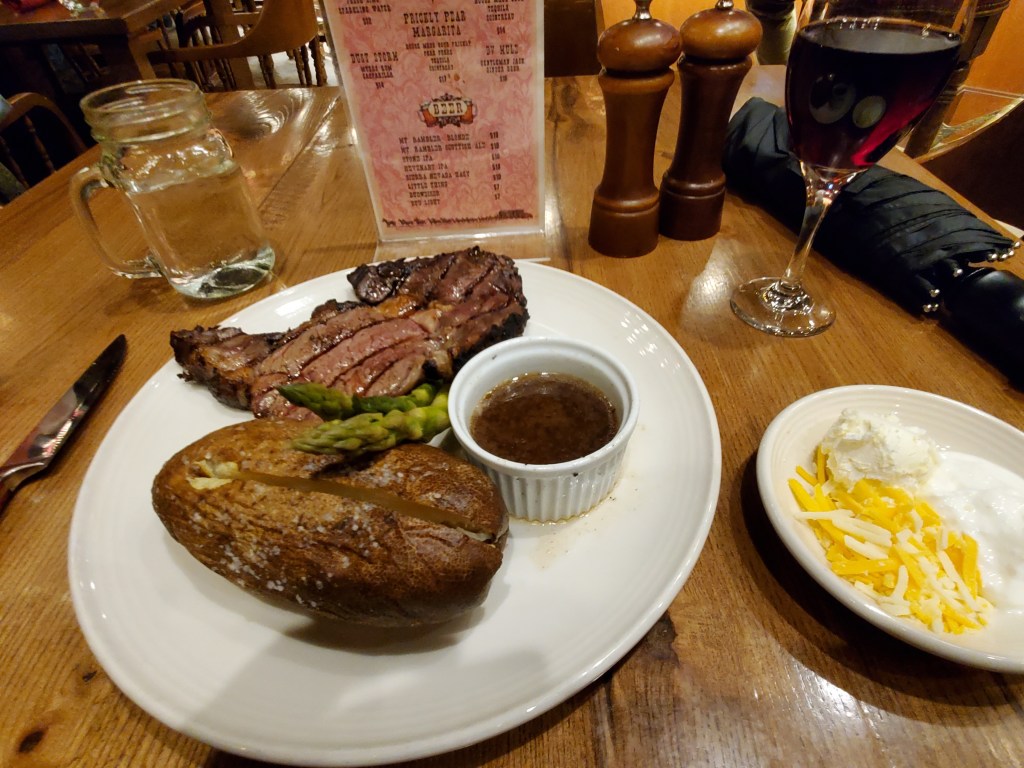
To celebrate, I splurged on a prime rib, baked potato, asparagus, and a glass of Pinot Noir, not at a local San Diego restaurant, but at the Last Kind Words Saloon in Death Valley National Park. Yep. Silly me did another road trip. January is definitely one of the better months to visit Death Valley.
This trip showed that I’m not as spry as I was before this summer’s radiation and hormone therapies. I found myself walking at a slower pace and with a bit less stamina/endurance. However, I’ll argue that walking 2.5 miles / 2.4 km through loose sand dunes will take a toll regardless of your fitness level. My legs were sore for days.
I know that I need to be more aware of this and become more active to at least maintain, if not improve my fitness level. (Yes, not consuming prime rib and baked potatoes will help, too. To my credit, I can’t recall the last time I had either.)
My next PSA test will be in March, so we’ll see if there’s any movement one way or the other off of my November 2022 reading of 0.05 ng/mL.
That’s it for this update. Be well in 2023!
Here are a few scenes from Death Valley:
Mesquite Dunes Zabriskie PointFurnace Creek Visitor Center Badwater BasinArtists Pallette Artists Pallette Artists Pallette Death Valley
Header image: Death Valley National Park, California
The Prostate Cancer Foundation is hosting a Zoom webinar at 4:30 p.m., Pacific Standard Time (Los Angeles) on Tuesday, 17 January 2023 to talk about rising PSA after treatment. The webinar is free and open to all, but you must register in advance.
You can send questions in advance to: webinar@pcf.org.
If you can’t attend, the webinar will be recorded so you can view it on their website later.
Finally. Things have pretty much returned to my pre-radiation therapy conditions, and I’ll take that as an early Christmas gift. Let’s hope it continues into the New Year.
The fatigue is gone, so I’ve had more energy to get out and do things.
Urinary issues are back to where they were before radiation. I’m much better at making it through the night with typically only one run to the toilet. Some nights I can make it all the way through; and a few nights I may have to make two or three trips, tops. Much better than the four to seven trips during radiation. The frequency during the day has gone way down, as has the urgency (but not as far as I’d like it to go).
My case of IBH (itchy butt hole), has pretty much—but not entirely—disappeared as well. That’s really been a positive development because having bowel issues is one of my biggest concerns with radiation.
Lastly, the pain that I was experiencing in my back and ribs has also gone away. I always attributed it to the hormone therapy, but the doctors didn’t agree. It’s been more than seven months since I received my six month dose of Eligard, so I’ll just leave it at that.
I was supposed to see my urologist on Tuesday, but I came down with a bad head cold or case of the flu (the crud stayed entirely in my head) over the last week. Today (Saturday) is the first day I’m back to about 90% but, on Thursday, I called the urologist’s office anyway to postpone the appointment. I didn’t want to bring any bug into the clinic as an early Christmas gift.
When I spoke with the nurse, we reviewed my PSA and agreed to retest in March 2023, with a follow-up appointment in late March or April. (The scheduling office is supposed to call me to set up the appointment.)
Be well and have a great holiday season!
Header Image: Christmas ornaments for sale at Vienna Christmas market, Vienna, Austria.
On this Thanksgiving Eve in the U.S., I just wanted to thank everyone who supported me through the last year of scans, tests, hormone therapy, and radiation therapy. Even though I’ve been dealing with this for twelve years, many of these were new and scary experiences for me. You helped me through them.
It’s funny in situation like these who steps forward to provide an ear to listen, some sage advice, and a shoulder to lean on. I’ve never met most of you in person, but you’ve supported me through your comments and emails, and I truly appreciate that.
I hope you have a great Thanksgiving—or Thursday, if you’re not in the U.S.—with your own support networks, whether they be family, friends, or fellow prostate cancer patients.
Header Image: Yosemite Valley, Yosemite National Park, California
I received the last of my Explanation of Benefits statements covering my salvage radiation therapy (SRT) with concurrent androgen deprivation therapy (ADT). You know me. For grins and giggles, I had to play with the numbers.
Ouch!
Therapy
Billed
Radical Prostatectomy and post-surgery infection (January 2011)
Those numbers do not include all of the doctor visits and PSA tests from diagnosis to today—just the surgery and SRT/ADT.
For the radical prostatectomy and the subsequent infection hospitalization, that’s what the hospital and doctors billed my employer-provided health insurance company. Of course, the insurance company didn’t pay the hospital the full amount, and I had some copay responsibilities to the tune of $4,372 as well.
For the SRT/ADT, the “Billed” number is what USCD has billed the VA for my treatment. Each zapping session was billed at $3,894. (My radiation oncologist had no idea it was that expensive. As a university employee, he’s not involved in billing.) It appears that the VA is reimbursing UCSD at a rate of somewhere between 10% and 15% of the billed costs.
My somewhat premature three-month follow-up was last Thursday, 10 November, and went about as expected. On the whole, he was pleased with where I’m at.
I reviewed several things with him.
First, we talked about my PSA being 0.05 ng/mL both in September and again in November. He was pleased with the number and didn’t think there was any significance in the fact that the two numbers taken about six weeks apart were the same. He chalked the reading up to the hormone therapy and said that at this early stage, my PSA was “meaningless” in determining the effectiveness of the radiation. We’ll have to see what it is a year or two down the road to determine that. No big surprise there.
He did say that I shouldn’t panic if the PSA number starts to go up, as long as it isn’t a huge leap or is increasing rapidly. He expected it may go up a bit and then stabilize and stay at a certain level as the hormone therapy wears off. Time will tell if he’s right.
I mentioned that my urinary frequency was back to pre-zapping levels, with far fewer trips to the toilet in the middle of the night (0-3). The urgency was slightly elevated from my pre-zapping days, but is tolerable as long as I act on it.
The one concern that I really wanted to talk about—and is the one I feared the most about radiation—were bowel issues.
The week before I went on my mini-vacation to Kings Canyon National Park, something was afoot in my bowels. I was having three to five bowel movements a day for about four days when I normally get by with one. I was thinking, “Oh, crap! Is this from the radiation??” I was concerned enough that I almost canceled my trip, but when things calmed down the weekend before, I decided to go ahead.
In the last two weeks or so, I’ve been suffering from what I call IBH—Itchy Butt Hole. (The nurse doing the prescreen interview cracked up when I told her that.) I also seem to be gassier than usual, and my diet hasn’t changed to cause an increase in gas production.
The doctor was a bit puzzled by this development, suggesting that the radiation may have irritated hemorrhoids and that a topical cream may help resolve the IBH. He was stumped by the increased gas and suggested that, if it persists, I talk to a GI doctor. He did say, however, if radiation had damaged my bowels, it would be more substantial than what I’m experiencing, so that was good to hear. Even though, I’m going to track this closely to see if things continue to worsen.
In the end, the radiation oncologist was quite pleased with where I’m at. We’ll follow-up in six months.
I have an appointment with the urologist on 13 December 2022, so we’ll see what he has to say and map out a PSA testing schedule.
Be well!
Header image: Premature Desert Blooms, Anza-Borrego State Park, near Borrego Springs, California
Woo-hoo! I’m still alive and kicking twelve years after diagnosis with this annoyingly insidious disease. I’ll take that as a definite win.
But regular readers already know that, in the last year, the path has gotten a little bumpier with the treatments needed to keep me around another twelve years (or more, hopefully). I guess that’s all part of the package deal. It doesn’t mean we have to like it, but it’s part of the cancer experience.
Also part of the cancer experience is thinking about one’s own mortality. It’s not something to dwell on, but it is something that I’m certain most cancer patients consider at some point.
Several years ago, I stumbled across Tim Urban’s TEDx Talk about procrastination (video below). It was a fun, engaging talk and, at the end, he introduced the concept of a “life hourglass.” In his example, he showed a table of empty boxes with each box representing one week of a ninety year life. Of course, the nerd in me had to take that one step further.
At the end of her life, my mom had a really healthy outlook on death and dying, to the point it surprised her hospice nurses. She made it okay to talk about what most would view as a rather morbid or taboo topic, and I guess I’m following in her suit. This exercise is really meant to be a more lighthearted approach to get us to think about the time we have remaining and how we best want to use it. Priorities.
Our family doesn’t have a history of longevity, so my getting to 90 years is against the odds even without cancer in the mix. The analyst in me wanted to get a more realistic understanding of my possible longevity, so I added in how long my parents and grandparents lived. In my hourglass below:
The two black squares represent when I hit 70 and 80 years of age.
The four orange squares represent my grandparents’ longevity.
The two red squares represent my parents’ longevity.
The two green squares represent my longevity, but need a little further explanation.
My father outlived his mother by exactly 50 days, both dying of cardiac issues at about 69.5 and 69.7 years of age. If I follow in their footsteps, the first / upper green square represents me making it to 69.6 years—the average between them. The second / lower green square represents my longevity based on the average of all six of them, or 72.5 years (more specifically, 19 July 2030).
Click to enlarge
Am I obsessed with death? No, I’m probably more obsessed with spreadsheets and analysis. (Perhaps I should have been an actuary 😂).
For me, this exercise has had value. Sure, all of us of a certain “mature” age recognize that more of our life is behind us in the rear-view mirror than is ahead of us through the windshield, and putting it into a visual format like this really makes you sit up and take notice. It makes you ask, “What am I going to do with those remaining boxes?”
Of course, side effects from treatments for advancing disease or other maladies associated with growing older can impact us, too. Those may begin to take away quality of life, filling some of those boxes from the bottom up, putting us in a vise being squeezed between time and future abilities. While they may not do us in, they can definitely hinder our ability to live a full life.
Of course, none of us have a crystal ball and know when any of this will happen. It could be tomorrow, or it could be thirty years from now, so that leaves today. (Yes, I know that’s as cliché as hell, but it’s true.)
So, if you’ll excuse me, I’m going to close my hourglass spreadsheet and open a few spreadsheets to plan some bucket list trips. Time’s a-wasting…
Be well and remember it’s Veterans Day today (hence the photo above).
Header Image: USS Cochrane DDG 21, My first ship in the U.S. Navy.
I met with the radiation oncologist Thursday morning, but I’ll put those details in another post over the weekend.