Day 4,880 – Full MO Report

My computer issues have been sorted, so here’s the full scoop behind my meeting with the medical oncologist (MO) on Tuesday.

The meeting started with a nurse practitioner (NP) which threw me for a bit of a loop and initial disappointment. Because this was my initial contact with the oncology team, we spent a bit of time reviewing my history and how we got here. She did say that she would bring the MO into the discussion once we went through the preliminaries.

The nurse had actually done a pretty thorough job of reviewing my file prior to the meeting, and was familiar with the recent bone scan and PSMA PET scan results. Her take on my situation was that we were somewhat in limbo with no signs of metastases anywhere, and that the path forward wasn’t so clear-cut. (That actually led to a brief discussion on how metastases is defined in the world of prostate cancer. She was of the school that it’s not metastatic until it shows up on scans, while I pressed and suggested that, because the prostate is gone and the cancer is somewhere, it must, by traditional definition, be metastatic.)

Once we were through with the initial screening, the nurse brought in the MO and introduced her to me. I did ask if she specialized in prostate cancer and she does not; she’s more of a general oncologist. She did say, however, that she reviewed my case with a genitourinary oncologist at the University of California San Diego (UCSD) the day before our meeting. That was a good to know (but not the same as having a seasoned prostate MO in the room).

At that point, the three of us started going down my checklist of questions.

We talked about whether there was value in delaying the start of any treatment until my PSA rose to a level where a scan would detect the location. In the preliminary screening, the NP seemed to be inclined to start the ADT before another PSMA PET scan, and she was a little surprised that the MO said we should do another scan in six months. The MO said that the scan may reveal lesions that could be spot radiated as a treatment option.

That led to me asking about whether there would be value in whole pelvic radiation and, again, without knowing the cancer’s location neither was a fan of pursuing that at this point. Even if we did know the location, they would defer that decision to the radiation oncologist (RO).

Because my PSA is so low (in relative terms), both seemed to be more inclined to start with just ADT and not a combination therapy of ADT plus antiandrogens. The MO acknowledged that the use of combination therapy could be more effective in controlling the cancer, but cautioned about the increased side effects from doing a combination therapy approach. She also mentioned that using combination therapy is generally reserved for when the cancer is more advanced. (I’m not sure that my research agrees with that thought.)

I believe in her discussion with the UCSD GU oncologist that they said they would probably hold off initiating hormone therapy until my PSA reached 2.0 ng/mL. I’m going to have to do a little research to see if that makes sense.

We talked about intermittent therapy and whether that would be appropriate, and the consensus was that, at my low PSA, I would be a good candidate for intermittent ADT. However, that would depend on my PSA doubling time and how my PSA responds to the ADT.

I did ask if cancer in the lymph nodes would be symptomatic and generally speaking, they said, it’s not. I asked because I had had a weird pressure sensation in my groin last month that was new. (Yes, I’m at that point where I ask myself if every new ache, pain, or sensation is related to the cancer when it pops up.)

They noted going through my record that there was no baseline testosterone test, so we all agreed that that would be helpful to have. The NP put the order in to have that done when I get my PSA tested on 1 May 2024.

The MO expressed concern about my recent cardiac work-ups after my October emergency room visit (nothing of substance was found). She reminded me that hormone therapy does have a small but real risk of increasing cardiac events.

In the last part of the meeting, I did ask if I’ll be seeing the same MO going forward, and the short answer was “indirectly.”

You’ve heard me talk before that one of the drawbacks of getting my care through the VA is that it’s a teaching hospital and that I rarely see the same physician/resident twice. It’s good that I get so many differing opinions, but it prevents me from building a long-term relationship with the doctor as well. Different residents will filter through the oncology department, but the MO I met with will be overseeing all of their cases behind the scenes, so she would be tangentially involved.

I was asking because I likened myself to being an orchestra conductor, coordinating the efforts between the urologists, radiation oncologist, my primary care physician, and now the medical oncologist. I was inquiring if she or anyone else at VA would take the lead on coordinating all of these discussions and treatment considerations. She did mention that they do have a “tumor board” that reviews much more advanced cases to map out coordinated treatment plans, but because I don’t have any substantial tumors in the scans, my case wouldn’t come up for review.

Interesting, though, was the fact that the NP and MO both viewed this meeting as me getting a second opinion instead of a hand-off of my case from the urology department to the oncology department. From their perspective, the urology department still has the lead on my case until I decide to move forward with hormone therapy.

One thing the NP brought up early in the conversation was that any treatment plan would have to be aligned with my goals. If my goal was to prevent metastasis (or delay it), then starting hormone therapy sooner would make more sense. But if my goal was to avoid hormone therapy side effects for as long as possible—recognizing the inherent risks—then it may make sense to delay therapy. To be honest, I’m not sure where on that spectrum I want to land.

We wrapped up the meeting, coming to a consensus that:

  • We’ll conduct a PSA test and get a testosterone baseline on 1 May 2024.
  • Calculate the PSA doubling time including the latest results.
  • Evaluate the results and decide whether to schedule another PSMA PET scan.

While I didn’t keep specific track of the meeting, it lasted somewhere between 30 and 45 minutes, which is quite unusual.


I came out of the meeting in good spirits because it was one of the most productive, collaborative meetings I’ve had in a long time. The conversation flowed quite easily, and I attribute that to the fact that women healthcare professionals seem to be much better prepared and much better at listening to a patient’s concerns than some of their male counterparts. This isn’t the first time that I’ve noticed that. (Don’t forget, it was the thoroughness of my female primary care physician that discovered the cancer via a DRE in the first place.)

To be honest, I’m not sure why I felt compelled to mention these observations based on my personal experiences. I just suspect that some prostate cancer patients may be reluctant to discuss problems with their male bits with female healthcare professionals. You might be surprised by the difference in quality of care that you receive, so don’t rule them out.


I have been more than satisfied with my care from the VA so far but, as my cancer advances, I am beginning to wonder if it makes sense to step outside the VA so I can get a team that is dedicated to my case and one that I can build a long-term relationship with.

At the top of my list would be UCSD followed by Scripps/MD Anderson. But the VA already has such close ties to UCSD, it’s almost like I’m getting care from them already. In fact, the MO I saw is a clinical professor of medicine at UCSD, most of the residents I see in urology are from UCSD, and my VA-provided RO is from UCSD but seeing him required “community care” pre-approval. (Community care is generally only approved if the VA doesn’t have the capacity or capability, so it could be tricky arguing to obtain it.)

So while I’m on Medicare and it would be relatively easy (but more expensive) for me to step away from the VA, I would explore options for getting approval to move into community care at the USCD GU medical oncologist through the VA first.

I’m not keen on changing horses in mid-stream, but it may make sense in the long run. I’ll have to think that through.


And now you know why I didn’t want to try and type this out on my phone on Tuesday. 😂 Thanks for reading this far!

Header image: A rare spring snow in Cuyamaca Rancho State Park, San Diego County, California, 14 March 2024

Day 4,832 – PSMA PET Scan Results

No evidence of recurrent prostate cancer or metastatic disease.

I know I should be excited but, at the same time, I don’t think I’ve been so frustrated by “good” news. Thanks to the steady increase in my PSA, we know something is happening somewhere, and I was really hoping this scan would end the game of cat-and-mouse that we’ve been playing trying to determine where the cancer is and what to do next. It didn’t.

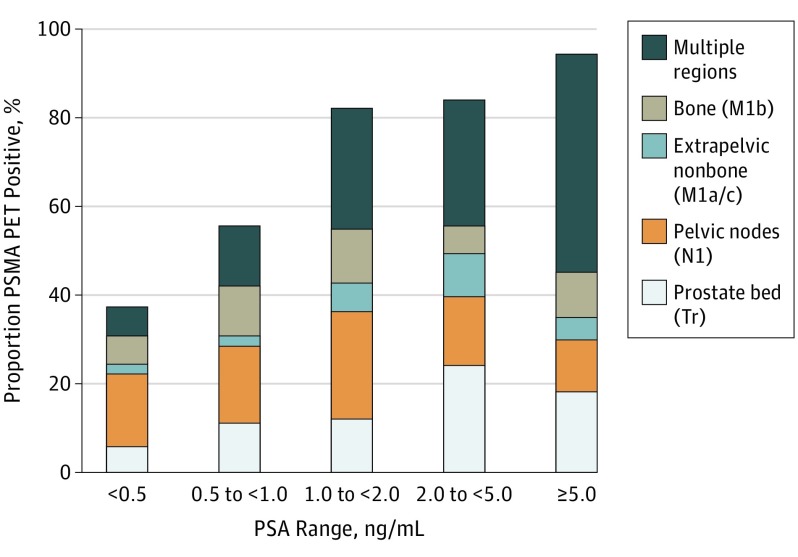
Even though I recognized going into the scan that, at my PSA level (0.37 ng/mL), there was an approximate 40% chance of detecting something, I was hopeful it would come up with something this time. Silly me and my expectations.

Detection Rate on a Patient Basis Stratified by PSA and Region Tr indicates prostate bed only; N1, pelvic nodes only; M1, extrapelvic only. Proportion of patients with 68Ga-PSMA-11 PET positive findings were stratified by PSA range and region of disease in accordance with PROMISE. https://pubmed.ncbi.nlm.nih.gov/30920593/

The other thing I’m beginning to wonder is if I’m in that 10% of patients for whom PSMA PET scans don’t work. (You may recall that being mentioned in this video from the PCRI: Rising PSA After Prostatectomy.) I have to dig into that more to see if it’s just PSMA PET scans that use Gallium-68 as the tracer, or if that applies to any PSMA PET scan regardless of the tracer used. I’m guessing it’s the latter.

Choline and Axumin scans are another option, but they don’t start reliably picking up cancer locations until the PSA is at 1.0 ng/mL or higher. Assuming my current PSA doubling time (6.2 months) remains steady, that means waiting another 11 months before I hit 1.0 ng/mL for those scans to have a chance of seeing anything.

I’ll be putting together my list of questions for the urologist appointment on 13 February (I’m open to suggestions). I suspect we’ll have a good discussion on subsequent PSA testing, the value of knowing where the cancer is located at this point, and when to start hormone therapy.

Again, the silver lining in this is that my scan didn’t light up like the Las Vegas strip. I need to keep that in mind.

Happy Friday!

Day 4,830 – PSMA PET Scan

PSMA PET scan No. 2 is behind me.

This was different from and easier than the first one. That’s because the VA just did a PET scan today, whereas my scan at UCLA included a CT scan on top of the PET scan.

That fact really didn’t occur to me until all was said and done. I’ll have to ask the doctor about the đifferent approaches.

In any case, today they juiced me up with Gallium-68 shortly after arrival. About 45 minutes later, I was on the scanner table ready to go. I barely felt the table move me through the scanner, and it took about 45 minutes to complete the scan.

Of course, the technician wouldn’t give me any sneak peak insights. “The doctor will interpret the scan.” I expect it could take a week or so for me to see any notes in my online records.

Again, even with my PSA closing in on 0.40 ng/mL, there’s only about a 50-50 chance it will give us any useful information at that PSA level. (As a refresher, my PSA going into the UCLA scan was 0.22 ng/mL.)

More to come.

Day 4,820 – PSA Results

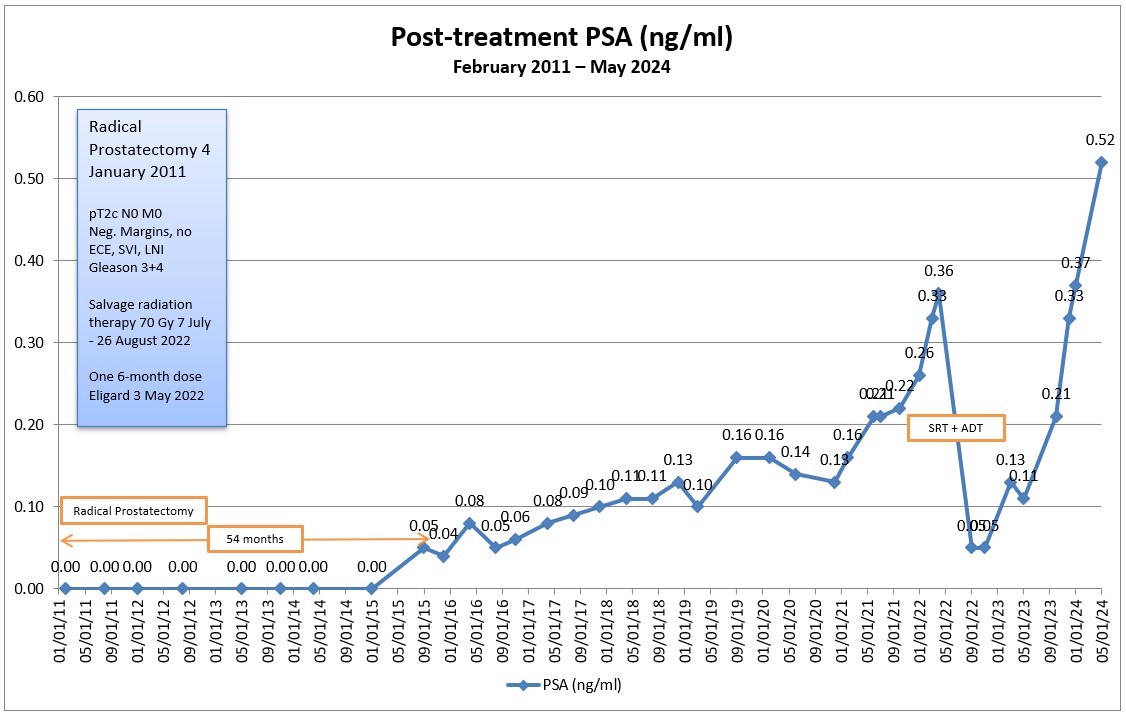
Okay. I got antsy and went for my PSA test on Friday instead of next week. As expected, my PSA increased from 0.33 ng/mL on 6 December 2023 to 0.37 ng/mL on 19 January 2024.

The silver lining in that cloud is that the rate of increase slowed a bit and it didn’t increase as much as I expected it would.

Sometimes, I get too nerdy for my own good. There was a 91% increase between the May and October readings, and there was a 57% increase between the October and December readings, so I averaged the two increases (74%) and projected that this increase would land me at just over 0.5 ng/mL. This increase ended up being just 12% over the previous December reading. Fickle PSA.

I ran the numbers through the Memorial Sloan-Kettering PSA Doubling Time calculator again, using the five values from March 2023 (0.13) on. My PSA doubling time dropped from 6.7 months to 6.2 months, and my PSA velocity increased from 0.2 ng/mL/yr to 0.3 ng/mL/yr since calculating it back in December.

I went for the test early because I really wanted to know the PSA value going into the PSMA PET scan that’s scheduled on 31 January 2024. Plus, if it dropped, I would have had time to ask the urologist if it was worth going ahead with the scan at a lower PSA level. (Remember, I went for a PSMA PET scan when my PSA was 0.22 ng/mL, and it didn’t show anything at that PSA level. Why subject myself to another dose of Gallium-68 if the outcome may not produce any useful information?)

My follow-up with the urologist to review the PSMA PET scan and PSA results is on 13 February, and we’ll map out what’s next from there.

So that’s the latest and greatest. More to come.

Header image: The famous Torrey Pines Golf Course, San Diego, California, home to the Farmers Insurance Open golf tournament

Day 4,815 – Bone and PSMA PET Scan Update

Just a quick update.

You already know that I completed my bone scan, which the VA required (for some inexplicable reason) before ordering a PSMA PET scan. This morning, I was able to schedule the PSMA PET scan with the VA, and it’s set for 31 January 2024. That was much faster than scheduling it with UCLA two years ago.

I’ll go for a PSA test the week before the PSMA PET scan, perhaps on 24 or 25 January. It will be interesting to see how much it’s increased. As a refresher:

9 May 2023 – 0.11 ng/mL

31 October 2023 – 0.21 ng/mL

6 December 2023 – 0.33 ng/ML

Should I get a pool going to see what it will be this time?

I have an appointment with the urologist on 13 February to review the results and map out next steps.

More to come.

Header image: Sunset over the Pacific Ocean at Carlsbad Beach, California

Month 158 – Bone Scan

We last left our hero and his urologist lamenting about the VA protocol requiring a bone scan prior to authorizing a PSMA PET scan to try to determine the location of his growing cancer…

Well, things fell into place a little quicker than I expected. I had my bone scan on Monday, 8 January 2024. As expected, the results were:

No abnormal uptake of tracer is seen to suggest osseous metastatic disease.

That’s a good thing. At least it didn’t light up like a Broadway marquee showing metastases everywhere.

I have a follow-up with the urologist on 13 February, and I’ll have another PSA test done in advance of that meeting. The only thing that’s unclear to me is the scheduling of the PSMA PET scan, so I just emailed the urologist to clarify.

In his notes from our December meeting, his plan was to do the “Bone scan and PSMA PET; Follow-up in 6 weeks; and PSA test in advance of the follow-up.”

I asked if he wanted me to complete the PSMA PET before the February meeting, or if he wanted to review the next PSA result and bone scan results in February before scheduling the PSMA PET scan. Hopefully, I’ll have an answer soon.

I have yet to share the bone scan results with the radiation oncologist. I’ll just wait until we have the PSMA PET scan nailed down before contacting him.


Mentally, I’m doing okay with all of this. I’ve reconciled that this is the path that I’m on, and we’ll just take one step and one test result at a time and go from there. That’s not to say that there aren’t days when I get anxious about the unknown ahead. I do. But I’m getting much better at not dwelling on the fact that this is happening.

Other than that, since my last post, I’ve learned that making homemade tamales is an hours-long labor of love; I made a quick trip to Yosemite at Christmas; I completed another orbit around the sun; I’m on tap for possible jury duty next week; and I have family coming to visit in early February. 2024 is off to a busy start.

Stay tuned for more to come…

Header Image: Yosemite Valley from Tunnel View, Yosemite National Park, California

PCF Webinar: PSMA PET Imaging: Doctor and Patient Perspectives

The Prostate Cancer Foundation is having a Zoom webinar on 14 March 2023 04:30 PM Pacific Daylight Time (Los Angeles) to review PSMA PET imaging from both the doctor and patient perspectives. You can register by clicking the image below or by clicking HERE.

(Daylight Saving Time in the U.S. begins on Sunday, 12 March 2023.)

    Day 4,054 – PSMA PET Results

    They were late. I hate tardiness. 🙂

    Again, going into this, I knew that there was a 50-50 shot that the PSMA PET scan would be able to pick up anything at my PSA level, and it appears that I fell into the “we didn’t see anything” category:

    ONCOLOGIC FINDINGS:

    History of prostate cancer status post prostatectomy with biochemical
    recurrence with:
    – No focal PSMA-uptake in the prostatectomy bed.
    – No PSMA-PET/CT evidence for distant metastasis.

    The fact that they didn’t see anything in my prostate bed and elsewhere is both a good and bad thing. Good, in that whatever cancer may be there was so small that the scan couldn’t pick it up. Bad, in that the scan wasn’t sensitive enough to pick things up at my PSA level (0.22 ng/ml).

    As a reminder, I’m just looking at the printout of my results online, and am not yet in a conversation with my doctor about the results, so I’m a little reluctant to come to too many conclusions about some other comments in the report without the benefit of his expertise. There was a section labeled:

    INDETERMINATE FINDING:

    – Focus of intense PSMA-uptake at the left lung lower lobe (fused 4-263)
    without CT correlate, likely a PSMA injection thrombus, not favored to
    represent metastatic disease.
    Attention on follow up.

    I added the emphasis above, but it’s something that raises an eyebrow and probably warrants further monitoring or investigation as suggested. That’s something I’ll speak with the doctor about.

    Speaking of speaking with the doctor, when I had my appointment in early November, we agreed to schedule a follow-up appointment to go over the scan results in January. However, the first available appointment wasn’t until the first week of February. I’m going to work on moving that earlier, even if it’s a call-in appointment instead of an in-person appointment.


    Am I happy with the results? Sort of.

    We know from my rising PSA that there’s cancer somewhere in some quantity. While this may be a “false negative,” it’s nice to know that I didn’t light up like the Rockefeller Center Christmas tree. That would have been bad.

    Will this cause me to run to the radiation oncologist to start salvage radiation right away based on my PSA alone? Nope. I have another PSA test in January, and if that stays in the 0.21-0.22 range, I’ll be content to continue my monitoring. But if it shoots up drastically, that may cause me to reconsider.

    Was it worth $3,300 out-of-pocket? I don’t know. I’m going to get back to you on that one. 🙂

    So that’s my PSMA PET scan story, and I’m sticking to it.

    If I don’t post again before Christmas, I hope you have a great holiday season!

    Be well!

    Month 133 – Waiting for PSMA PET Results

    As is often the case with medical tests, there’s a bunch of waiting involved. Even though the PSMA PET scan technician told me that the doctors would review the scan and have the results in 1-2 business days, apparently that didn’t mean that I’d have access to them right away.

    After a week or so of hopping online, I emailed UCLA Nuclear Medicine to ask when I would be able to view the results on my online account. Their response:

    Your results are set to auto-release in your account on 12/16/21 after 3:41pm.

    Now that’s a rather specific date and time which seems quite unusual to me, but at least I have an answer. (It reminds me of my Navy days; see my sea story below.)

    That would be my one complaint with UCLA. While the staff administering the scan was very patient-centric, the administrative end—not so much. I guess when you go to a world-renowned medical treatment facility, you’re just one of thousands and thousands of patients and personal attention becomes more challenging.

    On a related note, I also alerted the VA San Diego to be on the lookout for the results and to contact me when they come in. So far, no luck.

    More to come.


    When I was a Surface Warfare Officer in the U.S. Navy, I qualified as Officer of the Deck, which meant that I stood watches on the bridge of the ship and was responsible for everything that went on during my 4-6 hour shift.

    The captain of the ship (of all Navy ships) had something called Standing Night Orders for the Officers of the Deck to follow at night while the captain was asleep in his cabin. In the standing night orders, there was a place for the captain to write down whether or not he wanted a wake-up call and, if so, at what time.

    On one of my first overnight watches with this captain, he put down that he wanted a wake-up call at 5:28 a.m.

    That morning, I was busy with my head in the radar scope hood, trying to track and avoid colliding with another ship, and I missed the 5:28 a.m. call to the captain. But not to worry.

    At 5:29 a.m., he was standing on the bridge in full uniform, brusquely asking, “Why didn’t you call me at 5:28 a.m.???”

    Prick.

    Fortunately, we had a change of command and received a new, human captain about 6 weeks later.

    Day 4,039 – PSMA PET Scan Completed

    It’s over. The photos for my holiday cards are taken and ready to be processed. Look for a Christmas card with a cross section of my pelvis coming to you soon!

    I had my 68Ga PSMA-11 PET and CT scans yesterday. In short, all went well but the technician couldn’t (or wouldn’t) tell me if the scan lit up like the Rockefeller Center Christmas tree. She said that images had to be processed first, and that she wasn’t trained to interpret them anyway. The doctors would have to do that in 1-2 business days.

    The whole process took just under four hours—from the time I left my car in the parking garage to the time I got back in it.

    The Process

    Arrival

    I checked into the Department of Nuclear Medicine about 40 minutes before my scheduled appointment (I was told 7 a.m. by the booking representative), and was told that my appointment was actually at 7:45 a.m. Oh well. It gave us a little time to complete the necessary paperwork and payment.

    You’ll have several forms to complete, mostly asking about your current health status and history. Pretty easy. Just check the boxes and sign. You’ll also get one of those plastic wristbands with all of your information on it placed on your wrist. Mine initial band had my wrong birthday on it, so we had to have that corrected and a new wristband printed.

    If you’re like me and your paying for it out of pocket, this is also where they’ll ask for your credit card (no cash or check) and charge the $3,300 fee.

    Preparations

    After you’re checked in, they’ll let the staff know that you’re there ready to begin the preparation process.

    In the preparation room, the technician will insert an IV catheter into your arm that will be used to inject the 68Ga tracer and iodine contrast. As he does this, he’ll go through a very thorough explanation of what to expect once the scans begin.

    He will also prepare another contrast that you take orally. It’s about 1 to 1.25 liters of a slightly yucky-tasting solution that you have to consume over the course of 45 minutes. They’ll also want you to reserve about 6 to 8 ounces of the fluid to gulp down just before you go in the scan. They want to have it in your stomach and not your intestinal tract. But you can’t start ingesting any of this until the 68Ga tracer is injected into your arm.

    I believe that they actually manufacture the tracer on the spot for each patient. This is because, with its relatively short half-life, they can’t have it sitting around on a shelf waiting to be used.

    When he returned with the 68Ga tracer, it was in this cute little container that I’m guessing was lead-lined to contain the radiation. He connected it to the IV catheter, juiced me up, and instructed me to start drinking the solution.

    The last thing that he did was give me a little, “This guy is radioactive,” card to show to the authorities should I happen to set off sensors at airport or border security check points. Thankfully, I drove, so it wasn’t a concern for me.

    That whole process took a little over an hour.

    The Scans

    Once you’re primed and ready to go, they’ll take you to the scanning room but they’ll ask you to stop by the toilet to empty your bladder first.

    Interestingly the only articles of clothing that I had to remove were my shoes and jeans. Actually, they gave me the option of just pulling my jeans down below my knees or wearing a pair of hospital-provided pajama bottoms. I opted for comfort and the pajama bottoms.

    They’ll place you on your back on the scanner bed and place a little cushion under your knees to make you feel a little more comfortable and, I suppose, to help better position you for the scan. You’ll raise both arms over your head and you’ll have to keep them there throughout the scan.

    They’ll use your IV catheter to inject some iodine as a contrast. For me, the last time I had a CT scan and they injected the iodine, I became rather nauseated and told this technician about that incident.

    She told me that they inject the contrast at a much slower rate than what’s used for a normal CT, and that should lessen the effects of the nausea. Even so, for insurance purposes, we put a little bib around my neck and a towel on my left shoulder just in case. “Try not to move your body if you do vomit.” Yeah, right. Good luck with that. Fortunately, she was right about the slower injection rate. The feeling was there briefly, but much less intense that before.

    They’ll start with the PET scan first while the 68Ga tracer is still pretty strong, and it probably took about 25-35 minutes (I couldn’t see a clock for reference). Your only task is to stay completely still throughout. At the very beginning, you’ll be asked twice to inhale and hold your breath for about 10 seconds. After that, you just lay there, close your eyes, and enjoy the ride. (The scanning machine is nearly silent.)

    Once the PET scan is done, they’ll send you off to the toilet once again to empty your bladder before the CT scan.

    You’ll get back in position onto the scanner bed just as before—knees propped up and arms above the head—and they’ll begin the CT scan. The technician said it would take 8 minutes, but it seemed closer to 15 minutes to me.

    When you’re done with the CT scan, you’re done. You get dressed and head home—I didn’t have to stop at the reception desk afterwards. They will tell you, however, to drink lots of fluids (preferably water) to flush the contrasts from your system.

    They will forward the results to the physician who ordered the scan.

    Effects

    Aside from a slight metallic taste in my mouth and being really hungry after fasting in advance of the scans, I felt fine leaving the hospital. My shoulders were a little sore from holding my arms above my head for an hour or so, and that was about it.

    When I arrived home, though, it all caught up with me. I was spent.

    During the whole process, I felt very calm and relaxed, so I didn’t think it was stress-related fatigue, but I guess our subconscious can play games with us. It may have had something to do with waking up at 4 a.m. and not being able to fall back asleep, too. Or a combination of all of the above. Regardless, I just crashed on the sofa and took a nap.

    One other thing that happened yesterday afternoon was that I had a bunch of gremlins doing a jig in my stomach that caused me to run to the toilet half a dozen or so times. (TMI, I know.) Whether it was related to the contrasts or the hot giardiniera peppers I had on my Italian beef sandwich at lunch, I don’t know. Needless to say, it wasn’t anticipated either way. I’m better this morning, with a few lingering grumbles going on down there.

    Logistics

    Scheduling

    Regular readers already know the hassle I went through trying to get San Diego VA Medical Center to talk with UCLA Department of Nuclear Medicine, so I won’t rehash that here. Needless to say, be persistent if you encounter similar issues.

    I did find it interesting that the scheduler told me my appointment was at 7 a.m. when it was actually at 7:45 a.m. I’m not sure how or where that disconnect came into play.

    Lodging

    Because my appointment was so early in the morning, I opted to drive from San Diego to Los Angeles the afternoon before and stay in a nearby hotel to the tune of $216. Apparently, UCLA has its own hotel at the convention center, but the price would be about the same, if not more.

    Location

    Obviously, UCLA is a huge campus and I wished that the scheduling office provided more information about where the building was, where to park, and where the Nuclear Medicine department was located when they set the appointment. They provided nothing until I asked.

    They are located at 200 Medical Plaza Driveway Suite B114, Los Angeles, CA 90095.

    When you pull in from Westwood Blvd. to Medical Plaza Driveway, you’ll turn right but will want to be in the left lane to enter the parking garage (red arrows below).

    Entrance to parking garage from Westwood Blvd (red line) and walk inside the building from the lobby to the North Elevators (blue line). Photo from Google Maps.
    Entrance to parking garage (red arrow) and walk along the front of the building (inside) from the lobby to the North Elevators. Photo from Google Maps.

    Once you’re in the parking garage, you can take the elevators on the west side of the building up to the lobby. You’ll walk all the way across the lobby and follow the signs for the North Elevators (blue line above). Take the North Elevators down to Level B1 and the Nuclear Medicine department is right off the elevators in Suite B114.

    Parking is $14 per day and, no, they won’t validate your parking ticket even after spending $3,300.

    Final Thoughts

    First, the staff in the Nuclear Medicine department were amazingly friendly and caring. It made the whole experience all that much better.

    Second, I’ll have to admit that I second-guessed myself in wanting to have to get this done after the insurance company denied the payment. Not because of the cost (although it’s not insignificant), but because I knew from my own research that the 68Ga PSMA-11 PET scans are better at picking up the location of the cancer when the PSA level is 1.0 ng/ml (the insurance company threshold), than at my 0.22 ng/ml PSA level. Am I wasting $3,300 on a crap shoot? We’ll soon find out.

    Finally, there’s the, “If you can’t stand the answer, don’t ask the question,” factor in play here. If the scan wasn’t a crap shoot and does, in fact, reveal the location of the cancer, the pressure to act (i.e., salvage radiation) goes up by an order of magnitude. As you already know, I’ve been trying to dodge the short and long-term toxicities of salvage radiation for quite some time now, and my preference would be to continue to do that for as long as I can. There will be more research and decisions in the days and weeks ahead, that’s for certain.

    Let’s just hope that getting the results from UCLA to VA San Diego won’t be as difficult as getting them to talk to each other in the first place.

    Happy December! Be well!

    Cover photo from Google Maps