Day 5,256 – Doctor Visit

I had my post-PSMA PET scan visit with the urologist today, and I wasn’t really sure what to expect going into it.

The doctor (same as last time) shared the scan results saying that they’re something I should celebrate. I mentioned, though, that I have had three scans and were inconclusive despite the rising PSA numbers. He was quick to reply by saying that the scan not showing evidence of prostate cancer or metastasis was conclusive.

I understand where he’s coming from, but until we know where the cancer is, I’m going to have a difficult time accepting that perspective.

I did ask whether there was some sort of test that can determine if my cancer doesn’t express PSMA, and he said that there wasn’t. Something in my pea-sized brain tells me I need to double check him on that.

I also asked if there could be another explanation beyond the cancer that would explain my rising PSA. He ruled out the possibility of some residual prostate tissue being left behind after the surgery as being the cause based on my PSA kinetics over time.

In terms of what’s next, we’re kicking the can six months down the road for another PSA test and follow-up. I was a bit surprised that he wanted to wait six months, and suggested doing the test in three or four months. He was a bit insistent on the six month window. He felt comfortable with my current situation—the slight increase in my last PSA test from the previous one and my PSA doubling time—that waiting six months wouldn’t be a problem. He also argued that having a longer period between tests would better reflect what’s going on.

As we wrapped up, he reminded me that the scan results were good news, and I know that he’s right in that regard. I’ll work on changing my own perspective going forward (even though those little cancer bugs are still doing their thing inside me.)

My follow-up appointment is on 30 September 2025.

That’s it for today. Be well!

Header image: Cherry Blossoms, Japanese Friendship Garden, San Diego, California

Day 5,237 – PSA and PSMA PET Scan Results

I’m so over this.

Click to enlarge

On the whole, the news is good. My PSA just barely bumped up from 0.94 ng/mL in January to 0.95 ng/mL in March and, taking the last five readings, that increased my PSA doubling time from 7.7 months to 10 months.

The PSMA PET scan revealed “no evidence of prostate cancer or metastatic disease.”

So, if the news is good, why am I “so over this?”

I was really hoping that this third PSMA PET scan would bring some clarity as to where the cancer was located so we could know how to proceed—even if it meant revealing metastatic disease. It’s frustrating because we know the cancer is somewhere and because we know the PSA almost tripled between 19 January 2024 and 16 January 2025, but we don’t have enough information to do anything about it. It’s just more waiting in limbo.

Of course, having had three PSMA PET scans all turn up negative makes me question if I’m in that “lucky” category of ten percent of patients whose prostate cancer doesn’t express PSMA, making the scans useless for me. It’s something that I’ll definitely discuss with the doctor at my next appointment on 1 April 2025. I vaguely recall that there’s some sort of genomic test that may be able to assess if I really do fall into that ten percent. I’ll have to do some research on that.

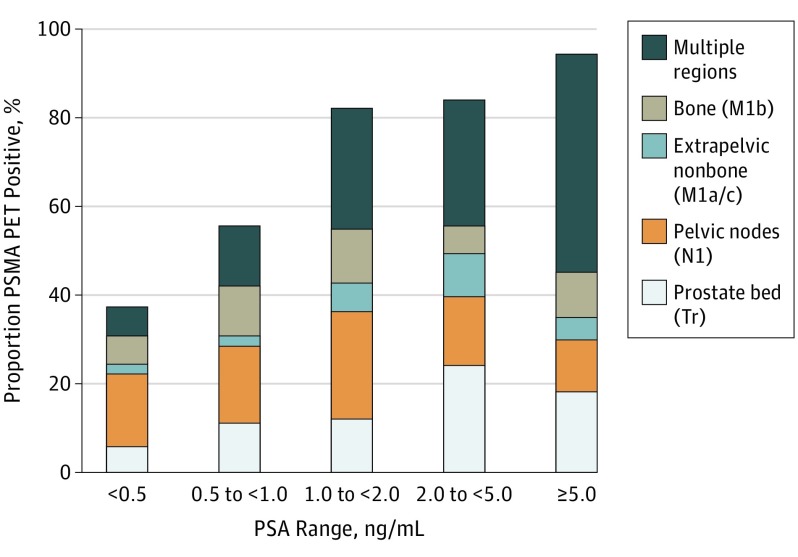
Maybe, too, I’ve placed too much faith in the scan’s ability to detect anything at my PSA level. But with a PSA level hovering around 1.0 ng/mL I thought we would have a decent chance of detecting something (chart below).

Detection Rate on a Patient Basis Stratified by PSA and Region Tr indicates prostate bed only; N1, pelvic nodes only; M1, extrapelvic only. Proportion of patients with 68Ga-PSMA-11 PET positive findings were stratified by PSA range and region of disease in accordance with PROMISE. https://pubmed.ncbi.nlm.nih.gov/30920593/

Needless to say, I’m truly glad that my PSA didn’t rocket even higher and that my scan didn’t light up like Times Square. Having definitive answers, though, would be the icing on the cake.


As far as the PSMA PET scan itself, it was pretty easy and took two hours to go through the entire process. I was instructed to drink 500 ml of water starting 2 hours before the scheduled scan time, and that was the only preparation needed.

I arrived at the hospital at 8 a.m. and was brought back to a radiation-proofed exam room where the technician started and IV at around 8:15 a.m. The 68Ga tracer was ready for injection around 8:40 a.m.

Around 9:30 a.m., the technician brought me back to the scanner where I got positioned on the bed and we began the scan which took 45 minutes. The scanner was very quiet (I could have dozed off) and large enough that it wasn’t claustrophobic. I was out of there by 10:15 a.m. and on my way home. Piece of cake.


On a related note, this was the longest it’s ever taken me to get the PSA test results posted online (hence the delay in this post). I actually called the clinic to get them over the phone because they still weren’t available online today (Thursday). The nurse I spoke with was very helpful and said, “We’re facing staffing issues and, well…” stopping herself in mid-sentence, probably remembering that the call was being recorded and not wanting to make a statement about the current environment for VA employees at the moment. I fear that this may be a precursor of things to come.

Be well!

Month 172 – PSMA PET & PSA

This will be a short update, as not much has really happened in the last month.

Tomorrow, I have my third PSMA PET scan. With luck, we’ll actually find the location of the cancer with this scan. That will help us decide what’s next in this adventure. I suspect I should be able to access the results online within a week or so. If not, I have a follow-up appointment on 1 April with the urologist.

I was going to get my PSA test done next week, but I wasn’t sure what impact a potential government shutdown might have on access to the lab, so I went for the blood draw on Monday. I’m guessing that I’ll break the 1.0 ng/mL threshold with this test.

That’s it for now. More to come in the days ahead.

Header image: Sunset over the Pacific Ocean, Silver Strand State Beach, California

Day 5,216 – PSMA PET Scan Scheduled

Just as predicted, the scheduler took a couple of days to call. We’ve got the PSMA PET scan on the calendar for 12 March 2025, well ahead of the follow-up appointment with the urologist on 1 April 2025. No bone scan needed.

That’s it. That’s the news for today.

Be well!

Day 5,214 – Doctor Visit

You may have overachieved when your doctor asks, “Are you a urologist?”

I had a good meeting with the real urologist this morning, and it appears that he actually read the questions I sent to him in advance. That made the discussion easier.

First on my question list was whether a PSMA PET scan was warranted. He agreed that it was, and we’re going to try to get that scheduled soon. He thought that, with my PSA at 0.94 ng/mL, there would be a better chance of actually finding something this time. The only concern is that the VA has required a bone scan ahead of the PSMA PET scan in the past, and he’s going to see if we can skip that. It may take several days for the schedulers to call me.

We did discuss the possibility of further radiation if a lesion is found away from the pelvis. I mentioned that I had had blood in my stools and mild radiation proctitis discovered (and addressed) during my recent colonoscopy. He was not keen on further radiation to the pelvis under those circumstances. Neither am I.

My next question was about the timing of beginning androgen deprivation therapy (ADT). He was pretty squishy on the timing, not knowing exactly where we’re at. I mentioned that, a year ago, the urologist told me that we’d start when my PSA hit 2.0 ng/mL, but the medical oncologist suggested holding off until metastasis. He generally agreed with the concept of starting it later so that the cancer doesn’t become resistant to it prematurely, with one caveat.

He seemed to give more weight to my PSA doubling time than did other doctors, and that’s when he asked me if I was a urologist. I had presented him my graph showing my PSA progression, and it showed my PSA doubling time. “How did you know how to calculate it?” I told him that I used the Memorial Sloan-Kettering PSA doubling time calculator. To him, my PSADT of 9 months was creeping into “concerning” territory, and might make him a little more inclined to start ADT earlier.

I asked him, “At what point do we call this metastatic disease?” and, “When should we get a medical oncologist (MO) involved?” To the first, he said that all we know is prostate cancer is somewhere in my body, but wouldn’t go so far as to call it metastatic yet. To the second, he was open to brining in a MO if the results of the PSMA PET scan warranted it.

We agreed to the following plan:

  • Get a PSMA PET scan and meet again in six weeks to review the results.
  • Get an updated PSA test before the six week review.
  • Let the results of the scan determine if we get the MO involved at that point.

I have the six-week follow-up appointment scheduled for 1 April 2025. My concern is getting the PSMA PET scan scheduled and completed before then. If I need a bone scan in advance of it, that may complicate or delay the PSMA PET scheduling further. If push comes to shove, I already had an appointment scheduled with urology on 8 May 2025, so that’s not that much of a delay if we can’t get everything scheduled before 1 April. 2025.

It was a productive meeting from my perspective, without any surprises.

More to come as we get things scheduled.

Header image: Cuyamaca Rancho State Park, California

Gallium supply to the U.S. cut off by China

This headline on the AP News feed caught my attention this morning:

China bans exports to US of gallium, germanium, antimony in response to chip sanctions

When you read the article, it omits any reference to gallium being used in medical diagnostics, so I have to wonder if this ban will adversely impact the ability to do 68Ga PSMA PET scans.

That question led me to a quick Google search on the production of 68Ga that yielded:

I’m no nuclear physicist or radiopharmaceutical guy but, given that process outlined above, it sounds to this layperson that PSMA PET scans could possibly be impacted.

Or I could be completely out to lunch, reading far too much into the story.

It’s definitely something to keep and eye on going forward, as I’m guessing another PSMA PET scan is in my future in January or February.

Day 5,118 – Urologist Visit

I met with the urologist this afternoon to go over my most recent PSA test results and the plan going forward. In a nutshell, we agreed to remain in limbo for another three months and retest the PSA in January and consider a PSMA PET scan if warranted at that point. (She was a bit skeptical that the PSMA PET scan would be conclusive even at my current PSA of 0.69 ng/mL.)

The urologist thought it was a little premature to start talking about androgen deprivation therapy, but recognized that that’s the next likely step down this path. I mentioned that, when I met with the urologist and medical oncologist in February, one suggested ADT at metastases and the other suggested starting at a PSA of 2.0 ng/mL. She said she could understand both positions.

Bottom line is that I continue to be in this sort of “no man’s land” of prostate cancer. We know it’s there; we just don’t know where, and we don’t want to pull the trigger on ADT prematurely. So more waiting.

One other thing that we discussed was radiation proctitis.

I’ve been sitting on this little tidbit for a while now, but I’ve been noticing blood in my stools. It initially appeared as spots a little smaller than a dime coin (~ 1 cm) but, over time, it has subsided to a small streak or a hint of blood. You know me: I had to create a spreadsheet to track it, and it’s been occurring in about ten percent of my bowel movements. That makes me feel better that it isn’t happening each and every time—that might indicate a larger problem if it were happening every time.

Fortunately, I haven’t had the diarrhea or mucus discharge that can come with more severe cases of radiation proctitis.

I mentioned this to my primary care physician during my appointment on 4 November, too. Both he and the urologist recommended a colonoscopy to check out what’s really going on. That joyful experience is scheduled for Friday, 22 November. Yippee!

I did come across this continuing education paper that gives a good overview if you’re really interested in learning more:

Radiation Proctitis

So the journey continues. Stay tuned for the next installment.

Header image: San Diego skyline and Mission Bay from Kate Sessions Memorial Park

Month 164 – Prostate Cancer Update

To my regular readers, you may want to skip this post. This is a high-level update intended for my family and friends who don’t regularly follow this blog (gasp!), and it will be shared with them via my personal social media accounts. If you’re new here, welcome. Feel free to read away.


It’s been a while since I’ve provided any detailed update on what’s going on in the world of my prostate cancer, so here goes.

We last left our hero two years ago as he began 35 sessions of salvage radiation therapy on 7 July 2022 in attempt to kill off his recurrent prostate cancer after his surgery in January 2011 ultimately failed. Unfortunately, those little cancer cells have proved themselves to be quite resilient, and the salvage radiation therapy has failed, too. Bummer.

We know this by tracking my prostate-specific antigens (PSA) on a regular basis. After the surgery, my PSA level should have dropped to undetectable (zero) because there was no prostate left to produce the PSA. But the PSA can live on in the cancer cells even without a prostate, and that’s how we know the cancer is still there.

After the radiation, my PSA should have dropped substantially, and it did, at least initially. But about 15 months after the radiation ended, my PSA was on the rise again. It rose enough to the surpass the PSA level when we started the radiation. In May 2024, it continued its upward climb to 0.52 ng/mL, the highest it’s been since the surgery. (In the grand scheme of things, it’s still a low value that many fellow prostate cancer patients would love to have, but the fact that it’s doubling about every six months is a concern.)

There is a relatively new scan that can detect prostate cancer cells at fairly low PSA levels. It works best when the PSA is close to 1.0 ng/mL, but it has detected prostate cancer about 30% of the time at PSA levels in the 0.2–0.3 ng/mL range. I went for this PSMA PET scan in January when my PSA was 0.37 ng/mL, and the scan failed to detect anything.

On the one hand, that’s great because there were no signs of metastasis and no evidence of prostate cancer. But on the other hand, we need to know where the cancer is located and what it’s up to in order to plan our next treatment options. Because it didn’t reveal its ugly head, we can’t make any meaningful treatment decisions right now.

If there are one or two small lesions someplace, we may be able to radiate them again depending on their size and location. But if there aren’t any distinct lesions and my PSA continues to increase, that’s likely the result of micrometastases and that would require a systemic treatment approach (e.g., hormone therapy, immunotherapy, chemotherapy, or any combination thereof).

After reviewing my May PSA results with the urologist, we agreed to punt for six months and do another PSA test in late October. I know that seems counterintuitive—letting the cancer continue to grow without taking action—but there’s a reason for it. I’m predicting my PSA at that point will be in the 0.75–1.0 ng/mL range in October, and we’ll do another PSMA PET scan to see if we can determine what’s going on and then plan from there.

Up until this year, all of my conversations have been with the urologist and radiation oncologist. In February, I met with a medical oncologist for the first time because they’re the ones who deal with the systemic treatments.

Based on my conversations with the urologist and medical oncologist, the next logical treatment option is hormone therapy. Prostate cancer lives off of testosterone, so if we kill off the testosterone, we slow the growth of the cancer cells. (Hormone therapy is not curative, however.) But the timing of starting hormone therapy is important.

If we started the hormone therapy now, it would rapidly knock my PSA down so far that it would make it next to impossible to do the PSMA PET scan in November and get any meaningful results.

The other problem with starting hormone therapy too early is that the prostate cancer can become hormone resistant much in the same way that bacteria can become resistant to antibiotics. Start the treatment too early, and you’ll lose its effectiveness when you really need it later.

There seemed to be a differing of opinions between the urologist and the medical oncologist as to what would trigger the start of hormone therapy. The urologist would hold off until there’s evidence of metastasis; the medical oncologist suggested we’d start when my PSA hit 2.0 ng/mL. We can figure that out when the time comes, but both agreed that hormone therapy (and other therapies) can keep me around another 10–15 years (or more).

Of course, my quality of life may be diminished as a result of the treatments. Hormone therapy can come with a whole host of unpleasant side effects such as fatigue, muscle loss, weight gain, loss of libido, hot flashes, etc. No need to rush into that Disneyland of experiences.

Physically, I am feeling fine. I’m completely asymptomatic when it comes to the cancer, but the side effects from the surgery and radiation are present and are a nuisance more than anything. Psychologically, though, it’s been a bit of an emotional roller coaster ride as I go from PSA test to PSA test, and failed treatment option to failed treatment option. We’re closing in on 14 years since diagnosis, and it does get tiring.

One of my regular blog readers and my urologist both suggested that, at this point, I look at my prostate cancer more as a chronic illness than as a life-threatening disease. I’m still trying to embrace that perspective and, even if I do, the worry will never go away.

There you have it. The latest and greatest in this adventure of living with prostate cancer. Follow along if you want to see my monthly updates, and we’ll probably know more right around the holidays.

Be well!

Header image: Lake Michigan coastline from the John Hancock Center, Chicago, Illinois

Month 162 – Urologist Visit

The short version from yesterday’s appointment with the urologist (who happens to be the Urology Department head):

Kick the proverbial can(cer) six months down the road and retest PSA then.

Generally speaking, I’m okay with that approach. I mean, really, what else is there to do at this point? We don’t have sufficient data points to make any definitive treatment decisions right now. Of course, I may feel differently after sleeping on this for a few nights.

I have to admit that it was a challenging meeting because the doctor just wanted to rapid-fire through all the discussion points and it was difficult to get my questions out. In the end, though, I prevailed.

She was blasé about the increase in my PSA, saying it went up “a little bit.” (A 41% increase in my mind is a tad beyond “a little bit,” but what do I know?) She didn’t see much value in doing another PSMA PET scan right now because a scan with a PSA of 0.52 ng/mL has about a 50-50 chance of detecting anything. That somewhat aligns with what the medical oncologist (MO) said in February—that it would be better to wait until my PSA was at least 0.7 or 0.8 before doing another scan.

My SWAG (scientific wild-assed guess) is that my PSA will be between 0.75 ng/mL and 1.1 ng/mL in November based on the average increases in my PSA over the last four readings and my PSA doubling time. (Bookmark this prediction for future reference! 😀)

We did talk about androgen deprivation therapy. Her biggest concern was that starting too early would just accelerate the eventual likelihood of resistance later on when ADT is needed the most, so she wouldn’t start ADT until there’s confirmed metastasis. (By comparison, the MO suggested holding off until my PSA hit 2.0 ng/mL.) I did ask if starting ADT early delays metastasis and she said it didn’t, which I thought was interesting.

We talked about whether it would be a monotherapy or a combination therapy, and she suspected we would start with just a monotherapy. She acknowledged that there are several studies out there showing that a combination therapy may lead to better outcomes but, in her mind, they weren’t persuasive enough to launch straight into combination therapy. However, she did say that there are certain circumstances where it may make sense, one of which was if the metastases was in the spine.

I asked about possible radiation of localized lesions and she was not all that enthusiastic about the idea. Her biggest concern was about going through radiation twice and whether that was a wise thing given what damage it may do to my body. “I’d have to defer to the radiation oncologist to make that assessment,” she said. Her fear was additional radiation damage / side effects, and I would have that same concern, too. I would have to consider very carefully zapping anywhere in the pelvic area again given the changes I have already experienced in my bowel habits.

Even if the scan showed one or two lesions that could be zapped, she would also start ADT because “it’s pretty much guaranteed that there would be cancer elsewhere that didn’t light up on the scan.” That makes sense.

Lastly, given where I’m at in this advanced prostate cancer no-man’s land, I was curious how she would label or stage my cancer. With no evidence of metastases on the last scan, she would still have me at Stage 2. (See the American Cancer Society staging of prostate cancer HERE.)

Of course, in my mind, I turned to the actual definition of metastasis:

the spread of a disease-producing agency (such as cancer cells) from the initial or primary site of disease to another part of the body

I don’t have a prostate (initial or primary site) but I do have evidence of cancer, so it must be in “another part of the body.” By that definition, it must mean that I’m metastatic, right? (Yeah, I know… Nothing in the prostate cancer world is that clear.)

I asked the question about staging more as an academic exercise because it really doesn’t matter much what the label or stage is. All I know is that I’m living with this bug growing inside me.


One of my blog followers, Phil, recently commented that his oncologist considered prostate cancer to be more of a chronic illness than a terminal illness, and that stuck with me. I mentioned that to the doctor, and she embraced that view wholeheartedly, telling me that patients like me can be kept around for many years—even decades—and the disease can be managed like hypertension or diabetes.

Intellectually, I already knew that. But, after 13+ years, it’s quite the mental leap to jump from, “I have the Big C and it continues to grow unabated,” to, “Cancer, schmancer. It’s like arthritis in my big toe. No big deal.” But it is a leap I’m trying to make.

You would expect that, after 13+ years of testing, waiting for results, reviewing results, and planning next steps, I’d be used to it by now. It’s routine. But I’m finding it to be more and more emotionally draining with each cycle as the uncertainty drags on. Perhaps it’s because I’m coming to terms with failed treatments when I had hopes for better outcomes, or perhaps it’s because I’m back in the wait-and-see mode. Or maybe it’s just the cumulative effect of being on this roller coaster for so long.

On the positive side, I know that I’ve been blessed. Many fellow prostate cancer patients would love to have their PSAs be at my level; my quality of life is pretty good considering all that my body has been through; and—most important—I’m still here 13+ years after diagnosis.


On a somewhat related note, I finally got my baseline testosterone results back: 424 ng/dL. That was taken almost two years to the day after receiving my six-month Eligard shot in advance of salvage radiation therapy, so I’m guessing that any effect the Eligard may have had on my testosterone level has worn off by now.

From what I can tell, that’s a decent / normal number for a 66-year-old guy.

At least we have a starting point for reference now.


Well, that’s it for this post. Time to go out and play for six months. Be well!


What’s next:

  • Week of 28 October – Get PSA test
  • 4 November – Physical with primary care physician
  • 14 November – Appointment with urologist

Header Image: La Jolla Coast, San Diego, California

Imaging Alternatives For PSMA Negative Prostate Cancer Patients

Here’s another informative video from the Prostate Cancer Research Institute for the ten percent of patients for whom PSMA PET scans may not work.

If I go for a third PSMA PET scan later this summer, and it fails to show anything at an even higher PSA level than my first two inconclusive scans (0.22 ng/mL and 0.37 ng/mL), I may find myself in that category.

I’ll provide my normal monthly update next week after my visit to the urologist on 14 May.