Day 5,237 – PSA and PSMA PET Scan Results

I’m so over this.

Click to enlarge

On the whole, the news is good. My PSA just barely bumped up from 0.94 ng/mL in January to 0.95 ng/mL in March and, taking the last five readings, that increased my PSA doubling time from 7.7 months to 10 months.

The PSMA PET scan revealed “no evidence of prostate cancer or metastatic disease.”

So, if the news is good, why am I “so over this?”

I was really hoping that this third PSMA PET scan would bring some clarity as to where the cancer was located so we could know how to proceed—even if it meant revealing metastatic disease. It’s frustrating because we know the cancer is somewhere and because we know the PSA almost tripled between 19 January 2024 and 16 January 2025, but we don’t have enough information to do anything about it. It’s just more waiting in limbo.

Of course, having had three PSMA PET scans all turn up negative makes me question if I’m in that “lucky” category of ten percent of patients whose prostate cancer doesn’t express PSMA, making the scans useless for me. It’s something that I’ll definitely discuss with the doctor at my next appointment on 1 April 2025. I vaguely recall that there’s some sort of genomic test that may be able to assess if I really do fall into that ten percent. I’ll have to do some research on that.

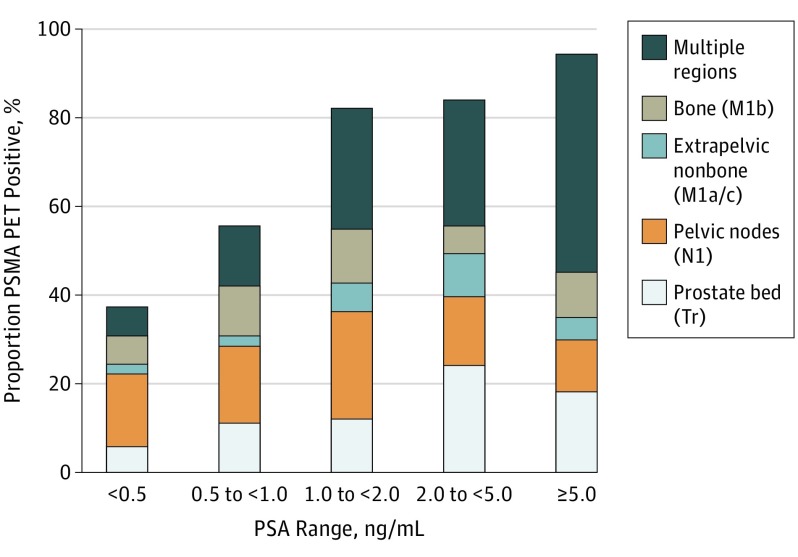
Maybe, too, I’ve placed too much faith in the scan’s ability to detect anything at my PSA level. But with a PSA level hovering around 1.0 ng/mL I thought we would have a decent chance of detecting something (chart below).

Detection Rate on a Patient Basis Stratified by PSA and Region Tr indicates prostate bed only; N1, pelvic nodes only; M1, extrapelvic only. Proportion of patients with 68Ga-PSMA-11 PET positive findings were stratified by PSA range and region of disease in accordance with PROMISE. https://pubmed.ncbi.nlm.nih.gov/30920593/

Needless to say, I’m truly glad that my PSA didn’t rocket even higher and that my scan didn’t light up like Times Square. Having definitive answers, though, would be the icing on the cake.


As far as the PSMA PET scan itself, it was pretty easy and took two hours to go through the entire process. I was instructed to drink 500 ml of water starting 2 hours before the scheduled scan time, and that was the only preparation needed.

I arrived at the hospital at 8 a.m. and was brought back to a radiation-proofed exam room where the technician started and IV at around 8:15 a.m. The 68Ga tracer was ready for injection around 8:40 a.m.

Around 9:30 a.m., the technician brought me back to the scanner where I got positioned on the bed and we began the scan which took 45 minutes. The scanner was very quiet (I could have dozed off) and large enough that it wasn’t claustrophobic. I was out of there by 10:15 a.m. and on my way home. Piece of cake.


On a related note, this was the longest it’s ever taken me to get the PSA test results posted online (hence the delay in this post). I actually called the clinic to get them over the phone because they still weren’t available online today (Thursday). The nurse I spoke with was very helpful and said, “We’re facing staffing issues and, well…” stopping herself in mid-sentence, probably remembering that the call was being recorded and not wanting to make a statement about the current environment for VA employees at the moment. I fear that this may be a precursor of things to come.

Be well!

Month 166 – Expanding My Audience

Between this prostate cancer blog and my travel blog, you’ve probably figured out that I enjoy the process of writing and sharing my experiences. While I’m no Pulitzer-prize winning author, a few people close to me have encouraged me to do something more formal—to “write a book.” I always thanked them for their compliment, and then gently set aside the notion of ever getting something published.

Until June.

Yes, I’ve been sitting on a little secret for almost three months. The editor of Cancer Health magazine came across my little ol’ blog and approached me to write an essay for their Voices column for their Fall 2024 issue of their magazine.

My initial reaction was one of surprise and intrigue and—if I’m being honest—a bit of anxiety. In the initial contact email, there wasn’t a ton of information about expectations, so I went to the website and looked at some of the archived Voices columns to see what might be involved. “Oh. I could do that.”

I went back to the editor and said, “I’m in.”

Prior to this, I had a vague understanding of the publishing process and knew that there would be some discussion about topics, length of the article, and deadlines. It would soon be followed by submitting drafts and digesting feedback. Also included in the exchange was a six-page contract covering usage rights and compensation.

I’m someone who’s better known for my spreadsheets than my writing, so when the editor read the final draft and said, “Wow… this one reads really great….Honestly, there’s very little I’d change in this…” I have to admit my chest puffed out a with a bit of pride.

After the magazine went live this week (hardcopy and online), I can now add “published author” to my résumé.

Is it a book? Nope. But we all start with baby steps, and a 500-word essay is my first step into the publishing world. Is this the beginning of something larger? Who knows. I enjoyed the whole process, and the editor did encourage future submissions. In the meantime, I’ll stick to self-publishing on my little ol’ blogs for now.

You may read the article here:

How to Navigate Conflicting Cancer Treatment Advice

Header Image: August Moonrise over San Diego, California skyline

Day 5,000

You know the nerd in me had to observe this milestone of being 5,000 days into this adventure of living with prostate cancer. 😂

In those 5,000 days, I have:

  • Learned more about prostate cancer and its treatment than I ever thought I would.
  • Had my emotions run from outright fear at diagnosis to elation with each undetectable PSA test after surgery back to fear as my PSA returned.
  • Adapted to my new normal with the side effects from surgery and radiation.
  • Shared my story in ways I never expected.
  • Learned who stepped up to provide support and who couldn’t do so for whatever reason.
  • Formed meaningful connections with fellow patients and caregivers from around the globe, and have been inspired by their stories.

That last point is important to me. Those readers who regularly engage with me, share your stories, and who offer your support have been a bright spot in this entire adventure, and I cannot thank you enough. Sadly, some of the men that I connected with over the years have succumbed to this insidious disease, and I miss our interactions.

Thank you again for putting up with my rantings for 5,000 days. Here’s hoping for 5,000 more.

—Dan

In case you’re wondering, 5,000 days equals:

  • 13 years, 8 months, and 9 days
  • 164 months and 9 days
  • 714 weeks and 2 days
  • 120,000 hours
  • 7,200,000 minutes
  • 432,000,000 seconds

Sleep better tonight knowing that. 🤓😂

Month 161 – Crappy Development

If you’ve been reading this blog from the beginning, you already know that no detail is spared in the telling of this prostate cancer tale. If you haven’t read some of the early, gory details, well, buckle up, Buttercup.

Let’s talk bowels and 💩.

LAST CHANCE. If you don’t want to follow along, check out my travel website HERE or my photography website HERE.


One of the known possible long-term side effects of radiation when it comes to prostate cancer is issues with your rectum and bowels, and those side effects can manifest themselves years after the radiation was completed. (It’s been 19 months since my last zapping session in August 2022.)

Something has changed with my bowels in the last few months, and I’m wondering if this is the beginning of those side effects.

The engineer in me is trying to evaluate different variables to see if these changes could be the result of something else.

As a baseline, I used to have one bowel movement a day in the morning and I was good for the day. Also, I’m a creature of habit, and my diet really hasn’t changed at all, so that’s likely not a contributing factor.

One other thing is the timing of the onset of my symptoms. It’s about the same time that I started my daily walking regimen in earnest in February. I doubt they’re related, but it is noteworthy.

So what’s different? Well:

  • About half the time, I’m now having two to three bowel movements a day. One recent day, there were five over the course of the entire day.
  • My stools have changed from well-formed “logs” to thin, soft “snakes” or “ropes” that tend to fall apart.
  • I find myself having short periods where I’m quite gassy and flatulent without any likely dietary cause (e.g., not eating frijoles for breakfast, lunch, and dinner).

The silver lining in this cloud is that I haven’t had any increases in bowel urgency, so this is quite manageable at the moment. I will admit, though, that there have been a few times when I’ve been on my daily walks when I felt the need to pass gas, and I felt I was on the edge of getting more than I bargained for if I did. Luckily, no accidents yet.

I haven’t done a ton of research on this yet, but a study out of Sweden, Salvage radiotherapy after radical prostatectomy: functional outcomes in the LAPPRO trial after 8-year follow-up, looked at the long-term side effects of salvage radiation therapy. The summary of their conclusions on bowel function:

Fecal leakage was more common after radiotherapy as found in answers to question about ‘accidentally leaked liquid stool’ with 4.5% in Radiotherapy group versus 2.6% in Control group, ‘accidentally leaked liquid stool’ once a week or daily, Odds ratio (95% CI): 1.90 [1.38; 2.62]), ‘mucus from anus’, 6.8% versus 1.5% (4.14 [2.98; 5.76]), ‘leakage of feces in clothes’, 5.6% versus 2.4%, (2.18 [1.18; 4.04]), respectively in Radiotherapy and Control groups (Figures 2, 3A and 3B and Tables S2 and S3 in the Supplement). Bleeding from the anus was more common after salvage radiotherapy, 8.6% versus 1.2% in control (3.21 [2.32; 4.44]) as was flatulence, 25% versus 14% (1.82 [1.40; 2.37]), whereas distress due to bowel symptoms did not differ, 7.8% versus 6% (1.27 [0.90; 1.80]). Defecation urgency was more common in the group given salvage radiotherapy as reported in answers to questions about need ‘to rush to the toilet’, 14% versus 5% (3.22 [2.46; 4.21]), ‘open your bowels again within 1 hour’, 17% versus 9.4% (1.53 [1.18; 1.98]). There was no statistically significant difference in ‘how often do your open your bowels’, 3% versus 2.5% (1.23 [0.92; 1.64]).

Carlsson, S., Bock, D., Lantz, A., Angenete, E., Koss Modig, K., Hugosson, J., Bjartell, A., Steineck, G., Wiklund, P., & Haglind, E. . (2023). Salvage radiotherapy after radical prostatectomy: functional outcomes in the LAPPRO trial after 8-year follow-up. Scandinavian Journal of Urology58, 11–19. https://doi.org/10.2340/sju.v58.7318

Another silver lining: no fecal leakage, mucus, or rectal bleeding so far. Woo-hoo!

Needless to say, this will be part of my conversation with my primary care physician on 9 May and with the urologist on 14 May. I’ll likely rope the radiation oncologist into the conversation, too.

I was reluctant to talk about this earlier because I wasn’t sure if this was a temporary thing or something longer term. This has been pretty persistent for about two months now, so I thought it was time to talk about it. As long as things don’t worsen, I can live with what’s happening right now (although I would prefer that I didn’t have to if I’m being perfectly honest).


I’ll have to admit that I’ve been feeling a general sense of anger and perhaps regret about this whole situation.

The source of those emotions isn’t from the side effects themselves, per se, but rather from this entire process that tends to move patients in the direction of what is considered to be overtreatment.

I may flesh this out in a longer, separate blog post one day, but when I see the likes of Dr. Scholz and others beginning to say, “Hmm. Maybe we should let the PSA rise so we can find out where the cancer is at before we start the treatments that could have life-long side effects adversely impacting the quality of life,” I get annoyed. Annoyed because I’m beginning to agree with that line of thought more and more, instead of the old, “It’s better to attack it while the PSA is low even though we don’t know exactly what’s going on.”

It’s frustrating because, my gut instinct all along was to delay until we knew where the cancer’s location, and I let the more rapid increases in my PSA, my shortening PSA doubling time, and the current “industry” guidance to act sooner rather than later get the better of me.

The frustration will continue as I move into the next chapter. I’ve been looking for studies on the best time to start androgen deprivation therapy (ADT) for someone in my situation and, from what I’ve seen so far, the guidance seems to run the full spectrum of starting early or delaying for years. Throw in the decision of whether it’s just ADT or ADT plus some sort of antiandrogen therapy, too.

I get that there are advances in research and technologies and that things are constantly changing. But at this point, I’d be happy for a clear path forward without adding additional side effects. (But I’m experienced and knowledgeable enough to know that’s just a pipe dream at this point.)

Rant over. Time to invest in some toilet paper company stock.


What’s next?

  • 1 May – PSA test
  • 9 May – Appointment with primary care (routine physical)
  • 14 May – Appointment with urologist.
  • TBD – Another PSMA PET scan if my PSA warrants it OR wait another three months for the next PSA test.