Day 5,859 – CT and Bone Scan Results

Sometimes, I wish my instant gratification monkey would stay locked up in his enclosure.

Having early online access to your test results is a double-edged sword. On the one hand, you get some of your questions answered but, on the other hand, ten new questions arise for every answered question.

You turn to Dr. Google to try and answer those new questions instead of waiting two weeks for your doctor appointment to get answers from the real deal. In the process, you can find yourself very quickly going down a rabbit hole that scares the crap out of you. Of course, you can be completely off base in your interpretation of the information, too.

On the flip side, though, getting ahead of myself and going down that rabbit hole will better prepare me to have a more meaningful conversation with the doctor when the time comes.

Quoting the radiologist who reviewed my CT scan, the results are “worrisome.”

Bottom Line Up Front

From the scans:

  • No metastasis indicated on the bone scan.
  • CT scan revealed suspicious lesions near the kidney and in the abdomen.
  • Two lymph nodes were also noted because of their size.
  • The CT radiologist did not use the word “metastasis” in her write-up.

Here’s my speculation based on my digging deeper into the findings using Dr. Google, et al.:

  • The suspicious findings are, in fact, metastatic given their location.
  • The findings in the abdomen may be prostatic peritoneal carcinomatosis.
  • It is extremely rare that prostate cancer metastasizes to the peritoneum, so there hasn’t been much research on its causes and best treatment options.

Bone Scan Results

The bone scan happened in two parts. First, an IV was started at 9:30 a.m. to inject the radioactive tracer, and then the scan itself took about 45 minutes at 1:30 p.m. The results were pretty straightforward:

No definite scintigraphic evidence of metastatic bone disease and no evidence of a widespread osseous process. As compared to the 2024 reference examination, there is no evidence of new or progressive osseous disease.

CT Scan Results

I was hooked up to an IV line to feed contrast into my body during the scan, and the scan itself took around 20 minutes. Interestingly, they split the CT scan report into two parts: one for the scan of my thorax and one for my abdomen and pelvis.

The break the reports into “Findings” and their final “Impression.” The impression is their overall summary of the scan.

CT Scan of the Thorax

This was the better news of the two. In short, there was, “No evidence of thoracic metastasis.”

It did make a few observations about other items in my thorax that were, to me, inconsequential and probably associated with just the years and mileage on this body. I’ll still ask about them with my primary care physician.

CT Scan of the Pelvis and Abdomen

This is where the report went off the rails in my lay person mind.

In the Findings section, they stated that my lower chest, liver, pancreas, spleen, reproductive organs, and adrenals were all “within normal limits.”

In the peritoneum: “No ascites or free air, no fluid collection.” (Remember that for later.)

There were a few items that raised my eyebrows though.

First, there is a “small lesion is seen just anterior to the interpolar region of the right kidney, measuring 1.2 cm.”

Second, the report for the lymph nodes stated, “A left periaortic lymph node measures 1 cm in short axis. 1 cm lymph node seen to the distal esophagus.” Interestingly, those findings were omitted from the final impressions write-up.

Third, and most concerning were the findings in the soft tissues / bone. “Numerous small omental implants are seen in right lateral portion of the omentum. Similar findings notes in the same position on the left side. Multiple additional omental implants are seen diffusely.”

Of course, I had to turn to Dr. Google to learn what an omentum and omental implants are:

In medicine, omental implants usually refer to deposits of abnormal tissue or cancer cells that attach to the greater omentum (a fatty fold of tissue hanging from the stomach and colon).

The full impression write-up:

Numerous small omental implants are noted diffusely in the omentum and an implant is seen just anterior to the right kidney. These findings are worrisome for carcinomatosis secondary to recurrent prostate cancer.

That doesn’t sound good to me.

Down the Rabbit Hole

This is where I may have made the mistake of going down the rabbit hole and scaring myself. Still, it will allow me to ask tons of questions during my appointment.

For grins and giggles, I plugged “carcinomatosis secondary to recurrent prostate cancer” into Dr. Google and came up with:

Carcinomatosis secondary to recurrent prostate cancer most commonly refers to peritoneal carcinomatosis—the spread of prostate cancer cells along the lining of the abdominal cavity (peritoneum). It is a rare and typically late presentation of recurrent or advanced disease, often linked to high-grade tumors, prior pelvic surgery (such as robotic-assisted radical prostatectomy), or castration-resistant prostate cancer.

Based on that, I tried to find a little more from more authoritative sources. I specifically wanted to hone in on the rarity of prostatic peritoneal cancer because we all know that prostate cancer typically metastasizes to the bones, lymph nodes, lungs, or liver.

From Eurorad:

While it is exceptionally rare, a few cases of metastasis to the peritoneum have been described in literature.

When prostate cancer metastasizes to the peritoneum, it is often accompanied by additional metastasis and rarely as isolated metastases. Prostate cancer is frequently advanced in the setting of peritoneal carcinomatosis and is associated with poor prognosis….

Prostate cancer with peritoneal carcinomatosis is a rare presentation with limited published case studies.1

From another article:

Peritoneal involvement by PC cells is rarely described in literature, particularly when not associated with other metastatic location or ascites. Rapoport reviewed the autopsy of 523 PC cases and found that only 13 cases [2.5%] had peritoneal deposits.

Many questions remain unanswered concerning the prognosis of this entity as well as its optimal management.2

And from the NIH:

By comparison, peritoneal carcinomatosis is a rare manifestation of advanced prostate cancer, with most reports in the literature consisting of individual case studies.3

One of the indicators of peritoneal carcinomatosis is the presence of ascites—pockets of fluid built up within the abdomen. The fact that the CT scan didn’t show any (see above) is a good sign and may indicate one of two things: Either there isn’t any peritoneal carcinomatosis or, if there is, it’s in early stages that hasn’t caused the ascites to develop yet.

My Take on All This

Again, I may be getting way ahead of myself here, and I may be completely out to lunch on my research, but I believe that I’m on the correct path for a discussion with the oncologist.

At this point, I’m not sure whether having another PSMA PET scan or getting an Axumin scan to try to confirm the CT scan findings is appropriate. It may be best to move straight into the ADT + ARPI therapy which, from the very limited case studies on peritoneal carcinomatosis seems to have a positive effect for a while.

Even prior to getting these results, I had been thinking about starting the ADT + ARPI therapy anyway in an effort to slow time to metastasis. If the findings really are metastatic, then the therapy will work to slow further metastasis.

Psychologically, I’m doing okay. I knew this day would come eventually—heck, I’ve been asking for an answer for years—but that doesn’t mean it’s any easier to digest once it arrives.

Treating peritoneal carcinomatosis seems to be much more challenging than going after bone lesions or lymph nodes, so I hope that I’m wrong about that. Because this is speculation based on my quick research, it makes it easier to not get too emotionally worked up about it right now. It’s just a possibility. I’ll wait for the oncologist to tell me if I was right or wrong.

I’ll do my best to push this all aside during our Thanksgiving holiday weekend, and just get ready for the oncologist appointment on 8 December.

Happy Thanksgiving and be well!

What’s Next

DateEvent
8 December 2026Medical oncologist appointment

Header image: Stormy sunset, Coronado, California
  1. https://www.eurorad.org/case/18278 ↩︎
  2. https://www.tandfonline.com/doi/full/10.2144/fsoa-2021-0009 ↩︎
  3. https://pmc.ncbi.nlm.nih.gov/articles/PMC12707985/ ↩︎

Day 5,850 – PSA Results

Well that was quick all the way around.

I jumped the gun and went for my bloodwork today (I fasted last night and this morning) and, instead of going to my local VA clinic, I went to the main VA hospital in La Jolla.

I wanted to do it as a dry run taking the trolley (public transit) during rush hour and to remember where the CT scan and the bone scan will be next week (separate locations within the hospital). I figured that, while I was there, I’d pop in and get my bloodwork done. I expected the lab to be packed at 9:30 on a Monday morning, but I was in and out in less than ten minutes. (And the phlebotomist was amazing—I didn’t even feel the needle go in. Seriously.)

By the time I got home at 11:30 a.m., the results were already posted online. I’ve never had them turned around that quickly.

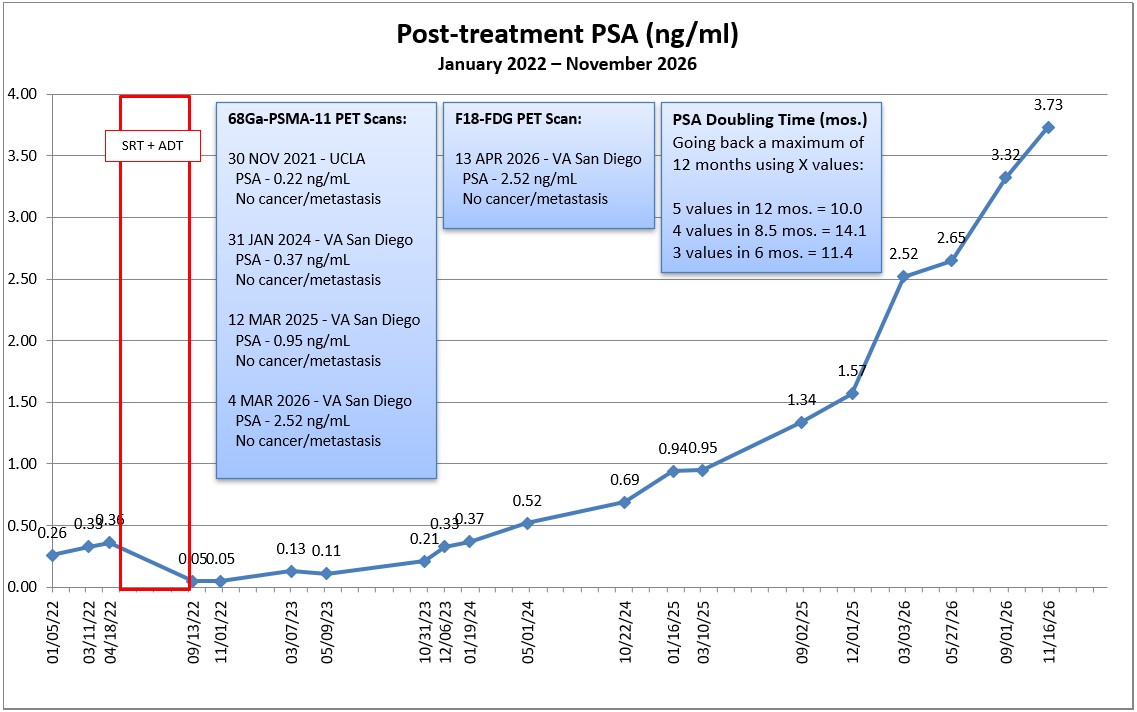
My PSA rose again—duh—from 3.32 ng/mL on 1 September to 3.73 ng/mL today. My PSA doubling time slowed down a tad to 10.0 months using the last five values going back to 1 December 2025 (<12 months).

All of my other test results seemed to be within the reference range for whatever it is they were measuring, so I guess that’s good.

I go for the scans a week from today, so we’ll see if they reveal anything (unlikely).

A friend has been pretty insistent on tagging along next week for moral support, so another reason I went the main hospital today was to scope out locations where he could work remotely while I’m getting juiced up and scanned. (I think he really just wants an excuse to get out of the office. 🙂 I’m okay with that. )

More to come as it develops.

Be well!

What’s Next

DateEvent
23 November 2026CT and bone scans
8 December 2026Medical oncologist appointment

Header image: Stormy sunset, Coronado, California

Month 191 – Calm before the Storm

It’s been a busy time since the last regular monthly post, but in a good way.

I managed to unplug for five days by taking a trip to chase autumn colors in the Eastern Sierra using Bishop, California as my base. I was a week or two early, but still managed to find some good colors. When I returned, I was Mr. Social Butterfly, going to one of the San Diego Padres’ last home baseball games; attending a friend’s birthday party; going to our monthly trivia night with friends at a favorite watering hole; and then watching the Padres beat my hometown Chicago Cubs, all in my first week back. It was good to disconnect and be distracted for a while. I needed that.

Before leaving on my trip, I participated in an online advanced prostate cancer support group run by the AnCan Foundation. (I had featured one of their videos on this blog back in April.) Within the group, there were a few doctors but pretty much everyone else were fellow prostate cancer patients sharing their experiences.

There was a ton of information that was flowing, so it was a tad like trying to take a sip of water from a firehose, but I did come away with some valuable input. Key points included:

  • Different experiences on different ADT + ARPI drug combinations when it came to side effects. The consensus seemed to be Orgovyx® and darolutamide were the preferred combination.
  • There was also a recommendation for me to push to get an Axumin PET scan given the four negative PSMA PET scans and the negative [F18] FDG PET scan.
  • One of the members strongly encouraged me to connect with Dr. Matthew Rettig who operates out of the West Los Angeles VA Medical Center and UCLA. (When I searched on “best prostate cancer medical oncologists in Southern California,” his name was number two on the results.)
  • They encouraged me to more thoroughly investigate a VA disability rating given the changes in how prostate cancer is addressed under the PACT Act. That’s low on my priority list for a variety of reasons that I won’t go into here.

I have to admit that, given my trip, my social calendar, and my need to unwind from both, I’ve been a bit slow in digesting the meeting’s contents and determining how I want to proceed.

Dr. Rettig’s opinion would be valuable at some point, and I’m just figuring out how and when to do that. I have the CT and bone scans scheduled next month (see below) and, to be honest, I don’t expect that they’ll show anything. I’m thinking that a set of negative results on those scans would give me strong justification for getting an Axumin scan and for the referral to Dr. Rettig. I can say, “I tried what you recommended. Now let’s humor me and find a way to get the Axumin scan.”

The VA can be a bit rigid in its protocols and procedures, and I’m inclined to go through the medical oncologist at VAMC San Diego to get the referral to VAMC West Los Angeles. I don’t want to be stepping on anyone’s toes, or finding out that I’ve inadvertently transferred my full-time care to Los Angeles. (The 147-mile / 236 km drive between home and VAMC WLA is brutal.)

For now, I’m content to wait the six weeks until the scans, get their results, and then push to see Dr. Rettig and go for an Axumin scan if needed. I should have an updated PSA test result at that point, too. Of course, I reserve the right to change my mind. 🙂


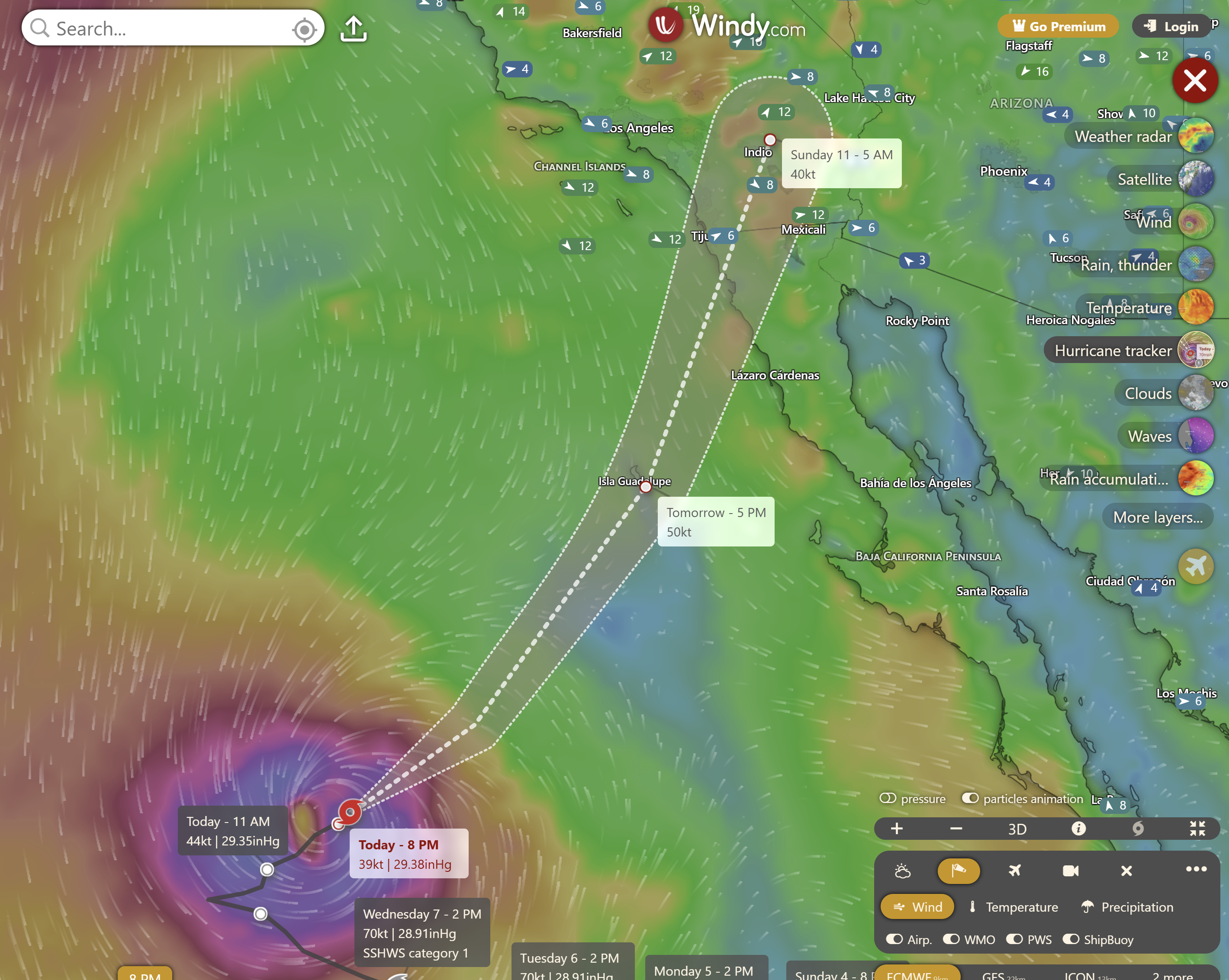
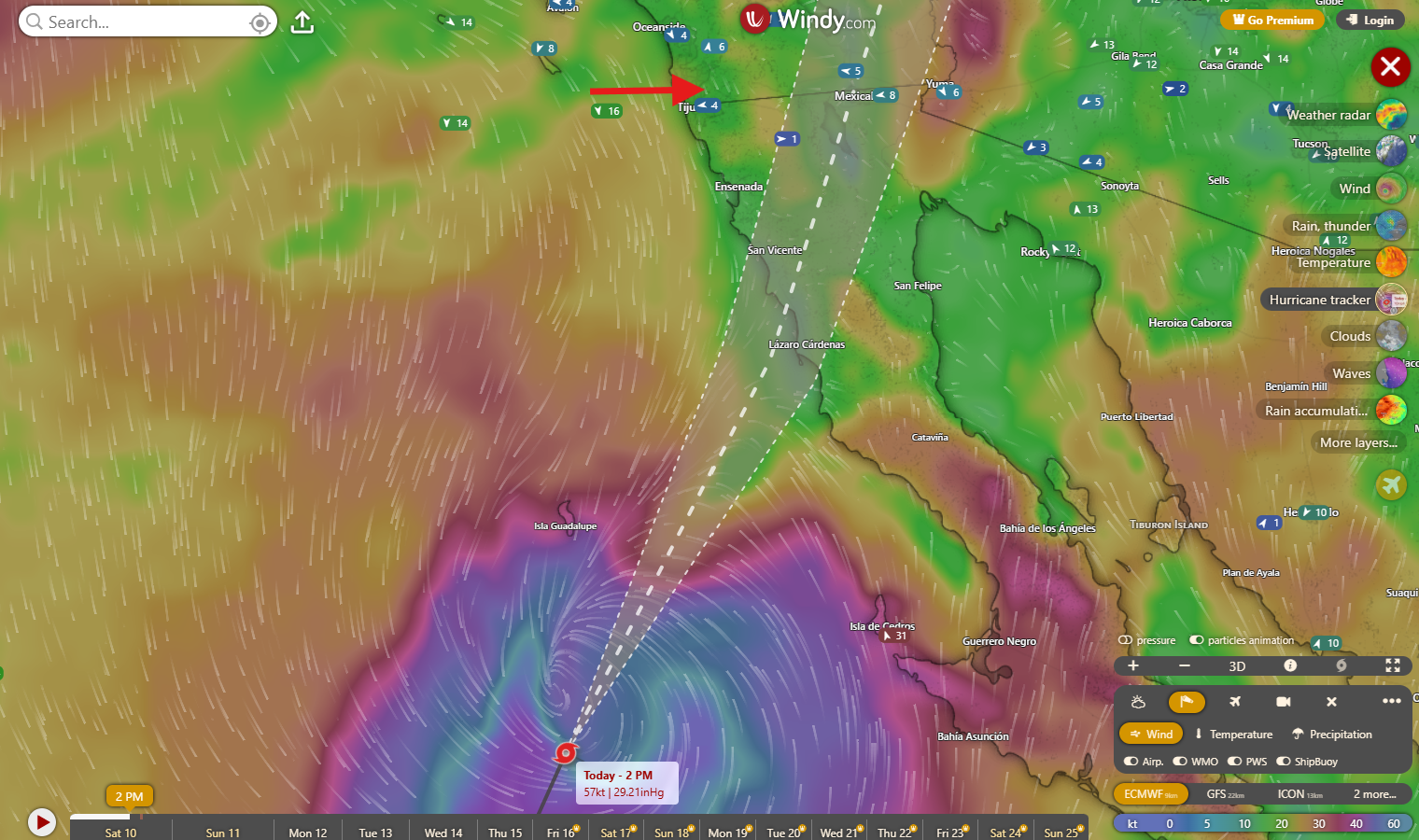
As I’ve been writing this post on Friday night, 9 October, I’ve had one ear open on the forecast for Tropical Storm Rachel, which should be arriving in the San Diego / Tijuana area in about 24 hours. The National Hurricane Center issued a Tropical Storm Watch for San Diego, and this is only the second time ever that a tropical alert has been issued on the west coast. (The last time was in 2023 for Hurricane Hilary. The last time a tropical system actually made landfall on the California coast was 1939.)

UPDATE 5 P.M. PDT, Saturday – Rachel’s forecasted track has moved a bit to the east. Friday night, it was going to pass about 17 miles / 27 km from my house near Tecate; the current track has it passing about 85 miles / 137 km east of my house near Mexicali.

It looks like the brunt of the storm will kick in around 11 p.m. and last through about 10 a.m. tomorrow. One forecast model shows wind gusts in my neighborhood will get up to about 45 mph / 72 km/h. It the mountains east of San Diego, it’s showing they may get up as high as 90 mph / 144 km/h.

The reason I’m so interested in tropical systems is because I rode out Hurricane Iwa which hammered Oahu (where I lived) and Kauai in 1982. It was quite the unnerving experience, About 2 years later, one of the ships I was assigned to got caught up in the periphery of a typhoon while we were at sea, and waves washed away one of our inflatable life rafts. Experience tells me to heed the warnings and take precautions. Better safe than sorry.

More to come. Be well!

Rachel’s Track Friday Night
Rachel’s Track Saturday afternoon

What’s Next

DateEvent
23 November 2026CT and bone scans
1 December 2026PSA Test
8 December 2026Medical oncologist appointment

Header image: North Lake near Bishop, California

Day 3,901 – CT Scan Results

Let’s start with the BLUF:

No definite evidence of locally recurrent or metastatic disease within the abdomen or pelvis.

(If you don’t know, BLUF = Bottom Line Up Front).

There was one 9 mm kidney-shaped lymph node that caught their attention, but didn’t think it to be remarkable.

They also commented on a bunch of my other organs and bits and pieces, but nothing seemed too out of the ordinary for any of them aside from a few dents and scratches from 63+ years of normal wear-and-tear and countless miles/kilometers.

The fact that the CT scan didn’t pick anything of substance up is a good thing and a bad thing. Good because it didn’t see anything; bad because it didn’t see anything. The likelihood of it detecting the lesions at my PSA level were small, and we knew that going into this. So even though we didn’t see anything, that doesn’t necessarily mean that it’s not there.

I did get a chuckle out of one line in the report:

Multidetector CT abdomen/pelvis was obtained after the uneventful administration of intravenous contrast.

Uneventful for who??? The radiologist? Sure. I did everything in my power to not puke all over their $300,000 scanner. 😲


I expect we’ll have the same result with bone scan next week, but time will tell.

That’s all for now.

Be well!

Day 3,899 – CT Scan

You know me. I love tracking things, and this post is the 400th published post on this blog. Woo-hoo! 🎈🎉✨ Of course, I would have preferred to not have written any of them at all, but that’s life.


I thought I had had a CT scan in the past, but if I did, I don’t remember it being anything like what I experienced today. It kicked my ass. Technically, it was the contrast they injected into me that kicked my ass. The scan—sliding in and out of the scanner—was a non-event.

The radiologist forewarned me of the sensations that I would experience shortly after he injected the contrast. The sensation of a full and warm bladder? Check. Metallic taste in my mouth? Check. A warm sensation throughout my body? Check.

What he didn’t do a very good job of was forewarning me of the intensity of the some of these things. At one point, I thought I was going to vomit like Vesuvius. It was awful. As soon as he stopped the IV flow of contrast, I could feel some of these side effects dissipating. (But not nearly as quickly as they came on.)

I didn’t even bother to ask the technician if they saw anything odd on the scan as they were running the test. I’ll usually do that because sometimes, if you’re lucky, the technician will help you out. They may not be able to be all that specific, but I’ve had one or two tell me, “You really don’t have anything to worry about.” I was just more focused on getting out of there without puking.

The whole appointment went like clockwork and went faster than I expected. My appointment was for 2:30 p.m. I pulled into the parking garage at 1:45 p.m.; was checked in a Radiology by 2 p.m.; on the scanner bed by 2:10 p.m.; and headed back to my car by 2:35 p.m. Again, I know there are tons of complaints about the VA healthcare system, but San Diego VA Medical Center has been top-notch as far as I’m concerned.

The radiologist thought they would have the full results available by Friday.

I’ll have to admit that on my commute to work this morning, I had a bit of a knot in my stomach. Not because I was afraid of the scan (now I am—a little), but because this is the beginning of the process that will give me results I may not want to hear.

On a related note, my employer-provided healthcare insurance did confirm that the Department of Nuclear Medicine at UCLA is in network, so that’s a good thing.

What’s next? Here’s an estimated timeline:

  • Get online access to CT Scan results sometime this weekend or early next week.
  • Have the bone scan on Friday, 23 July.
  • Get online access to bone scan results 3-5 business days after the scan.
  • Have a follow-up appointment to review both scan results with the urologist on 3 August.

I’ll contact UCLA to start that process and hopefully have all of my homework done in time for the appointment on 3 August.

Well, time to drink a few liters of water to purge that contrast out of me.

Be well!

Day 3,892 – Scan-a-Palooza

Let the radioactive fun begin!

I was able to schedule my bone and CT scans this morning with considerable ease. In fact, things will happen much sooner than I thought they might. My CT scan is scheduled next Wednesday, 14 July, and my bone scan is scheduled Friday, 23 July.

I have to go for some pre-scan lab work tomorrow afternoon to ensure that my kidneys are working fine and won’t be damaged by one of the contrasts.

I haven’t given up on the Ga-68 PSMA PET scan. In fact, I wrote my health insurance company an email about 4:30 a.m. as I tossed and turned. (Last night was hell. If I slept more than 2 hours—non-consecutively—that was about it.) They tout having a response within 2 business days, so we’ll see if they come through with that.

UCLA is out of network for my insurance company, so I’d have to cough up 40% of the cost if they’re going to cover it at all. I’m okay with that. (For my overseas readers, welcome to U.S. health care systems!)

So that’s the latest and greatest. More to come, I’m sure.

Be well!