Day 3,819 – Doctor’s Visit

The dreaded tools of the DRE trade.

My visit to the urologist this afternoon went just as expected, and even a little better.

With the San Diego VA Medical Center being a teaching hospital, it’s rare that I see the same doctor twice. Because I liked the doctor I saw last time because of the conversation we had and the plan that we mapped out together, I specifically requested to see her again this time. Unfortunately, a young resident showed up in her place.

That actually may have worked to my advantage.

Dr. K started the conversation by asking if I had come to a decision as to whether I wanted to do salvage radiation therapy or hormone therapy. I was a bit taken aback by that—”Haven’t we skipped a few steps here, Doc?”—but then I remembered the way that Dr. L wrote up her notes from my visit with her, it would be easy for him to come to that conclusion.

I filled in a few of the blanks with Dr. K regarding our plan to follow up the negative CT and bone scans with an Axumin or PSMA PET scan in hopes of finding the cancer before making the SRT vs. ADT decision. He dutifully reminded me that either or both scans could come back negative, too, meaning that the cancer was still likely in the pelvis or prostate bed.

Interestingly, when we were talking about the merits of the Axumin and PSMA PET scans, he immediately went to, “Why even bother with the Axumin scan; go straight to the PSMA scan.” I didn’t even have to nudge him in that direction. He and I were on the same page.

To his knowledge, though, SD VAMC had not yet referred anyone to get a PSMA PET scan, but he seemed eager to figure our how to make it happen and have me be the first (or among the first) to be referred. He wasn’t even sure where to begin, so I told him.

Instructions for PSMA Referral

I opened my file folder that I had with me and pulled out the one-page sheet that I had put together, stepping him through the referral process that UCLA had shared with me. It was all there for him, and he asked, “May I keep this?”

He did admit, though, that he had no idea how long it may take to get approval from the hospital team before he could even ask for the referral, so this may play out over a few weeks or longer. Rest assured that I’ll keep on top of this, asking for periodic updates.

I’m pretty excited that we’re moving in the direction of going straight to the PSMA PET scan, but also recognize there can be a number of administrative twists and turns along the way.

In the interim, we agreed to test my PSA again in early November, keeping on a four-month testing cycle. I’m okay with that while we’re trying to sort everything else out.


We also talked about my incontinence episodes becoming more frequent and more substantial in the last 6 weeks or so. He wanted to rule out a urinary tract infection, so he sent me off for some labs and we’ll see what they yield.

These episodes have put me back in incontinence pads for the last few weeks. Before, a sneeze or a cough would yield a few drops; now, they yield a squirt. Not good.

More to monitor and report on going forward.

That’s it for this post.

Be well!
Day 3,910 – Bone Scan Results

As a baby boomer, I grew up with Spock. Both of them.

First, there was Dr. Benjamin Spock, the noted pediatrician who told my parents—and millions of other parents—how to raise and care for their kids. Then, of course, there was the Star Trek Spock, whose existence was rooted in Vulcan logic.

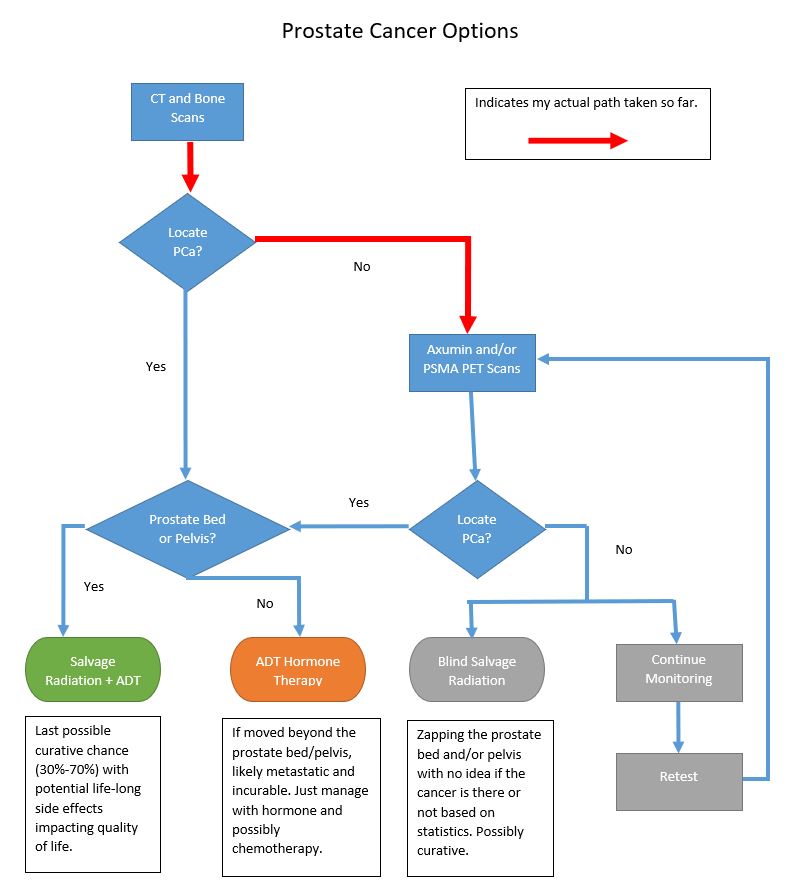
Now I’m not a Trekkie, but if you’ve read any part of this blog, you do know that facts, figures, and logic are high on my priority list, too. I thought, “What better way is there to outline the possible scenarios and decisions that are ahead of me than to put them all in a flow chart.” So here goes:

So let’s step through this.

We start with the CT and Bone scans that happened over the last two weeks. The first question is, “Did those scans determine the location of the prostate cancer (PCa)?”

If the answer is yes, then the next question is, “Was the prostate cancer in the prostate bed and/or pelvis?”

PCa in Prostate Bed/Pelvis

If the answer is yes, the PCa is in the prostate bed and/or pelvis, then Salvage Radiation Therapy (SRT) with or without Androgen Deprivation Therapy (ADT) (Hormone therapy) offers the last possible chance of a true cure. Of course, there are risks associated with SRT that would impact your daily quality of life: bowel control, bladder control, and lack of sexual function. Additionally, depending on which study you look at, SRT may be successful only 30% to 70% of the time. (Green bubble above.)

PCa is Not in Prostate Bed/Pelvis

But if the answer is no, the PCa is outside of the prostate bed and pelvis, that means the PCa is now distant and likely metastasized. If that’s the case, there is no cure and the PCa can only be managed with hormone therapy and perhaps chemotherapy. (Orange bubble above.)

CT and Bone Scans do not Locate the Prostate Cancer

We’ve talked at some length that neither the CT scan nor the bone scan have the sensitivity to pick up the cancer’s location based on my PSA level of 0.21 ng/mL. It was very likely that neither would pick up the cancer at that first decision point on the flow chart, so further investigation is required by using the Axumin or PSMA PET scan.

CT and Bone Scan Results

In fact, neither the CT nor the bone scan picked up the location of the cancer:

No definite scintigraphic evidence of metastatic bone disease and no evidence of a widespread osseous process

So that’s actually good news with the bone scan. It shows that it has not metastasized to the bones, which is definitely a good thing. (Or, at least if there is metastasis to the bones, it’s at a level that’s unable to be picked up by the sensitivity of the scan.)

Next Steps

We follow my red arrows above and run the Axumin or PSMA PET scans (or both) to see if either of those can pick up the location of the cancer. I’ll have that discussion with the urologist on 3 August 2021, and we’ll see when we can get them on the calendar.

If the Axumin and/or PSMA find the cancer in the prostate bed/pelvis, then we go back to the section above and land on SRT as the option. But if it’s found outside the prostate bed/pelvis, then we go back to the other section where we just manage with ADT. (If the lesion outside the pelvis is well-defined, it may be something that could be zapped in its location. Something to explore.)

If the Axumin or PSMA PET scan cannot locate the PCa, then things get fuzzy fast.

Sure, we could go ahead and blindly complete the salvage radiation therapy, hoping that we’re zapping in the correct place. Or, we could continue to monitor for a while longer and then retest to see if the cancer can be pinpointed.

This may have been a bit of an oversimplification of what’s ahead for me, but I’m hoping that it makes sense to you.

Be well!