Month 179 – Urologist Discussion

Well, that went about as I expected.

In a nutshell, we’re punting the ball another three months down the road.

The doctor commented on the continuing rise in my PSA and said after consulting with the doctor who saw me last time, said that he wanted to recheck my PSA in six months and “wait a year” for another PSMA PET scan. I should have asked for clarification on that, but I think he was referring to waiting a year after my last PSMA PET scan in March 2025 and not a year from today.

I wasn’t entirely comfortable with waiting another six months, so we agreed to test PSA again in December (three months after my September test) and go from there.

We also talked about spot radiation if anything pops up on the scan. He seemed a bit reluctant for that to be an option, and went straight to starting hormone therapy. It’s as though he was making the transition from curative options to management options, and, to be perfectly honest, I believe I made that transition in my own mind once the salvage radiation failed. That doesn’t mean that I wouldn’t try zapping a lesion or two if they popped up on the scan depending on location (no more zapping to the pelvis and risking further bowel complications).

We did talk about my experience with hormone therapy during the salvage radiation, and the timing of starting it this time around. In that discussion, he brought up the topic of bringing in a medical oncologist at some point depending on the scan results and my PSA test results.

We talked at length about my urinary frequency and some options for that. He suggested some pelvic floor therapy might be beneficial, so I said I’d be willing to give that a try.

Overall, I’m okay with where we’re at and the planned course of action for now. I’ll go for my PSA test in early December, and if there’s another significant jump, I’ll press for the PSMA PET scan to be done sooner rather than later.

My next scheduled urologist appointment is 30 December 2025.

Be well!

Header image: Sunset, Imperial Beach, California

Day 5,256 – Doctor Visit

I had my post-PSMA PET scan visit with the urologist today, and I wasn’t really sure what to expect going into it.

The doctor (same as last time) shared the scan results saying that they’re something I should celebrate. I mentioned, though, that I have had three scans and were inconclusive despite the rising PSA numbers. He was quick to reply by saying that the scan not showing evidence of prostate cancer or metastasis was conclusive.

I understand where he’s coming from, but until we know where the cancer is, I’m going to have a difficult time accepting that perspective.

I did ask whether there was some sort of test that can determine if my cancer doesn’t express PSMA, and he said that there wasn’t. Something in my pea-sized brain tells me I need to double check him on that.

I also asked if there could be another explanation beyond the cancer that would explain my rising PSA. He ruled out the possibility of some residual prostate tissue being left behind after the surgery as being the cause based on my PSA kinetics over time.

In terms of what’s next, we’re kicking the can six months down the road for another PSA test and follow-up. I was a bit surprised that he wanted to wait six months, and suggested doing the test in three or four months. He was a bit insistent on the six month window. He felt comfortable with my current situation—the slight increase in my last PSA test from the previous one and my PSA doubling time—that waiting six months wouldn’t be a problem. He also argued that having a longer period between tests would better reflect what’s going on.

As we wrapped up, he reminded me that the scan results were good news, and I know that he’s right in that regard. I’ll work on changing my own perspective going forward (even though those little cancer bugs are still doing their thing inside me.)

My follow-up appointment is on 30 September 2025.

That’s it for today. Be well!

Header image: Cherry Blossoms, Japanese Friendship Garden, San Diego, California

Day 5,237 – PSA and PSMA PET Scan Results

I’m so over this.

Click to enlarge

On the whole, the news is good. My PSA just barely bumped up from 0.94 ng/mL in January to 0.95 ng/mL in March and, taking the last five readings, that increased my PSA doubling time from 7.7 months to 10 months.

The PSMA PET scan revealed “no evidence of prostate cancer or metastatic disease.”

So, if the news is good, why am I “so over this?”

I was really hoping that this third PSMA PET scan would bring some clarity as to where the cancer was located so we could know how to proceed—even if it meant revealing metastatic disease. It’s frustrating because we know the cancer is somewhere and because we know the PSA almost tripled between 19 January 2024 and 16 January 2025, but we don’t have enough information to do anything about it. It’s just more waiting in limbo.

Of course, having had three PSMA PET scans all turn up negative makes me question if I’m in that “lucky” category of ten percent of patients whose prostate cancer doesn’t express PSMA, making the scans useless for me. It’s something that I’ll definitely discuss with the doctor at my next appointment on 1 April 2025. I vaguely recall that there’s some sort of genomic test that may be able to assess if I really do fall into that ten percent. I’ll have to do some research on that.

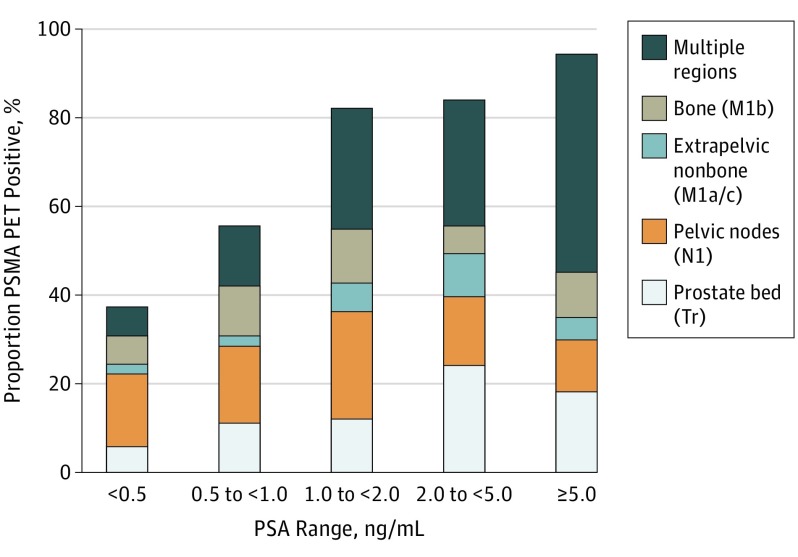
Maybe, too, I’ve placed too much faith in the scan’s ability to detect anything at my PSA level. But with a PSA level hovering around 1.0 ng/mL I thought we would have a decent chance of detecting something (chart below).

Detection Rate on a Patient Basis Stratified by PSA and Region Tr indicates prostate bed only; N1, pelvic nodes only; M1, extrapelvic only. Proportion of patients with 68Ga-PSMA-11 PET positive findings were stratified by PSA range and region of disease in accordance with PROMISE. https://pubmed.ncbi.nlm.nih.gov/30920593/

Needless to say, I’m truly glad that my PSA didn’t rocket even higher and that my scan didn’t light up like Times Square. Having definitive answers, though, would be the icing on the cake.


As far as the PSMA PET scan itself, it was pretty easy and took two hours to go through the entire process. I was instructed to drink 500 ml of water starting 2 hours before the scheduled scan time, and that was the only preparation needed.

I arrived at the hospital at 8 a.m. and was brought back to a radiation-proofed exam room where the technician started and IV at around 8:15 a.m. The 68Ga tracer was ready for injection around 8:40 a.m.

Around 9:30 a.m., the technician brought me back to the scanner where I got positioned on the bed and we began the scan which took 45 minutes. The scanner was very quiet (I could have dozed off) and large enough that it wasn’t claustrophobic. I was out of there by 10:15 a.m. and on my way home. Piece of cake.


On a related note, this was the longest it’s ever taken me to get the PSA test results posted online (hence the delay in this post). I actually called the clinic to get them over the phone because they still weren’t available online today (Thursday). The nurse I spoke with was very helpful and said, “We’re facing staffing issues and, well…” stopping herself in mid-sentence, probably remembering that the call was being recorded and not wanting to make a statement about the current environment for VA employees at the moment. I fear that this may be a precursor of things to come.

Be well!

Month 172 – PSMA PET & PSA

This will be a short update, as not much has really happened in the last month.

Tomorrow, I have my third PSMA PET scan. With luck, we’ll actually find the location of the cancer with this scan. That will help us decide what’s next in this adventure. I suspect I should be able to access the results online within a week or so. If not, I have a follow-up appointment on 1 April with the urologist.

I was going to get my PSA test done next week, but I wasn’t sure what impact a potential government shutdown might have on access to the lab, so I went for the blood draw on Monday. I’m guessing that I’ll break the 1.0 ng/mL threshold with this test.

That’s it for now. More to come in the days ahead.

Header image: Sunset over the Pacific Ocean, Silver Strand State Beach, California

Day 5,216 – PSMA PET Scan Scheduled

Just as predicted, the scheduler took a couple of days to call. We’ve got the PSMA PET scan on the calendar for 12 March 2025, well ahead of the follow-up appointment with the urologist on 1 April 2025. No bone scan needed.

That’s it. That’s the news for today.

Be well!

Day 5,214 – Doctor Visit

You may have overachieved when your doctor asks, “Are you a urologist?”

I had a good meeting with the real urologist this morning, and it appears that he actually read the questions I sent to him in advance. That made the discussion easier.

First on my question list was whether a PSMA PET scan was warranted. He agreed that it was, and we’re going to try to get that scheduled soon. He thought that, with my PSA at 0.94 ng/mL, there would be a better chance of actually finding something this time. The only concern is that the VA has required a bone scan ahead of the PSMA PET scan in the past, and he’s going to see if we can skip that. It may take several days for the schedulers to call me.

We did discuss the possibility of further radiation if a lesion is found away from the pelvis. I mentioned that I had had blood in my stools and mild radiation proctitis discovered (and addressed) during my recent colonoscopy. He was not keen on further radiation to the pelvis under those circumstances. Neither am I.

My next question was about the timing of beginning androgen deprivation therapy (ADT). He was pretty squishy on the timing, not knowing exactly where we’re at. I mentioned that, a year ago, the urologist told me that we’d start when my PSA hit 2.0 ng/mL, but the medical oncologist suggested holding off until metastasis. He generally agreed with the concept of starting it later so that the cancer doesn’t become resistant to it prematurely, with one caveat.

He seemed to give more weight to my PSA doubling time than did other doctors, and that’s when he asked me if I was a urologist. I had presented him my graph showing my PSA progression, and it showed my PSA doubling time. “How did you know how to calculate it?” I told him that I used the Memorial Sloan-Kettering PSA doubling time calculator. To him, my PSADT of 9 months was creeping into “concerning” territory, and might make him a little more inclined to start ADT earlier.

I asked him, “At what point do we call this metastatic disease?” and, “When should we get a medical oncologist (MO) involved?” To the first, he said that all we know is prostate cancer is somewhere in my body, but wouldn’t go so far as to call it metastatic yet. To the second, he was open to brining in a MO if the results of the PSMA PET scan warranted it.

We agreed to the following plan:

  • Get a PSMA PET scan and meet again in six weeks to review the results.
  • Get an updated PSA test before the six week review.
  • Let the results of the scan determine if we get the MO involved at that point.

I have the six-week follow-up appointment scheduled for 1 April 2025. My concern is getting the PSMA PET scan scheduled and completed before then. If I need a bone scan in advance of it, that may complicate or delay the PSMA PET scheduling further. If push comes to shove, I already had an appointment scheduled with urology on 8 May 2025, so that’s not that much of a delay if we can’t get everything scheduled before 1 April. 2025.

It was a productive meeting from my perspective, without any surprises.

More to come as we get things scheduled.

Header image: Cuyamaca Rancho State Park, California

Gallium supply to the U.S. cut off by China

This headline on the AP News feed caught my attention this morning:

China bans exports to US of gallium, germanium, antimony in response to chip sanctions

When you read the article, it omits any reference to gallium being used in medical diagnostics, so I have to wonder if this ban will adversely impact the ability to do 68Ga PSMA PET scans.

That question led me to a quick Google search on the production of 68Ga that yielded:

I’m no nuclear physicist or radiopharmaceutical guy but, given that process outlined above, it sounds to this layperson that PSMA PET scans could possibly be impacted.

Or I could be completely out to lunch, reading far too much into the story.

It’s definitely something to keep and eye on going forward, as I’m guessing another PSMA PET scan is in my future in January or February.

Imaging Alternatives For PSMA Negative Prostate Cancer Patients

Here’s another informative video from the Prostate Cancer Research Institute for the ten percent of patients for whom PSMA PET scans may not work.

If I go for a third PSMA PET scan later this summer, and it fails to show anything at an even higher PSA level than my first two inconclusive scans (0.22 ng/mL and 0.37 ng/mL), I may find myself in that category.

I’ll provide my normal monthly update next week after my visit to the urologist on 14 May.

Day 4,832 – PSMA PET Scan Results

No evidence of recurrent prostate cancer or metastatic disease.

I know I should be excited but, at the same time, I don’t think I’ve been so frustrated by “good” news. Thanks to the steady increase in my PSA, we know something is happening somewhere, and I was really hoping this scan would end the game of cat-and-mouse that we’ve been playing trying to determine where the cancer is and what to do next. It didn’t.

Even though I recognized going into the scan that, at my PSA level (0.37 ng/mL), there was an approximate 40% chance of detecting something, I was hopeful it would come up with something this time. Silly me and my expectations.

Detection Rate on a Patient Basis Stratified by PSA and Region Tr indicates prostate bed only; N1, pelvic nodes only; M1, extrapelvic only. Proportion of patients with 68Ga-PSMA-11 PET positive findings were stratified by PSA range and region of disease in accordance with PROMISE. https://pubmed.ncbi.nlm.nih.gov/30920593/

The other thing I’m beginning to wonder is if I’m in that 10% of patients for whom PSMA PET scans don’t work. (You may recall that being mentioned in this video from the PCRI: Rising PSA After Prostatectomy.) I have to dig into that more to see if it’s just PSMA PET scans that use Gallium-68 as the tracer, or if that applies to any PSMA PET scan regardless of the tracer used. I’m guessing it’s the latter.

Choline and Axumin scans are another option, but they don’t start reliably picking up cancer locations until the PSA is at 1.0 ng/mL or higher. Assuming my current PSA doubling time (6.2 months) remains steady, that means waiting another 11 months before I hit 1.0 ng/mL for those scans to have a chance of seeing anything.

I’ll be putting together my list of questions for the urologist appointment on 13 February (I’m open to suggestions). I suspect we’ll have a good discussion on subsequent PSA testing, the value of knowing where the cancer is located at this point, and when to start hormone therapy.

Again, the silver lining in this is that my scan didn’t light up like the Las Vegas strip. I need to keep that in mind.

Happy Friday!

Day 4,830 – PSMA PET Scan

PSMA PET scan No. 2 is behind me.

This was different from and easier than the first one. That’s because the VA just did a PET scan today, whereas my scan at UCLA included a CT scan on top of the PET scan.

That fact really didn’t occur to me until all was said and done. I’ll have to ask the doctor about the đifferent approaches.

In any case, today they juiced me up with Gallium-68 shortly after arrival. About 45 minutes later, I was on the scanner table ready to go. I barely felt the table move me through the scanner, and it took about 45 minutes to complete the scan.

Of course, the technician wouldn’t give me any sneak peak insights. “The doctor will interpret the scan.” I expect it could take a week or so for me to see any notes in my online records.

Again, even with my PSA closing in on 0.40 ng/mL, there’s only about a 50-50 chance it will give us any useful information at that PSA level. (As a refresher, my PSA going into the UCLA scan was 0.22 ng/mL.)

More to come.