Day 4,832 – PSMA PET Scan Results

No evidence of recurrent prostate cancer or metastatic disease.

I know I should be excited but, at the same time, I don’t think I’ve been so frustrated by “good” news. Thanks to the steady increase in my PSA, we know something is happening somewhere, and I was really hoping this scan would end the game of cat-and-mouse that we’ve been playing trying to determine where the cancer is and what to do next. It didn’t.

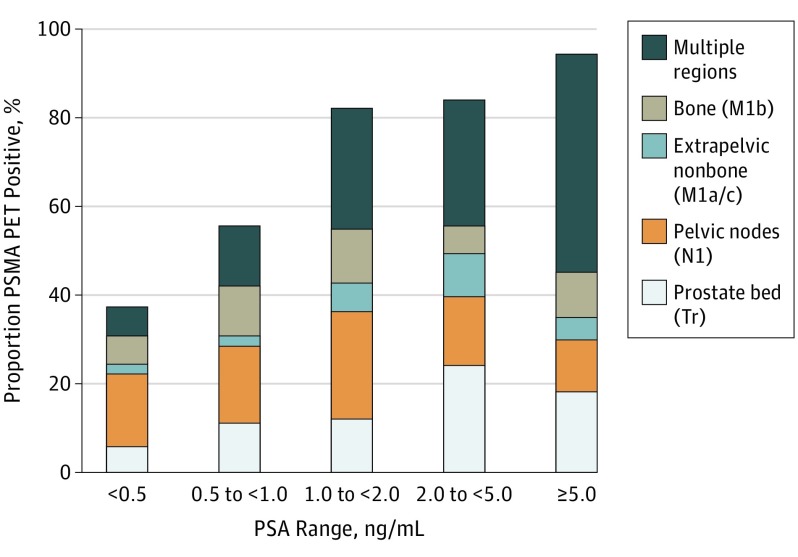
Even though I recognized going into the scan that, at my PSA level (0.37 ng/mL), there was an approximate 40% chance of detecting something, I was hopeful it would come up with something this time. Silly me and my expectations.

Detection Rate on a Patient Basis Stratified by PSA and Region Tr indicates prostate bed only; N1, pelvic nodes only; M1, extrapelvic only. Proportion of patients with 68Ga-PSMA-11 PET positive findings were stratified by PSA range and region of disease in accordance with PROMISE. https://pubmed.ncbi.nlm.nih.gov/30920593/

The other thing I’m beginning to wonder is if I’m in that 10% of patients for whom PSMA PET scans don’t work. (You may recall that being mentioned in this video from the PCRI: Rising PSA After Prostatectomy.) I have to dig into that more to see if it’s just PSMA PET scans that use Gallium-68 as the tracer, or if that applies to any PSMA PET scan regardless of the tracer used. I’m guessing it’s the latter.

Choline and Axumin scans are another option, but they don’t start reliably picking up cancer locations until the PSA is at 1.0 ng/mL or higher. Assuming my current PSA doubling time (6.2 months) remains steady, that means waiting another 11 months before I hit 1.0 ng/mL for those scans to have a chance of seeing anything.

I’ll be putting together my list of questions for the urologist appointment on 13 February (I’m open to suggestions). I suspect we’ll have a good discussion on subsequent PSA testing, the value of knowing where the cancer is located at this point, and when to start hormone therapy.

Again, the silver lining in this is that my scan didn’t light up like the Las Vegas strip. I need to keep that in mind.

Happy Friday!

Day 4,830 – PSMA PET Scan

PSMA PET scan No. 2 is behind me.

This was different from and easier than the first one. That’s because the VA just did a PET scan today, whereas my scan at UCLA included a CT scan on top of the PET scan.

That fact really didn’t occur to me until all was said and done. I’ll have to ask the doctor about the đifferent approaches.

In any case, today they juiced me up with Gallium-68 shortly after arrival. About 45 minutes later, I was on the scanner table ready to go. I barely felt the table move me through the scanner, and it took about 45 minutes to complete the scan.

Of course, the technician wouldn’t give me any sneak peak insights. “The doctor will interpret the scan.” I expect it could take a week or so for me to see any notes in my online records.

Again, even with my PSA closing in on 0.40 ng/mL, there’s only about a 50-50 chance it will give us any useful information at that PSA level. (As a refresher, my PSA going into the UCLA scan was 0.22 ng/mL.)

More to come.

Day 4,820 – PSA Results

Okay. I got antsy and went for my PSA test on Friday instead of next week. As expected, my PSA increased from 0.33 ng/mL on 6 December 2023 to 0.37 ng/mL on 19 January 2024.

The silver lining in that cloud is that the rate of increase slowed a bit and it didn’t increase as much as I expected it would.

Sometimes, I get too nerdy for my own good. There was a 91% increase between the May and October readings, and there was a 57% increase between the October and December readings, so I averaged the two increases (74%) and projected that this increase would land me at just over 0.5 ng/mL. This increase ended up being just 12% over the previous December reading. Fickle PSA.

I ran the numbers through the Memorial Sloan-Kettering PSA Doubling Time calculator again, using the five values from March 2023 (0.13) on. My PSA doubling time dropped from 6.7 months to 6.2 months, and my PSA velocity increased from 0.2 ng/mL/yr to 0.3 ng/mL/yr since calculating it back in December.

I went for the test early because I really wanted to know the PSA value going into the PSMA PET scan that’s scheduled on 31 January 2024. Plus, if it dropped, I would have had time to ask the urologist if it was worth going ahead with the scan at a lower PSA level. (Remember, I went for a PSMA PET scan when my PSA was 0.22 ng/mL, and it didn’t show anything at that PSA level. Why subject myself to another dose of Gallium-68 if the outcome may not produce any useful information?)

My follow-up with the urologist to review the PSMA PET scan and PSA results is on 13 February, and we’ll map out what’s next from there.

So that’s the latest and greatest. More to come.

Header image: The famous Torrey Pines Golf Course, San Diego, California, home to the Farmers Insurance Open golf tournament

Androgen Deprivation Therapy and Prostate Cancer

With androgen deprivation therapy (ADT) a near certainty in my future, I’ve been trying to get smarter about it. In my research, I came across this video from Dr. Eric Small at the University of California San Francisco (UCSF), that gives an introductory overview of ADT.

If you’re not familiar with some of the lingo and drug names, it may be like taking a sip of water from a fire hose, but Dr. Small gets the concepts across pretty clearly.

After watching the video, my pea-sized brain came up with what may be an oversimplified, imperfect analogy that may make Dr. Small cringe. (I’m happy to be corrected if this analogy is out to lunch!)

We know that prostate cancer needs testosterone to survive and grow, and the testes and adrenal glands both produce testosterone. So how do we cut off the supply of testosterone from those two sources to the cancer cells?

Imagine that the cancer is your backyard swimming pool (even a kiddie pool). Pools (cancer cells) need water (testosterone) to do what they do best. Your testes are one hose that fills the pool, and your adrenal glands are the second hose that fills the pool.

If we don’t want water (testosterone) in the pool (cancer), we shut off the spigots on the hoses to stop the flow. To turn off the spigot from the testes, we use one set of drugs (Lupron, Eligard, Zoladex, Firmagon, or Orgovyx). To turn off the spigot from the adrenal glands, we use a different drug, Abiraterone.

But there’s another way to stop the pool from getting water, and that’s to place a watertight cover over the top of it. That’s what the antiandrogen drugs do—they cover the pool and stop the water from getting in. These drugs are Flutamide, Nilutamide, Bicalutamide, Enzalutamide, Apalutamide, or Darolutamide.

ADT blocks the production of testosterone and antiandrogen drugs prevent the cancer cells from receiving the testosterone.

I’m sure more research is in my future, and I’ll be certain to share what I learn. In the meantime, don’t giggle too much at my analogy.

Day 4,815 – Bone and PSMA PET Scan Update

Just a quick update.

You already know that I completed my bone scan, which the VA required (for some inexplicable reason) before ordering a PSMA PET scan. This morning, I was able to schedule the PSMA PET scan with the VA, and it’s set for 31 January 2024. That was much faster than scheduling it with UCLA two years ago.

I’ll go for a PSA test the week before the PSMA PET scan, perhaps on 24 or 25 January. It will be interesting to see how much it’s increased. As a refresher:

9 May 2023 – 0.11 ng/mL

31 October 2023 – 0.21 ng/mL

6 December 2023 – 0.33 ng/ML

Should I get a pool going to see what it will be this time?

I have an appointment with the urologist on 13 February to review the results and map out next steps.

More to come.

Header image: Sunset over the Pacific Ocean at Carlsbad Beach, California

Month 158 – Bone Scan

We last left our hero and his urologist lamenting about the VA protocol requiring a bone scan prior to authorizing a PSMA PET scan to try to determine the location of his growing cancer…

Well, things fell into place a little quicker than I expected. I had my bone scan on Monday, 8 January 2024. As expected, the results were:

No abnormal uptake of tracer is seen to suggest osseous metastatic disease.

That’s a good thing. At least it didn’t light up like a Broadway marquee showing metastases everywhere.

I have a follow-up with the urologist on 13 February, and I’ll have another PSA test done in advance of that meeting. The only thing that’s unclear to me is the scheduling of the PSMA PET scan, so I just emailed the urologist to clarify.

In his notes from our December meeting, his plan was to do the “Bone scan and PSMA PET; Follow-up in 6 weeks; and PSA test in advance of the follow-up.”

I asked if he wanted me to complete the PSMA PET before the February meeting, or if he wanted to review the next PSA result and bone scan results in February before scheduling the PSMA PET scan. Hopefully, I’ll have an answer soon.

I have yet to share the bone scan results with the radiation oncologist. I’ll just wait until we have the PSMA PET scan nailed down before contacting him.


Mentally, I’m doing okay with all of this. I’ve reconciled that this is the path that I’m on, and we’ll just take one step and one test result at a time and go from there. That’s not to say that there aren’t days when I get anxious about the unknown ahead. I do. But I’m getting much better at not dwelling on the fact that this is happening.

Other than that, since my last post, I’ve learned that making homemade tamales is an hours-long labor of love; I made a quick trip to Yosemite at Christmas; I completed another orbit around the sun; I’m on tap for possible jury duty next week; and I have family coming to visit in early February. 2024 is off to a busy start.

Stay tuned for more to come…

Header Image: Yosemite Valley from Tunnel View, Yosemite National Park, California

Day 4,782 – Doctor Discussions

I’ve had conversations with my radiation oncologist and my urologist this week.

UCSD Radiation Oncologist Discussion

The conversation with the RO was via email, which was fine by me. I’m thankful he takes the time to get back to me. In a nutshell, he said:

  • We’re on the verge of needing to do a PSMA PET scan.
  • We should get the PSMA PET scan before any ADT.1
  • If PSMA PET shows limited site(s) of recurrence, SBRT radiation may be an option to “ablate the larger cancer deposit and work in concert with ADT.”

His recommendation was to get the PSMA PET scan now or to wait one month until early January 2024 and take another PSA test. If it remains steady, “we are good,” but if PSA rises again, it would be time for a PSMA PET scan.

I’ll let him know it took me two months to get my first PSMA PET scan at UCLA after speaking to the scheduling office, so getting it “now” may not be an option.

One other thing I need to nail down is where I can get the scan done again. When I had it in November 2021, the only two facilities in the U.S. that were approved to do the scan were UCLA and UCSF. Since then, far more facilities are capable of doing it, I believe including UCSD.

VA Urologist Discussion

Preparing for the meeting today, I put together an outline of things I wanted to discuss:

  • PSMA PET Scan
    • If the VA would cover the cost this time.
    • If there’s a difference in the tracers used (Ga-68 versus PYLARIFY® (piflufolastat F 18)
  • ADT and the timing
  • Whether they prefer a sequential or combination approach (e.g., include chemotherapy with ADT).
  • Getting a medical oncologist who specializes in prostate cancer involved in the case.

But once I got there, I was definitely off my A-game for some reason, and the conversation was one of the weirder, more disjointed conversations that I’ve had with a VA urologist.

First, he was a new (to me) urologist and he entered the exam room a bit like a bull in a China shop. He didn’t introduce himself and just started out with, “I looked at your PSA and read your email. What questions do you have for me?” Not even so much as a, “Sorry to see your PSA increase after SRT.” That threw me off right there.

It was a bumpy conversation, but we eventually talked about most everything on my list. I’ll save the bit about the scan for last.

Interestingly, he seemed to downplay spot radiation if lesions are found during a scan and was more focused on starting androgen deprivation therapy as the next course of treatment. But he wouldn’t start it until after a scan was completed. He did say under certain specific circumstances, spot radiation may be helpful.

In the discussion about sequential versus combination treatments, he said that they would do a combination. I asked if it would be ADT and chemotherapy, and he said no. It would be ADT and antiandrogen therapy in combination using Eligard for the ADT and one of the following:

I asked about chemotherapy with ADT, and he said that the antiandrogens have taken the place of Docetaxel (Taxotere), which I thought was an odd statement from my limited knowledge. I believe that Taxotere is still very much a treatment option used later in the progression of the cancer. I need to dig into that more.

Concerning shifting my case to a medical oncologist (MO), he said that would happen on its own, as he wasn’t allowed to prescribe the antiandrogen drugs. The MO would also know how to better manage the side effects of the combined therapies.

Now, for the kicker part of the conversation…

He agreed that a PSMA PET scan was the best way forward but—and even he disagreed with this—the VA protocol is to have a bone scan first. The protocol said that, if a bone scan was negative, then a PSMA PET scan could be authorized.

He assured me that, at my PSA level of 0.33 ng/mL, the bone scan would, in fact, be negative. (Doing a quick Dr. Google search, it appears that bone scans start to pick up lesions when the PSA is over 20 ng/mL. Yep, 0.33 vs. 20.

So getting my soapbox and editorializing a bit here… It makes zero sense to get a bone scan in my present circumstances. None. The VA can be very slow to catch up with the times in certain circumstances, and this happens to be one of those times. It just seems to be a waste of time and resources when we already know that the bone scan isn’t sensitive enough to pick up anything at my PSA level. But I’m not sure I’m up for “fighting city hall” to try and get the PSMA PET scan out of the gate.

On a positive note, the VA apparently can now do the PSMA PET scan according to the doctor.

I have to admit that I’m toying with the idea of using my Medicare coverage and going outside the VA for the PSMA PET scan and skipping the VA bone scan altogether. I need to dig into that and see how that would work and how quickly that could happen.

I just want to make sure that I’m not shooting myself in the foot in the process—the VA has to authorize community care in advance for them to continue to cover the costs. I don’t want them to say, “Hey, you chose to go outside the VA system, so now you can pay for all the tests and drugs.” I know Medicare would pick up a good chunk of the costs, but I may be on the hook for more than I bargained for.

The urologist thought the bone scan could be scheduled pretty quickly and, if that’s the case, that may put me closer to a PSMA PET scan faster than if I try to go outside the VA and create new relationships with new providers (although I think my radiation oncologist at UCSD may be able to assist me in ordering one and getting it scheduled).

We ended the conversation with him saying that we’ll do another PSA test in three months. That surprised me a bit given its rapid rise over five weeks. “We know it’s going to increase,” he said, but he did offer to retest in six to eight weeks. I don’t think we ever landed on a firm answer, so I need to chase that down.

In a way, though, it’s probably more important to get the scan(s) done first, and tracking the PSA is secondary to that. Does it really matter if we retest PSA in eight weeks versus twelve weeks? I doubt it.

I left the meeting without:

  • A date to have the bone scan.
  • A follow-up date with the urologist (dependent on scan results).
  • A date for the next PSA test.

Sounds like a productive meeting to me. 😂


One other thing that happened today, which was quite unusual for me, was that I was far more nervous going into it than I should have been. I don’t know what was up with that. I had difficulty articulating my thoughts, and my hand was shaking ever so slightly as I was taking notes. That freaked me out even more. I guess the emotions associated with this new chapter have been a bit more than I expected.

When the meeting was over, I sat in the waiting area for a good ten minutes to just decompress and to scribble down a few more notes while the conversation was fresh in my mind.

Once I calmed down, I went to the Nuclear Medicine department to try to schedule the bone scan, but the scheduler was away and the guy staffing the desk wasn’t familiar with the process. I’ll be back there tomorrow morning for another test2, so I can try scheduling again when I’m there tomorrow.

I’ll keep you posted.


  1. This aligns with what Dr. Scholz says in this video. Taking ADT before the scan may reduce the size of the cancer to the point where the scan can’t pick it up. https://youtu.be/CBILHS0FJfk?si=zaoHCOkm-mWOmdyz&t=525 ↩︎

Advanced Prostate Cancer Treatments + Extended Q+A | Mark Scholz MD

This hour and fifteen minute long video from the Prostate Cancer Research Institute and Dr. Mark Scholz was incredibly informative to me given my recent uptick in PSA and where I may be heading.

He talks about the various types of advanced prostate cancer and the different treatment options or tools that are available to manage or even try to cure it.

One thing he talks about (starting around 17:15 in the video), is the shift from the historical approach of using sequential treatments to using multiple treatment methods simultaneously to attack the cancer. That looks to have promising outcomes.

The main presentation ends around 36.5 minutes into the video, and it’s followed up by an interview with questions and answers for the remainder of the video.

Day 4,776 – PSA Results (Not Good)

Well, 💩.

The suspense of not knowing what my PSA was up to was killing me, so I went a couple of days earlier than I planned to have my PSA test. I was expecting it to go up a bit, but I wasn’t expecting it to leap a tall building in a single bound.

My PSA jumped from 0.21 ng/mL on 31 October to 0.33 ng/mL on 6 December, a 57% increase in five weeks. Ugh. Using the four PSA values from this year and Memorial Sloan Kettering PSA Doubling Time calculator, my PSADT is 6.7 months.

I’d say it’s safe to conclude that the salvage radiation therapy missed the mark, but I’ll confirm that with an in-person appointment with the urologist on Thursday, 14 December and with the radiation oncologist via email.

I’m writing this late on Thursday night, about 20 minutes after seeing the results online, so I’m still shocked and processing it all. I’ll wrap this post up in the morning…

Back at the keyboard Friday morning after a somewhat fitful night of sleep…

Needless to say, this was (and still is) a bit of a gut-punch for me to see the PSA increase so rapidly. It’s definitely got me concerned and wondering where the cancer is if the radiation didn’t even make a dent in it.

So what’s next? I don’t know. I suspect these would be a few possibilities:

First, maybe let the PSA continue to rise a little more until it’s over 0.5 ng/mL but less than 1.0 ng/mL to give a PSMA PET scan a better chance of picking up where the cancer is located. At 1.0 ng/mL, PSMA PET scans can find the cancer about 90% of the time.

If there are only a couple of localized lesions, we may be able to radiate them.

Second, I’m sure androgen deprivation therapy (ADT) is definitely on the horizon, whether we do a scan and radiation or not. My only question would be the timing of the ADT. If it’s given before a scan, would that make it more difficult for the scan to pick up the lesions? I don’t know.

Last, Dr. Mark Scholz of the Prostate Cancer Research Institute, recently posted a video where he talked about a shift in how they approach treating advanced prostate cancer. (I’ll post the video in a separate post.)

Traditionally, treatments were offered sequentially. You’d start with hormone therapy, and when the cancer became resistant, you shifted to a different type of hormone therapy. When that failed, you would move into chemotherapy, a PARP inhibitor (immunotherapy), injectable radiation, and finally clinical trials.

There is research showing that combination therapies may be more effective in staving off the cancer. Instead of just starting out with ADT, it may make sense to combine ADT with radiation or ADT with chemotherapy right out the gate. Yes, there may be increased immediate side effects from the dual treatment, but early studies are showing higher cure rates and longer survival. Additionally, if the combined treatments are successful, this may lead to a better long-term quality of life because you may be able to be taken off ADT.

My appointment with the urologist is on Thursday, 14 December, and you bet I’ll have a ton of questions ready. One of them will be about getting a full-blown medical oncologist who specializes in prostate cancer involved at this point.

In the meantime, I’m going to have to start learning the language of advanced prostate cancer. There are so many different drugs and treatments with weird names that don’t really indicate what they do or how they’re used that it’s tough to keep them straight. Perhaps a spreadsheet may be in order…

I am trying to look for the silver lining in the cloud. I guess that would be that my PSA is still quite low. But the dark part of the cloud is the fact that I’m probably entering the phase where the treatments and their side effects will eventually be worse than the disease when it comes to daily quality of life. I tolerated the six-month dose of Eligard in 2022 pretty well, but it wasn’t without side effects. I guess I’ll cross that bridge when I get to it.

Oh. And I’m open to any and all insights from those who have traveled this path ahead of me.

Well, time to get out of the house and try to put this out of my mind for a brief period. (Translation: Escapism.)

Rising PSA After Prostatectomy – PCRI Video

Here is another informative video from the Prostate Cancer Research Institute and Dr. Scholz. It hit too close to home for me, as it describes the dilemma I faced in deciding when to initiate salvage radiation therapy.

Perhaps the key point that Dr. Scholz makes (at 6:08 in the video) is that there’s “a huge advantage of knowing where the cancer is and allowing the radiation therapist to target that spot” as it relates to a newer approach of letting the PSA rise so that modern imaging can determine the location(s).

Later in the video at the 9:40 mark, he goes on to say:

It’s quite tempting in many of the cases that I see to allow the PSA to go a little bit higher knowing that that 0.5 threshold [used by radiation therapists] was set at a time when we didn’t have scans and we didn’t know where the cancer was. There’s such an advantage of knowing where the cancer is and allowing the radiation therapist to target the disease that I tend to liberalize a little bit and allow the PSAs to rise above 0.5 if necessary.

In other words, because of the value in knowing the location of the cancer that can lead to curative outcomes if properly targeted by the radiation therapist, it may be worth allowing the PSA to rise to the point where it can be detected on a scan.

I toyed with the idea of getting a second PSMA PET scan when my PSA hit 0.33 and 0.36, but because it was rising rapidly and because I knew it could take two to four months to get another PSMA PET scan scheduled, I opted to act and go ahead with the salvage radiation therapy. I do have to question if it may have been wise to do the second scan so the RO knew exactly where to aim because, with my PSA rising again, we may have missed our mark.

Will I dwell on that? Nope. I made the best decision I could with the information available at the time.

The bottom line is that we all have to assess our own risk levels and be comfortable with our decisions.