Day 5,095 – Let the Waiting Begin

I went for my PSA test this morning, so now the waiting begins for the results to be posted online. I suspect that I’ll be able to access them late Thursday night or Friday.

I also had about four or five other tubes of blood drawn (I can’t watch 🤢) for my annual physical with my primary care physician on 4 November. While there, I also got my high-dose flu shot for old geezers and the updated COVID vaccine. All of that turned me into veritable pin cushion this morning.

As much flak as the VA Healthcare system receives, I have to admit that I’m always impressed with my local clinic. No appointment was needed for either the lab work or the vaccines, and it took just 17 minutes from the time I checked in until my lab work was completed, and another seven minutes to get the vaccines. I was in and out in 24 minutes. I challenge civilian clinics to match that.

More to come soon.

Month 167 – PSA Time

Well, it’s nearly time for the PSA roller coaster to depart the station once again. (You never get off the PSA roller coaster, you just keep riding it in never-ending loops.)

I’m not exactly sure when I’ll go to the lab—either next week (short holiday week) or the week after—but I need to get it done by the end of the month because I have an appointment with my primary care physician on 4 November, and an appointment with the urologist on 14 November. I suspect that I’ll get my seasonal flu shot while I’m at the clinic, too.

If anyone is interested, we could get a pool going to guess where the PSA test results will come in at. 😄 On 1 May 2024, it was 0.52 ng/mL. The “Trend” function on my spreadsheet has it coming in at 0.70 ng/mL using the last five PSA test results from my post-radiation nadir. My money would be on somewhere between 0.80 ng/mL and 1.0 ng/mL.

Other than that, I’m just getting ready for the palm fronds to start falling as we get deeper into autumn here in San Diego. 😂


On a fun note, I attended both of the San Diego Padres Wild Card baseball games on 1 and 2 October, and the crowd went bonkers when we clinched the best-of-three series to win a spot in the playoffs.

We’re playing our arch nemesis, the Los Angeles Dodgers, in Game 5 of the National League Division Series tonight (Friday, 11 October) to see who advances to the National League Championship Series. (We’re tied two games apiece and the winner of tonight’s game will advance. Hope I didn’t jinx ourselves by writing about this. 🤞)

Sorry for the shaky camera work. There was so much happening all over the place, it was tough to know what to focus on.

On an even funnier note, I found this perfect bed for those suffering from hot flashes while on hormone therapy.

Header image: Crepuscular rays at sunset over the Salton Sea, California while hoping to see Comet Tsuchinshan-ATLAS on 10 October 2024. (I didn’t.)

Month 166 – Expanding My Audience

Between this prostate cancer blog and my travel blog, you’ve probably figured out that I enjoy the process of writing and sharing my experiences. While I’m no Pulitzer-prize winning author, a few people close to me have encouraged me to do something more formal—to “write a book.” I always thanked them for their compliment, and then gently set aside the notion of ever getting something published.

Until June.

Yes, I’ve been sitting on a little secret for almost three months. The editor of Cancer Health magazine came across my little ol’ blog and approached me to write an essay for their Voices column for their Fall 2024 issue of their magazine.

My initial reaction was one of surprise and intrigue and—if I’m being honest—a bit of anxiety. In the initial contact email, there wasn’t a ton of information about expectations, so I went to the website and looked at some of the archived Voices columns to see what might be involved. “Oh. I could do that.”

I went back to the editor and said, “I’m in.”

Prior to this, I had a vague understanding of the publishing process and knew that there would be some discussion about topics, length of the article, and deadlines. It would soon be followed by submitting drafts and digesting feedback. Also included in the exchange was a six-page contract covering usage rights and compensation.

I’m someone who’s better known for my spreadsheets than my writing, so when the editor read the final draft and said, “Wow… this one reads really great….Honestly, there’s very little I’d change in this…” I have to admit my chest puffed out a with a bit of pride.

After the magazine went live this week (hardcopy and online), I can now add “published author” to my résumé.

Is it a book? Nope. But we all start with baby steps, and a 500-word essay is my first step into the publishing world. Is this the beginning of something larger? Who knows. I enjoyed the whole process, and the editor did encourage future submissions. In the meantime, I’ll stick to self-publishing on my little ol’ blogs for now.

You may read the article here:

How to Navigate Conflicting Cancer Treatment Advice

Header Image: August Moonrise over San Diego, California skyline

September is Prostate Cancer Awareness Month

It’s that time of year again. It’s time to remember that September is Prostate Cancer Awareness Month, and you should take a little time to educate yourself about this disease that’s been impacting my life for nearly 14 years.

Here are some great free resources to learn more about the disease and its treatment:

Of course, I’d like to think this little ol’ blog of mine has been a pretty decent resource, too. (Shameless self-promotion.)

Please take some time in September to increase your awareness about prostate cancer before you get diagnosed. Understand the risks—family history, race, age, diet—and how they may influence your decision to get screened for prostate cancer.

Be well!

Month 165 – Two Years Post-zapping

Yeah, this month’s post is late. I was really struggling to come up with something to write about to hit my normal publish-on-the-11th-of-the-month date, and then I remembered that it’s been two years since my salvage radiation therapy ended on 26 August 2022.

So here’s a quick update on how things are going post-radiation.

Impact on PSA

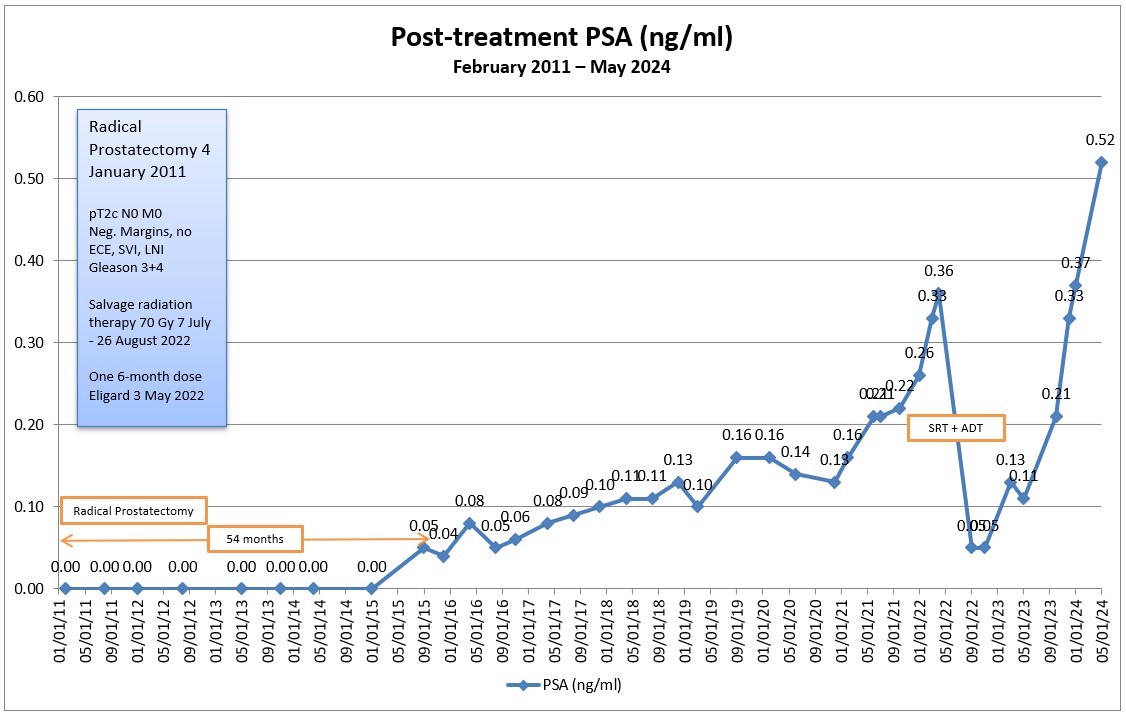
Of course, the biggest and most disappointing thing is that the radiation didn’t do what it was supposed to do, and my PSA dipped for a bit and then continued to rise to a level higher than when we started the SRT (0.52 ng/mL vs 0.37 ng/mL).

I’ll take my next PSA test in October, and we’ll see if another PSMA PET scan is in order to determine the location of any hotspots. If it’s identified, we’ll look at whether additional spot radiation is needed/desired, or if we consider starting androgen deprivation therapy. More to come.

Side Effects

For the most part, I believe that the side effects two years out from the SRT have been relatively minor.

Urinary Issues

I’m not sure if the radiation really impacted my urinary issues much at all. If anything, I have a slight increase in stress incontinence and sometimes a slight increase in urgency.

Frequency, on the other hand, seems to be all over the place. Some days, I go multiple hours without needing to urinate; other days—especially at night, unfortunately—I’m running to the toilet about once an hour. That can be quite annoying and have quite the impact on my sleep. It’s not every night, thankfully, but enough to have noticed a change.

Bowel Issues

A few months ago, I talked about how my bowel patterns had changed from a once-a-day movement to three to five movements a day. Thankfully, that has calmed down, too. I’m back to one or two trips a day now, and that’s a good improvement. Hopefully, it stays that way (or gets better).

Summary

The radiation failed to do what it was supposed to do and, thankfully, the cost of that failure in terms of long-term side effects caused by the radiation seems to be relatively low so far.

I have an appointment with my primary care physician on 4 November and one with the urologist on 14 November, so I’ll get another PSA test done the last week of October in advance of those appointments.

Be well!

Header image: Sunset at Imperial Beach Pier, Imperial Beach, California

Day 5,000

You know the nerd in me had to observe this milestone of being 5,000 days into this adventure of living with prostate cancer. 😂

In those 5,000 days, I have:

  • Learned more about prostate cancer and its treatment than I ever thought I would.
  • Had my emotions run from outright fear at diagnosis to elation with each undetectable PSA test after surgery back to fear as my PSA returned.
  • Adapted to my new normal with the side effects from surgery and radiation.
  • Shared my story in ways I never expected.
  • Learned who stepped up to provide support and who couldn’t do so for whatever reason.
  • Formed meaningful connections with fellow patients and caregivers from around the globe, and have been inspired by their stories.

That last point is important to me. Those readers who regularly engage with me, share your stories, and who offer your support have been a bright spot in this entire adventure, and I cannot thank you enough. Sadly, some of the men that I connected with over the years have succumbed to this insidious disease, and I miss our interactions.

Thank you again for putting up with my rantings for 5,000 days. Here’s hoping for 5,000 more.

—Dan

In case you’re wondering, 5,000 days equals:

  • 13 years, 8 months, and 9 days
  • 164 months and 9 days
  • 714 weeks and 2 days
  • 120,000 hours
  • 7,200,000 minutes
  • 432,000,000 seconds

Sleep better tonight knowing that. 🤓😂

Month 164 – Prostate Cancer Update

To my regular readers, you may want to skip this post. This is a high-level update intended for my family and friends who don’t regularly follow this blog (gasp!), and it will be shared with them via my personal social media accounts. If you’re new here, welcome. Feel free to read away.


It’s been a while since I’ve provided any detailed update on what’s going on in the world of my prostate cancer, so here goes.

We last left our hero two years ago as he began 35 sessions of salvage radiation therapy on 7 July 2022 in attempt to kill off his recurrent prostate cancer after his surgery in January 2011 ultimately failed. Unfortunately, those little cancer cells have proved themselves to be quite resilient, and the salvage radiation therapy has failed, too. Bummer.

We know this by tracking my prostate-specific antigens (PSA) on a regular basis. After the surgery, my PSA level should have dropped to undetectable (zero) because there was no prostate left to produce the PSA. But the PSA can live on in the cancer cells even without a prostate, and that’s how we know the cancer is still there.

After the radiation, my PSA should have dropped substantially, and it did, at least initially. But about 15 months after the radiation ended, my PSA was on the rise again. It rose enough to the surpass the PSA level when we started the radiation. In May 2024, it continued its upward climb to 0.52 ng/mL, the highest it’s been since the surgery. (In the grand scheme of things, it’s still a low value that many fellow prostate cancer patients would love to have, but the fact that it’s doubling about every six months is a concern.)

There is a relatively new scan that can detect prostate cancer cells at fairly low PSA levels. It works best when the PSA is close to 1.0 ng/mL, but it has detected prostate cancer about 30% of the time at PSA levels in the 0.2–0.3 ng/mL range. I went for this PSMA PET scan in January when my PSA was 0.37 ng/mL, and the scan failed to detect anything.

On the one hand, that’s great because there were no signs of metastasis and no evidence of prostate cancer. But on the other hand, we need to know where the cancer is located and what it’s up to in order to plan our next treatment options. Because it didn’t reveal its ugly head, we can’t make any meaningful treatment decisions right now.

If there are one or two small lesions someplace, we may be able to radiate them again depending on their size and location. But if there aren’t any distinct lesions and my PSA continues to increase, that’s likely the result of micrometastases and that would require a systemic treatment approach (e.g., hormone therapy, immunotherapy, chemotherapy, or any combination thereof).

After reviewing my May PSA results with the urologist, we agreed to punt for six months and do another PSA test in late October. I know that seems counterintuitive—letting the cancer continue to grow without taking action—but there’s a reason for it. I’m predicting my PSA at that point will be in the 0.75–1.0 ng/mL range in October, and we’ll do another PSMA PET scan to see if we can determine what’s going on and then plan from there.

Up until this year, all of my conversations have been with the urologist and radiation oncologist. In February, I met with a medical oncologist for the first time because they’re the ones who deal with the systemic treatments.

Based on my conversations with the urologist and medical oncologist, the next logical treatment option is hormone therapy. Prostate cancer lives off of testosterone, so if we kill off the testosterone, we slow the growth of the cancer cells. (Hormone therapy is not curative, however.) But the timing of starting hormone therapy is important.

If we started the hormone therapy now, it would rapidly knock my PSA down so far that it would make it next to impossible to do the PSMA PET scan in November and get any meaningful results.

The other problem with starting hormone therapy too early is that the prostate cancer can become hormone resistant much in the same way that bacteria can become resistant to antibiotics. Start the treatment too early, and you’ll lose its effectiveness when you really need it later.

There seemed to be a differing of opinions between the urologist and the medical oncologist as to what would trigger the start of hormone therapy. The urologist would hold off until there’s evidence of metastasis; the medical oncologist suggested we’d start when my PSA hit 2.0 ng/mL. We can figure that out when the time comes, but both agreed that hormone therapy (and other therapies) can keep me around another 10–15 years (or more).

Of course, my quality of life may be diminished as a result of the treatments. Hormone therapy can come with a whole host of unpleasant side effects such as fatigue, muscle loss, weight gain, loss of libido, hot flashes, etc. No need to rush into that Disneyland of experiences.

Physically, I am feeling fine. I’m completely asymptomatic when it comes to the cancer, but the side effects from the surgery and radiation are present and are a nuisance more than anything. Psychologically, though, it’s been a bit of an emotional roller coaster ride as I go from PSA test to PSA test, and failed treatment option to failed treatment option. We’re closing in on 14 years since diagnosis, and it does get tiring.

One of my regular blog readers and my urologist both suggested that, at this point, I look at my prostate cancer more as a chronic illness than as a life-threatening disease. I’m still trying to embrace that perspective and, even if I do, the worry will never go away.

There you have it. The latest and greatest in this adventure of living with prostate cancer. Follow along if you want to see my monthly updates, and we’ll probably know more right around the holidays.

Be well!

Header image: Lake Michigan coastline from the John Hancock Center, Chicago, Illinois

Month 162 – Urologist Visit

The short version from yesterday’s appointment with the urologist (who happens to be the Urology Department head):

Kick the proverbial can(cer) six months down the road and retest PSA then.

Generally speaking, I’m okay with that approach. I mean, really, what else is there to do at this point? We don’t have sufficient data points to make any definitive treatment decisions right now. Of course, I may feel differently after sleeping on this for a few nights.

I have to admit that it was a challenging meeting because the doctor just wanted to rapid-fire through all the discussion points and it was difficult to get my questions out. In the end, though, I prevailed.

She was blasé about the increase in my PSA, saying it went up “a little bit.” (A 41% increase in my mind is a tad beyond “a little bit,” but what do I know?) She didn’t see much value in doing another PSMA PET scan right now because a scan with a PSA of 0.52 ng/mL has about a 50-50 chance of detecting anything. That somewhat aligns with what the medical oncologist (MO) said in February—that it would be better to wait until my PSA was at least 0.7 or 0.8 before doing another scan.

My SWAG (scientific wild-assed guess) is that my PSA will be between 0.75 ng/mL and 1.1 ng/mL in November based on the average increases in my PSA over the last four readings and my PSA doubling time. (Bookmark this prediction for future reference! 😀)

We did talk about androgen deprivation therapy. Her biggest concern was that starting too early would just accelerate the eventual likelihood of resistance later on when ADT is needed the most, so she wouldn’t start ADT until there’s confirmed metastasis. (By comparison, the MO suggested holding off until my PSA hit 2.0 ng/mL.) I did ask if starting ADT early delays metastasis and she said it didn’t, which I thought was interesting.

We talked about whether it would be a monotherapy or a combination therapy, and she suspected we would start with just a monotherapy. She acknowledged that there are several studies out there showing that a combination therapy may lead to better outcomes but, in her mind, they weren’t persuasive enough to launch straight into combination therapy. However, she did say that there are certain circumstances where it may make sense, one of which was if the metastases was in the spine.

I asked about possible radiation of localized lesions and she was not all that enthusiastic about the idea. Her biggest concern was about going through radiation twice and whether that was a wise thing given what damage it may do to my body. “I’d have to defer to the radiation oncologist to make that assessment,” she said. Her fear was additional radiation damage / side effects, and I would have that same concern, too. I would have to consider very carefully zapping anywhere in the pelvic area again given the changes I have already experienced in my bowel habits.

Even if the scan showed one or two lesions that could be zapped, she would also start ADT because “it’s pretty much guaranteed that there would be cancer elsewhere that didn’t light up on the scan.” That makes sense.

Lastly, given where I’m at in this advanced prostate cancer no-man’s land, I was curious how she would label or stage my cancer. With no evidence of metastases on the last scan, she would still have me at Stage 2. (See the American Cancer Society staging of prostate cancer HERE.)

Of course, in my mind, I turned to the actual definition of metastasis:

the spread of a disease-producing agency (such as cancer cells) from the initial or primary site of disease to another part of the body

I don’t have a prostate (initial or primary site) but I do have evidence of cancer, so it must be in “another part of the body.” By that definition, it must mean that I’m metastatic, right? (Yeah, I know… Nothing in the prostate cancer world is that clear.)

I asked the question about staging more as an academic exercise because it really doesn’t matter much what the label or stage is. All I know is that I’m living with this bug growing inside me.


One of my blog followers, Phil, recently commented that his oncologist considered prostate cancer to be more of a chronic illness than a terminal illness, and that stuck with me. I mentioned that to the doctor, and she embraced that view wholeheartedly, telling me that patients like me can be kept around for many years—even decades—and the disease can be managed like hypertension or diabetes.

Intellectually, I already knew that. But, after 13+ years, it’s quite the mental leap to jump from, “I have the Big C and it continues to grow unabated,” to, “Cancer, schmancer. It’s like arthritis in my big toe. No big deal.” But it is a leap I’m trying to make.

You would expect that, after 13+ years of testing, waiting for results, reviewing results, and planning next steps, I’d be used to it by now. It’s routine. But I’m finding it to be more and more emotionally draining with each cycle as the uncertainty drags on. Perhaps it’s because I’m coming to terms with failed treatments when I had hopes for better outcomes, or perhaps it’s because I’m back in the wait-and-see mode. Or maybe it’s just the cumulative effect of being on this roller coaster for so long.

On the positive side, I know that I’ve been blessed. Many fellow prostate cancer patients would love to have their PSAs be at my level; my quality of life is pretty good considering all that my body has been through; and—most important—I’m still here 13+ years after diagnosis.


On a somewhat related note, I finally got my baseline testosterone results back: 424 ng/dL. That was taken almost two years to the day after receiving my six-month Eligard shot in advance of salvage radiation therapy, so I’m guessing that any effect the Eligard may have had on my testosterone level has worn off by now.

From what I can tell, that’s a decent / normal number for a 66-year-old guy.

At least we have a starting point for reference now.


Well, that’s it for this post. Time to go out and play for six months. Be well!


What’s next:

  • Week of 28 October – Get PSA test
  • 4 November – Physical with primary care physician
  • 14 November – Appointment with urologist

Header Image: La Jolla Coast, San Diego, California

Imaging Alternatives For PSMA Negative Prostate Cancer Patients

Here’s another informative video from the Prostate Cancer Research Institute for the ten percent of patients for whom PSMA PET scans may not work.

If I go for a third PSMA PET scan later this summer, and it fails to show anything at an even higher PSA level than my first two inconclusive scans (0.22 ng/mL and 0.37 ng/mL), I may find myself in that category.

I’ll provide my normal monthly update next week after my visit to the urologist on 14 May.

Day 4,923 – PSA Results

No surprise here. In my spreadsheet, I put a placeholder value of 0.50 ng/mL for this PSA test based on the previous trend, and the actual result came in slightly higher at 0.52 ng/mL.

The PSA Doubling Time is dropping as well. Using the last five readings and the Memorial Sloan-Kettering PSA Doubling Time calculator, my PSADT was:

  • 6.7 months on 6 December 2023
  • 6.2 months on 19 January 2024
  • 5.1 months on 1 May 2024

It seems safe to say that the salvage radiation therapy failed to do the trick.

I am trying to describe my reaction to this hour-old news. I guess words that I might use would be: numb, indifferent, resigned. I don’t know. It’s a bit weird. I certainly had zero expectation that my PSA would go down or even hold steady given the previous trend.

You may recall the conversation with the medical oncologist suggested that we monitor and do another PSMA PET scan in six months, which would make it August. The question now is, based on these results, do we stick with that plan? Or do we move to the discussion on the type of androgen deprivation therapy and the timing of ADT?

I did ask the phlebotomist if he was drawing blood for a testosterone baseline test and he said yes. I don’t see the results posted online yet (my record is still going through its once-a-day update as I type this).

Well, it’s after midnight. I’ll sleep on this and perhaps I’ll be a tad more focused in the morning after having processed this.


What’s next:

  • 9 May – Appointment with primary care physician (annual physical)
  • 14 May – Appointment with urologist

Header Image: Scenes from San Diego Bay, San Diego, California