I went for another PSA test this week in advance of my (almost) three-month follow-up appointment with my radiation oncologist next week.
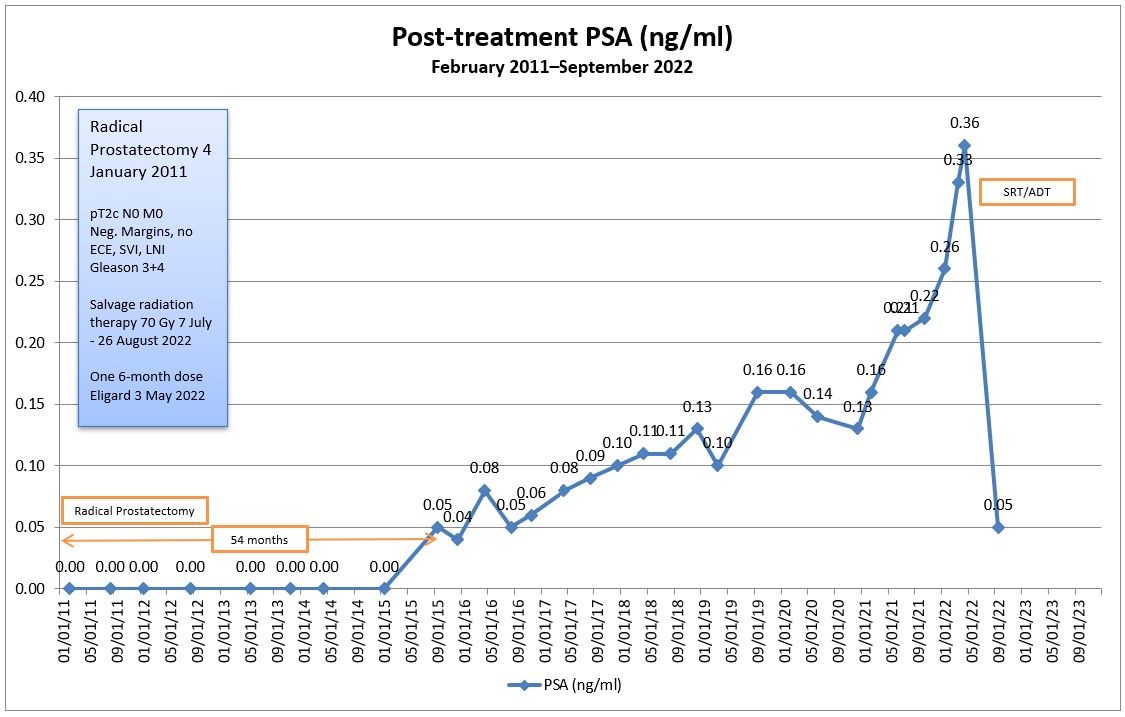
My PSA came in at 0.05 ng/ml. That’s the same that it was in September shortly after finishing the radiation on 26 August 2022.
The fact that it didn’t go up is good. The fact that it didn’t go down is, well, I don’t know. I do know that I would have liked to seen it go down. I also know that, with radiation, your PSA may never get back to undetectable and you have a nadir value that becomes your baseline for future PSA tests.
Two data points don’t necessarily make a trend, so I suspect it will take a few more PSA tests to do so.
It will also be interesting to see what happens as the Eligard begins to wear off. It was six months ago today that I was given the six-month dose.
My appointment with the radiation oncologist is on 10 November and my appointment with the urologist is on 13 December. It will be interesting to get their perspectives.
Be well!
Header Image: San Juan Mountains near Trout Lake, Colorado
About two weeks after I completed my salvage radiation therapy, the concessionaire that runs lodging in some of our national parks was having a flash sale, and I was eager to book something to pamper myself after the summer of radiation. I was still beat up from the therapy, but I went ahead and booked the room anyway, thinking that it’s easier to cancel the reservation if I wasn’t feeling up to it than to make one later on.
I came close to cancelling the reservation, but didn’t.
Immediately after my last blog post on 11 October, my side effects took an unexpected turn when my bowels started acting up.
Normally, I’m a pretty regular guy with one bowel movement a day, usually in the morning. But for those four or five days before my trip, I was having three to five movements a day in conjunction with an irritated anus (itchy and burning sensations). Fortunately, things calmed down just before the trip and I went anyway.
Loss of bowel control has been one of my biggest fears with doing the radiation so, needless to say, this was quite alarming for me. I never actually lost control during any of these episodes—it was just increased frequency which was workable but annoying. It’s definitely something I’ll discuss with the radiation oncologist when we meet on 10 November.
Going into the trip, I knew that I wasn’t in the same physical condition as I was before the treatment, but I was a bit surprised by how much had changed.
I hiked the Zumwalt Meadow trail in May 2021 and did just fine. It’s a relatively flat trail at about 5,000 feet / 1,500 meters elevation with a somewhat tricky part through a rock fall area. I hiked the trail again on this trip, but found it was much slower going for me. As I got to the rock fall area, I could feel the burn in my legs as I was climbing up and down the rock steps placed on the trail. I guess that’s the hormone therapy kicking in, weakening my leg muscles.
Zumwalt Meadows Trail from Google Maps
Each day in the park, I found myself heading back to the room in the lodge for an afternoon siesta. Perhaps it was the altitude, the cool morning autumn air, and the hiking that did me in (or a combination of all), but I found that my stamina was diminished and needed the little nap.
Of course, that whole experience affected me mentally and emotionally as well. Initially, I was frustrated that I couldn’t do some of the simple things that I did before—or at least couldn’t do them as easily as I had done them before. But those feelings didn’t last too long, thankfully.
By the end of the trip, I turned more to acceptance than frustration.
I accepted the fact that, for this trip, my body had been beaten up pretty badly and I really did nothing to prepare for it between the time the side effects were subsiding and the start of the trip. After meeting a gregarious couple who were in their 80s navigating the rock fall area very cautiously, I reminded myself that what matters most is that I’m out here doing this—just as they were—and it mattered less how fast or agile I was. We just have to adapt to our new limitations.
Even so, it can be difficult to accept the fact that my body may no longer be able to cash the checks my mind is wanting to write.
But I also recognize that I need to take ownership in restoring or preserving my fitness level by doing more physical activity. There are things I would like to see and do yet, and if this is my new “best,” then some of those may now be in question, and that would be disappointing to say the least.
In the end, it was good that I went and learned what I did. It helps frame my mind for what I need to do going forward, and what may or may not be possible for future trips.
Be well!
My original plan was for three nights in Kings Canyon and then return home, but at the last minute, I decided to add another day and drove through Yosemite National Park and over Tioga Pass to see the autumn colors in the Eastern Sierra Nevada mountains near Bishop, California. You can check out my posts on my other blog here:
I don’t know where the time has gone. It’s hard to believe that we’re approaching two months since ending the salvage radiation therapy.
On the whole, things have improved significantly for me since then. My energy level has returned to pre-zapping levels, except when I’m stupid and stay up way too late at night (that’s something I can control). That’s been a good thing because I’ve been able to get out and enjoy the world again.
As far as the urinary control issues are concerned, they’re much improved, too. I opted to stop the Tamsulosin (Flomax) near the end of September, and that seems to have helped. My frequency is greatly improved. During the day, I can go several hours between runs to the toilet, and at night, I’m only have to empty my bladder one to three times a night. That’s a godsend.
The urgency still can be a bit of an issue. There are times where I don’t have much time to get to the toilet if I let things go a little too long. On a related note, since stopping the Tamsulosin, my leakage / incontinence has improved as well, even with the urgency. That’s a positive, too.
I had a video appointment with my primary care physician about the pain I’ve been experiencing in my back. In short, even though things seems to be slowly improving (even after the call with him on 26 September), he still wants me to have an MRI to see what may be going on. That’s scheduled for this Friday.
I’m not exactly sure how the hormone therapy works as you approach the end of the six month dosage period, but I’m guessing its effects may linger another few months beyond the end of the dosage. Again, I’ve been blessed in that my only real side effect has been the mild fatigue—no weight gain and no hot flashes. (Even though all three of my doctors say my back pain is unrelated to the hormone therapy, I’m still not convinced. There’s a first for everything, right???)
The radiation oncologist’s office wouldn’t schedule my three-month follow-up appointment until the end of October when they had a better handle on the doctor’s November schedule. I’ll get my PSA checked again in November in advance of that appointment, and I have a follow-up with the urologist on 13 December.
It’s good to be back into a more normal state after all of that. Let’s hope that there are no long-term radiation side effects that start popping up two to five years down the road.
Today’s visit with the urologist went about as expected—just a routine review of the salvage radiation therapy, its after-effects, and what’s next.
He was pleased with the drop in my PSA and thought that it may drop even further given how soon after the test was taken after the completion of the radiation. He stressed that we’ll have to establish a nadir in the next year to get a true starting point to determine the effectiveness of the radiation. He was okay with doing another PSA test in November in advance of my radiation oncologist follow-up visit.
Regarding my urinary frequency and urgency, he said I was pretty much where I should be after the radiation, and that it could take up to six months for things to truly calm down. I mentioned that the radiation oncologist put me on tamsulosin / Flowmax, and that it seemed to help a little with my frequency issues.
But I also told him that I stopped taking the tamsulosin over the weekend because my incontinence was up while I was on it and I just wanted to see what it’s like without it. So far, so good.
I did talk about my back and rib pain and once again asked if it could be related to the Eligard. Once again, he thought it was highly unlikely. He also ruled out the possibility that it could be metastases given where my PSA level is at. He did do a bit of a hands-on physical exam to rule out kidney stones (been there, done that, this is not kidney stones). He also made the comment, “Hey, I do plumbing”—I cracked up—and he was glad that I’ll be speaking with my primary care physician about it next week.
He didn’t want to put me on any additional medications for the urinary issues because of side effects that they may have, and we never explicitly spoke about whether to continue the hormone therapy or not. We did, though, talk about this first six-month dose wearing off in the next few months, so it wasn’t as though the topic was completely ignored.
Going forward, I’ll get another PSA test sometime in November; have my follow-up with the radiation oncologist shortly after (yet to be scheduled); and follow-up with urology on 13 December 2022. (I did avoid a 3:30 p.m. appointment like today because traffic sucked driving home.)
Be well.
Header Image: Cathedral Rock and Oak Creek near Sedona, Arizona
The title of this post may be a tad misleading. My PSA results were okay; my disappointment is with something else.
PSA Results
My PSA came back at 0.05 ng/ml. The lab calls anything <0.03 ng/ml “undetectable.”
I’m not quite sure how to feel about that. It’s back to where it was when if first came detectable seven years ago, but I was kind of hoping the hormone therapy would have knocked it all the way down to undetectable. It’s going to take considerable time for the salvage radiation therapy to do its thing to the PSA.
The urologist scheduled this PSA test back in May when I received my Eligard injection. The radiation oncologist wanted me to have a PSA test just before our follow-up appointment in late November/early December (that appointment date won’t be determined until late October).
Disappointment
For the first time in my ten years of dealing with VA San Diego, I’ve been disappointed with how things are being handled.
Late in the evening on Saturday, 3 September (our three-day Labor Day holiday weekend with no work on Monday), I emailed my primary care physician about the back pain I was experiencing. His assistant acknowledged my email on Wednesday, 7 September, saying he would pass my email to the doctor for action.
I never heard from the doctor last week or Monday of this week, but Tuesday, 13 September, I received an email informing me that a prescription had shipped. That caught me off-guard because I wasn’t expecting anything.
In a nutshell, the doctor had simply gone ahead and prescribed a muscle relaxer and an MRI based on my email alone, without any discussion with me at all. That annoyed me because he wasn’t looking at the larger picture.
The muscle relaxer has common side effects of:
Confusion
constipation
dizziness, faintness, or lightheadedness when getting up suddenly from a lying or sitting position
headache
increased need to urinate
nausea
passing urine more often
sweating
trouble sleeping
unusual tiredness or weakness
The side effects in bold are those that are most concerning to me, because those are exactly the side effects from the radiation and Eligard that I’m trying to reduce, not add to them.
Additionally, I’m already on medication to control my blood pressure, and the Flomax (Tamsulosin) also lowers blood pressure. This muscle relaxer also interacts with both to further lower blood pressure.
Had my doctor and I had a conversation before he issued the prescription, we could have addressed those concerns.
His nurse called me on Tuesday morning and said someone would call me to set up a video conference call with the doctor, and as of today (Thursday), I’m still waiting for the call.
Perhaps the real reason that I’m so frustrated is that I feel as though I’m getting to the point in this disease where the treatments are beginning to impact my quality of life more than the disease itself did prior to the treatments. That sucks, and it’s difficult to reconcile.
Yes, I know it’s very early after the radiation therapy and things will likely improve with more time, and I also know that I’m getting way ahead of myself but, even so, I can’t help but feeling that I am at least one step closer to “the treatment is worse than the disease” phase, and that’s something I’ve wanted to avoid for a long, long time. With luck, these current side effects are temporary, and I’ll have many steps to go before that really kicks in.
Be well.
Header Image: Clearing storm at Grand Tetons National Park, Wyoming
One of my blog’s readers recently shared with me some information about the Prostate Cancer Promise research project (thanks, C.M.!).
It’s a project that’s seeking to collect DNA samples from patients at any stage of their prostate cancer so that they can identify certain patients with hereditary DNA mutations to track over the course of 15+ years in hopes of being able to help identify more tailored treatment options, as well as being able to let family members know that there is a gene that’s passed from generation to generation that makes them more prone to prostate cancer.
You will be selected for inclusion in the study if you have one of the hereditary mutations they’re looking for.
The research project is being conducted by Johns Hopkins University, the University of Washington, and Color, a company that specializes in DNA testing. The study is open only to U.S. citizens, and you can learn more about it either at their website, prostatecancerpromise.org, or their YouTube channel.
There’s a shorter cursory overview video followed by a more in-depth video below:
Disclaimer: I have no connection with the study, either as a participant or otherwise, and share this only for informational purposes only.
Header image: Grand Prismatic Spring, Yellowstone National Park, Wyoming
After a hectic summer, it’s about time that I get back on my regular posting schedule of at least one post a month on the 11th of each month.
There’s good news and there’s less good news.
The good news: On the fatigue front, that’s been slowly but surely abating and my energy levels are improving steadily. I still have my moments, but it’s much better than it used to be. I expect that my energy levels will be back to pre-radiation therapy levels by the end of next week at the rate they’re going. Also decreasing are the number of trips to the toilet during both the day and night (about 2-3 trips each night). Hopefully, there’s still room for improvement there.
The less good news: The pain in my back, unfortunately, has intensified. Initially, it was a low-grade ache with occasional spikes in pain if I moved in an unexpected way. Now, it’s really become a more constant and prevalent ache, and it takes even less movement to set off a spike in pain. I’m guessing that’s related more to the ADT than anything else, and I’m trying to get some answers from my medical team.
Barring any hiccups, my plan is to get my blood drawn for my first PSA test during ADT and after SRT on Tuesday, 13 September. It’s probably premature (but that’s what the urologist ordered), and I have no idea what to expect. The ADT has had four and a half months to do something to my PSA, but the SRT has had only two weeks. Anyone care to guess?
As a refresher, my PSA was 0.36 ng/ml on 18 April 2022; the ADT was administered on 3 May 2022; and SRT ran 7 July – 26 August 2022. I’ll post the results as soon as I have access to them.
I have my follow-up appointment with the urologist on Tuesday, 20 September, and I just remembered that I need to call the radiation oncologist’s office to get on their schedule for late November or early December.
Save the dates! Two of the heavy-hitter organizations in the world of prostate cancer will be holding online seminars in the weeks ahead. You may want to check them out.
2022 Prostate Cancer Patient Conference – The Prostate Cancer Research Institute
The Prostate Cancer Research Institute is a great source of information for those diagnosed with prostate cancer. Each year, they hold a Prostate Cancer Patient Conference, and this year’s conference is scheduled Saturday and Sunday, 10–11 September 2022. You can sign up for free and you may also submit any questions that you have.
Their agenda still has some gaps to fill as I write this, but I’m sure more will be known by the time the conference begins. All times are in Pacific Daylight Saving Time (Los Angeles), and you can join by Zoom from anywhere.
The Prostate Cancer Foundation is launching a new webinar series with its first session being held 4:30 p.m.–5:30 p.m. PDT (Los Angeles), Tuesday, 20 September 2022.
The topics for the first session are “Prostate 8: Simple Lifestyle Changes That Work” and “Mental Health and Prostate Cancer.”
If you recall my last update, I was all abuzz with energy on my first day after salvage radiation therapy ended. Well, that didn’t last long.
Sunday and Monday I was pretty much knocked out with fatigue, and Tuesday wasn’t much better. The rest of the week saw slight improvements with each passing day, but you would have still found me taking a cat nap here or there.
The urinary frequency is still there, meaning I’m still running to the toilet four to six times a night which is annoying. But there has been another change, and I’m not sure if it’s a result of the radiation, the Flomax (Tamsulosin), or a combination of both.
Post-surgery, pre-radiation, I would get the urge to empty my bladder and I’d have time to make it to the toilet and then consciously start the flow to empty my bladder. Since the radiation, the time between my brain receiving the urge to empty my bladder and the time I need to be at the toilet is much shorter. It also seems that my ability to control the start of the flow is lessened to a degree, meaning it starts flowing on its own. That’s led to one minor accident where I was just a few seconds shy of getting to the toilet.
I’m not overly concerned about this at the moment, as it’s still early after the radiation ended. Plus, it may be the Flomax that’s contributing to this as well, and the radiation oncologist said it would be acceptable to stop taking it around the end of September if I felt it wasn’t helping me with the urinary frequency. However, if it continues beyond that, I may have to get one of those “Where’s the toilet?” apps for my phone. 🙂
This morning, I was surprised by blood on the toilet paper after my morning constitutional. I’m pretty sure it’s from irritated hemorrhoids rather than from something deeper inside. It’s something to keep an eye on going forward.
You may recall that, back in June about five weeks after I received my Eligard injection, I was noticing a dull musculoskeletal ache in the middle of my back. Through the summer, that stayed pretty consistent—just a minor ache in the background not causing any issues. It was tolerable and I didn’t think much of it. In the last few weeks, that’s changed.
The ache is more intense and a bit more widespread across my back than when it first appeared. Plus, I can have brief shots of acute pain if I move suddenly or twist my body in a weird way (like after unexpectedly bumping into something). It’s more like a muscle spasm response than anything else. But it can and does impact how the way I walk (a little more gingerly) and how I stand up.
Of course, hormone therapy is known to contribute to musculoskeletal issues, and one of the listed side effects of Flomax is “body aches.” Perhaps they’re additive.
Of course, my mind also has to go down the path of possible distant metastases to the spine or ribs even though it’s extraordinarily unlikely given where my PSA was at going into SRT (0.36 ng/ml). Still, it’s a conversation that I’m going to have with my urologist in my meeting on 20 September.
The eagle-eyed among you will notice that I’ve made a few cosmetic and content changes to this website.
The cosmetic changes are mainly on the home page to make it a little more visually appealing and to get readers to my most recent blog posts faster.
When I started this blog, my content focused mostly on my surgery experiences. But now that I’ve hit the prostate cancer trifecta—surgery, salvage radiation, and hormone therapy—I thought it was time to broaden the scope of the site to reflect those experiences. The old menu at the top of the page used to have “Surgery” as one of the options, and it’s now been replaced with “My Treatments” with the sub-menu items of:







 Dan's Journey through Prostate Cancer